1920 Trivia, Fun Facts, and Pop Culture History
Quick Facts from 1920
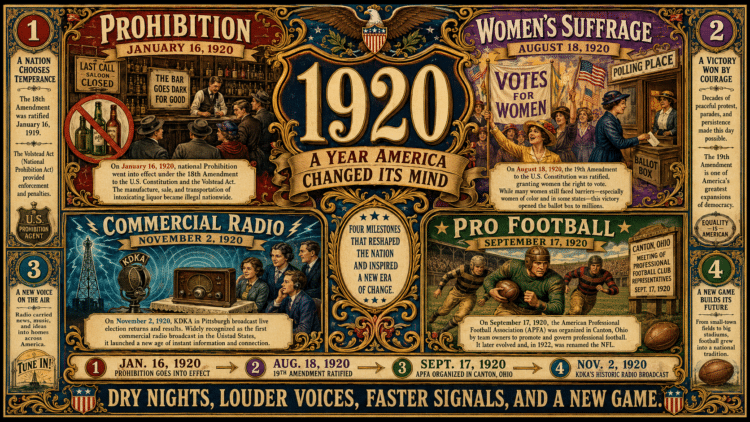
- World Changing Events: Prohibition began on January 16. Women won the right to vote on August 18. Commercial radio launched on November 2. The NFL was founded on September 17. All four happened in the same year — 1920 was arguably one of the most transformative single years of the 20th century.
- Influential Songs: I’ll Be With You in Apple Blossom Time by Charles Harrison, and Swanee by Al Jolson
- Must-See Movies: The Mark of Zorro, The Cabinet of Dr. Caligari, and Dr. Jekyll and Mr. Hyde
- Most Famous American: Al Jolson
- Price of Wrigley’s Doublemint gum: 5 cents per pack; Price of silver: $1.37 per ounce; First-class stamp: 2 cents
- U.S. Life Expectancy: Males 53.6 years; Females 54.6 years
- Federal spending: $6.36 billion; Unemployment: 5.2%
- The Funny Fat Guy: Roscoe “Fatty” Arbuckle
- The Other Funny Guy: Harold Lloyd
- The Conversation: America emerged from WWI and the Spanish Flu into a decade of deliberate, defiant, and sometimes reckless celebration
Top Ten Baby Names of 1920
Girls: Mary, Dorothy, Helen, Margaret, Ruth, Mildred, Virginia, Elizabeth, Frances, Anna
Boys: John, William, Robert, James, Charles, George, Joseph, Edward, Frank, Richard
The Stars
Douglas Fairbanks, Theda Bara, Pola Negri, Mary Pickford, Olive Thomas
The Quotes
“I know, but I had a better year.” — Babe Ruth, when told his $80,000 salary exceeded President Hoover’s $75,000
“Return to normalcy.” — Warren G. Harding’s 1920 campaign slogan. When critics said he’d invented the word “normalcy,” Harding said: “I have looked for ‘normality’ in my dictionary and do not find it there. ‘Normalcy,’ however, I did find, and it is a good word.” (The word had actually appeared in print as early as the 1850s.)
“There is no news today.” — BBC Radio announcer, Good Friday, April 18, 1930 (not 1920 — this belongs on the 1930 page, noted here to flag the correction)
2nd Academy Awards
The Academy Awards did not yet exist — the first ceremony was held in 1929 for films from 1927-1928. There is no Oscar winner for 1920.
Time Magazine Person of the Year
Time magazine did not exist until 1923. There is no 1920 Person of the Year.
Miss America
The first Miss America pageant was held in September 1921 in Atlantic City. There is no Miss America for 1920.
We Lost in 1920
Olive Thomas, silent film actress and wife of Jack Pickford, died September 10, age 25, in Paris from accidental mercury bichloride poisoning, becoming one of Hollywood’s first major scandals
Mohandas Gandhi’s son Harilal Gandhi, estranged from his father throughout the independence movement, was still alive in 1920
John Reed, American journalist and author of Ten Days That Shook the World, died October 17, age 32, from typhus in Moscow; he is one of the few Americans buried in the Kremlin
Max Weber, German sociologist, died June 14, at age 56
William Dean Howells, American novelist and first president of the NAACP, died May 11, at age 83
Amedeo Modigliani, Italian artist, died January 24, age 35, from tuberculosis; his pregnant wife Jeanne Hébuterne died by suicide the following day, age 21
America in 1920 — The Context
America in 1920 was a country shaking itself awake after the worst decade in living memory. World War I killed over 116,000 Americans. The Spanish Flu had killed an estimated 675,000 more. The combined death toll in four years exceeded anything the country had experienced since the Civil War.
What followed was not a quiet recovery but an explosive release. The Roaring Twenties didn’t start in 1922 or 1923; they started in 1920, the moment the armistice was signed, and people decided they were done grieving. They danced. They drank — even after drinking became illegal. They drove automobiles, listened to the radio, and went to the movies. The flapper, the speakeasy, the jazz age, the consumer economy — all of it began here.
1920 was also the year the bill came due for some of America’s oldest debts. Women got the vote. The Harlem Renaissance was in full flower. The Great Migration of Black Americans from the South to Northern cities was reshaping Chicago, Detroit, Cleveland, and New York. America was becoming something new — not everyone was happy about it.
Prohibition
On January 16, 1920, the 18th Amendment went into effect, banning the manufacture, sale, and transportation of alcoholic beverages in the United States. The Volstead Act provided enforcement mechanisms.
Prohibition did not stop drinking. It made drinking a federal crime while simultaneously making drinking more socially glamorous. Speakeasies — illegal bars — numbered an estimated 30,000 in New York City alone by the mid-1920s. The NYPD’s Prohibition Squad was widely regarded as one of the most corrupt law enforcement agencies in American history.
Prohibition created the American Mafia as a functioning criminal enterprise. Al Capone, Lucky Luciano, Meyer Lansky, and dozens of other organized crime figures built empires on illegal liquor. By 1926, the illegal alcohol trade was estimated to be worth $3.6 billion annually.
One unintended consequence: Walgreens pharmacy grew from 20 stores in 1920 to nearly 400 by 1933, largely because doctors could legally prescribe whiskey for “medicinal purposes” and pharmacies could legally sell it. Walgreens filled a lot of prescriptions.
Prohibition was repealed by the 21st Amendment in December 1933. It remains the only Constitutional amendment ever repealed.
Women’s Suffrage
The 19th Amendment was ratified on August 18, 1920, when the Tennessee House of Representatives voted 50-49 to approve it — the deciding vote cast by 24-year-old Harry Burn, who had received a note from his mother that morning urging him to “be a good boy” and vote for ratification. He was the only legislator to switch his vote.
The amendment granted women the right to vote nationwide. By early 1920, every state west of the Mississippi already allowed women to vote. The Southern states were the holdouts.
In practice, the right to vote differed greatly from the right to vote in law. Black women in the South — along with Black men — faced poll taxes, literacy tests, grandfather clauses, and outright violence designed to keep them from the ballot. Full voting rights for all Americans were not secured until the Voting Rights Act of 1965.
Commercial Radio
On November 2, 1920, KDKA in Pittsburgh broadcast the results of the Harding-Cox presidential election live — the first commercial radio broadcast in American history. The station had been licensed on October 27. The broadcast reached an estimated audience of 1,000 listeners, all of whom owned crystal radio sets assembled at home.
Within three years, there were 500 radio stations across the United States. Within a decade, radios were in more than 12 million homes. The medium transformed how Americans experienced music, news, comedy, and sports — and created the concept of mass media.
Warren Harding became the first U.S. president to address the nation by radio in 1922, beginning a tradition of presidential broadcast communication that continued through Franklin Roosevelt’s fireside chats and into the television age.
The NFL
The American Professional Football Association was founded on September 17, 1920, at a Hupmobile automobile dealership in Canton, Ohio. Jim Thorpe — the greatest all-around athlete of the era — was named its first president, largely for his promotional value. Fourteen teams paid a $100 franchise fee. The organization was renamed the National Football League in 1922.
In 1920, the NFL was a loosely organized collection of teams playing for regional bragging rights. The Green Bay Packers, Chicago Bears, and New York Giants were all founded within the decade. Professional football was considered an inferior version of the college game by most Americans. That would change.
The Harlem Renaissance
The Harlem Renaissance was in full flourish in 1920 — a cultural, social, and artistic explosion centered in the Harlem neighborhood of Manhattan, driven by the Great Migration of Black Americans from the rural South to Northern cities. Poets, novelists, musicians, painters, and intellectuals were redefining Black American identity and creating an artistic legacy that would shape American culture for a century.
Langston Hughes, Zora Neale Hurston, Countee Cullen, Claude McKay, and Louis Armstrong were among the figures who would define the movement. The music was jazz. The literature was modernist, urgent, and proud. The philosophy was self-determination. The neighborhood of Harlem was, in the early 1920s, one of the most intellectually fertile communities in the world.
Pop Culture Facts and History
Hollywood’s first “super couple” was Douglas Fairbanks and Mary Pickford — he, the swashbuckling action star, she “America’s Sweetheart” — who married in March 1920. They built a home they called Pickfair, which became the most socially significant address in Hollywood. In 1919, together with Charlie Chaplin and D.W. Griffith, they had founded United Artists, one of the first actor-owned film distribution companies. They divorced in 1936.
The first Band-Aid was invented in 1920 by Earle Dickson, a Johnson & Johnson employee, who made a bandage for his wife Josephine using adhesive tape and cotton gauze — she kept cutting herself in the kitchen. He told his supervisors; they made him a vice president and named it the Band-Aid. By 2020, an estimated 100 billion Band-Aids had been sold.
The word “robot” entered public consciousness in 1920, introduced by Czech playwright Karel Čapek in his play R.U.R. (Rossum’s Universal Robots). Čapek credited his brother Josef with actually coining the word, derived from the Czech word robota, meaning “forced labor.” It was the first time the concept of artificial mechanical workers was named.
The word “googol” — meaning 10 to the power of 100 — was coined in 1920 by nine-year-old Milton Sirotta, nephew of mathematician Edward Kasner, when asked to invent a name for an unimaginably large number. Googolplex — originally defined by Sirotta as “one followed by writing zeroes until you get tired” — was standardized by Kasner as 10 to the power of a googol. Google’s founders named their company after googol in 1998, misspelling it in the process.
Kingsford Charcoal has its origins in 1920, when Henry Ford’s Model T factory generated so much wood waste that Ford contracted with a relative, E.G. Kingsford, to build a charcoal manufacturing plant to process it. Ford Charcoal was sold through Ford dealerships. The company was later renamed Kingsford Charcoal.
The first domestic radio sets went on sale in the United States in September 1920. A Westinghouse radio cost $10 — equivalent to roughly $145 today. The broadcast they received was almost exclusively local.
Shipping children through the U.S. Postal Service was technically legal until 1920, when the Post Office officially banned the practice. Several children had been shipped, all safely, at rates significantly cheaper than train fare. The children traveled in mail cars with friendly postal workers. One Ohio couple mailed their son to his grandmother’s house, a trip of roughly a mile. The Post Office decided this was enough.
Eugene V. Debs ran for president in 1920 as the Socialist Party candidate from inside a federal prison in Atlanta, where he was serving a 10-year sentence for anti-war speech. His campaign slogan: “Vote for Convict No. 9653.” He received 913,664 votes — nearly 3.5% of the total. President Harding pardoned him in 1921.
The first professional wrestling match filmed for cinema audiences was recorded in 1920, featuring Joe Stecher defeating Earl Caddock. The film is the oldest existing professional wrestling footage.
Harvard University convened a secret court in 1920 — chaired by President Abbott Lawrence Lowell — to identify and expel homosexual students. Nine students were expelled, one committed suicide, and one faculty member died by suicide after being interrogated. The proceedings were kept secret for over 80 years.
The Wall Street bombing on September 16, 1920, at 12:01 p.m., killed 38 people and injured over 400 when a horse-drawn wagon loaded with 100 pounds of dynamite and 500 pounds of cast-iron slugs exploded outside the offices of J.P. Morgan and Company. It remains one of the deadliest terrorist attacks on U.S. soil prior to Oklahoma City in 1995. The perpetrators were never identified. The pockmarks in the Morgan building’s facade were deliberately left unrepaired as a memorial and remain visible today.
The Duluth Lynchings occurred on June 15, 1920, when three Black circus workers — Elias Clayton, Elmer Jackson, and Isaac McGhie — were lynched by a mob of thousands in Duluth, Minnesota, after being falsely accused of raping a white woman. A subsequent investigation found no evidence that any assault had occurred. No one was ever convicted of the killings. A memorial to the three men was unveiled in Duluth in 2003.
The first Negro National League baseball game was played on May 2, 1920, in Indianapolis. The league was organized by Andrew “Rube” Foster, who is considered the father of Black baseball.
The longest MLB game in innings history was played May 1, 1920: Brooklyn Robins vs. Boston Braves, called at 26 innings tied 1-1 due to darkness.
Eddie Eagan won the light heavyweight boxing gold medal at the 1920 Antwerp Olympics — and then won another gold medal in the 4-man bobsled at the 1932 Lake Placid Winter Olympics. He is the only athlete in history to win gold medals at both the Summer and Winter Olympics in different sports.
Snap-on Tools was founded in 1920 in Milwaukee by Joseph Johnson and William Seidemann, introducing the revolutionary concept of interchangeable socket wrenches — a set of five handles and ten sockets that could be “snapped on” in any combination. Auto mechanics immediately adopted them.
Drano was introduced in 1920, giving American homeowners their first chemical weapon against clogged drains. The marketing was straightforward: your drain is clogged; this will unclog it. It worked.
National Geographic established the first color photo laboratory at a U.S. publication in 1920, beginning what would become a revolutionary approach to photojournalism.
Raggedy Andy was introduced in 1920 as a companion to Raggedy Ann, who had been patented in 1915. Both were created by author and illustrator Johnny Gruelle, who based the character on a rag doll found in his attic.
The Habits
Dancing the Charleston, drinking at speakeasies, going to the movies, listening to the radio, and driving a Ford Model T to wherever the evening took you.
Christmas Gifts and First Appearances of 1920
Raggedy Andy, wooden pogo sticks, Lionel Trains
Nobel Prize Winners
Physics — Charles Édouard Guillaume (for the discovery of anomalies in nickel steel alloys)
Chemistry — Walther Nernst (for work in thermochemistry)
Medicine — August Krogh (for the discovery of capillary motor regulation)
Literature — Knut Hamsun (Norwegian novelist)
Peace — Léon Bourgeois (French statesman, early proponent of the League of Nations)
Economics — Prize not yet established (first awarded 1969)
Popular and Best-Selling Books of 1920
A Man for the Ages — Irving Bacheller
The Great Impersonation — E. Phillips Oppenheim
Kindred of the Dust — Peter B. Kyne
The Man of the Forest — Zane Grey
Mary-Marie — Eleanor H. Porter
Harriet and the Piper — Kathleen Norris
The Lamp in the Desert — Ethel M. Dell
The Portygee — Joseph C. Lincoln
The Re-Creation of Brian Kent — Harold Bell Wright
The River’s End — James Oliver Curwood
Also published in 1920: Main Street by Sinclair Lewis — a satirical skewering of small-town American conformity that became a bestseller and launched Lewis toward the Nobel Prize a decade later. Edith Wharton’s The Age of Innocence was published in 1920 and won the Pulitzer Prize, making her the first woman to win it.
Broadway in 1920
Beyond the Horizon by Eugene O’Neill opened on February 2, 1920, winning the Pulitzer Prize and establishing O’Neill as America’s most important playwright. Sally opened on December 21, 1920, starring Marilyn Miller, and ran for 570 performances — one of the biggest musical hits of the early decade.
Best Film Oscar Winner
The Academy Awards did not exist until 1929. There is no Oscar winner for 1920.
The Bomb
Movie: Way Down East — D.W. Griffith’s melodrama featuring a famous ice floe rescue scene was a genuine hit, not a bomb. The bomb was any film that tried to deal honestly with returning veterans’ trauma. Audiences in 1920 wanted escape, not reminders. Radio: The first broadcasts in 1920 were barely distinguishable from static to most listeners. The medium’s potential was obvious; its content was still primitive.
Top Movies of 1920
- The Mark of Zorro
- Way Down East
- Dr. Jekyll and Mr. Hyde
- The Cabinet of Dr. Caligari
- The Penalty
- Occasionally Yours
- The Last of the Mohicans
- Pollyanna
- The Kid (Charlie Chaplin — released January 1921 but filmed in 1920)
- Haunted Spooks
Most Popular Entertainment of 1920
Radio was just beginning — commercial broadcasting launched on November 2, 1920. Before that date, radio was amateur and experimental. Movies were the dominant mass entertainment. Vaudeville was still enormously popular. Dance halls and ballrooms are packed with crowds every weekend. The phonograph was in an increasing number of homes.
Amos ‘n’ Andy on the radio would not debut until 1928, but by 1920, the seeds of radio entertainment were being planted. The medium would transform American culture faster than any technology since the printing press.
1920 Billboard Number One Songs
(Popularity tracked by sheet music sales and phonograph records — no formal chart existed yet)
December 5, 1919 – January 16, 1920: Oh! What a Pal Was Mary — Henry Burr
January 17 – January 30: I’ve Got My Captain Working for Me Now — Al Jolson
January 31 – April 30: Dardanella — Ben Selvin’s Novelty Orchestra (13 weeks)
May 1 – May 7: Alice Blue Gown — Edith Day
May 8 – July 2: Swanee — Al Jolson
July 3 – August 6: When My Baby Smiles at Me — Ted Lewis and His Band
August 7 – September 17: Hold Me — Art Hickman
September 18 – September 24: The Love Nest — John Steel
September 25 – October 15: St. Louis Blues — Marion Harris
October 16 – October 29: The Love Nest — Art Hickman (returned to #1)
October 30 – December 10: Whispering — Paul Whiteman
December 11, 1920 – January 28, 1921: The Japanese Sandman — Paul Whiteman
Dardanella by Ben Selvin’s Novelty Orchestra spent 13 weeks at the top — the dominant song of early 1920. Al Jolson had two separate #1 hits in 1920. Paul Whiteman ended the year at #1 and carried his dominance into 1921.
1920 United States Census
Total U.S. Population: 106,021,537
For the first time in American history, the census recorded more Americans living in urban areas than rural ones.
New York, NY — 5,620,048
Chicago, IL — 2,701,705
Philadelphia, PA — 1,823,779
Detroit, MI — 993,069
Cleveland, OH — 796,841
St. Louis, MO — 772,897
Boston, MA — 748,060
Baltimore, MD — 733,826
Pittsburgh, PA — 588,343
Los Angeles, CA — 576,673
Los Angeles ranked 10th in 1920. By 1940, it would rank 5th. The automobile and the film industry were about to change everything.
Sports Champions of 1920
World Series: Cleveland Indians (the only World Series with a triple play, a grand slam, and a pitcher hitting a home run — all by the same team)
Stanley Cup: Ottawa Senators
U.S. Open Golf: Edward “Ted” Ray
U.S. Open Tennis — Men: Bill Tilden | Women: Molla Bjurstedt Mallory
Wimbledon — Men: Bill Tilden | Women: Suzanne Lenglen
NCAA Football: California
Kentucky Derby: Paul Jones
Boston Marathon: Peter Trivoulides — 2:29:31
Sports Highlight: The 1920 Cleveland Indians World Series was one of the most dramatic ever played. In Game 5, second baseman Bill Wambsganss executed the only unassisted triple play in World Series history. The same game featured the first grand slam in World Series history and a home run by pitcher Jim Bagby. Cleveland won the Series 5-2 over Brooklyn. Bill Tilden won both the U.S. Open and Wimbledon, beginning the most dominant run in tennis of the pre-Open era.
FAQ — 1920 Trivia, Fun Facts, and Pop Culture History
Q: What were the most important events of 1920?
A: Four events in the same year reshaped America permanently: Prohibition began January 16; women won the vote August 18; commercial radio launched November 2; and the NFL was founded September 17. No single year in the 20th century produced more lasting institutional change.
Q: What was Prohibition, and did it work?
A: The Prohibition banned the manufacture and sale of alcohol under the 18th Amendment, effective January 16, 1920. It did reduce overall alcohol consumption, but it also created 30,000 speakeasies in New York City alone, launched the American Mafia as a functioning criminal enterprise, and made Al Capone a millionaire. It was repealed in 1933 — the only Constitutional amendment ever repealed.
Q: When did women win the right to vote?
A: The 19th Amendment was ratified on August 18, 1920, when Tennessee became the deciding 36th state to approve it by a vote of 50-49. The deciding vote was cast by 24-year-old Harry Burn, who switched his position after receiving a note from his mother. In practice, Black women in the South faced Jim Crow laws preventing them from voting until the Voting Rights Act of 1965.
Q: When was the first commercial radio broadcast?
A: KDKA in Pittsburgh broadcast live presidential election results on November 2, 1920 — the first licensed commercial broadcast in American history. Within a decade, more than 12 million American homes had radios.
Q: When was the NFL founded?
A: The American Professional Football Association was founded on September 17, 1920, in Canton, Ohio, with Jim Thorpe as its first president. It was renamed the National Football League in 1922. The franchise fee was $100 per team.
Q: What was the Wall Street bombing of 1920?
A: On September 16, 1920, a horse-drawn wagon packed with dynamite and iron slugs exploded at noon outside J.P. Morgan and Company on Wall Street, killing 38 people and injuring over 400. It was the deadliest terrorist attack on U.S. soil until the Oklahoma City bombing in 1995. The perpetrators were never caught. The pockmarks on the Morgan building’s stone facade were left unrepaired and remain visible today.
Q: Who invented the Band-Aid?
A: Earle Dickson, a Johnson & Johnson employee, invented it in 1920 for his wife, Josephine, who kept injuring herself cooking. He showed his supervisors; they made him a vice president and named it the Band-Aid. It became one of the most successful consumer products in history.
Q: What word entered the English language from a 1920 play?
A: “Robot” — introduced in Karel Čapek’s 1920 play R.U.R., derived from the Czech word for forced labor. It was the first time artificial mechanical workers were given a name.
Q: What 1920 census milestone changed America?
A: For the first time in American history, the 1920 census recorded more Americans living in urban areas than rural ones — a demographic shift that defined 20th-century American culture, politics, and economics.
Q: What famous literary works were published in 1920?
A: Main Street by Sinclair Lewis — his satirical portrait of small-town American conformity — became a bestseller and launched his Nobel Prize-winning career. The Age of Innocence by Edith Wharton won the Pulitzer Prize, making her the first woman to receive it.
More 1920 History and Trivia Resources
Most Popular Baby Names (BabyCenter.com)
Popular and Notable Books (popculture.us)
Broadway Shows that Opened in 1920
1920 Calendar, courtesy of Time and Date.com
1920 US Census Fast Facts
Fact Monster
1920 in Movies (according to IMDB)
Wikipedia 1920<