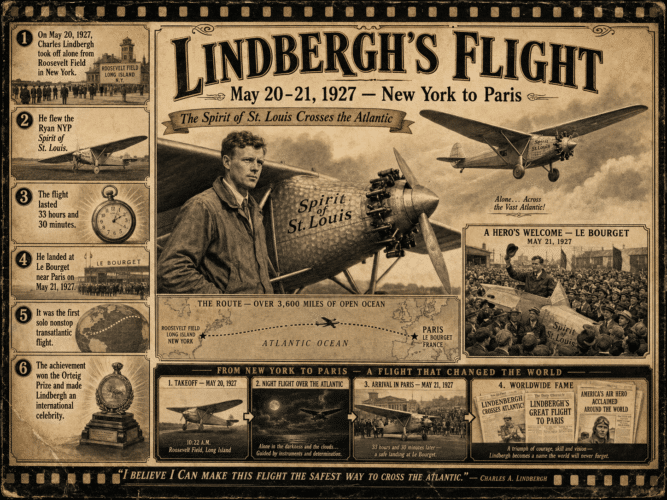
World-Changing Event: Charles Lindbergh took off from Roosevelt Field on Long Island at 7:52 a.m. on May 20, 1927, and landed at Le Bourget Field outside Paris at 10:22 p.m. on May 21 — 33 hours and 30 minutes later. He was the first person to fly solo and nonstop across the Atlantic Ocean. 100,000 people were waiting for him in the dark when he landed.
Top Songs: Stardust by Hoagy Carmichael, I’m Looking Over a Four Leaf Clover, and Ain’t She Sweet by Ben Bernie
Must-See Movies: Metropolis, Wings, The Jazz Singer, It, Sunrise, and The Unknown
The Most Famous Person in America: Charles Lindbergh
The Biggest Entertainer: Al Jolson
Notable Books: Elmer Gantry by Sinclair Lewis and To the Lighthouse by Virginia Woolf
Men’s raccoon coat: $295 to $395; Model A Ford: $385; steak sandwich at the Cotton Club: $1.25
Chinese Zodiac: Year of the Rabbit, associated with caution, creativity, and a preference for peace — a useful disposition in a year with this much going on
The Conversation: Did you hear Lindbergh made it? And have you seen The Jazz Singer yet?
Top Ten Baby Names of 1927
Girls: Mary, Dorothy, Betty, Helen, Margaret Boys: Robert, John, William, James, Charles
U.S. Life Expectancy in 1927
Males: 59.0 years; Females: 62.1 years
The Stars
Josephine Baker, Clara Bow, Dolores Costello, Marion Davies, Dolores Del Rio, Greta Garbo, Myrna Loy, Mary Pickford, Anna May Wong
Time Magazine’s Man of the Year
Charles Lindbergh — Time’s inaugural Man of the Year selection, and one of its most obvious. He had done something no one had ever done before, and the entire world had been watching.
Miss America
Lois Delander, Joliet, IL
We Lost in 1927
Isadora Duncan, the pioneering American dancer who invented modern dance and led one of the most unconventional lives of her era, died on September 14, 1927, in Nice, France. Her long silk scarf caught in the wheel of an open automobile. She was 50.
Jerome K. Jerome, the British humorist best known for Three Men in a Boat, died June 14, 1927, at age 68.
Born in 1927
Harry Belafonte — March 1, 1927, in Harlem, New York. He became a singer, actor, and civil rights activist, among Martin Luther King Jr.’s closest allies.
César Chávez — March 31, 1927, in Yuma, Arizona. He co-founded the United Farm Workers union and became the most prominent Latino labor leader in American history.
America in 1927 — The Context
Calvin Coolidge was in the fourth year of his term, and in August 1927, he made one of the most consequential announcements of the decade: “I do not choose to run for president in 1928.” The statement was typically Coolidgian — brief, opaque, and final. He simply stepped aside, clearing the way for Herbert Hoover and setting up the election that would choose the man who would preside over the Depression.
The economy was still roaring. The stock market was rising. Automobile ownership was spreading rapidly, with the Model A replacing the Model T. Jazz filled the radio and the clubs. Prohibition meant alcohol was everywhere it wasn’t supposed to be and nowhere it was legal. The decade had two years left and showed no sign of running out of energy. The crash was invisible from 1927.
Charles Lindbergh
Charles Lindbergh was a 25-year-old airmail pilot when he took off from Roosevelt Field on Long Island at 7:52 a.m. on May 20, 1927, in a single-engine monoplane called the Spirit of St. Louis. He had a periscope instead of a forward windshield. He carried 451 gallons of fuel and no radio. He had sandwiches and two canteens of water. He flew through fog, rain, and ice over the North Atlantic and arrived at Le Bourget Field outside Paris at 10:22 p.m. Paris time on May 21 — 33 hours, 30 minutes, and 29.8 seconds after takeoff. He had never flown over the ocean before.
An estimated 100,000 people had gathered at Le Bourget despite the late hour. Lindbergh’s plane was mobbed before it had stopped rolling. He later said the first thing he noticed was that the faces in the crowd were smiling. His ticker-tape parade in New York drew approximately four million people — the largest crowd for a public event in American history to that point.
The $25,000 Orteig Prize, which had been offered since 1919 for the first nonstop flight between New York and Paris, was his. Six aviators had died attempting it in the preceding years. Lindbergh had simply outplanned them all.
The Jazz Singer
The Jazz Singer opened at the Warner Theatre in New York on October 6, 1927, starring Al Jolson. It was the first feature-length film with synchronized sound in selected sequences — not the entire film, but two key scenes with dialogue and ten songs. The first spoken words in a feature film were Jolson’s ad-lib: “Wait a minute, wait a minute. You ain’t heard nothin’ yet.”
The film was not technically the first sound film — various short sound films had been produced since the 1910s, and Don Juan in 1926 used a synchronized music-and-sound-effects track. But The Jazz Singer was the first sound film to become a sensation, and it made the transition from silent to sound film irreversible. Within two years, virtually the entire Hollywood studio system had converted to sound. Many silent film stars, whose voices did not match audience expectations, found their careers effectively ended.
The Jazz Singer was based on the life of Al Jolson himself — a Jewish cantor’s son who left religious tradition for show business. Jolson was a cantor’s son who did exactly the same thing.
Metropolis
Fritz Lang’s Metropolis, released in Germany in January 1927, depicted a dystopian future city divided between an elite living in towers and a laboring class working underground. The film’s visual design influenced science fiction films for the rest of the century. The female robot character Maria was the first robot depicted in cinema. The Maschinenmensch influenced the design of C-3PO in Star Wars, the Terminator, and dozens of other science fiction icons. It was also one of the most expensive films ever made to that point, and it lost enormous amounts of money.
The Great Mississippi Flood
From April through August 1927, the Mississippi River flooded its banks across a 27,000-square-mile area in the greatest river flood in American history. The floodwaters affected ten states, left approximately 700,000 people homeless, and killed an estimated 500. The federal government’s response — or lack thereof — fell primarily to Herbert Hoover, then Secretary of Commerce, who organized relief so effectively that it made him a national hero and helped propel him to the presidency.
The flood’s impact on African Americans was severe and largely ignored. Black residents were forced to work on the levees at gunpoint and housed in inferior refugee camps. The Red Cross documented discrimination but said nothing publicly. The federal government’s differential treatment of Black flood victims contributed significantly to the Great Migration northward and to the shift of Black voters from the Republican Party — the party of Lincoln — toward the Democrats over the following decade.
W.C. Handy’s When the Levee Breaks, written in response to the 1927 flood and recorded by Kansas Joe McCoy and Memphis Minnie in 1929, became one of the most famous blues standards ever recorded. Led Zeppelin’s version on Led Zeppelin IV in 1971 introduced it to a new generation.
Sacco and Vanzetti
Nicola Sacco and Bartolomeo Vanzetti, Italian immigrant anarchists, had been convicted of murder and robbery in 1921 in a trial widely condemned as unjust — a conviction obtained in an atmosphere of anti-immigrant and anti-radical hysteria. They maintained their innocence. The case generated international protests on a scale rarely seen for a criminal proceeding. Writers, intellectuals, and political figures across Europe and Latin America appealed for clemency.
On August 23, 1927, after six years of appeals, both men were executed by electric chair in Massachusetts. Demonstrations erupted in capital cities worldwide. Poet Edna St. Vincent Millay was among those arrested protesting outside the prison. The Massachusetts governor issued a formal proclamation in 1977 declaring that Sacco and Vanzetti had been unfairly tried. Whether they were guilty or innocent has never been definitively settled.
The Bath School Disaster
On May 18, 1927, Andrew Kehoe, a 55-year-old school board treasurer in Bath, Michigan, who had lost a local election, detonated explosives he had secretly planted beneath the Bath Consolidated School over a period of months. The explosion killed 36 children and two teachers. He then detonated a truck bomb outside the school that killed four more people, including himself. 58 people were injured. It remains the deadliest mass murder at a school in American history — a record that held for 95 years until the Uvalde, Texas shooting in 2022.
Pop Culture Facts and History
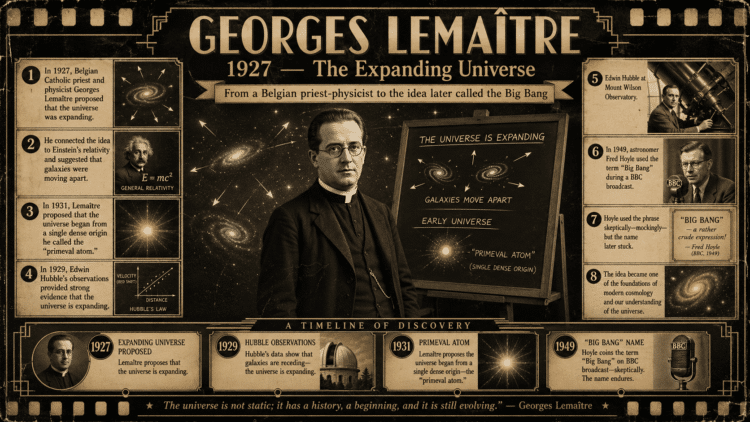
The Big Bang Theory was first proposed in 1927 by Georges Lemaître, a Belgian Catholic priest and physicist, who called it the “hypothesis of the primeval atom.” He proposed that the universe was expanding and had originated from a single point of enormous density. His work was largely ignored until Edwin Hubble’s 1929 observations confirmed the universe was expanding. The name “Big Bang” was actually coined derisively by astronomer Fred Hoyle in 1949; he intended it as a mockery. The name stuck.
Kool-Aid was invented in 1927 by Edwin Perkins of Hastings, Nebraska, who developed a powdered concentrate version of his liquid drink, “Fruit Smack,” that could be shipped cheaply by mail. He sold it for 10 cents a packet. The timing — just before the Depression — made an inexpensive homemade beverage enormously popular. The Kool-Aid Man, introduced in 1954, became one of the most recognizable advertising characters in American history.
7-Eleven was founded in 1927 as the Southland Ice Company in Dallas, Texas, which began selling milk, eggs, and bread from its ice docks to serve customers. The stores were eventually named 7-Eleven in 1946 to reflect their hours — 7 a.m. to 11 p.m. They now operate more than 77,000 locations worldwide and are open 24 hours, making the name historically inaccurate yet deeply embedded.
The Harlem Globetrotters were founded in Chicago in 1927 by Abe Saperstein, who organized a team of Black basketball players at a time when they were excluded from the mainstream professional leagues. Their first game was played on January 7, 1927, in Hinckley, Illinois — 48 miles outside Chicago. Despite the name, they did not play a home game in Harlem until 1968. Their first game there was 41 years after the team was named for it.
Pan American Airways was founded on March 14, 1927, by Juan Trippe. Its inaugural commercial flight — from Key West, Florida, to Havana, Cuba — took off on October 18, 1927. Pan Am went on to define American commercial aviation for the next six decades.
The Academy of Motion Picture Arts and Sciences was founded on May 4, 1927. Its initial purpose was not to award — it was to mediate labor disputes between studios and workers, conduct technical research, and improve the industry’s public image. The Academy Awards were added as a secondary function. The first ceremony was held in May 1929.
The first transatlantic telephone call was made on January 7, 1927, between New York and London. The call cost $75 for three minutes — approximately $1,300 in current value. It was made through two-way radio technology. The infrastructure for undersea telephone cables would not exist for another 29 years.
Philo Farnsworth successfully transmitted the first electronic television image in San Francisco on September 7, 1927. Farnsworth had conceived the basic design at age 14 while plowing a potato field in Idaho, theorizing that an electron beam could scan an image line by line, the way a field is plowed row by row. He later won a court battle against RCA and David Sarnoff to establish his priority in the invention.
The first S’mores recipe appeared in print in 1927, in a Girl Scouts publication called Tramping and Trailing with the Girl Scouts. The recipe was called “Some More” and listed graham crackers, chocolate, and toasted marshmallows as the ingredients. The name compressed naturally over time to “s’mores.” The recipe has not changed.
The first “trick or treat” phrase appeared in print in 1927, in a newspaper article from Blackie, Alberta, Canada, describing Halloween customs. The phrase described the practice of children demanding treats under threat of mischief. American adoption of the phrase became widespread in the 1930s and 1940s.
Grauman’s Chinese Theatre opened on Hollywood Boulevard on May 18, 1927, with the premiere of The King of Kings. The hand-and-footprint tradition in the forecourt — supposedly begun when actress Norma Talmadge accidentally stepped in wet cement — became one of Hollywood’s most enduring rituals.
Mount Rushmore sculptor Gutzon Borglum began drilling on the face of the mountain on October 4, 1927. The sculpture took 14 years to complete and was never fully finished — Borglum died in March 1941, and his son Lincoln took over, halting work in October 1941 when funding ran out. The interior hall that Borglum planned was never built.
The Ford Model T’s production run ended on May 26, 1927, after 15 million cars had been manufactured since 1908. The Model A replaced it at $385. The Model T had done more than any other single product to reshape American society — enabling mobility, reshaping cities, building suburbs, and transforming manufacturing with the assembly line that produced it.
Babe Ruth hit 60 home runs in 1927 — more than any other American League team hit that season — setting a record that stood for 34 years until Roger Maris hit 61 in 1961. His 1927 Yankees team, which went 110-44, is widely considered the greatest baseball team ever assembled.
The Holland Tunnel, connecting Manhattan to Jersey City, New Jersey, under the Hudson River, opened on November 13, 1927. It was the first underwater vehicular tunnel in the United States. At the time of its opening, it was the longest underwater tunnel in the world. Chief engineer Clifford Holland died in 1924 before it was completed. It was named for him.
Former Liberian President Charles King won the 1927 election with 234,000 votes in a country with an estimated 15,000 eligible voters. The Guinness World Records recognized it as the most fraudulent election in recorded history — a category, unfortunately, with considerable competition.
George P. Burdell, a fictional student, was enrolled at Georgia Tech in 1927 by William Edgar Smith, who filled out a second application in Burdell’s name as a joke. Burdell has since received every degree Georgia Tech offers, was listed as a crew member on a B-17 bomber during World War II, appeared on Mad Magazine’s Board of Directors, was nominated for Time’s Person of the Year in 2001, and has been enrolled in every Georgia Tech online course since the system was introduced.
Pogs — the small cardboard discs that became a collecting craze in the 1990s — originated in Hawaii as early as 1927, used as bottle caps for a passion fruit, orange, and guava juice drink. The game of stacking and flipping them long predated the 1990s fad.
The word “trick or treat” appeared in print for the first time in 1927; the words “bobby socks,” “Dixieland,” “water ski,” and “wind chime” also entered print that year, and the foot-measuring device used in shoe stores — the Brannock Device, named for its inventor Charles Brannock — was introduced in 1927. It is still manufactured and used today.
Nobel Prize Winners
Physics — Arthur Holly Compton and Charles Thomson Rees Wilson; Compton for the discovery of the effect named after him (the Compton Effect, demonstrating the particle nature of X-rays); Wilson for the cloud chamber, a device that made the tracks of subatomic particles visible for the first time and became one of the most important tools in 20th-century physics Chemistry — Heinrich Wieland for his investigations of the constitution of the bile acids and related substances, foundational to biochemistry and the understanding of cholesterol Medicine — Julius Wagner-Jauregg for his discovery of the therapeutic value of malaria inoculation in the treatment of dementia paralytica; he gave patients malaria to create a fever that killed the syphilis bacteria, causing the neurological disease, a procedure that was both genuinely effective and deeply alarming Literature — Henri Bergson, a French philosopher, is best known for his rich and vitalizing ideas and the brilliant skill with which they have been presented, for Creative Evolution Peace — Ferdinand Buisson and Ludwig Quidde for their lifelong work in international peace efforts
Broadway in 1927
Show Boat opened December 27, 1927, at the Ziegfeld Theatre, with music by Jerome Kern and book and lyrics by Oscar Hammerstein II. Based on Edna Ferber’s novel, it was the first Broadway musical to integrate serious themes — racial prejudice, miscegenation, alcoholism, and the passage of time — into the dramatic structure rather than using them as incidental background. It introduced Ol’ Man River, Can’t Help Lovin’ Dat Man, and Make Believe. It is considered the foundational American musical — the show that established what the form could be.
Strike Up the Band premiered on Broadway in 1927 and was withdrawn due to a poor response to its political satire. A revised version opened in 1930 to considerable success. George and Ira Gershwin wrote the score.
Top Movies of 1927
Wings
The Jazz Singer
It
Sunrise
Metropolis
The Unknown
The General
Flesh and the Devil
The Circus
College
Wings became the first film to win the Academy Award for Best Picture at the inaugural ceremony in May 1929, covering the 1927-28 film period. It was the only silent film ever to win Best Picture. Its aerial combat sequences — filmed using real aircraft and real pilots, with cameras mounted on the planes — were the most technically sophisticated action sequences made to that point. The film launched Gary Cooper’s career in a small supporting role.
Popular and Best-Selling Books of 1927
A Good Woman — Louis Bromfield Elmer Gantry — Sinclair Lewis The House on the Cliff (Hardy Boys #2) — Franklin Dixon Jalna — Mazo de la Roche To the Lighthouse — Virginia Woolf The Tower Treasure (Hardy Boys #1) — Franklin Dixon Twilight Sleep — Edith Wharton
The Hardy Boys series — The Tower Treasure and The House on the Cliff — debuted in 1927, the first titles in a juvenile mystery series that would go on to run to 66 books and sell over 70 million copies. The series was developed by Edward Stratemeyer under the house pseudonym Franklin W. Dixon, written by a rotating staff of ghostwriters. The original 1927 volumes were revised and updated in the 1950s and 1960s; the originals are now considered collectibles.
Biggest Pop Artists of 1927
Gene Austin, Paul Whiteman, Al Jolson, Guy Lombardo, Nick Lucas, Ruth Etting, Cliff Edwards, Ben Bernie, Vaughn DeLeath, Gene Goldkette, Red Nichols, Whispering Jack Smith, Fred Waring’s Pennsylvanians, Duke Ellington
Duke Ellington opened at the Cotton Club in Harlem on December 4, 1927, and played there for the next several years. The Cotton Club engagements, broadcast nationally on radio, turned Ellington from a popular regional bandleader into a national figure and one of the defining artists of the Jazz Age.
Sports Champions of 1927
World Series: New York Yankees swept the Pittsburgh Pirates 4-0; Ruth and Gehrig were at the peak of their powers; the 1927 Yankees finished 110-44 and are regularly cited as the greatest baseball team ever assembled Stanley Cup: Ottawa Senators defeated the Boston Bruins 2-0 U.S. Open Golf: Tommy Armour, a Scottish-born American pro who had lost sight in one eye during World War I, his win established him among the top golfers of his era U.S. Open Tennis: Men/Women: Rene Lacoste / Helen Wills Wimbledon: Men/Women: Henri Cochet / Helen Wills NCAA Football Champions: Illinois and Yale (co-champions) Kentucky Derby: Whiskery Boston Marathon: Clarence DeMar, 2:40:22
Sports Highlight: Babe Ruth’s 60 home runs in 1927 broke his own record of 59 set in 1921 and stood as the American League record for 34 years. The 1927 Yankees — “Murderers’ Row” — are the standard against which all subsequent great baseball teams are measured. Helen Wills won both Wimbledon and the U.S. Open without losing a set in either tournament, a level of dominance that made her the most celebrated female athlete in the United States.
FAQ — 1927 Trivia, Fun Facts, and Pop Culture History
Q: What did Charles Lindbergh accomplish in 1927? A: On May 20-21, 1927, Lindbergh completed the first solo nonstop transatlantic flight, departing Roosevelt Field on Long Island and arriving at Le Bourget Field outside Paris 33 hours and 30 minutes later. He was 25 years old, carried no radio, and had never flown over the ocean. His reception in Paris drew 100,000 people. His ticker-tape parade in New York drew approximately four million.
Q: What were the first words spoken in a feature film? A: Al Jolson’s ad-libbed line in The Jazz Singer (1927): “Wait a minute, wait a minute. You ain’t heard nothin’ yet.” The film’s release made the transition from silent to sound film inevitable and effectively ended the silent era within two years.
Q: What was the Bath School Disaster? A: On May 18, 1927, school board treasurer Andrew Kehoe detonated explosives he had secretly planted beneath the Bath Consolidated School in Bath, Michigan, killing 36 children and two teachers. He then detonated a truck bomb that killed four more people, including himself. It remains the deadliest school massacre in American history.
Q: Who proposed the Big Bang Theory in 1927? A: Georges Lemaître, a Belgian Catholic priest and physicist, who proposed in 1927 that the universe was expanding and had originated from a single dense point he called the “primeval atom.” Edwin Hubble’s 1929 observations confirmed the expansion. The name “Big Bang” was coined as a mocking term by astronomer Fred Hoyle in 1949 and was subsequently adopted seriously.
Q: Who were the Harlem Globetrotters, and when did they play in Harlem? A: Founded in Chicago in 1927 by Abe Saperstein, the Harlem Globetrotters were a Black basketball team organized because Black players were excluded from mainstream professional leagues. Despite their name, they did not play a game in Harlem until 1968 — 41 years after their founding.
Q: What was the Great Mississippi Flood of 1927? A: The largest river flood in American history, affecting 27,000 square miles across ten states from April through August 1927. Approximately 700,000 people were left homeless. Herbert Hoover’s organization of relief operations was considered so successful that it elevated him to national prominence and helped launch his successful presidential campaign in 1928.
Q: What was Show Boat, and why did it matter? A: A Broadway musical that opened December 27, 1927, with music by Jerome Kern and book and lyrics by Oscar Hammerstein II. It was the first American musical to integrate serious dramatic themes — including race, alcoholism, and the long passage of time — into its structure rather than using them as background decoration. It is considered the foundational American musical and the work that established what the form could achieve.
Q: What record did Babe Ruth set in 1927? A: Ruth hit 60 home runs in 1927, breaking his own previous record of 59. The 1927 Yankees finished 110-44 and are regularly considered the greatest baseball team ever assembled. Ruth’s 60 home runs exceeded the total hit by several entire American League teams that season.