

1919 Trivia, Fun Facts, and Pop Culture History
Quick Facts from 1919
- World-Changing Event: The Treaty of Versailles was signed on June 28, 1919, formally ending World War I. The French Supreme Allied Commander, Ferdinand Foch, reviewed the terms and declared: “This is not peace. It is an armistice for twenty years.” World War II began twenty years and sixty-four days later.
- America-Changing Event: Prohibition arrived. The 18th Amendment was ratified on January 16, 1919, banning the manufacture, sale, and transportation of alcohol. Americans had ten months to prepare before it took effect in January 1920. They did not use those months to quit drinking.
- Top Songs: A Pretty Girl Is Like a Melody by John Steel, I’m Forever Blowing Bubbles by the Criterion Quartet, and How Ya Gonna Keep ‘Em Down on the Farm by the Peerless Quartet
- Must-See Movies: Broken Blossoms (D.W. Griffith), Male and Female (Cecil B. DeMille), and The Miracle Man
- Notable Books: Winesburg, Ohio by Sherwood Anderson and Ten Days That Shook the World by John Reed
- Chinese Zodiac: Year of the Goat, associated with creativity, gentleness, and a tendency to go along with the group — perhaps not the ideal zodiac year for a country on the verge of banning alcohol
- The Conversation: Did you hear what the White Sox did? And what do you think of this Prohibition business?
Top Ten Baby Names of 1919
Girls: Mary, Helen, Dorothy, Margaret, Ruth
Boys: John, William, James, Robert, Charles
U.S. Life Expectancy in 1919
Males: 53.5 years; Females: 56.0 years
A significant recovery from 1918’s catastrophic Spanish Flu numbers of 36.6 and 42.2. The dead did not come back, but the statistical baseline did.
We Lost in 1919
Theodore Roosevelt, the 26th President of the United States, conservationist, Nobel Peace Prize winner, and one of the most energetic personalities ever to occupy the White House, died in his sleep at Sagamore Hill, his Long Island estate, on January 6, 1919. He was 60. His friend Senator Henry Cabot Lodge said, “He had lived and thought and worked at a rate that would have exhausted most men in half the time.” He had never recovered from the death of his son Quentin in France the previous year.
Andrew Carnegie, the Scottish-American steel magnate who became the second-richest American in history and gave away approximately 90% of his fortune to libraries, universities, and public institutions, died August 11, 1919, at age 83 in Lenox, Massachusetts.
Emiliano Zapata, a Mexican revolutionary leader and champion of agrarian reform, was ambushed and killed on April 10, 1919, at age 39, by forces loyal to the Mexican government. He became one of the most enduring symbols of the Mexican Revolution.
Born in 1919
J.D. Salinger — born January 1, 1919, in New York City; author of The Catcher in the Rye.
Andy Rooney — born January 14, 1919; the 60 Minutes commentator whose essays on minor aggravations became one of the longest-running features in television news history.
America in 1919 — The Context
The war was over, the boys were coming home, and the country was in no mood for calm. 1919 was one of the most turbulent years in American domestic history. Major labor strikes paralyzed steel, coal, and other industries. Race riots — part of what historians call the “Red Summer” — swept through dozens of cities as white mobs attacked Black communities, often with the participation or acquiescence of local authorities. Anarchist bombings targeted government officials. A “Red Scare” led to mass arrests and deportations of suspected radicals. And Woodrow Wilson, who had spent the year fighting to get the Senate to ratify the Treaty of Versailles and join the League of Nations, suffered a stroke in October that left him incapacitated. His wife Edith quietly assumed many executive functions for the remainder of his term, making her arguably the first woman to exercise presidential authority in American history.
The country that emerged from 1919 was simultaneously exhausted and itching for something new. The Roaring Twenties were three months away.
The Treaty of Versailles
The Paris Peace Conference opened in January 1919 with representatives from 27 nations. The dominant voices were the “Big Four”: Woodrow Wilson of the United States, David Lloyd George of Britain, Georges Clemenceau of France, and Vittorio Orlando of Italy. Wilson arrived with his Fourteen Points — a framework for a just and lasting peace built on self-determination, open diplomacy, and a League of Nations. Clemenceau wanted Germany crushed. The final treaty, signed June 28, 1919, in the Hall of Mirrors at Versailles, imposed harsh reparations on Germany, stripped it of territory, and assigned it sole blame for the war. Wilson got the League of Nations. The U.S. Senate refused to ratify the treaty and never joined it. Germany signed the document under protest. Marshal Foch walked out and made his twenty-year prediction. History confirmed it.
Prohibition
The 18th Amendment — ratified January 16, 1919, effective January 17, 1920 — banned the manufacture, sale, and transportation of intoxicating liquors in the United States. It was the culmination of decades of organizing by the temperance movement. The Volstead Act, passed in October 1919, defined “intoxicating” as anything containing more than 0.5% alcohol and established enforcement mechanisms. What followed was thirteen years of speakeasies, bootleggers, rumrunners, the expansion of organized crime, and the general discovery that telling Americans they cannot have something is an excellent way to make them want it more.
Before the income tax amendment in 1913, the government had relied heavily on alcohol taxes for revenue. Prohibition required that the foundation already be in place. The connection was deliberate.
The Great Molasses Flood
On January 15, 1919, a large steel storage tank owned by the United States Industrial Alcohol Company burst on Commercial Street in Boston’s North End, releasing approximately 2.3 million gallons of molasses in a wave estimated at 25 to 35 feet high traveling at 35 miles per hour. The wave demolished buildings, crushed a section of elevated railway, and swept horses and people into the streets. Twenty-one people were killed and 150 were injured. Survivors reported that the molasses was so thick and cold that people who fell into it could not get back up. Cleanup took weeks. Boston residents claimed for years afterward that on hot summer days the neighborhood still smelled faintly of molasses. Food historians have confirmed this as plausible.
The Wingfoot Air Express Disaster
On July 21, 1919, the Goodyear blimp Wingfoot Air Express caught fire over downtown Chicago and crashed through the glass skylight of the Illinois Trust and Savings Building. Two passengers, one crew member, and ten bank employees inside the building were killed. Two people parachuted from the blimp and survived. It remains one of the more unlikely disaster scenarios in Chicago’s history.
The Red Summer
The summer and fall of 1919 saw race riots in more than three dozen American cities, in what NAACP field secretary James Weldon Johnson named “Red Summer.” Returning Black soldiers, who had served their country overseas, came home to find Jim Crow laws intact and racial violence intensifying. In Chicago, a race riot sparked by the stoning of a Black teenager at a segregated beach killed 38 people and injured over 500. In Washington, D.C., mobs of white servicemen attacked Black residents for four days before federal troops restored order. In Elaine, Arkansas, violence following a meeting of Black sharecroppers resulted in the deaths of over 100 Black men, women, and children and 5 white men. The events of Red Summer remain among the most underreported chapters of American history.
Wilson’s Stroke and Edith Wilson
In October 1919, while on a national speaking tour to build public support for the League of Nations, President Woodrow Wilson suffered a severe stroke that left him paralyzed on his left side and blind in one eye. His condition was concealed from the public and most of the Cabinet. First Lady Edith Wilson — his second wife, whom he had married in 1915 — managed access to the President, screened his communications, and made decisions about which matters required his attention. She later described her role as a “stewardship,” insisting she had never made policy decisions. Historians have generally concluded that the distinction was finer than she acknowledged. She ran the executive branch for the remainder of Wilson’s term, which ended in March 1921. She is often described as the first woman to exercise presidential authority in American history.
Eisenhower Drives Across America
In the summer of 1919, then-Lieutenant Colonel Dwight D. Eisenhower joined a U.S. Army motor convoy attempting to drive from Washington, D.C., to San Francisco along the Lincoln Highway. The convoy consisted of 81 vehicles and 280 men. It took 62 days. Average speed across long stretches was six miles per hour. Bridges collapsed. Vehicles sank in mud. Roads simply ended. The experience made a lasting impression on Eisenhower, who cited it — along with Germany’s Autobahn system, which he observed during World War II — as the inspiration for the Interstate Highway System he built as president in the 1950s.
Pop Culture Facts and History
United Artists was founded on February 5, 1919, by Charlie Chaplin, Mary Pickford, Douglas Fairbanks, and D.W. Griffith — four of the biggest names in silent film, who created their own studio to control distribution of their own work. The Hollywood establishment was not pleased. Richard Rowland, head of Metro Pictures, reportedly said: “The inmates are running the asylum.” The quote has been attributed to him ever since, though he likely regretted it.
The Grand Canyon was established as a national park by act of Congress on February 26, 1919, signed by President Wilson. Theodore Roosevelt had designated it a national monument in 1908 after Congress had repeatedly failed to act. It took another eleven years to make it a park. It is now the second-most-visited national park in the United States.
Harold Hamgravy debuted in the comic strip Thimble Theatre in 1919 as the boyfriend of Olive Oyl. The strip had no particular distinction at the time. A character named Popeye joined it ten years later, in 1929, and the strip’s entire history was retroactively overshadowed.
Pepperoni was created in the United States in 1919, developed by Italian-American butchers as an Americanized version of spicy Southern Italian salami. The word was first used to describe the sausage that year. Italy does not recognize pepperoni as a traditional product. It is now the most popular pizza topping in America, which Italy also does not recognize.
RCA — the Radio Corporation of America — was founded in 1919 as a government-encouraged consolidation of radio technology assets, designed to ensure American dominance in global wireless communication. It became one of the most important communications companies of the 20th century and was eventually absorbed into General Electric in 1985.
KLM — Royal Dutch Airlines — was founded on October 7, 1919. It is the oldest airline in the world still operating under its original name.
Bentley Motors was founded in 1919 by W.O. Bentley in London. He had spent the war designing rotary aero engines and turned his attention to making the finest motorcars in the world. He succeeded, at least until the company ran out of money in 1931 and was purchased by Rolls-Royce.
Pachelbel’s Canon in D was written around 1694 but was completely forgotten after Pachelbel’s death. It survived in only two manuscripts, was first published in 1919, and was first recorded in 1940. It was essentially unknown until a 1970 recording by the Jean-François Paillard Chamber Orchestra made it one of the most recognizable pieces of classical music worldwide. Every wedding reception since approximately 1975 owes it a debt.
The word “copacetic,” meaning completely satisfactory or in excellent order, first appeared in print in a 1919 biography of Abraham Lincoln by J. Alfred Sharp, in the sentence: “Now there’s the kind of a man! Stout as a buffalo an’ as to looks, I’d call him, as ye might say, real copasetic.” Where Sharp got the word is unknown. Its origin has never been definitively traced, producing endless etymological speculation and at least three competing theories involving Yiddish, Creole French, Italian, and Native American languages. None has been proven.
Crystal methamphetamine was first synthesized in 1919 by Japanese chemist Akira Ogata, who developed a method for reducing ephedrine using red phosphorus and iodine. The drug was used medically and distributed to soldiers in World War II before its addictive and destructive properties were fully understood.
Oregon became the first U.S. state to tax gasoline in 1919, at one cent per gallon. Every other state eventually followed. The federal gasoline tax was not established until 1932.
Bayer lost the trademark to “Aspirin” in the United States under the terms of the Treaty of Versailles in 1919, as part of Germany’s war reparations. The name became generic in America, Canada, the United Kingdom, and Australia. Bayer also lost the trademark to “Heroin,” which it had originally marketed as a cough suppressant and a supposedly non-addictive substitute for morphine. The drug was not subsequently improved by losing its trademark.
Michael Keogh, an Irish-born U.S. Army soldier, intervened in 1919 to stop an angry mob from beating two right-wing political agents to death on a Munich street. He thought nothing more of it. In 1930, attending a rally in Nuremberg, he recognized one of the men he had saved. It was Adolf Hitler.
The Pennsylvania Hotel in New York City received its telephone number — Pennsylvania 6-5000 — in 1919, making it the oldest continuously held phone number in the United States. When the exchange-name system was retired, it became (212) 736-5000. The number is still active today.
Eisenhower’s 1919 cross-country convoy experience — six miles per hour through collapsing bridges and vanishing roads — directly inspired the Interstate Highway System he championed as president. The system, authorized by the Federal Aid Highway Act of 1956, is the largest public works project in American history.
A U.S. Navy Curtiss NC-4 flying boat completed the first transatlantic flight on May 27, 1919, traveling from Newfoundland to Lisbon via the Azores. The flight took 19 days with multiple stops. John Alcock and Arthur Brown completed the first nonstop transatlantic flight just two weeks later, on June 14-15, 1919, flying from Newfoundland to Ireland in just over 16 hours. Both achievements occurred eight years before Lindbergh’s celebrated 1927 crossing, the first solo nonstop transatlantic flight.
The pop-up toaster was invented in 1919 by Charles Strite, a factory worker in Stillwater, Minnesota, who was tired of the burned toast in his company cafeteria. He patented his design in 1921. Bread had been around for roughly 14,000 years. The automatic mechanism to prevent burning it didn’t appear until 1919.
A large “skyscraper” was built in Wichita Falls, Texas, in 1919 after investors were told it would be 480 feet tall. It is 480 inches tall — about four stories. The investors discovered the discrepancy after construction was complete. The building still stands.
Charles Schwab, the steel magnate, conducted an informal social experiment aboard a ship in 1919, offering a $1 loan to each of the 154 Black American soldiers he met, with his address as the repayment destination. He received repayment from 138 of them — approximately 90%. He cited it afterward as a demonstration of trustworthiness that surprised the prejudices of his era.
Einstein’s General Theory of Relativity was confirmed during the total solar eclipse of May 29, 1919, when British astronomer Arthur Eddington measured the bending of starlight around the sun and found it matched Einstein’s predictions exactly. The confirmation made headlines worldwide and made Einstein an international celebrity overnight.
The concept of the gravitational slingshot, using a planet’s gravity to propel a spacecraft toward another destination, was first theorized in 1919 by Yuri Kondratyuk, a Ukrainian engineer who also independently worked out much of the mathematics needed for lunar orbital rendezvous. NASA used Kondratyuk’s calculations for the Apollo program’s lunar orbit insertion. He died in 1942 in World War II. His contribution was not widely recognized until decades later.
Man o’ War
Man o’ War, considered by many historians the greatest thoroughbred ever to race, won 20 of his 21 career starts. His only loss came in 1919, at Saratoga, to a horse named Upset. The loss was later attributed in part to a chaotic start in which Man o’ War was facing the wrong direction when the starting barrier was released. His owner, Samuel Riddle, declined to enter him in the 1920 Kentucky Derby, believing the race conditions were unfair to top horses. Man o’ War did not run in the Triple Crown series and still became arguably the most celebrated racehorse in American history.
The Scandals
A large “skyscraper” promised to investors in Wichita Falls, Texas, was built 480 inches tall — roughly 40 feet, or four stories — rather than the 480 feet they had been told. Investors who had funded what they believed would be a significant commercial tower got a building roughly the height of a house. It still stands at 609-611 Scott Avenue and has been referred to locally, with varying degrees of affection, as “The Newby-McMahon Building.”
The Black Sox Scandal
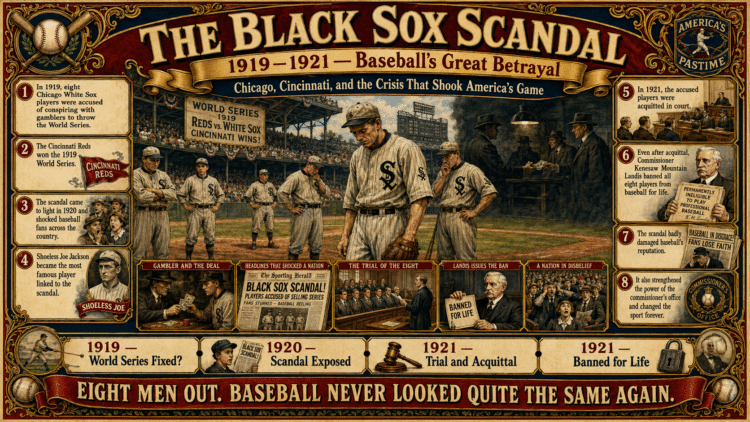
The 1919 World Series between the Cincinnati Reds and the Chicago White Sox ended with the Reds winning five games to three. What was not known publicly until the following year was that eight White Sox players — including the legendary “Shoeless” Joe Jackson — had accepted money from gamblers to intentionally lose the Series. The scandal, when it broke, shook public confidence in professional baseball to its foundation. The eight players were acquitted in a 1921 trial but were banned from baseball for life by the newly appointed Commissioner of Baseball, Kenesaw Mountain Landis. Shoeless Joe’s case has been argued ever since, with supporters pointing to his .375 Series batting average as evidence of something less than a full effort to lose. He has never been reinstated.
Eight Chicago White Sox players accepted payments from gamblers to intentionally lose the 1919 World Series: “Shoeless” Joe Jackson, Eddie Cicotte, Buck Weaver, Chick Gandil, Swede Risberg, Happy Felsch, Fred McMullin, and Lefty Williams. The payments ranged from $5,000 to $10,000 per player. The gamblers who organized the fix included associates of notorious New York gambler Arnold Rothstein, though Rothstein himself was never charged.
The players were acquitted at trial in 1921 after key confessions mysteriously disappeared from the evidence files. Commissioner Kenesaw Mountain Landis banned all eight for life anyway, a decision that has never been reversed. Joe Jackson’s case is the most argued. He batted .375 in the Series and committed no errors. His supporters believe he took the money but did not deliver. The scandal led directly to the creation of the Commissioner of Baseball position, with Landis empowered to act as the sport’s independent authority. It is one of the few instances in American sports history where a scandal produced a structural reform that actually worked. The Hall of Fame has never admitted him.
Nobel Prize Winners
Physics — Johannes Stark, for his discovery of the Doppler effect in canal rays and the splitting of spectral lines in electric fields, known as the Stark effect
Chemistry — not awarded in 1919
Medicine — Jules Bordet, for discoveries relating to immunity, particularly the role of complement in antibody-mediated immunity, foundational to modern immunology
Literature — Carl Spitteler, a Swiss poet, for his epic Olympian Spring, written across two decades; he remains one of the least-read Nobel literature laureates
Peace — Woodrow Wilson, for founding the League of Nations, though the U.S. Senate had refused to allow the United States to join it; Wilson was too ill to travel to Oslo to accept the prize
Broadway in 1919
Irene opened on November 18, 1919, at the Vanderbilt Theatre and ran for 670 performances — the longest-running Broadway musical to that point. It introduced the standard “Alice Blue Gown” and was the first postwar musical comedy to capture the optimistic, upward-mobility mood that would define Broadway in the 1920s.
The Royal Vagabond and Apple Blossoms also opened in 1919, the latter featuring the young Fred Astaire and his sister Adele in their Broadway debut.
Top Movies of 1919
- Broken Blossoms
- The Miracle Man
- Male and Female
- True Heart Susie
- Scarlet Days
- The Unpainted Woman
- A Regular Girl
- The Other Half
- Puppy Love
- The Homebreaker
Popular and Best-Selling Books of 1919
The Four Horsemen of the Apocalypse — V. Blasco Ibanez
The Arrow of Gold — Joseph Conrad
The Desert of Wheat — Zane Grey
Dangerous Days — Mary Roberts Rinehart
The Sky Pilot in No Man’s Land — Ralph Connor
The Re-Creation of Brian Kent — Harold Bell Wright
Dawn — Gene Stratton-Porter
The Tin Soldier — Temple Bailey
Winesburg, Ohio — Sherwood Anderson
Ten Days That Shook the World — John Reed The Economic
Consequences of the Peace — John Maynard Keynes
The Education of Henry Adams — Henry Adams (posthumous)
My Antonia — Willa Cather (1918, widely read in 1919)
Biggest Pop Artists of 1919
Nora Bayes, Al Bernard, Henry Burr, Albert Campbell, Conway’s Band, Arthur Fields, Earl Fuller’s Novelty Orchestra, Marion Harris, Charles Harrison, Al Jolson, Olive Kline, John McCormack, Billy Murray, The Peerless Quartet, Prince’s Orchestra, The Shannon Four, Joseph C. Smith’s Orchestra, John Steel, The Sterling Trio, Wilber Sweatman’s Original Jazz Band, Van and Schenck, The Victor Military Band, Bert Williams, Yerkes Jazzarimba Orchestra
Sports Champions of 1919
World Series: Cincinnati Reds — defeated the Chicago White Sox 5-3 in a best-of-nine series; the fix was in, though it did not become public knowledge until 1920
Stanley Cup: No champion — the Finals between the Montreal Canadiens and the Seattle Metropolitans were abandoned after several players fell ill with the Spanish Flu; Joe Hall of Montreal died five days after the series was canceled, one of the pandemic’s most direct intersections with professional sports
U.S. Open Golf: Walter Hagen won his second U.S. Open title, cementing his emergence as the dominant American golfer of the era
U.S. Open Tennis: Men/Women: Bill Johnston / Hazel Hotchkiss Wightman Wimbledon — Men/Women: Bill Tilden / Suzanne Lenglen
NCAA Football Champions: Harvard, Texas A&M, and Notre Dame (co-champions)
Kentucky Derby: Sir Barton — the first winner of the Triple Crown, taking the Kentucky Derby, Preakness Stakes, and Belmont Stakes; the achievement was not recognized as a formal Triple Crown until 1930, when the term was coined retroactively
Boston Marathon: Carl Linder, 2:29:13
Sports Highlight: Sir Barton’s 1919 Triple Crown was not recognized as such at the time — the Triple Crown as a named achievement did not officially exist until 1930. Man o’ War’s single career loss, to a horse named Upset at Saratoga in 1919, gave the English language a new use for the word “upset” as a term for an unexpected defeat. The Green Bay Packers were founded in August 1919 by Curly Lambeau, after the Indian Packing Company provided $500 for equipment — hence the name. The team has not moved or been sold since.
FAQs — 1919 Trivia, Fun Facts, and Pop Culture History
Q: What was the Black Sox Scandal?
A: Eight Chicago White Sox players accepted payments from gamblers — connected to New York gambler Arnold Rothstein — to intentionally lose the 1919 World Series to the Cincinnati Reds. They were acquitted at trial but banned from baseball for life by Commissioner Kenesaw Mountain Landis. None has been reinstated. Shoeless Joe Jackson’s case remains the most debated in baseball history.
Q: What caused the Great Molasses Flood?
A: A large storage tank containing 2.3 million gallons of molasses burst on Commercial Street in Boston’s North End on January 15, 1919. The resulting wave was estimated at 25 to 35 feet high, traveling at 35 miles per hour. Twenty-one people were killed and 150 were injured. The United States Industrial Alcohol Company was found liable after a years-long lawsuit.
Q: What was the Red Summer of 1919?
A: A period of widespread racial violence in 1919 in which white mobs attacked Black communities across more than three dozen American cities. The name was coined by NAACP field secretary James Weldon Johnson. The Chicago riot alone killed 38 people. The violence was driven partly by competition for jobs and housing as returning Black veterans sought equal treatment after serving overseas.
Q: Why did Einstein’s 1919 eclipse observation matter?
A: During the total solar eclipse of May 29, 1919, British astronomer Arthur Eddington measured the bending of starlight around the sun, confirming Einstein’s General Theory of Relativity. The result overturned Newton’s theory of gravity and made Einstein internationally famous overnight.
Q: When was the first Triple Crown won?
A: Sir Barton won the Kentucky Derby, Preakness Stakes, and Belmont Stakes in 1919, though the achievement was not called the Triple Crown at the time. The term was coined retroactively in 1930. Sir Barton is recognized today as the first Triple Crown winner.
Q: What did Eisenhower’s 1919 cross-country drive have to do with American highways?
A: The U.S. Army motor convoy that Eisenhower joined took 62 days to cross the country at an average of about six miles per hour, with bridges collapsing and roads disappearing entirely. The experience, combined with his observation of Germany’s Autobahn during World War II, led him to champion the Interstate Highway System as president. The Federal Aid Highway Act of 1956 authorized its construction.
Q: How did the word “upset” come to mean an unexpected defeat?
A: Man o’ War, considered the greatest racehorse of his era, suffered his only career loss at Saratoga in 1919 — to a horse literally named Upset. The coincidence was too good for the sporting press to ignore, and the term entered widespread use as a synonym for an unexpected result.
Q: Who was Edith Wilson, and why does she matter?
A: Edith Bolling Wilson was President Woodrow Wilson’s second wife. After Wilson suffered a severe stroke in October 1919, she managed access to the president and decided which matters required his attention for the remainder of his term. She is often described as the first woman to exercise executive authority in the United States, though she always insisted she was acting only as a caretaker.
More 1919 Facts & History Resources:
Most Popular Baby Names (BabyCenter.com)
Popular and Notable Books (popculture.us)
Broadway Shows that Opened in 1919
1919 Calendar, courtesy of Time and Date.com
Fact Monster
1919 in Movies (according to IMDB)
Wikipedia 1919


