1922 History, Facts, and Trivia
Quick Facts from 1922
- World-Changing Event: Three seismic shifts in the same year: the Ottoman Empire was abolished after six centuries, ending the last major Islamic caliphate; Mussolini and the Fascist Party seized power in Italy, establishing the template for 20th-century fascism; and the Union of Soviet Socialist Republics was formally created on December 30, 1922, establishing the state that would define the Cold War for the next 70 years
- Top Songs: My Buddy by Henry Burr, April Showers by Al Jolson, and Chicago (That Toddling Town) by Paul Whiteman
- Must-See Movies: Nosferatu, Foolish Wives, Nanook of the North, and Robin Hood
- The Most Famous Person in America: Babe Ruth
- The Funny Guy: Harold Lloyd
- Notable: Betty White was born in 1922. Sliced bread was introduced in 1928. Betty White was older than sliced bread.
- Dr. Swift’s Root Beer (24 bottles, 8 oz.): $2.25; loaf of bread: 10 cents; butter (1 lb.): 43 cents; dozen bananas: 30 cents
- Chinese Zodiac: Year of the Dog, associated with loyalty, honesty, and a strong sense of justice — qualities not especially abundant in Italy or Russia in 1922
- The Conversation: Did you hear Harding’s voice on the radio at the Lincoln Memorial? And what do you make of these Fascists in Italy?
Top Ten Baby Names of 1922
Girls: Mary, Dorothy, Helen, Margaret, Ruth, Betty, Virginia, Mildred, Elizabeth
Boys: John, Robert, William, James, Charles, George, Joseph, Edward, Richard, Frank
U.S. Life Expectancy in 1922
Males: 58.4 years; Females: 61.0 years
The Stars
Theda Bara, Marion Davies, Pola Negri, Mary Pickford
Miss America
Mary Katherine Campbell, Columbus, Ohio — her first title; she won again in 1923, making her the only person to win Miss America twice.
We Lost in 1922
Marcel Proust, the French novelist whose seven-volume In Search of Lost Time is considered one of the greatest works in world literature, died on November 18, 1922, at age 51, from pneumonia and a pulmonary abscess. He had been writing and revising his great novel for over a decade, largely from a cork-lined bedroom in Paris. The final three volumes were published posthumously.
Alexander Graham Bell, the inventor of the telephone, died August 2, 1922, at age 75, at his estate in Nova Scotia. All telephone service in the United States and Canada was silenced for one minute at the moment of his burial as a tribute.
Born in 1922
Betty White — January 17, 1922, in Oak Park, Illinois. She became one of the most beloved television performers in American history, with a career spanning eight decades. She was older than sliced bread, penicillin, and the Golden Gate Bridge.
Judy Garland — June 10, 1922, in Grand Rapids, Minnesota. Dorothy Gale, Esther Smith, and Vicki Lester, among many others.
Charles M. Schulz — November 26, 1922, in Minneapolis, Minnesota. He created Peanuts in 1950 and drew it every day until two days before his death in 2000. Charlie Brown never kicked the football.
America in 1922 — The Context
Warren Harding was in the second year of his presidency, governing during an economic recovery following the brief postwar recession. The economy was strengthening. Radio stations were multiplying — from a few dozen at the start of 1922 to over 500 by year’s end. The Roaring Twenties were gaining momentum. Prohibition had been in effect for two years and was producing the opposite of its intended results: organized crime was growing, speakeasies were everywhere, and the cocktail culture that Prohibition was supposed to prevent was more elaborate than it had ever been.
The international picture was more turbulent. Three empires — the Ottoman, the Russian, and the German — had collapsed in the preceding decade, and the new political structures that replaced them ranged from unstable democracies to outright authoritarian regimes. Italy, the first major democracy to fall to fascism, would not be the last.
Mussolini and the March on Rome
On October 28, 1922, approximately 30,000 Fascist “Blackshirts” marched on Rome in a show of force intended to compel the Italian government to hand power to Benito Mussolini. Prime Minister Luigi Facta asked King Victor Emmanuel III to declare martial law. The king refused. Facta resigned. Mussolini, who had spent the month in Milan, was summoned to Rome and appointed Prime Minister on October 29. He was 39 years old.
The March on Rome was the first successful fascist seizure of power in a modern democracy. It established the template — mass mobilization, paramilitary intimidation, exploitation of institutional weakness, and a king or president willing to trade democracy for order — that other fascist movements across Europe studied and adapted. Hitler specifically cited Mussolini’s example as proof that the strategy could work.
The Discovery of King Tut’s Tomb
Howard Carter had been searching the Valley of the Kings in Egypt for years, funded by Lord Carnarvon. On November 4, 1922, a workman clearing rubble accidentally exposed a stone step. Carter excavated further and found a sealed doorway. He wired Carnarvon in England. Carnarvon arrived. On November 26, 1922, they made a small opening in the second sealed doorway. Carnarvon asked Carter if he could see anything. Carter looked in by candlelight and said, “Yes, wonderful things.”
What Carter saw were the gilded furnishings of the antechamber — chairs, chariots, statues, and boxes piled in their original arrangement. It was the most intact royal tomb ever discovered. The inner burial chamber, with the sarcophagus, was not opened until February 1923.
The discovery of the tomb triggered a wave of Egyptomania across the Western world. Egyptian motifs flooded Art Deco architecture, fashion, and design. The use of eyeliner in the West, which had declined since antiquity, was revived directly by fascination with ancient Egyptian cosmetics revealed in the tomb paintings and artifacts. Department stores across America sold “Cleopatra” eye shadow kits within months.
The First Insulin Injection
On January 11, 1922, 14-year-old Leonard Thompson became the first person to receive a therapeutic injection of insulin at Toronto General Hospital. Thompson had been dying of diabetic ketoacidosis. The first injection produced an allergic reaction. A refined version was administered twelve days later, on January 23. Thompson recovered. He lived another 13 years.
Before insulin, a diagnosis of Type 1 diabetes was a death sentence. Patients were typically placed on starvation diets that slowed the progression of the disease at the cost of extreme emaciation. Frederick Banting and Charles Best had isolated insulin the previous year. The dramatic ward scenes that followed — comatose children waking as nurses moved bed to bed with injections — were among the most striking moments in medical history.
Niels Bohr won the Nobel Prize in Physics in 1922. In recognition, the Carlsberg Brewery gave him a house next to the brewery, with a direct pipeline to the tap room, so he had free beer whenever he wanted. This may be the most enjoyable Nobel Prize benefit in the award’s history.
Pop Culture Facts and History
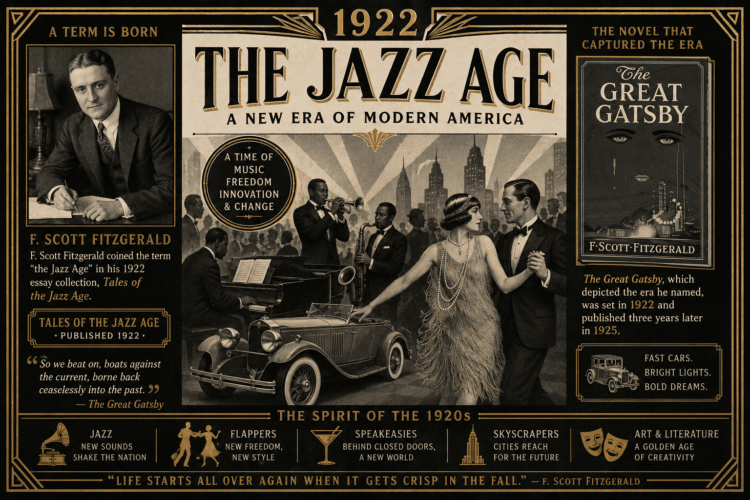
F. Scott Fitzgerald coined the term “the Jazz Age” in his 1922 essay collection, Tales of the Jazz Age. The novel The Great Gatsby, which depicted the era he named, was set in 1922 and published three years later.
Ulysses by James Joyce was published in Paris on February 2, 1922 — Joyce’s 40th birthday — by Sylvia Beach’s Shakespeare and Company bookshop. The novel follows Leopold Bloom through a single day in Dublin, June 16, 1904, in a stream-of-consciousness style that drew on Homer’s Odyssey as a structural framework. It had been published in serial form in the American literary magazine The Little Review until the U.S. Post Office declared several sections obscene and banned further publication in 1920. The complete novel was available in the United States only through smuggling until 1934, when an American court ruled it was not obscene. It is regularly cited as the greatest novel of the 20th century.
T.S. Eliot’s The Waste Land was published in October 1922 in both The Criterion literary journal (which Eliot edited) and The Dial in New York. It ran to 434 lines and incorporated quotations from seven languages. Ezra Pound had edited the original draft down from approximately twice its final length. Its opening lines — “April is the cruelest month, breeding / Lilacs out of the dead land” — became some of the most recognized in modern poetry. It defined literary modernism.
Nosferatu, directed by F.W. Murnau and released on March 4, 1922, was the first vampire film and introduced the concept that sunlight was lethal to vampires. In Bram Stoker’s 1897 novel, sunlight merely weakened Dracula’s powers. The film’s unauthorized adaptation of Stoker’s story led his widow to sue for copyright infringement. The court ordered all prints destroyed. Several survived. The sunlight-kills-vampires rule survived in every subsequent vampire story and became so standard that most people assume it came from Stoker.
Nanook of the North, directed by Robert Flaherty and released June 11, 1922, was the first commercially successful feature-length documentary film, following an Inuit man and his family in the Canadian Arctic. Many scenes were staged or reconstructed for the camera, making it more accurately described as a docudrama, but it established the documentary as a commercially viable film form and Flaherty as the father of documentary filmmaking.
The Lincoln Memorial was dedicated on May 30, 1922, in Washington, D.C. President Harding’s address at the ceremony was the first presidential speech broadcast on the radio. The 19-foot marble statue of Lincoln seated in the memorial’s chamber is so large that if Lincoln were to stand, he would be 28 feet tall.
The first radio commercial aired on August 28, 1922, on WEAF radio in New York City — a ten-minute advertisement for apartments in Jackson Heights, Queens, paid for by the Queensboro Corporation at a cost of $100. The concept of selling airtime to advertisers was not universally accepted; many broadcasters and listeners believed radio should be a public service medium. The commercial model prevailed.
Our Gang — later retitled The Little Rascals for television in 1955 — was created by producer Hal Roach and debuted as a series of short films in 1922. The series was notable for its time in depicting Black and white children playing together on equal terms, at a moment when the Ku Klux Klan had millions of members and such images were genuinely provocative. It ran through 1944.
The Straw Hat Riot of 1922 was a multi-day disturbance in New York City that began on September 13, when a group of young men began knocking straw boater hats off the heads of men still wearing them past the unofficial September 15 deadline, after which straw hats were considered socially unacceptable. The confrontations escalated over eight days, resulting in dozens of arrests. The underlying cause was an informal yet rigorously enforced social norm about seasonal hat-wearing that modern observers find difficult to take seriously, a view also held by the New York Police Department.
Gummy Bears were created in 1922 by Hans Riegel of Bonn, Germany, who founded the candy company Haribo (a portmanteau of HAnns RIegel BOnn). The original bears were larger than today’s version and called “Dancing Bears,” inspired by trained bears Riegel had seen at festivals. Haribo is still the world’s largest gummy bear manufacturer. The candy’s full name, Goldbären (Gold Bears), is trademarked.
Walgreens introduced the malted milkshake in 1922, created by employee Ivar “Pop” Coulson at the Chicago flagship store, who added two scoops of vanilla ice cream to the existing malted milk drink. The malted milkshake became one of the defining products of American drugstore culture for the next four decades.
The BBC began daily radio broadcasts from London on November 14, 1922, initially as the British Broadcasting Company. It became the British Broadcasting Corporation in 1927. It is the world’s oldest national broadcasting organization and the largest broadcaster by employee count.
The first 3D movie — The Power of Love — was released in 1922. The film used a dual-projection system that required viewers to close one eye or the other to see different images, which also gave it two different endings: a happy one visible with the right eye and a sad one with the left. No copies of the film survive. It was a remarkably conceptually ambitious film for which no evidence remains.
Howard Carter discovered the entrance to Tutankhamun’s tomb on November 4, 1922. The burial chamber was fully opened in February 1923. The discovery’s influence on Western fashion and design was immediate and pervasive — Egyptian revival architecture, jewelry, and decorative arts flooded the market within months, and the Art Deco style that dominated the decade absorbed Egyptian geometric motifs throughout.
The Herrin Massacre occurred on June 22, 1922, in Herrin, Illinois, during a strike at the Southern Illinois Coal Company. Replacement workers — “scabs” — who had been promised safe passage out of the area were instead killed by union members after the mine operators refused to honor the agreement. Nineteen replacement workers and two union miners were killed. A grand jury returned indictments; no one was ever convicted. The massacre was one of the most violent labor incidents in American history.
The Oorang Indians were an all-Native American NFL franchise based in LaRue, Ohio, active from 1922 to 1923. The team was funded by Walter Lingo, owner of the Oorang Dog Kennels, primarily as a marketing vehicle for his Airedale terrier breeding operation. Jim Thorpe, stripped of his 1912 Olympic medals, played on the team. The franchise was notable for its halftime shows featuring trained dogs, knife-throwing, and wrestling with bears.
Rebecca Latimer Felton was appointed to the U.S. Senate from Georgia on November 21, 1922, becoming the first woman to serve in the Senate. She was 87 years old. She held the seat for one day — her appointment was a ceremonial recognition by the Georgia governor, who appointed her knowing she would be replaced by the elected senator when Congress reconvened. In her one day’s service, Felton gave a speech on the Senate floor. She had been a champion of prison reform, women’s rights, and education throughout her long public life. She was also, as of 1922, the last member of Congress to have owned slaves.
Charles Osborne of Anthon, Iowa, began hiccuping in 1922 while attempting to weigh a hog before slaughter. He hiccupped continuously for 68 years, until 1990, during which he hiccupped an estimated 430 million times. He was entered in the Guinness World Records as the man with the longest hiccup attack. He stopped hiccupping one year before his death. He reportedly said it was a relief.
A temperature of 136 degrees Fahrenheit was recorded in El Azizia, Libya, on September 13, 1922, and was recognized for decades as the highest air temperature ever measured on Earth. In 2012, the World Meteorological Organization reviewed the measurement and disqualified it due to problems with the equipment, the observer, and the site conditions. The current official record is 134 degrees Fahrenheit, recorded in Death Valley on July 10, 1913.
J.G. Tierney, a Bureau of Reclamation surveyor, drowned in the Colorado River on December 20, 1922, while conducting site surveys for what became the Hoover Dam. He was the first person to die in connection with the dam project. Thirteen years later, on December 20, 1935, his son Patrick W. Tierney became the last person to die working on the dam — on the same calendar date as his father.
The Klondike Bar was invented in 1922 by William Isaly of Isaly’s Dairy in Mansfield, Ohio — a block of vanilla ice cream dipped in chocolate and mounted on a stick. The tagline “What would you do for a Klondike Bar?” did not arrive until decades later, but the ice cream did not change.
Lead paint was recognized as toxic as early as the 1890s and was banned by the League of Nations in 1922. The United States did not ban lead paint until 1978. American children were exposed to it for an additional 56 years after the international community had recognized the danger.
Nobel Prize Winners
Physics — Niels Henrik David Bohr for his investigation of the structure of atoms and of the radiation emanating from them; his model of the atom with electrons orbiting a nucleus in discrete energy levels became foundational to quantum mechanics; Carlsberg Brewery celebrated by giving him a house with a beer tap
Chemistry — Francis William Aston for his discovery, by means of his mass spectrograph, of isotopes in a large number of non-radioactive elements, and for his enunciation of the whole-number rule governing atomic masses
Medicine — Archibald Vivian Hill and Otto Fritz Meyerhof for discoveries relating to the production of heat in the muscle, foundational to understanding exercise physiology
Literature — Jacinto Benavente, a Spanish playwright, for the happy manner in which he has continued the illustrious traditions of the Spanish drama
Peace — Fridtjof Nansen, Norwegian explorer, scientist, and diplomat, for his humanitarian work organizing food relief for victims of the Russian famine; the “Nansen passport” he designed for stateless persons remains in modified use today
Broadway in 1922
Abie’s Irish Rose opened May 23, 1922, at the Fulton Theatre and ran for 2,327 performances — the longest Broadway run in history at the time, a record it held until Tobacco Road surpassed it in 1941. It was a comedy about an Irish Catholic girl and a Jewish boy who secretly marry, producing consternation in both families. Critics were nearly unanimous in dismissing it as thin and sentimental. Audiences did not care. It ran for five years.
Top Movies of 1922
- Robin Hood
- Foolish Wives
- Nanook of the North
- Nosferatu
- Dr. Mabuse: The Gambler
- The Prisoner of Zenda
- Grandma’s Boy
- Beyond the Rocks
- Tol’able David
- The Sheik
Popular and Best-Selling Books of 1922
Babbitt — Sinclair Lewis
The Breaking Point — Mary Roberts Rinehart
Gentle Julia — Booth Tarkington
If Winter Comes — A.S.M. Hutchinson
The Sheik — Edith M. Hull
Simon Called Peter — Robert Keable
To the Last Man — Zane Grey
Ulysses — James Joyce
The Waste Land — T.S. Eliot
Tales of the Jazz Age — F. Scott Fitzgerald
Ulysses was published in Paris in 1922 and immediately recognized as a work of extraordinary ambition and difficulty. It was banned in the United States until 1934. The Waste Land was published the same year, establishing 1922 as perhaps the single most consequential year in 20th-century English-language literature — two of its defining works appeared within months of each other.
Biggest Pop Artists of 1922
Al Jolson, Paul Whiteman, Billy Jones, Fanny Brice, Isham Jones, Ted Lewis, Van and Schenck, Marion Harris, Eddie Cantor, Nora Bayes, Bert Williams, Ethel Waters, Bessie Smith (emerging)
Sports Champions of 1922
World Series: New York Giants defeated the New York Yankees 4-0-1 (one game ended in a tie due to darkness); the Giants won their second consecutive World Series; Babe Ruth went 2 for 17, one of his worst postseason performances
Stanley Cup: Toronto St. Patricks defeated the Vancouver Millionaires 3-2
U.S. Open Golf: Gene Sarazen — at 20 years old, the youngest U.S. Open champion to that point; he won the PGA Championship the same year
U.S. Open Tennis: Men/Women: Bill Tilden / Molla Bjurstedt Mallory
Wimbledon: Men/Women: Gerald Patterson / Suzanne Lenglen
NCAA Football Champions: California, Cornell, and Princeton (co-champions)
Kentucky Derby: Morvich won the Kentucky Derby and went on to an undefeated season
Boston Marathon: Clarence DeMar, 2:18:10 — his second consecutive victory
Sports Highlight: Gene Sarazen won both the U.S. Open and the PGA Championship in 1922 at age 20, launching one of the most celebrated careers in golf history. He went on to win all four major championships, becoming part of the original “career Grand Slam” club. The highest-scoring game in Major League Baseball history was played on August 25, 1922, when the Chicago Cubs defeated the Philadelphia Phillies 26-23 — 49 total runs. The record still stands.
FAQs: 1922 Trivia, Fun Facts, and Pop Culture History
Q: What three major geopolitical events happened in 1922?
A: The Ottoman Empire was abolished, ending six centuries of rule; Mussolini and the Fascist Party seized power in Italy; and the USSR was formally established on December 30, 1922. Three of the defining political forces of the 20th century — the collapse of empire, the rise of fascism, and the consolidation of Soviet communism — all reached decisive moments in the same year.
Q: Who received the first insulin injection?
A: Leonard Thompson, a 14-year-old patient at Toronto General Hospital, on January 11, 1922. The treatment saved his life. Before insulin, Type 1 diabetes was a death sentence. Thompson lived another 13 years after his treatment.
Q: What literary works were published in 1922?
A: Ulysses by James Joyce and The Waste Land by T.S. Eliot were both published in 1922, along with F. Scott Fitzgerald’s Tales of the Jazz Age. 1922 is widely considered the most significant single year in the history of English-language literary modernism.
Q: What was the Straw Hat Riot?
A: A multi-day disturbance in New York City beginning September 13, 1922, triggered by young men forcibly knocking straw hats off the heads of men still wearing them past the unofficial September 15 social deadline for such headwear. It produced dozens of arrests. It was exactly as it sounds.
Q: What was the first vampire film, and what did it contribute to vampire mythology?
A: Nosferatu, directed by F.W. Murnau and released on March 4, 1922. It introduced the rule that sunlight is lethal to vampires — a concept absent from Bram Stoker’s original novel. The film was made without authorization from the Stoker estate, which sued to have all prints destroyed. Several survived. The sunlight rule became permanent in all subsequent vampire fiction.
Q: When was the Lincoln Memorial dedicated?
A: May 30, 1922. President Harding’s address at the ceremony was the first presidential speech broadcast on the radio. The statue of Lincoln inside is 19 feet tall — if Lincoln stood, he would be 28 feet tall.
Q: What happened when Alexander Graham Bell died in 1922?
A: All telephone service in the United States and Canada was silenced for one minute at 6:25 p.m. on August 4, 1922, the moment of his burial, as a tribute to the inventor of the telephone. The silence was coordinated across the entire North American telephone network.
Q: What record has never been broken from the 1922 baseball season?
A: The highest-scoring game in Major League Baseball history: the Chicago Cubs defeated the Philadelphia Phillies 26-23 on August 25, 1922, a total of 49 runs. The record has stood for over a century.
More 1922 Facts & History Resources:
Most Popular Baby Names (BabyCenter.com)
Popular and Notable Books (popculture.us)
Broadway Shows that Opened in 1922
1922 Calendar, courtesy of Time and Date.com
Fact Monster
1920s, Infoplease.com World History
1922 in Movies (according to IMDB)
Retrowaste Vintage Culture
1920s Slang
Wikipedia 1922