1936 History, Facts, and Trivia
Quick Facts from 1936
- World Changing Event: A devastating heat wave struck North America in the summer of 1936 — temperatures reached 121°F in some regions, killing an estimated 5,000 Americans and devastating crops already weakened by the Dust Bowl. It remains the deadliest weather event in U.S. history.
- Influential Songs: He’s Got the Whole World in His Hands, Summertime, and It Ain’t Necessarily So (both from Porgy and Bess)
- Must-See Movies: Modern Times, Show Boat, Reefer Madness, Mr. Deeds Goes to Town, Swing Time, Things to Come, Sabotage, and My Man Godfrey
- Most Famous American: Jesse Owens
- Notable Books: Gone with the Wind by Margaret Mitchell and How to Win Friends and Influence People by Dale Carnegie
- Monopoly board game: $1.98
- Movie ticket: approximately 35 cents
- Median family income: approximately $1,160 per year
- The Funny Guy: Jack Benny
- The Conversation: King Edward VIII of Great Britain abdicated the throne on December 11 to marry American divorcée Wallis Simpson — the first British monarch to voluntarily give up the crown
- U.S. Life Expectancy: Males — 56.6 years | Females — 60.6 years
Top Ten Baby Names of 1936
Girls: Mary, Shirley, Barbara, Betty, Patricia Boys: Robert, James, John, William, Richard
The Stars
Josephine Baker, Joan Blondell, Claudette Colbert, Joan Crawford, Olivia de Havilland, Kay Francis, Jean Harlow, Hedy Lamarr, Myrna Loy, Ginger Rogers, Barbara Stanwyck, Mae West
8th Academy Awards
The ceremony was held on March 5, 1936, at the Biltmore Hotel in Los Angeles, hosted by Frank Capra.
Mutiny on the Bounty won Best Picture — but did not win any other Oscar that night, a rare occurrence for a Best Picture winner. The Informer, directed by John Ford, won the most awards of the evening — Best Director, Best Actor (Victor McLaglen), Best Screenplay, and Best Score. This was the first year the Best Supporting Actor and Best Supporting Actress categories were introduced. Walter Brennan won Best Supporting Actor for Come and Get It; Gale Sondergaard won Best Supporting Actress for Anthony Adverse. This was the only year in Oscar history that write-in votes were permitted. Bette Davis received substantial write-in support for Of Human Bondage despite not being officially nominated, leading to subsequent changes to the formal nomination rules.
Time Magazine Woman of the Year
Wallis Simpson — the American divorcée whose relationship with King Edward VIII triggered the abdication crisis that shook the British monarchy to its foundations.
Miss America
Rose Coyle, Philadelphia, PA
We Lost in 1936
King George V of Great Britain — died January 20, age 70, succeeded by Edward VIII, who then abdicated within the year
Rudyard Kipling, author of The Jungle Book, died on January 18, at the age 70
G.K. Chesterton, author and creator of Father Brown, died June 14, at the age 62
Federico García Lorca, Spanish poet and playwright, executed by Nationalist forces at the start of the Spanish Civil War, August 19, age 37
Maxim Gorky, Russian writer, died June 18, age 68
Ivan Pavlov, physiologist famous for conditioning experiments with dogs, died February 27, age 86.
Albert Fish, a serial killer, was executed at Sing Sing Prison on January 16. He had murdered and cannibalized children and reportedly told guards he was looking forward to the electric chair as the one experience he had never tried.
The Conversation
King Edward VIII abdicated the British throne on December 11, 1936 — the first English monarch to voluntarily give up the crown. In his radio address to the nation, he said: “I have found it impossible to carry on the heavy burden of responsibility and to discharge the duties of king, as I would wish to do, without the help and support of the woman I love.” His younger brother was proclaimed King George VI. Edward and Wallis Simpson married the following year. He never returned to a significant public role. She never received the title “Her Royal Highness.”
The 1936 Berlin Olympics
Adolf Hitler planned to use the Berlin Games as a global showcase of Aryan racial superiority. It did not go according to plan.
Jesse Owens, a 22-year-old Black American from Alabama, won four gold medals: the 100m, 200m, long jump, and 4x100m relay. He was the first American track and field athlete to win four gold medals at a single Olympics. His achievement stood alone until Carl Lewis matched it in 1984.
The popular story that Hitler “snubbed” Owens is more complicated than history usually tells it. Hitler did not shake Owens’s hand — but he had already been told by Olympic officials that he must congratulate all winners or none. He chose none. Hitler had acknowledged the German victors on the first day, before receiving this instruction. The person Hitler more clearly snubbed was Black American high jumper Cornelius Johnson, leaving the stadium just before Johnson’s medal ceremony on day one. Owens himself later said: “Hitler didn’t snub me — it was FDR who snubbed me. The President didn’t even send me a telegram.” Roosevelt never publicly acknowledged Owens’s four gold medals.
After returning home to a ticker-tape parade in New York, Owens was forced to ride the freight elevator to his own reception at the Waldorf Astoria. Commercial opportunities dried up. He spent years running exhibition races against horses and motorcycles to earn a living. Owens died in 1980 at the age of 66.
German long jumper Luz Long — Owens’s main competitor — offered Owens advice during qualifying that helped him advance to the final, then embraced him publicly after Owens won the gold. The friendship between them, forged under Hitler’s gaze, became one of the most celebrated moments of the Games. Long was killed fighting for Nazi Germany in World War II. Their families remain in contact to this day.
Mack Robinson — older brother of Jackie Robinson — won the silver medal in the 200m at Berlin. Upon returning to Pasadena, California, the only work available to him as a Black man was sweeping streets. He did it while wearing his U.S. Olympic sweatshirt.
The Olympic torch relay from ancient Olympia to the host city — now a universal Olympic tradition — was invented by the Nazis for the 1936 Berlin Games as a propaganda device.
The 1936 Games were the first Olympics broadcast on television, transmitted via closed-circuit to 25 specially equipped theaters in Berlin. The world did not fully understand what television would become for another decade.
At the 1936 Olympics, boxer Thomas Hamilton-Brown lost his opening bout — so he went on an eating binge to console himself. A scoring error was later discovered, and he had not actually lost, making him eligible to continue. He was disqualified because he had gained too much weight to compete in his weight class.
Firsts, Inventions, and Wonders
GEICO — the Government Employees Insurance Company — was founded in 1936. It did not start using a gecko in its ads for another 63 years.
The Green Hornet radio show debuted in 1936, featuring a masked vigilante whose true identity was that of a newspaper publisher. The Lone Ranger’s creators produced it, and the characters were established as relatives.
Life magazine debuted on November 23, 1936, with a cover photograph of the Fort Peck Dam by Margaret Bourke-White. It became America’s first all-photographic news magazine and dominated the market for decades.
Billboard magazine — founded in 1894 — published its first music hit parade chart on January 4, 1936, creating the template for the modern music chart.
The Phantom debuted in newspaper comic strips on February 17, 1936 — the first superhero to wear a skin-tight costume and mask, predating Superman by two years.
The Volkswagen Beetle — designed under Adolf Hitler’s directive to create a “People’s Car” affordable to ordinary Germans — was introduced in 1936. The car outlasted the regime that created it by decades and became a global cultural icon.
Professor Quiz premiered in 1936 as the first radio quiz show, establishing a format that would spawn thousands of imitators across radio and television for the next 90 years.
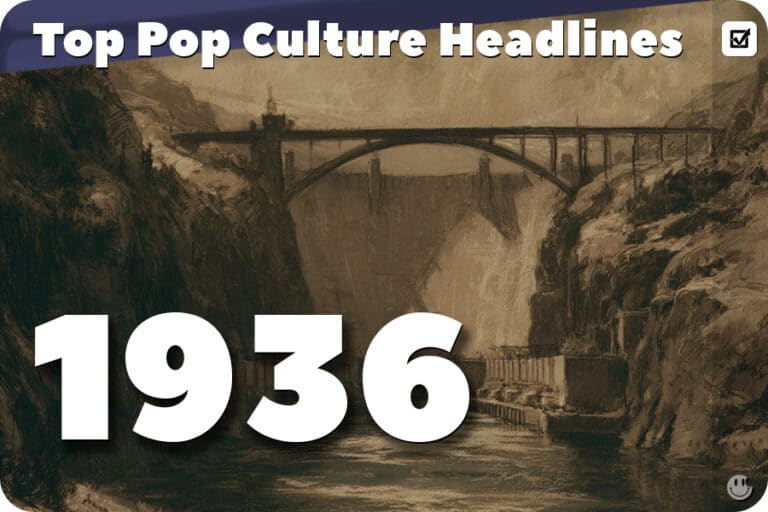
The Hoover Dam was completed on March 1, 1936. On October 9, it began sending electricity across 266 miles of desert to power Los Angeles.
Alan Turing published On Computable Numbers in 1936, establishing the theoretical foundation for modern computers — a paper that would eventually be recognized as one of the most important mathematical works of the 20th century.
The Great Sphinx of Giza — buried in sand up to its shoulders for centuries — was not fully excavated until 1936.
Ray-Ban sunglasses were founded in 1936, originally developed for U.S. Army Air Corps pilots to protect against glare.
Goya Foods, Harris Teeter, National Amusements, and the Solo Cup Company were all founded in 1936.
New words entering print for the first time in 1936 include: blabbermouth, cloud nine, den mother, gift wrap, hijack, Ivy League, masking tape, newsbreak, pay phone, scavenger hunt, and worrywart.
Wisconsin law from 1935 to 1937 required all restaurants to serve cheese and butter with every meal. This was Wisconsin being Wisconsin.
Frank Lloyd Wright designed Fallingwater — the house built over a waterfall in Pennsylvania — in 1936. It is widely considered the greatest work of American architecture.
Things to Come (1936) was the first film to depict zombies caused by an engineered plague, predating the modern zombie genre by decades.
The longest game in NHL history was played on March 26, 1936 — the Montreal Maroons and Detroit Red Wings were scoreless until 16 and a half minutes into the sixth overtime period, when Mud Bruneteau ended it at 2:25 a.m.
On June 19, 1936, Max Schmeling knocked out Joe Louis in the 12th round at Yankee Stadium — handing Louis his first professional defeat. The rematch two years later became one of the most politically charged sporting events in history.
The General Motors sit-down strike began on December 30, 1936, when autoworkers occupied the Fisher Body Plant in Flint, Michigan. It lasted 44 days, spread to 150,000 workers in 35 cities, and resulted in the recognition of the UAW — one of the most significant labor victories in American history.
The first modern Santa Claus Land — predecessor to Holiday World — did not open until 1946. In 1936, Americans were still a decade away from the first theme park.
In a 1936 Gallup Poll, 82% of Americans said married women should not work if their husbands had jobs. Meanwhile, economic necessity meant many did anyway.
Pennsylvania still charges an 18% tax on alcohol to pay for damages from the 1936 Johnstown flood. The money needed was raised within six years. The tax remains.
The Johnstown flood tax aside, 1936 was the year FDR won reelection with 523 electoral votes to Alf Landon’s 8 — one of the most lopsided presidential victories in American history.
The BBC began its television service in 1936 — the world’s first regular high-definition television service, available to approximately 400 sets in the London area.
Gone with the Wind by Margaret Mitchell — published June 10, 1936 — won the Pulitzer Prize the following year and sold a million copies in its first six months. It remains one of the best-selling novels in American history.
In the Raynham Hall in England, photographers Indre Shira and Captain Provand captured what became known as “The Brown Lady” — one of the most famous alleged ghost photographs ever taken.
The Baseball Hall of Fame inducted its first five members in 1936: Ty Cobb, Babe Ruth, Honus Wagner, Christy Mathewson, and Walter Johnson. Ty Cobb received more votes than Babe Ruth, despite being one of the most disliked men in baseball. Only four people attended his funeral in 1961.
Pop Culture Facts and History
Radio was the dominant entertainment medium in 1936 — approximately 75% of American households owned one, and listening was free. Comedy programs, soap operas, and sporting events were the most popular broadcasts. Benny Goodman’s swing orchestra was filling ballrooms and bringing jazz to white mainstream audiences for the first time.
Modern Times (1936) was Charlie Chaplin’s last mostly silent film and his most overtly political, depicting a factory worker ground up and spit out by industrial capitalism. It was made eight years into the sound era by a filmmaker who refused to fully surrender to it.
Movie tickets cost approximately 35 cents in 1936. Despite the Depression, Americans still went to the movies — nearly 20,000 theaters operated across the country. Hollywood’s response to the Depression was escapism: musicals, screwball comedies, and glamour. Swing Time with Fred Astaire and Ginger Rogers was the dance movie of the year.
The Depression did not significantly hurt box office receipts. People who couldn’t afford food still found 35 cents for the movies. Hollywood understood its role.
Swing music in 1936 was not background music — it was the soundtrack to national recovery. Benny Goodman’s August 1935 performance at the Palomar Ballroom in Los Angeles is often cited as the launch of the Swing Era, which hit full stride in 1936 with dancers filling ballrooms coast to coast.
The Habit
Reading How to Win Friends and Influence People by Dale Carnegie
Christmas Gifts and Firsts of 1936
Monopoly (already popular, now mass-market), jigsaw puzzles, roller skates, chemistry sets
Nobel Prize Winners
Physics — Victor F. Hess and Carl D. Anderson
Chemistry — Petrus Debye
Medicine — Sir Henry Hallett Dale and Otto Loewi
Literature — Eugene Gladstone O’Neill
Peace — Carlos Saavedra Lamas
Economics — Prize not yet established (first awarded 1969)
Popular and Best-Selling Books of 1936
The Doctor — Mary Roberts Rinehart
Drums Along the Mohawk — Walter D. Edmonds
Eyeless in Gaza — Aldous Huxley
Gone with the Wind — Margaret Mitchell
How to Win Friends and Influence People — Dale Carnegie
The Hurricane — Charles Nordhoff and James Norman Hall
It Can’t Happen Here — Sinclair Lewis
The Last Puritan — George Santayana
Murder in Mesopotamia — Agatha Christie
Sparkenbroke — Charles Morgan
The Thinking Reed — Rebecca West
We the Living — Ayn Rand
White Banners — Lloyd C. Douglas
Broadway in 1936
No major Broadway opening data provided in source — notable 1936 Broadway productions included On Your Toes (introducing the word “jazz” to the mainstream Broadway audience) and the revival of Show Boat.
Best Film Oscar Winner
Mutiny on the Bounty, directed by Frank Lloyd, won Best Picture at the 8th Academy Awards in 1936, presented for the 1935 film year, though The Informer won the most awards that evening.
The Bomb
Movie: The Garden of Allah — a Technicolor desert romance so overwrought it was parodied almost immediately upon release. Radio: The quiz show format launched with Professor Quiz — and immediately proved Americans would answer questions for prizes, a discovery that has never stopped being exploited.
Top Movies of 1936
- Modern Times
- Mr. Deeds Goes to Town
- My Man Godfrey
- Show Boat
- Swing Time
- Dodsworth
- The Story of Louis Pasteur
- San Francisco
- Things to Come
- Reefer Madness
Most Popular Radio Shows of 1936
(Television barely existed for consumers — radio was the only broadcast entertainment medium)
- Major Bowes Amateur Hour (NBC)
- Jack Benny Program (NBC)
- Amos ‘n’ Andy (NBC)
- Your Hit Parade (NBC)
- The Lux Radio Theatre (CBS)
- Burns and Allen (CBS)
- The Eddie Cantor Show (NBC)
- Rudy Vallee Show (NBC)
- The Green Hornet (WXYZ Detroit)
- Little Orphan Annie (NBC)
Biggest Pop Artists of 1936
Fred Astaire, Connee Boswell, The Boswell Sisters, Bing Crosby, Jimmy Dorsey and His Orchestra, Tommy Dorsey and His Orchestra, Duke Ellington, Shep Fields and His Rippling Rhythm, Jan Garber and His Orchestra, Benny Goodman and His Orchestra, Billie Holiday, Hal Kemp and His Orchestra, Henry King and His Orchestra, Andy Kirk and His 12 Clouds of Joy, Guy Lombardo and His Royal Canadians, Jimmie Lunceford and His Orchestra, Abe Lyman and His California Orchestra, Mantovani and His Orchestra, Freddy Martin and His Orchestra, Russ Morgan, Ozzie Nelson and His Orchestra, Ray Noble and His Orchestra, Tempo King and His Kings of Tempo, Fats Waller, Teddy Wilson and His Orchestra
1936 Billboard Number One Songs
(The Billboard Hit Parade launched January 4, 1936 — early chart methodology tracked radio airplay and sheet music sales rather than individual recordings)
Most popular songs of 1936 included:
Pennies from Heaven — Bing Crosby
Is It True What They Say About Dixie? — Jimmy Dorsey
The Way You Look Tonight — Fred Astaire (from Swing Time — won the Academy Award for Best Original Song)
Easy to Love — James Stewart and Eleanor Powell
I’ve Got You Under My Skin — Cole Porter
Summertime — various artists (from Porgy and Bess)
These Foolish Things — Benny Goodman
Goody Goody — Benny Goodman
The Music Goes Round and Round — Tommy Dorsey
Until the Real Thing Comes Along — Andy Kirk
Sports Champions of 1936
World Series: New York Yankees
NFL Champions: Green Bay Packers
Stanley Cup: Detroit Red Wings
U.S. Open Golf: Tony Manero
U.S. Open Tennis — Men: Fred Perry | Women: Alice Marble
Wimbledon — Men: Fred Perry | Women: Helen Jacobs
NCAA Football: Minnesota
Kentucky Derby: Bold Venture
Boston Marathon: Ellison Brown — 2:33:40
Sports Highlight: Jesse Owens won four gold medals at the Berlin Olympics — 100m, 200m, long jump, and 4x100m relay — in one of the greatest individual performances in Olympic history. Fred Perry became the first man to win all four Grand Slam singles titles over his career, completing the set at the U.S. Open.
FAQ — 1936 Trivia, Fun Facts, and Pop Culture History
Q: What was the biggest cultural event of 1936?
A: The Berlin Olympics, where Jesse Owens won four gold medals and delivered the most powerful rebuttal to Nazi racial ideology that sport has ever produced — without saying a single word.
Q: What king abdicated in 1936?
A: King Edward VIII of Great Britain abdicated on December 11, 1936 — the first English monarch to voluntarily give up the throne — to marry American divorcée Wallis Simpson.
Q: Did Hitler snub Jesse Owens at the 1936 Olympics?
A: The full story is more complicated. Hitler had already stopped publicly acknowledging any medal winners after the first day, when Olympic officials told him he must congratulate all or none. The person Hitler more clearly snubbed was Black American high jumper, Cornelius Johnson. Owens himself said he felt more snubbed by President Roosevelt, who never sent him a telegram or publicly acknowledged his four gold medals.
Q: What famous novel was published in 1936?
A: Gone with the Wind by Margaret Mitchell was published on June 10, 1936. It sold a million copies in six months and won the Pulitzer Prize. It remains one of the best-selling novels in history.
Q: What mathematical curiosity made 1936 notable?
A: 1936 is a perfect square — 44 × 44 = 1,936. The next year to be a perfect square was 2025 (45 × 45).
Q: What labor milestone happened in 1936?
A: The General Motors sit-down strike began on December 30, 1936, in Flint, Michigan. It lasted 44 days and resulted in recognition of the United Auto Workers union — one of the most significant labor victories in American history.
Q: What theoretical work published in 1936 changed computing forever?
A: Alan Turing published On Computable Numbers in 1936, establishing the mathematical foundation for modern computers — a decade before any practical computer was built.
Q: What was the most popular entertainment in 1936?
A: Radio. Approximately 75% of American households owned one, and listening was free. Swing music filled ballrooms. Movie tickets were 35 cents, and Americans still went despite the Depression.
Q: What new magazine debuted in 1936?
A: Life magazine debuted on November 23, 1936, with a Margaret Bourke-White photograph on the cover. It became America’s first all-photographic news magazine and dominated the market for decades.
Q: What sports record stood for 25 years after the 1936 Olympics?
A: Jesse Owens’s long jump world record of 8.13 meters, set in 1935, stood until 1960. His four-gold-medal Olympic achievement wasn’t equaled until Carl Lewis in 1984.
More 1936 History and Trivia Resources
Most Popular Baby Names (BabyCenter.com)
Popular and Notable Books (popculture.us)
Broadway Shows that Opened in 1936
1936 Calendar, courtesy of Time and Date.com
Fact Monster
The Great Depression & US Foreign Policy
1930s, Infoplease.com World History
1936 in Movies (according to IMDB)
Retrowaste Vintage Culture
1930s Slang
Wikipedia 1936
WW II Timeline, Digital History