1940 Trivia, Fun Facts, and Pop Culture History
Quick Facts from 1940
- Miraculous Event: Between May 26 and June 4, 1940, the British military evacuated 338,226 Allied troops from the beaches of Dunkirk, France, using a flotilla of over 800 military vessels and hundreds of civilian boats — fishing boats, pleasure craft, lifeboats, and river ferries. It was the largest military evacuation in history, accomplished in nine days, under constant German air attack. Churchill called it “a miracle of deliverance.”
- Influential Songs: When You Wish Upon a Star, Down Argentine Way, and Beat Me Daddy, Eight to the Bar
- Must-See Movies: The Great Dictator, Fantasia, The Philadelphia Story, The Grapes of Wrath, His Girl Friday, My Little Chickadee, Pinocchio
- Most Famous Person in America: Probably Franklin D. Roosevelt, winning an unprecedented third term; or Winston Churchill, who dominated every front page
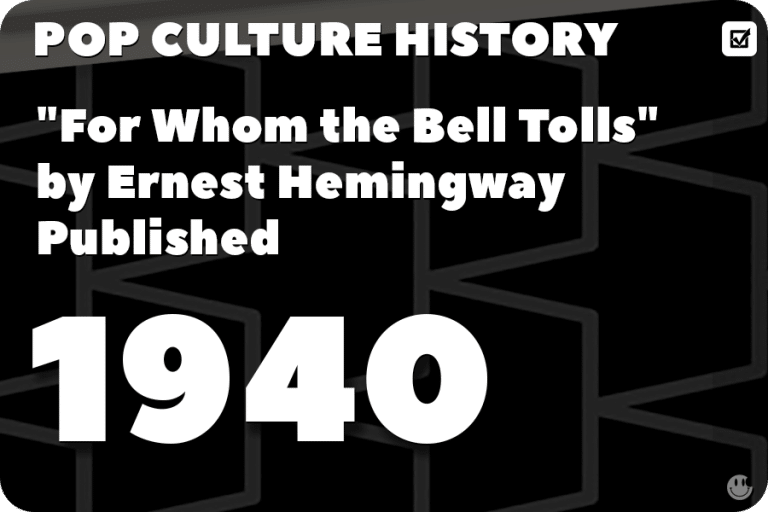
- Notable Books: For Whom the Bell Tolls by Ernest Hemingway, Horton Hatches the Egg by Dr. Seuss, and Pat the Bunny by Dorothy Kunhardt
- The 40-hour work week became federal law in 1940 under the amended Fair Labor Standards Act
- Loaf of bread: 10 cents; Gallon of gas: 11 cents; Issue of Life magazine: 10 cents; First-class stamp: 3 cents
- U.S. Life Expectancy: Males 60.8 years; Females 65.2 years
- Federal spending: $9.47 billion; Federal debt: $50.7 billion; Unemployment: 14.6%
- The Funny Trio: Bob Hope, Bing Crosby, and Dorothy Lamour
- The Conversation: People started saying “Cheese!” when smiling for the camera. In the earliest days of photography, subjects said “prunes” to keep from smiling — a pursed lip was considered more dignified than a grin.
Top Ten Baby Names of 1940
Girls: Mary, Barbara, Patricia, Judith, Betty, Carol, Nancy, Linda, Shirley, Sandra Boys: James, Robert, John, William, Richard, Charles, David, Thomas, Donald, Ronald
The Stars
Ingrid Bergman, Lilian Bond, Claudette Colbert, Olivia de Havilland, Betty Grable, Rita Hayworth, Katharine Hepburn, Hedy Lamarr, Vivien Leigh, Myrna Loy, Brenda Marshall, Ginger Rogers, Barbara Stanwyck, Gene Tierney, Lana Turner
The Quotes
“We shall fight on the beaches, we shall fight on the landing grounds, we shall fight in the fields and in the streets, we shall fight in the hills; we shall never surrender.” — Winston Churchill, House of Commons, June 4, 1940
“I’ll be all around in the dark — I’ll be everywhere. Wherever you can look, wherever there’s a fight, so hungry people can eat, I’ll be there.” — Henry Fonda as Tom Joad, The Grapes of Wrath
“Now I’m going to tell you something I’ve kept to myself for years… ‘Win just one for the Gipper.'” — Pat O’Brien as Knute Rockne, Knute Rockne All-American (This film also launched Ronald Reagan’s political identity — he was forever after called “The Gipper.”)
“[After a pause] He’s making it up as he goes.” — John Rhys-Davies as Sallah, Raiders of the Lost Ark — wait, wrong decade. But the spirit applies perfectly to 1940.
12th Academy Awards
The ceremony was held on February 29, 1940 (a leap year), at the Coconut Grove at The Ambassador Hotel in Hollywood. Bob Hope hosted for the first time — a role he would reprise 18 more times over the following decades.
Gone with the Wind swept the evening with eight awards, including Best Picture, Best Director (Victor Fleming), and Best Actress (Vivien Leigh). It remains one of the most dominant performances by a single film in Oscar history.
Hattie McDaniel won Best Supporting Actress for Gone with the Wind, becoming the first African American to win an Academy Award. She was not permitted to sit with her co-stars at the segregated venue and was seated at a separate table near the back. She delivered a gracious acceptance speech while knowing this. The irony of accepting an award for playing a servant while being treated as one was not lost on anyone paying attention.
The Wizard of Oz won Best Original Song for Over the Rainbow and Best Original Score.
Time Magazine Person of the Year
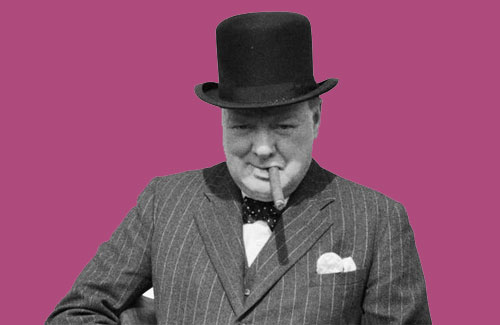
Winston Churchill — appointed British Prime Minister on May 10, 1940, the same day Germany launched its invasion of France and the Low Countries. Within weeks, he had become the defining voice of resistance to fascism.
Miss America
Frances Burke, Philadelphia, PA
We Lost in 1940
F. Scott Fitzgerald, author of The Great Gatsby, died on December 21, age 44, from a heart attack while working on The Last Tycoon. He died believing himself a failure, having sold fewer than 25,000 copies of Gatsby in his lifetime. The book has since sold over 25 million.
Nathanael West, author of The Day of the Locust, died on December 22, age 37, in a car accident one day after Fitzgerald. He had run a stop sign after hearing about Fitzgerald’s death on the radio.
Leon Trotsky, Russian revolutionary, was assassinated on August 21 in Mexico City by a Soviet agent who drove an ice pick into his skull. He survived the initial blow and fought his attacker before dying the following day.
Emma Goldman, anarchist and activist, died May 14, at age 70
Walter Chrysler, automobile manufacturer, died August 18, at age 65
Paul Klee, a Swiss-German artist, died June 29, at the age of 60
Selma Lagerlöf, Swedish author and first woman to win the Nobel Prize in Literature, died on March 16, at the age of 81
The World at War in 1940
1940 was the year the world learned what it was in for.
Germany had invaded Poland in September 1939, triggering declarations of war from Britain and France. Through the winter of 1939-40, little happened — a period the British called the “Phoney War.” Then, in April 1940, Germany invaded Denmark and Norway. In May, it launched a devastating attack on France, Belgium, Luxembourg, and the Netherlands simultaneously. France, expected to hold, collapsed in six weeks.
Winston Churchill became Prime Minister of Great Britain on May 10, 1940, replacing Neville Chamberlain. His first speech to Parliament contained no illusions: “I have nothing to offer but blood, toil, tears, and sweat.”
The Battle of Britain began in July 1940 — the first major campaign fought entirely by air forces. The German Luftwaffe attempted to destroy the Royal Air Force as a prerequisite to invasion. Britain’s RAF, outnumbered but aided by radar and fighting over home territory, held them off. By September, Hitler postponed the invasion indefinitely. Churchill’s tribute to the pilots who won: “Never in the field of human conflict was so much owed by so many to so few.”
The London Blitz began on September 7, 1940. Germany bombed London for 57 consecutive nights, then continued raids across Britain for eight months. Over 43,000 British civilians were killed; more than a million homes were destroyed. The British did not yield.
In June 1940, France signed an armistice with Germany. The French Resistance formed immediately. General Charles de Gaulle broadcast from London on BBC Radio, calling on France to continue fighting. He had no army, no country, and no authorization. He broadcast anyway.
Franklin D. Roosevelt won an unprecedented third presidential term on November 5, 1940, defeating Republican Wendell Willkie. He signed the Selective Training and Service Act in September 1940 — the first peacetime military draft in American history. America was not yet at war, but it was preparing.
The 1940 and 1944 Summer Olympics were both canceled due to the war. The 1940 Winter Olympics were also canceled.
The Miracle of Dunkirk
When the German army encircled Allied forces on the French coast in late May 1940, approximately 400,000 British and French troops faced annihilation or capture. The only route of escape was the sea.
The British launched Operation Dynamo on May 26. Over nine days, an armada of vessels crossed the English Channel under constant attack — Royal Navy destroyers, merchant ships, lifeboats, river ferries, fishing boats, pleasure craft, and private yachts. Owners of small boats along the English coast were simply called and asked if their boats could be used. Most said yes.
338,226 men were evacuated. Churchill called it a “miracle” while reminding Parliament that evacuations do not win wars. The men were rescued; their equipment was left behind. What it gave Britain was an army to fight with, and a story that became a national mythology: ordinary people doing extraordinary things when the moment demanded it.
Pop Culture Facts and History
Charlie Chaplin’s The Great Dictator was released on October 15, 1940. Chaplin played both a Jewish barber and Adenoid Hynkel, dictator of Tomania — a direct parody of Hitler. It was a courageous film: the United States was not yet at war, and many warned Chaplin it would destroy his career. It became his biggest commercial success. The closing six-minute speech — delivered in character as the barber, who has been mistaken for Hynkel — remains one of the most powerful monologues in cinema history.
Pinocchio was released on February 7, 1940. When You Wish Upon a Star won the Academy Award for Best Original Song and became the signature theme of the Walt Disney Company. Fantasia was released on November 13. Together, these two films defined the artistic ambition of Disney animation at its peak.
Tom and Jerry cartoon shorts debuted in theaters in 1940, created by William Hanna and Joseph Barbera for MGM. The cat-and-mouse formula they established has been in continuous production, in various forms, for over 80 years.
Bugs Bunny made his first formal appearance in A Wild Hare on July 27, 1940, opposite Elmer Fudd. His first line: “What’s up, Doc?” — delivered with complete calm while being hunted. An unnamed, similar rabbit had appeared in earlier Warner Bros. cartoons, but A Wild Hare established his personality, voice (Mel Blanc), and attitude. Bugs was born in Brooklyn, New York, according to his official biography.
Robin, the Boy Wonder, debuted in Detective Comics #38 in April 1940, created by Bob Kane, Bill Finger, and Jerry Robinson. Batman had been operating alone for less than a year. Robin’s arrival — and the concept of a boy sidekick — transformed superhero comics. The 1940s became the Golden Age of comic books, with Superman, Batman, Captain America, and Wonder Woman all defining American wartime culture.
The Superman radio show debuted on February 12, 1940. Among its many contributions to pop culture: it invented Kryptonite (in 1943) as a plot device so the voice actor could take a vacation, and it ran a storyline in 1946 explicitly mocking the Ku Klux Klan using the organization’s actual secret codes and rituals, which had been provided by a journalist who had infiltrated the Klan.
The Pennsylvania Turnpike opened on October 1, 1940 — the first modern superhighway in the United States, running 160 miles across Pennsylvania. It had no traffic lights, no railroad crossings, and a speed limit of 70 mph. Engineers called it “The Tunnel Highway.” Americans called it the future.
The Sturgis Motorcycle Rally was held for the first time in Sturgis, South Dakota, on August 14, 1940. Nine riders competed in a race organized by Indian motorcycle dealer J.C. “Pappy” Hoel. It now draws over 500,000 riders annually, making it one of the largest motorcycle rallies in the world.
The first televised baseball game aired on WGN-TV on May 1, 1940 — an exhibition game between the Chicago White Sox and Cubs. The audience was approximately 4,000 Chicagoans who owned TV sets.
The Lascaux Cave paintings were discovered on September 12, 1940, in France’s Dordogne region by four teenagers who stumbled upon the entrance while following their dog. The paintings date to approximately 17,000 years ago and include hundreds of animals painted with extraordinary sophistication. The cave was opened to the public in 1948 and closed in 1963 when the CO2 from visitors began damaging the paintings.
Brenda Starr, Reporter, debuted as a newspaper comic strip on June 30, 1940, written and drawn by Dalia Messick under the pen name “Dale Messick”; she used a gender-neutral name because she knew a strip by a woman would be rejected. It ran until 2011.
Chiune Sugihara was the Japanese Vice-Consul in Kaunas, Lithuania, in 1940. As German forces closed in, thousands of Jewish refugees begged for visas to escape through Japan. Sugihara requested permission from Tokyo three times. He was refused three times. He issued the visas anyway, writing them by hand for 18-20 hours a day for 29 days, issuing approximately 6,000 visas that saved an estimated 6,000 lives. He was recalled, lost his diplomatic career, and lived in obscurity for decades. He later said simply: “They were human beings, and they needed help.”
M&Ms were invented in 1940 by Forrest Mars Sr. and Bruce Murrie, inspired by soldiers in the Spanish Civil War who ate chocolate pellets with a hard sugar coating to keep them from melting in the heat. The “M” in M&Ms stands for Mars and Murrie. They came in six original colors: red, yellow, green, brown, orange, and violet. Violet was replaced by tan in 1949.
Glenn Miller’s Pennsylvania 6-5000 (1940) referenced an actual New York phone number — the Hotel Pennsylvania at 401 7th Avenue, across from Penn Station. The number (212-736-5000) remained in service for decades, making it arguably the longest-running phone number in American pop culture history.
Pachelbel’s Canon in D was composed in the 1690s and was forgotten for over 200 years. It survived in two manuscripts, was first published in 1919, and was first recorded in 1940. It is now one of the most performed and recognized pieces of classical music in the world.
The first color television demonstration by CBS was made in 1940, though it would not become commercially available until the 1950s.
London’s Richmond Golf Club kept its course open during the German bombing campaign with a remarkable rule: “A player whose stroke is affected by the simultaneous explosion of a bomb may play another ball from the same place. Penalty: one stroke.”
People began shouting “Geronimo!” when jumping from aircraft in 1940 after Private Aubrey Eberhardt made the claim before a practice parachute jump to prove he wasn’t scared. His entire platoon refused to be outdone. The tradition spread through the entire U.S. Army.
The America First Committee, founded in September 1940, gathered nearly one million members in opposition to U.S. entry into World War II. Its most prominent spokesman was aviator Charles Lindbergh. It disbanded on December 11, 1941 — four days after Pearl Harbor.
Booker T. Washington became the first African American depicted on a U.S. postage stamp in 1940 — a 10-cent commemorative.
The Great Smoky Mountains National Park was formally dedicated by President Roosevelt on September 2, 1940.
In 1940, scientists concluded that ice cream consumption was the leading cause of the polio epidemic, based entirely on the observation that polio cases peaked in summer, when children also ate the most ice cream. This was a case of correlation mistaken for causation on a spectacular scale. It would take another 15 years to develop the actual vaccine.
The Tragedy
The Rhythm Club fire at a dance hall in Natchez, Mississippi, on April 23, 1940, killed 209 people — the building had only one exit, and Spanish moss used as decoration spread the fire instantly. It remains one of the deadliest nightclub fires in American history.
Nobel Prize Winners
Physics — Not awarded (war)
Chemistry — Not awarded (war)
Medicine — Not awarded (war)
Literature — Not awarded (war)
Peace — Not awarded (war)
Economics — Prize not yet established (first awarded 1969)
All Nobel Prizes were suspended during World War II from 1940 through 1942.
Popular and Best-Selling Books of 1940
The Family — Nina Fedorova
For Whom the Bell Tolls — Ernest Hemingway
The Grapes of Wrath — John Steinbeck (won the Pulitzer Prize in 1940)
Horton Hatches the Egg — Dr. Seuss
How Green Was My Valley — Richard Llewellyn
Kitty Foyle — Christopher Morley
Mrs. Miniver — Jan Struther
The Nazarene — Sholem Asch
Night in Bombay — Louis Bromfield
Oliver Wiswell — Kenneth Roberts
Pat the Bunny — Dorothy Kunhardt
Stars on the Sea — F. van Wyck Mason
The Grapes of Wrath by John Steinbeck won the Pulitzer Prize in 1940, having been published in 1939. It sold 430,000 copies in its first year. The state of California attempted to ban it. Steinbeck won the Nobel Prize in Literature in 1962.
Broadway in 1940
Pal Joey opened December 25, 1940, with music by Richard Rodgers and lyrics by Lorenz Hart, introducing a new kind of Broadway anti-hero.
Cabin in the Sky opened on October 25, 1940, featuring an all-Black cast. Louisiana Purchase and Panama Hattie with Ethel Merman were also major hits of the season.
Best Film Oscar Winner
Gone with the Wind, directed by Victor Fleming, won Best Picture at the 12th Academy Awards in 1940, presented for the 1939 film year. It swept eight awards — the most by any film at that point. It cost $3.9 million to make and earned $390 million by 1941, making it the most profitable film in history relative to cost for decades.
The Bomb
Movie: One Million B.C. — a caveman epic that managed to make prehistoric life deeply boring. Radio: The comedy that bombed was any attempt to joke about the war in Europe. American audiences were not ready; most comedy stuck safely to domestic subjects throughout 1940.
Top Movies of 1940
- Fantasia
- Pinocchio
- Boom Town
- Rebecca
- The Great Dictator
- The Philadelphia Story
- The Grapes of Wrath
- Strike Up the Band
- Santa Fe Trail
- My Little Chickadee
Most Popular Radio Shows of 1940
(Television barely existed for consumers — radio was the dominant home entertainment medium)
- Fibber McGee and Molly (NBC)
- Jack Benny Program (NBC)
- Charlie McCarthy Show (NBC)
- Bob Hope Show (NBC)
- Bing Crosby’s Kraft Music Hall (NBC)
- The Lone Ranger (WXYZ/NBC)
- Lux Radio Theatre (CBS)
- The Shadow (CBS)
- Amos ‘n’ Andy (NBC)
- The Fred Allen Show (NBC)
1940 Billboard Number One Songs
(Early chart methodology tracked radio airplay and sheet music sales; multiple songs charted simultaneously)
November 25, 1939 – January 26, 1940: Scatter-Brain — Frankie Masters
January 27 – February 9: All the Things You Are — Tommy Dorsey
February 3 – March 2: Careless — Glenn Miller (5 weeks)
February 12 – May 3: In the Mood — Glenn Miller (12 weeks — the dominant song of early 1940)
February 24 – March 2: Indian Summer — Tommy Dorsey
March 16 – March 23: Darn That Dream — Benny Goodman
March 30 – May 3: When You Wish Upon a Star — Glenn Miller
May 4 – July 19: Tuxedo Junction — Glenn Miller (9 weeks)
May 4 – June 28: The Woodpecker Song — Glenn Miller (7 weeks)
June 22 – July 4: Imagination — Glenn Miller
July 20 – July 26: Fools Rush In (Where Angels Fear to Tread) — Glenn Miller
July 27 – August 23: I’ll Never Smile Again — Tommy Dorsey
August 24 – September 6: Where Was I? — Charlie Barnet
September 7 – September 13: The Breeze and I — Jimmy Dorsey
September 14 – October 18: Sierra Sue — Bing Crosby
October 19 – November 22: Only Forever — Bing Crosby
November 23 – November 27: Blueberry Hill — Glenn Miller
November 28 – December 20: Ferryboat Serenade — The Andrews Sisters
November 28 – December 20: Trade Winds — Bing Crosby
December 21, 1940 – March 14, 1941: Frenesi — Artie Shaw and His Orchestra
Glenn Miller dominated 1940 so completely that he had multiple songs charting simultaneously for much of the year. In the Mood, his signature piece, spent 12 weeks at the top. Miller would disappear over the English Channel on December 15, 1944, en route to Paris; his plane was never found. He was 40 years old.
1940 United States Census
Total U.S. Population: 132,164,569
New York, NY — 7,457,995
Chicago, IL — 3,396,808
Philadelphia, PA — 1,931,334
Detroit, MI — 1,623,452
Los Angeles, CA — 1,504,277
Cleveland, OH — 878,336
Baltimore, MD — 859,100
St. Louis, MO — 816,048
Boston, MA — 770,816
Pittsburgh, PA — 671,659
Sports Champions of 1940
World Series: Cincinnati Reds
NFL Champions: Chicago Bears (73-0 over the Washington Redskins — the most lopsided game in NFL history)
Stanley Cup: New York Rangers
U.S. Open Golf: Lawson Little
U.S. Open Tennis — Men: Donald McNeill | Women: Alice Marble
Wimbledon: Not held due to World War II
NCAA Football: Minnesota
NCAA Basketball: Indiana
Kentucky Derby: Gallahadion
Boston Marathon: Gérard Côté — 2:28:28
Sports Highlight: The 1940 NFL Championship game on December 8 was the most lopsided result in professional football history. The Chicago Bears defeated the Washington Redskins 73-0, scoring 11 touchdowns in a game that was not as close as the score suggests. The Redskins had beaten the Bears 7-3 three weeks earlier in the regular season; Bears coach George Halas reportedly posted the Washington owner’s dismissive post-game comments on the Bears’ locker room wall as motivation.
FAQs: 1940 History, Facts, and Trivia
Q: What was the Miracle of Dunkirk?
A: Between May 26 and June 4, 1940, Britain evacuated 338,226 Allied troops from the beaches of Dunkirk, France, using 800+ military vessels and hundreds of civilian boats. It was the largest military evacuation in history, conducted under continuous German attack, and became one of the defining stories of the war.
Q: What was the Battle of Britain?
A: From July to October 1940, the German Luftwaffe attempted to destroy the Royal Air Force as a prerequisite to invading England. Britain’s RAF, aided by radar, held them off. Hitler abandoned the invasion. Churchill’s tribute to the RAF pilots: “Never in the field of human conflict was so much owed by so many to so few.”
Q: What historic Oscar win happened in 1940?
A: Hattie McDaniel became the first African American to win an Academy Award, receiving Best Supporting Actress for Gone with the Wind. She was required to sit at a separate table from her co-stars at the segregated ceremony venue.
Q: What famous cartoon characters debuted in 1940?
A: Bugs Bunny made his formal debut in A Wild Hare on July 27, 1940, saying “What’s up, Doc?” for the first time. Tom and Jerry debuted in the same year in MGM theaters. Robin, the Boy Wonder, appeared in Detective Comics in April 1940.
Q: What was The Great Dictator?
A: Charlie Chaplin’s direct parody of Adolf Hitler, released in October 1940. It was the first Hollywood film to explicitly mock the Nazis, made while the U.S. was still officially neutral. Chaplin later said that had he known the full extent of the Nazi atrocities, he could not have made a comedy.
Q: Who was Chiune Sugihara?
A: The Japanese Vice-Consul in Lithuania who defied direct orders from Tokyo and issued approximately 6,000 visas to Jewish refugees fleeing Nazi persecution in 1940, saving an estimated 6,000 lives. He wrote visas by hand for up to 20 hours a day for 29 days. He lost his diplomatic career as a result and lived in obscurity for decades before his actions were recognized.
Q: What was the most dominant song of 1940?
A: In the Mood by Glenn Miller spent 12 weeks at the top of the charts and remains one of the most recognizable pieces of the Swing Era. Glenn Miller had multiple #1 songs simultaneously throughout much of 1940.
Q: What was the worst nightclub disaster of 1940?
A: The Rhythm Club fire in Natchez, Mississippi, on April 23, 1940, killed 209 people when Spanish moss decorations caught fire in a building with only one exit.
Q: What happened to Glenn Miller?
A: Glenn Miller, who dominated the 1940 charts, disappeared on December 15, 1944, when his single-engine plane vanished over the English Channel on a flight to Paris. No wreckage or bodies were ever found. He was 40 years old.
Q: What was the most lopsided game in NFL history?
A: The 1940 NFL Championship, in which the Chicago Bears defeated the Washington Redskins 73-0 on December 8, 1940. The Redskins had beaten the Bears by four points just three weeks earlier.
More 1940 History and Trivia Resources
Most Popular Baby Names (BabyCenter.com)
Popular and Notable Books (popculture.us)
Broadway Shows that Opened in 1940
1940 Calendar, courtesy of Time and Date.com
Fact Monster
Forties Nostalgia
1940s, Infoplease.com World History
1940 in Movies (according to IMDB)
Retrowaste Vintage Culture
1940s Slang
1940 US Census Fast Facts
Wikipedia 1940
WW II Timeline (US Dept. of Defense)