1904 History, Facts, and Trivia
Quick Facts from 1904
- World Changing Event: Construction of the Panama Canal began on May 4, 1904 — the largest engineering project in American history to that point, requiring the excavation of 240 million cubic yards of earth across 51 miles of jungle, swamp, and mountains. It would take ten years and cost approximately 5,600 lives.
- Popular Songs: Meet Me in St. Louis, Louis; Give My Regards to Broadway; and Sweet Adeline
- Must-See Film: The Great Train Robbery was still packing nickelodeons from its December 1903 release
- Most Famous American: Theodore Roosevelt — elected in his own right in November 1904 by the largest popular vote margin in history to that point
- U.S. Life Expectancy: Males 46.2 years; Females 49.1 years
- The Conversation: The St. Louis World’s Fair — 19 million people, 63 countries, the Olympics, and a debate about who invented the ice cream cone that has never fully been resolved
Top Ten Baby Names of 1904
Girls: Mary, Helen, Anna, Margaret, Ruth, Elizabeth, Florence, Ethel, Emma, Marie
Boys: John, William, James, George, Robert, Charles, Joseph, Frank, Edward, Walter
The Stars
Maude Adams, the most popular stage actress in America, was starring as Peter Pan following the play’s London premiere. Anna Held continued her run as Broadway’s reigning star. The nickelodeon film audience was growing fast but film actors were still anonymous.
The Quote
“The man who makes no mistakes does not usually make anything.” — Theodore Roosevelt
“I am tired of being treated like a second-class citizen.” — Rosa Parks, born February 4, 1913 — not yet born. But the sentiment was already being felt by millions of Black Americans living under Jim Crow in 1904.
We Lost in 1904
Anton Chekhov, Russian playwright, died July 15, age 44, of tuberculosis at a German spa. His last words were reportedly “I haven’t had champagne for a long time.” His doctor brought him a glass; he drank it, smiled, lay down, and died.
Antonín Dvořák, Czech composer — died May 1, age 62
Samuel Smiles, Scottish author of Self-Help, died April 16, at the age of 91
Kate Chopin, American author of The Awakening, died on August 22, at the age of 53
Henry Morton Stanley, explorer, died May 10, at age 63
America in 1904 — The Context
Theodore Roosevelt was governing with a vigor and ambition that his Republican establishment backers had never anticipated. He had sued to break up the Northern Securities Company railroad monopoly, established the Department of Commerce and Labor, and was about to begin construction of the Panama Canal. In November, he won reelection by the largest popular vote margin in American history to that point — 56% of the vote against Democrat Alton Parker. The Progressive Era was in full swing.
The country was simultaneously building its modern infrastructure and revealing its worst impulses. The same year the New York City Subway opened, and FIFA was founded, a Congolese man named Ota Benga was exhibited at the St. Louis World’s Fair in a cage with primates, and the 1904 Olympics featured “Anthropology Days” in which indigenous people were made to compete in Western athletic events for the entertainment of spectators who viewed them as racially inferior.
The St. Louis World’s Fair
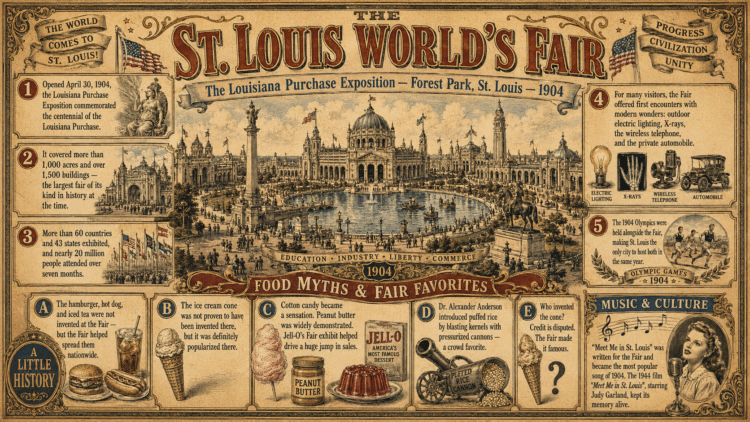
The Louisiana Purchase Exposition opened on April 30, 1904, in Forest Park, St. Louis, commemorating the centennial of the Louisiana Purchase. It covered over 1,000 acres and more than 1,500 buildings, at the time, the largest fair of its kind in history. Fairgoers could explore exhibits from over 60 countries and 43 states. Nearly 20 million people attended over the course of seven months.
For many attendees, the World’s Fair offered their first experiences with the latest and greatest technological innovations: outdoor electric lighting, an X-ray machine, a wireless telephone, and the private automobile.
The 1904 Olympics were held concurrently with the World’s Fair, making St. Louis the only city to host both in the same year.
The Food Myths: The hamburger, hot dog, and iced tea were not invented at the 1904 World’s Fair — all three existed decades earlier. The ice cream cone was not invented there either, but it may have been popularized there. What the Fair genuinely did was expose nearly 20 million people to foods and products they had never encountered, then send them home to tell everyone about it. The Fair didn’t invent American fast food culture — it launched it nationally.
Cotton candy was popularized at the Fair. Peanut butter was demonstrated widely. Jell-O quadrupled its sales between 1902 and 1906 largely due to its Fair exhibition. Puffed rice was introduced by Dr. Alexander Anderson, who used pressurized cannons to explode rice kernels to eight times their original size. Visitors waited 30 minutes to watch the demonstration.
The ice cream cone story is genuinely complicated. The ice cream cone, since it cannot be proven to have been invented there, was definitely popularized at the Fair. Multiple vendors claim credit — Syrian immigrant Ernest Hamwi, Charles Menches, and others. An Italian immigrant in New York had already patented an edible cone mold in 1903. The Fair made the cone universally known; whoever actually invented it remains disputed.
Meet Me in St. Louis was written specifically for the Fair and became the most popular song of 1904. The Film Meet Me in St. Louis (1944), starring Judy Garland, would make it eternal.
Pop Culture Facts and History
The New York City Subway opened on October 27, 1904, running from City Hall to West 145th Street — the first section of what would become the largest subway system in the Western Hemisphere. The opening day fare was a nickel. 150,000 riders used it on the first day. It replaced a 90-minute horse-drawn carriage journey with a 26-minute train trip.
Peter Pan, or The Boy Who Wouldn’t Grow Up, by J.M. Barrie, premiered at the Duke of York’s Theatre in London on December 27, 1904. The play was an immediate sensation, with actress Nina Boucicault in the title role. Barrie eventually donated the rights to the Great Ormond Street Hospital for Sick Children in London. The copyright in the United Kingdom was extended by Parliament in perpetuity — the only work to hold such a distinction.
The T-shirt was invented in 1904 by the Cooper Underwear Company and marketed specifically to bachelors — men who could not sew on buttons or replace worn collar bands. The original pitch line was essentially “even a man who can’t sew can wear this.” The T-shirt would remain underwear for another 50 years before it became outerwear.
The safety razor was patented by King Camp Gillette on November 15, 1904. Gillette had the idea of disposable razor blades in 1895 but needed eight years to develop a blade thin enough and cheap enough to be thrown away. He sold 51 razors and 168 blades in 1903. In 1904, after the patent was granted, he sold 90,000 razors and 12.4 million blades. The shaving industry was never the same.
The term “hangover” entered common usage in 1904. Before that, the morning-after sensation from excessive drinking was described as “crapulous” — from the Latin crapula, meaning excessive drinking. “Hangover” is clearly the better word, which is why it won.
Thomas Sullivan, a New York tea merchant, invented tea bags by accident in 1904. He sent small silk tea bags as samples to customers, intending them to be opened and the tea brewed normally. Customers simply dunked the bags in hot water instead. Sullivan recognized this as an improvement and began producing bags specifically for steeping. The tea bag is entirely the result of customers using it incorrectly.
The term “banana republic” was coined by American writer O. Henry in 1904 while living in Honduras to avoid prosecution for embezzlement in the United States. He used it to describe Honduras in his short story collection Cabbages and Kings. The term entered political science permanently.
Lane Bryant’s department store should have been named Lena Bryant, after its Lithuanian-Jewish immigrant founder, Lena Himmelstein Bryant. A bank officer misspelled her name, “Lane,” when she opened her account in 1904. She never bothered to correct it. The company was originally focused on maternity and large-size women’s clothing — segments that mainstream retailers ignored. It became one of the most successful specialty retailers in American history.
The Bank of Italy opened in San Francisco in October 1904, founded by Amadeo Giannini specifically to serve Italian immigrants and working-class customers who were turned away by established banks. After the 1906 earthquake, Giannini loaded cash and gold into two wagons and drove them out of the burning city, allowing him to begin making loans to rebuild San Francisco within days while other banks were still trying to open their vaults. The bank eventually became Bank of America.
George Eyser, an American gymnast who had lost his left leg in a railroad accident and competed on a wooden prosthetic, won six medals at the 1904 St. Louis Olympics in a single day — three gold, two silver, and one bronze. In events including vault, parallel bars, pommel horse, and rope climbing. His achievement received almost no attention at the time and was largely forgotten for decades.
Ota Benga — a Mbuti man from the Belgian Congo who had survived a massacre that killed his wife and children — was brought to the United States and exhibited at the St. Louis World’s Fair alongside indigenous peoples in an exhibit designed to illustrate supposed racial hierarchy. In 1906, he was displayed in the Bronx Zoo’s Monkey House alongside an orangutan, with a sign identifying him as a “native African.” African American ministers in New York protested furiously. He was eventually released, educated, and employed in Virginia. When World War I prevented his planned return to Africa, he shot himself in the heart on March 20, 1916. He was approximately 32 years old.
FIFA — the Fédération Internationale de Football Association — was founded in Paris on May 21, 1904, by seven national associations: France, Belgium, Denmark, the Netherlands, Spain, Sweden, and Switzerland. England, the country that had codified the rules of football, did not join until the following year. The United States was not involved. FIFA now governs football in 211 member nations — more members than the United Nations.
The CQD distress signal — “All stations: Distress” — was established on January 7, 1904, as the first standardized maritime emergency signal. It was replaced by SOS in 1906, primarily because SOS was simpler to transmit in Morse code. The Titanic operators used CQD and SOS interchangeably in 1912.
The Dream of the Rarebit Fiend comic strip by Winsor McCay debuted on September 10, 1904. McCay — who would later create Little Nemo in Slumberland — used the strip to depict bizarre, surreal nightmares experienced by characters who had eaten too much Welsh rarebit before bed. It ran until 1925 and is considered a foundational work of American surrealism in comics.
The Russo-Japanese War began on February 8, 1904, when Japan launched a surprise attack on the Russian naval base at Port Arthur without a declaration of war — foreshadowing the attack on Pearl Harbor 37 years later. It was the first modern war in which a non-European power decisively defeated a European one. Theodore Roosevelt mediated the peace settlement, winning the Nobel Peace Prize in 1906.
The Great Baltimore Fire of February 7-8, 1904, burned for 30 hours and destroyed over 1,500 buildings in 30 blocks of central Baltimore. Remarkably, no one was killed, though the economic damage was severe. Fire departments from as far as New York and Washington sent equipment — only to discover their hose couplings were incompatible with Baltimore’s hydrants. This discovery directly led to the standardization of fire hose coupling sizes across the United States.
The SS General Slocum disaster on June 15, 1904, killed over 1,000 people — mostly women and children from a German Lutheran congregation on an annual church excursion — when the steamboat caught fire on New York’s East River. Lifejackets had rotted and disintegrated; fire hoses burst when pressurized; crew members were untrained. The 1,021 deaths made it the deadliest disaster in New York City history until September 11, 2001. The captain was convicted of negligence and sentenced to ten years in prison.
The Trans-Siberian Railway was completed on July 21, 1904, after 13 years of construction, connecting Moscow to Vladivostok across 5,772 miles. It crossed seven time zones, 16 major rivers, and terrain that included taiga, steppe, and permafrost. At completion, a journey that had previously taken months by horse and cart could be made in 13 days.
Puccini’s Madama Butterfly premiered at La Scala in Milan on February 17, 1904, to one of the worst receptions in opera history — the audience booed, hissed, and disrupted the performance. Puccini withdrew the opera, revised it over three months, and relaunched it. It became one of the most performed operas in history. The original La Scala audience is among the most embarrassingly wrong crowds ever assembled.
The first New Year’s Eve celebration in Times Square was held on December 31, 1904, organized by the New York Times to celebrate its new building at One Times Square — then called Longacre Square. The building was renamed Times Square for the occasion. The celebration featured fireworks from the roof. The famous ball drop didn’t begin until 1907.
Harley-Davidson sold its first motorcycle in 1904 — one year after building its first one. They produced eight motorcycles that year.
The Protestant Ethic and the Spirit of Capitalism by Max Weber was published in 1904-1905 and argues that Protestant theology — particularly Calvinist ideas about work, thrift, and the calling — shaped the development of modern capitalism. It remains one of the most debated works in social science.
Nobel Prize Winners
Physics — Lord Rayleigh (for the discovery of argon and investigations into the densities of gases)
Chemistry — Sir William Ramsay (for the discovery of noble gases)
Medicine — Ivan Petrovich Pavlov (for work on the physiology of digestion — and, incidentally, conditioned reflexes)
Literature — Frédéric Mistral and José Echegaray (shared) Peace — Institut de Droit International
Ivan Pavlov’s Nobel Prize was technically for his work on digestive physiology, not conditioned reflexes — the famous experiments with dogs and bells came later and were never themselves awarded a Nobel Prize.
Popular and Best-Selling Books of 1904
The Crossing — Winston Churchill (American novelist)
The Deliverance — Ellen Glasgow
The Masquerader — Katherine Cecil Thurston (published anonymously)
Rebecca of Sunnybrook Farm — Kate Douglas Wiggin
Beverly of Graustark — George Barr McCutcheon
Also notable: The Golden Bowl by Henry James, The Protestant Ethic and the Spirit of Capitalism by Max Weber, and Nostromo by Joseph Conrad.
Broadway in 1904
Little Johnny Jones by George M. Cohan opened November 7, 1904, introducing the songs Give My Regards to Broadway and Yankee Doodle Dandy — two of the most enduring songs in American theater history. Cohan wrote, directed, produced, and starred in it. He was 26 years old.
Top Films of 1904
The Great Train Robbery — still the dominant film in nickelodeon programs across America from its December 1903 release
A Policeman’s Tour of the World — Méliès
The Widow and the Only Man — Biograph Company
An Impossible Voyage — Méliès
Most Popular Entertainment of 1904
Vaudeville, nickelodeon films, and live music. The phonograph was becoming a genuine home entertainment appliance.
Baseball was the dominant spectator sport.
The St. Louis World’s Fair was the cultural event of the year for anyone who could make the trip.
1904 Most Popular Songs
Meet Me in St. Louis, Louis — Billy Murray (written for the World’s Fair)
Give My Regards to Broadway — Billy Murray (from Little Johnny Jones)
Sweet Adeline (You’re the Flower of My Heart) — Haydn Quartet
Bedelia — Billy Murray Yankee Doodle Boy — Billy Murray
Under the Bamboo Tree — Arthur Collins
Navajo — Billy Murray Alexander — Billy Murray
Billy Murray dominated the popular music charts of the early 1900s so completely that he was effectively the most recorded popular artist of the decade.
Sports Champions of 1904
World Series: Not held — New York Giants manager John McGraw refused to play Boston, calling the American League an “inferior organization.” It remains the only year the World Series was canceled due to a team’s refusal to participate.
American League: Boston Americans
National League: New York Giants
Stanley Cup: Ottawa Hockey Club
U.S. Open Golf: Willie Anderson (his third consecutive title — one of only four players ever to win three consecutive U.S. Opens)
U.S. Open Tennis — Men: Holcombe Ward | Women: May Sutton
Wimbledon — Men: Laurence Doherty | Women: Dorothea Douglass
NCAA Football: Pennsylvania and Michigan (shared)
Kentucky Derby: Elwood
Boston Marathon: Michael Spring — 2:38:04
Sports Highlight: The 1904 Olympics in St. Louis were a near-disaster — poorly organized, dominated absurdly by the United States, which won 239 of 280 available medals, and marred by the racist “Anthropology Days” sideshow. The marathon was the most chaotic: the “winner” Fred Lorz was disqualified for riding in a car for 11 miles, the actual winner Thomas Hicks, was nearly dying from doses of strychnine and brandy administered by his handlers as performance enhancers, and a Cuban runner named Felix Carvajal ran the course in street clothes after losing all his money gambling in New Orleans en route to St. Louis. He stopped to eat apples from an orchard along the course, got food poisoning from rotten apples, and still finished fourth.
FAQs: 1904 History, Facts, and Trivia
Q: Was the ice cream cone invented at the 1904 World’s Fair?
A: Not exactly. The ice cream cone existed before the 1904 St. Louis World’s Fair — an Italian immigrant in New York had patented an edible cone mold in 1903. But the Fair, which drew nearly 20 million people, popularized the cone nationwide. Multiple vendors at the Fair claim to have invented it on the spot. The true origin remains genuinely disputed.
Q: What was the 1904 World’s Fair?
A: The Louisiana Purchase Exposition opened April 30, 1904, in St. Louis, covering over 1,000 acres with exhibits from 63 countries. Nearly 20 million people attended over the course of seven months. The 1904 Olympics were held simultaneously. It was the largest World’s Fair in history up to that point and is widely credited with popularizing foods such as ice cream cones, cotton candy, and peanut butter.
Q: When did the New York City Subway open?
A: October 27, 1904 — running from City Hall to West 145th Street. The opening day fare was a nickel. 150,000 riders used it on the first day. It replaced a 90-minute horse car journey with a 26-minute subway trip.
Q: What was the worst maritime disaster in New York City’s history before 9/11?
A: The SS General Slocum fire on June 15, 1904, killed over 1,000 people — mostly women and children from a German Lutheran church on a summer excursion — when their steamboat caught fire on the East River. Rotted lifejackets and burst fire hoses left passengers with no means of survival.
Q: What did the 1904 Baltimore Fire reveal about American firefighting?
A: When fire departments from other cities arrived to help, they discovered their hose couplings were incompatible with Baltimore’s fire hydrants. The discovery directly led to the national standardization of fire hose couplings — a safety reform that has since saved countless lives.
Q: What 1904 invention changed shaving forever?
A: The Gillette safety razor, patented November 15, 1904. King Gillette sold 51 razors and 168 blades in 1903 before the patent; in 1904, he sold 90,000 razors and 12.4 million blades. The disposable blade model he created became the template for the razor industry.
Q: What song debuted in 1904 that is still universally known?
A: Give My Regards to Broadway and Yankee Doodle Dandy, both from George M. Cohan’s Little Johnny Jones, which opened November 7, 1904. Cohan was 26 years old. Both songs have been performed continuously for over 120 years.
Q: Why was the 1904 World Series not played?
A: New York Giants manager John McGraw refused to play the American League champion Boston Americans, declaring the AL an inferior league. It remains the only World Series canceled due to a team’s deliberate refusal to participate.
Q: What was the term “banana republic” and where did it come from?
A: O. Henry coined the term in 1904 while hiding in Honduras to avoid embezzlement prosecution in the United States. He used it to describe politically unstable countries whose economies depended on exporting a single agricultural product. It entered permanent political usage.
Q: What happened to Ota Benga?
A: Ota Benga, a Mbuti man from the Belgian Congo who had survived a massacre that killed his family, was exhibited at the 1904 World’s Fair as part of a racist exhibit. In 1906, he was displayed in the Bronx Zoo’s Monkey House. After years of education and employment in Virginia, he was prevented from returning to Africa by WWI, and he died by suicide on March 20, 1916, at the age of approximately 32.
More 1904 Facts & History Resources:
Most Popular Baby Names (BabyCenter.com)
Popular and Notable Books (popculture.us)
Broadway Shows that Opened in 1904
1904 Calendar, courtesy of Time and Date.com
Fact Monster
Wikipedia 1904