1906 History, Facts, and Trivia
Quick Facts from 1906
- World Changing Event: The San Francisco Earthquake struck at 5:13 a.m. on April 18, 1906, with a magnitude of 7.8 on the Richter scale. The earthquake and resulting fires killed an estimated 3,000 people, destroyed over 28,000 buildings, and left 300,000 people homeless. It remains the deadliest natural disaster in California history.
- U.S. Population: 85.4 million — Alabama, Mississippi, Iowa, and Tennessee were each more populous than California
- President: Theodore Roosevelt — the youngest president in American history at 43, and one of the most consequential
- U.S. Life Expectancy: Males — 46.9 years | Females — 50.8 years
- Average wage: 22 cents per hour
- Average annual income: $200–$400 per year
- Only 8% of American homes had a telephone
- Only 14% had a bathtub
- Only 8,000 cars existed in the entire U.S., on 144 miles of paved roads
- Maximum speed limit in most cities: 10 mph
- A three-minute phone call from Denver to New York: $11.00
- 2 in 10 American adults could not read or write
- Only 6% of Americans had graduated from high school
Top Ten Baby Names of 1906
Girls: Mary, Helen, Margaret, Anna, Ruth
Boys: John, William, James, George, Robert
The Stars
The concept of “movie stars” barely existed in 1906 — film performers were anonymous. Studios feared that if audiences knew actors’ names, they would demand higher salaries. The most recognizable faces in American entertainment were stage and vaudeville performers, opera singers, and newspaper comic strip characters.
We Lost in 1906
Paul Cézanne, a Post-Impressionist painter, died on October 22, age 67, from pneumonia after being caught in a rainstorm while painting outdoors
Susan B. Anthony, suffragist — died March 13, age 86, fourteen years before women won the right to vote. Her last public words were: “Failure is impossible.”
Henrik Ibsen, Norwegian playwright — died May 23, age 78
Frederic Remington, painter and sculptor of the American West, died December 26, age 48
Elizabeth Cady Stanton, suffragist and women’s rights pioneer, died October 26, age 86
Born in 1906
Notable arrivals in 1906 include Lou Costello (March 6), future half of Abbott and Costello; Bugsy Siegel (February 28), future gangster and Las Vegas visionary; Grace Hopper (December 9), future computer scientist who coined the term “debugging”; and Benjamin Eisenstadt, who would invent Sweet’N Low in 1957.
The Scandals
Stanford White — one of America’s most celebrated architects — was shot and killed on June 25, 1906, by millionaire Harry Thaw on the rooftop restaurant of Madison Square Garden, which White himself had designed. The motive was White’s longtime affair with Evelyn Nesbit, a showgirl and model whom Thaw had married. The trial that followed became the first “Trial of the Century” — a tabloid sensation that consumed the nation. In the first trial the jury was hung. In the second, Thaw was found not guilty by reason of insanity and institutionalized. He eventually escaped. White’s reputation was destroyed. Nesbit lived until 1967.
Grace Brown, a factory worker from upstate New York, was murdered on a lake in the Adirondacks in July 1906 by Chester Gillette, her employer’s nephew, who wanted to escape their relationship to marry a wealthier woman. The case inspired Theodore Dreiser’s novel An American Tragedy (1925).
In the Brownsville Affair of August 1906, Black soldiers from the 25th Infantry Regiment were accused of a shooting incident in Brownsville, Texas. Despite little evidence of their guilt and their own insistence of innocence, President Roosevelt dishonorably discharged 167 of them — ending their military careers and stripping their pensions. The discharges were not upgraded to honorable until 1972.
The Atlanta Race Riot of September 22–24, 1906, resulted in the deaths of at least 27 people — mostly Black — and severe damage to Atlanta’s Black business district. It was sparked by inflammatory newspaper coverage and white mob violence and accelerated the Great Migration of Black Americans northward.
Firsts, Inventions, and Wonders
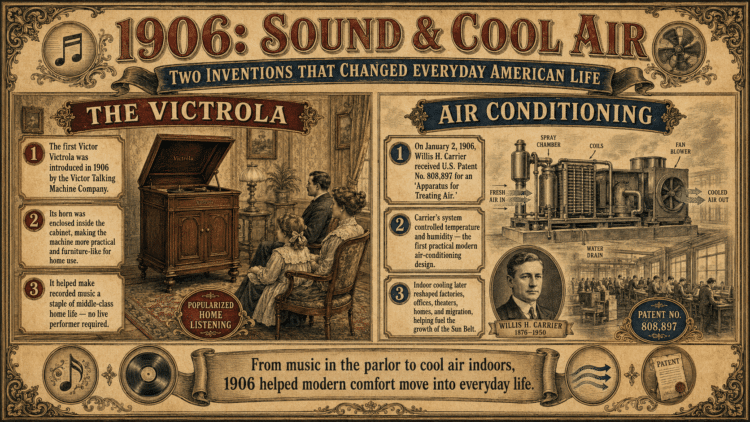
The first Victor Victrola phonograph player was manufactured in 1906, bringing recorded music into American homes for the first time at a price point middle-class families could afford. Music would never again require a live performer in the room.
Willis Carrier received U.S. Patent #808,897 on January 2, 1906, for the world’s first practical air conditioning system. He called it an “Apparatus for Treating Air.” The ability to cool indoor spaces would eventually reshape where Americans lived, worked, and moved — accelerating the growth of the Sun Belt by decades.
The world’s first animated cartoon — Humorous Phases of Funny Faces by J. Stuart Blackton — was copyrighted in 1906. Blackton drew faces on a blackboard and photographed them frame by frame, erasing and redrawing to create the illusion of movement.
The Story of the Kelly Gang, released in Australia in 1906, is widely recognized as the world’s first feature-length narrative film — running approximately 60–70 minutes and depicting the life of outlaw Ned Kelly. No complete copies survive.
The Wright Brothers’ patent (#821,393) for their “Flying Machine” — filed in 1903 — was finally granted on May 22, 1906. They had flown at Kitty Hawk three years earlier but had been largely ignored.
Finland became the first country in the world to grant women full political rights — both the right to vote and the right to run for office — in 1906. The following year, 19 women were elected to the Finnish Parliament.
Devil’s Tower in Wyoming was declared the first United States National Monument on September 24, 1906, by President Theodore Roosevelt under the Antiquities Act. It was the same Devil’s Tower that would feature in Close Encounters of the Third Kind seventy years later.
The Pure Food and Drug Act and the Meat Inspection Act were signed into law by President Roosevelt in 1906, directly inspired by the public outcry following the publication of The Jungle. For the first time, the federal government regulated what Americans ate and drank.
Kellogg’s was founded in 1906 by Will Keith Kellogg and Charles D. Bolin as the Battle Creek Toasted Corn Flake Company. They had been making health food for patients at a sanitarium. Cornflakes were the most boring possible beginning for what became one of the most recognized brands in the world.
The Dow Jones Industrial Average closed above 100 for the first time on January 12, 1906, at 100.26. It took 67 more years to close above 1,000.
SOS — three dots, three dashes, three dots — was adopted as the international distress signal at the International Radiotelegraph Conference in Berlin in 1906. It was chosen for its simplicity, not because it stands for anything. “Save Our Souls” was a backronym invented later.
The first French Grand Prix was held on a 64-mile circuit at Le Mans in 1906, inaugurating what would become the world’s most prestigious road racing event.
On December 24, 1906, Canadian-born inventor Reginald Fessenden made the first radio broadcast of voice and music from Brant Rock, Massachusetts. He played the violin and read from the Bible. Only operators on ships and military stations could hear it. Radio as a public medium was still 14 years away.
Alpha Phi Alpha — the first Black intercollegiate Greek-letter fraternity — was founded at Cornell University on December 4, 1906. Its seven founding members did so in the face of explicit racial exclusion from existing fraternities.
The Rolls-Royce Silver Ghost debuted in 1906 and is considered by many to be the finest automobile ever built. Its engine was so quiet that passengers could hear the clock ticking. It set the standard for luxury automobiles for a generation.
The Telharmonium — the world’s first music synthesizer — was demonstrated at Telharmonic Hall in New York on September 26, 1906. It weighed 200 tons and was the size of a small building. It transmitted music over telephone lines to restaurants and hotels. The technology was too expensive and impractical to survive. The concept did not die.
Winsor McCay’s comic strip Little Nemo in Slumberland debuted in American newspapers in 1906 — featuring extraordinary dream-sequence artwork that influenced animation, surrealism, and visual storytelling for generations.
President Roosevelt traveled to Panama in November 1906 to inspect the canal construction — becoming the first sitting U.S. president to leave American soil. He was photographed operating a giant steam shovel. He was delighted.
The permanent wave — or “perm” — for hair was introduced by Karl Nessler in London in October 1906. The process took 12 hours and used borax and cow urine. Women lined up for it anyway.
The hot fudge sundae was invented in 1906 by C.C. Brown at his ice cream shop on Hollywood Boulevard in Los Angeles. The term “filet mignon” appeared in print for the first time the same year, in an O. Henry short story.
Pop Culture Facts and History
America in 1906 was a nation in motion. Cities were swelling with immigrants — in 1907, the year after, 1.2 million people would arrive at Ellis Island alone. Ragtime was the music of the moment. Scott Joplin’s Maple Leaf Rag had been the biggest sheet music seller in American history. Jazz was beginning to stir in New Orleans. Vaudeville filled every theater in every city.
The phonograph was a new miracle. Most Americans had never heard recorded music before the Victrola appeared. The idea that you could hear a voice or instrument without a living performer present was genuinely astonishing. Enrico Caruso — the greatest operatic tenor of the era — was the first major recording star, and his phonograph records were sold in department stores across America.
Films existed but were barely recognizable as an art form. Movies in 1906 were short — five to ten minutes — and shown in nickelodeons, small storefronts where admission cost a nickel. There were no stars, no feature films, no Hollywood. The industry was centered in New York and New Jersey. The medium was considered a novelty for the lower classes. Within a decade, all of that would change completely.
Upton Sinclair published The Jungle in February 1906. He meant it as a socialist argument for workers’ rights — “I aimed at the public’s heart and by accident hit its stomach,” he later wrote. What actually outraged Americans was the description of what went into their food: rat droppings, diseased meat, and floor scrapings. Meat sales dropped by half. The Pure Food and Drug Act was passed within months. It was one of the most consequential unintended consequences in American publishing history.
The popular expression of the decade was “23 Skidoo!” — a phrase that could mean almost anything but generally signified “get out of here” or approval. Its exact origin is disputed. Everyone used it. Nobody can fully explain it.
Heroin, morphine, cocaine, and marijuana were all available over the counter at American pharmacies in 1906. Advertisers promoted heroin as a cough remedy. Bayer — the aspirin company — marketed it under the brand name “Heroin” as a non-addictive substitute for morphine. The Harrison Narcotics Tax Act, regulating these drugs, was still eight years away.
Only 18% of U.S. households had a full-time servant or domestic worker in 1906 — down from much higher rates in the 19th century, as industrial employment drew domestic workers to factories.
Barbershop quartets were among the most popular forms of entertainment in 1906. Sheet music — not recordings — was how most Americans consumed music. A family’s piano was their primary source of entertainment.
Dr. Alois Alzheimer presented his research on the disease that would bear his name at a medical conference in 1906. The audience asked zero questions — because they were eager to get to the next presentation about “compulsive pleasure seeking.” Auguste Deter, the patient whose case had inspired his research, was the first person ever diagnosed with Alzheimer’s Disease.
The Tragedy
In 1906, the Courrieres mining disaster in France killed over 1,000 miners when an underground fire caused a series of massive explosions — the worst mining disaster in European history.
The San Francisco Earthquake of April 18, 1906, killed approximately 3,000 people, destroyed 28,000 buildings, and left 300,000 homeless. In response to the looting that followed, Mayor Eugene Schmitz authorized troops to “kill any persons found engaging in looting or the commission of any other crime.” The city was rebuilt within a decade.
Nobel Prize Winners
Physics — J.J. Thomson
Chemistry — Henri Moissan
Medicine — Camillo Golgi and Santiago Ramón y Cajal
Literature — Giosuè Carducci
Peace — Theodore Roosevelt (for negotiating the peace treaty ending the Russo-Japanese War of 1905)
Economics — Prize not yet established (first awarded 1969)
Theodore Roosevelt remains the only sitting U.S. president to win the Nobel Peace Prize.
Popular and Best-Selling Books of 1906
Coniston — Winston Churchill (the American novelist, not the British politician)
Lady Baltimore — Owen Wister
The Fighting Chance — Robert W. Chambers
The House of a Thousand Candles — Meredith Nicholson
Jane Cable — George Barr McCutcheon
The Jungle — Upton Sinclair
The Awakening of Helena Ritchie — Margaret Deland
The Spoilers — Rex Beach The House of Mirth — Edith Wharton
The Wheel of Life — Ellen Glasgow
Also notable: White Fang by Jack London began serialization in Outing magazine in 1906.
Broadway in 1906
Notable 1906 Broadway productions included George Washington Jr. and 45 Minutes from Broadway — both by George M. Cohan, who was the dominant force in American popular theater. His song “You’re a Grand Old Flag” was the pop anthem of 1906.
Best Film Oscar Winner
The Academy Awards did not exist until 1929. There is no Oscar winner for 1906.
Top Movies of 1906
(All silent films — features did not yet exist in America. These are the most notable short films of the year.)
Humorous Phases of Funny Faces (first animated cartoon),
The Story of the Kelly Gang (Australia — first feature film)
Dream of a Rarebit Fiend
The 100-to-One Shot
Rescued by Rover
Most Popular Entertainment of 1906
Vaudeville, phonograph records, live music in saloons and dance halls, baseball, nickelodeon films, comic strips, dime novels, and the piano in the parlor.
The most famous American comic strip of 1906 was The Katzenjammer Kids, which had been running since 1897 and was still the longest-running comic strip in history. Little Nemo in Slumberland debuted this year. Buster Brown was in every newspaper in the country. Americans in 1906 followed comic strips the way later generations would follow television.
Most Popular Songs of 1906
(Popularity tracked by sheet music sales and phonograph recordings — no formal charts existed)
You’re a Grand Old Flag — George M. Cohan
Waltz Me Around Again Willie — Billy Murray
Anchors Aweigh — Alfred Hart Miles (debuted 1906)
Waiting at the Church — Billy Murray
Bedelia — Billy Murray
In My Merry Oldsmobile — Billy Murray
Harrigan — George M. Cohan
Everybody Works but Father — Billy Murray
Billy Murray was the dominant recording artist of the era — his baritone voice was perfectly suited to the acoustic recording technology of the time.
Sports Champions of 1906
World Series: Chicago White Sox (defeated crosstown rivals the Chicago Cubs 4–2 — the only all-Chicago World Series in history. The White Sox, nicknamed the “Hitless Wonders,” were massive underdogs against the heavily favored Cubs.)
Stanley Cup: Ottawa Hockey Club and Montreal Wanderers (shared)
U.S. Open Golf: Alex Smith
U.S. Open Tennis — Men: William Clothier | Women: Helen Homans
Wimbledon — Men: Laurence Doherty | Women: Dorothea Douglass
NCAA Football: Princeton
Kentucky Derby: Sir Huon
Boston Marathon: Tim Ford — 2:45:45
Sports Highlight: On September 5, 1906, Bradbury Robinson of St. Louis University threw the first legal forward pass in American football history — transforming a ground-based game into the aerial sport it would eventually become.
FAQ — 1906 History, Facts, and Trivia
Q: What was the biggest disaster of 1906?
A: The San Francisco Earthquake of April 18, 1906 — magnitude 7.8 — killed approximately 3,000 people, destroyed over 28,000 buildings, and left 300,000 homeless. It remains the deadliest natural disaster in California history.
Q: What invention from 1906 changed where Americans live?
A: The air conditioner — Willis Carrier received the patent for the world’s first practical air conditioning system in January 1906. Its eventual mass adoption reshaped American migration patterns, making the Sun Belt habitable and transforming where tens of millions of Americans chose to live.
Q: What book, published in 1906, changed the food safety law?
A: The Jungle by Upton Sinclair, published in February 1906. Sinclair intended to expose the exploitation of immigrant workers, but instead horrified the public with descriptions of contaminated meat. The Pure Food and Drug Act passed within months.
Q: What was the first animated cartoon? A: Humorous Phases of Funny Faces by J. Stuart Blackton, copyrighted in 1906 — the first film to show drawn figures actually moving through animation.
Q: Who was the most famous president of 1906?
A: Theodore Roosevelt — who won the Nobel Peace Prize for negotiating the end of the Russo-Japanese War, became the first president to leave U.S. soil while in office, established the first National Monument, and pushed through landmark food safety legislation. All in one year.
Q: What was daily life like in America in 1906?
A: Most Americans earned between $200 and $400 per year. Only 8% had a telephone, 14% had a bathtub, and only 8,000 cars existed in the entire country. Entertainment meant vaudeville, the piano, baseball, comic strips, and the neighborhood saloon. The phonograph was a new miracle. Movies were five-minute novelties shown in storefront nickelodeons.
Q: What was the most popular slang term of 1906?
A: “23 Skidoo!” — a phrase that meant something between “get out of here” and enthusiastic approval. Its exact origin remains disputed. Everyone used it. Nobody can fully explain it.
Q: What drugs were available at the pharmacy in 1906?
A: Heroin, morphine, cocaine, and marijuana were all sold over the counter at American pharmacies. Bayer marketed heroin as a non-addictive cough remedy. The laws regulating them were still nearly a decade away.
Q: What was the first National Monument?
A: Devil’s Tower in Wyoming was proclaimed the first U.S. National Monument by President Roosevelt on September 24, 1906, under the Antiquities Act.
Q: What sports milestone happened in 1906?
A: The first legal forward pass in American football was thrown by Bradbury Robinson of St. Louis University on September 5, 1906, beginning the transformation of football from a ground game to an aerial sport.
More 1906 History and Trivia Resources
Most Popular Baby Names (BabyCenter.com)
Popular and Notable Books (popculture.us)
Broadway Shows that opened in 1906
1906 Calendar, courtesy of Time and Date.com
1900 US Census Fast Facts
Fact Monster
1906 in Movies (according to IMDB)
Wikipedia 1906