1907 Trivia, Fun Facts, and Pop Culture History
Quick Facts from 1907
- World Changing Event: The Panic of 1907 was the first worldwide financial crisis of the twentieth century. It transformed a recession into a contraction that surpassed in severity only the Great Depression. It was also the crisis that finally convinced Congress that the United States needed a central bank — leading directly to the creation of the Federal Reserve System in 1913.
- Popular Songs: On the Road to Mandalay, School Days, and Harrigan
- Most Famous Americans: Theodore Roosevelt and J.P. Morgan, who single-handedly stopped a financial collapse
- U.S. Life Expectancy: Males 45.6 years; Females 49.9 years
- The Conversation: The Panic of 1907 — and whether one man, J.P. Morgan, should have the power to decide which banks lived and died
Top Ten Baby Names of 1907
Girls: Mary, Helen, Margaret, Anna, Ruth, Elizabeth, Florence, Ethel, Emma, Marie Boys: John, William, James, George, Robert, Charles, Joseph, Frank, Edward, Walter
The Stars
The Ziegfeld Follies opened in 1907. Florenz Ziegfeld’s spectacular annual revue of chorus girls, comedy, and spectacle became the defining glamour event of American theater for the next two decades. Enrico Caruso remained the most famous voice in the world. Nickelodeon film performers were still nameless.
The Quote
“This creature softened my heart of stone. She died, and with her died my last warm feelings for humanity.” — Joseph Stalin, at the funeral of his first wife Kato Svanidze, 1907. She had died of tuberculosis at age 22.
“On January 1, I shook hands with 8,510 people.” — Theodore Roosevelt, 1907, having set a world record he would hold for over 70 years
The Academy Awards, Time Magazine, Miss America
None existed in 1907.
We Lost in 1907
Edvard Grieg, Norwegian composer, died September 4, at the age of 64
Francis Thompson, English poet, died on November 13, at the age of 47
Jesús García — died November 7, age 26, driving a burning dynamite train away from his town (see The Hero section)
America in 1907 — The Context
Theodore Roosevelt was in the fifth year of his presidency, and the Progressive Era was reshaping American institutions. Antitrust suits, conservation policies, and labor regulations were changing the relationship between government and corporations. The country was prosperous — until October, when a copper speculator’s failed gamble set off a chain reaction that nearly brought the entire financial system to its knees.
The Panic of 1907 was the crisis that proved the United States could not function without a central bank. Without a central bank to address the Panic of 1907, financier J.P. Morgan locked a bunch of bankers in his library until they committed to a bailout. The image of private citizens deciding the fate of the national economy was precisely what convinced Congress to act.
The Panic of 1907
The panic was triggered by the failed attempt in October 1907 to corner the market in United Copper Company stock. When the bid failed, banks that had lent money to the cornering scheme suffered runs that later spread to affiliated banks and trusts, leading a week later to the downfall of the Knickerbocker Trust Company, New York City’s third-largest trust.
In October of that year, a cascade of bank runs rattled both Wall Street and Main Street. Within weeks, the stock market had lost nearly half its value. Clearinghouses partially suspended cash payments in 73 cities. Factories cut production 16%. The economy shrank.
J.P. Morgan — 70 years old, the most powerful private financier in American history — stepped in. At 70, he became a one-man de facto central bank, summoning bank leaders to his private library on Manhattan’s Madison Avenue. He ordered them to open their books, locked the doors, and refused to let anyone leave until they pledged millions to keep the system afloat. His intervention worked — barely.
His dramatic intervention restored short-term confidence. But it also exposed a troubling truth: The U.S. financial system rested not on public authority but on the will and judgment of a few powerful men. The aftermath was decisive. The frequency of crises and the severity of the 1907 panic added to concerns about the outsized role of J.P. Morgan and renewed the impetus for a national debate on reform. Senator Nelson Aldrich led the charge. In 1910, a secret meeting on Jekyll Island, Georgia — attended by bankers and Treasury officials — sketched the blueprint for what became the Federal Reserve. Congress passed the Federal Reserve Act in December 1913.
The Panic of 1907 created the institution that has managed the U.S. money supply ever since. Every Federal Reserve interest rate decision, every quantitative easing program, every financial crisis response of the last century traces back to one copper speculator’s failed gamble in October 1907.
The Hero
Jesús García was a 26-year-old railroad brakeman in Nacozari, Sonora, Mexico, on November 7, 1907. A train loaded with dynamite and other explosives caught fire while standing in the station. García boarded the burning locomotive and drove it six kilometers away from the town before the dynamite exploded, destroying the train and killing him. His action saved the entire town of Nacozari from destruction. He is honored as a national hero in Mexico. The town was renamed Nacozari de García in his honor. He is known as “El Héroe de Nacozari.”
Pop Culture Facts and History
UPS was founded in Seattle in August 1907 by 19-year-old Jim Casey and his friend Claude Ryan with a $100 loan. Casey borrowed the money from a friend. Their company, the American Messenger Company, initially delivered messages and parcels on foot and by bicycle. They had two bicycles and one telephone. The company was renamed United Parcel Service in 1919. It now delivers approximately 24 million packages per day.
Bakelite — the world’s first fully synthetic plastic — was invented in New York by Belgian chemist Leo Baekeland in 1907, who coined the term “plastics.” Baekeland had already sold his previous invention, a photographic paper called Velox, to Eastman Kodak for $1 million. He used the proceeds to fund a laboratory where he developed Bakelite. It could be molded into any shape and did not conduct electricity — making it ideal for electrical insulation, telephone handsets, radio casings, and thousands of other applications. The Plastic Age had begun.
The Plaza Hotel opened on October 1, 1907, at the corner of Fifth Avenue and 59th Street in Manhattan. The opening night rate was $2.50 per room — considered expensive at the time. Its guest list over the following decades would read like a catalog of the famous. Cary Grant, the Beatles, and F. Scott Fitzgerald all stayed there. Fitzgerald set scenes of The Great Gatsby at the Plaza. Eloise, the fictional girl who lived at the Plaza in the children’s book series, first appeared in 1955.
The first Ziegfeld Follies opened at the Jardin de Paris roof theater on July 8, 1907, produced by Florenz Ziegfeld Jr. as his “Follies of 1907.” Inspired by the Parisian Folies Bergère, it featured beautiful chorus girls, elaborate costumes, comedy sketches, and musical numbers. It ran annually until 1931 and at various points featured W.C. Fields, Will Rogers, Fanny Brice, Eddie Cantor, Bert Williams, and a young Bob Hope. It was the most spectacular entertainment in America for two decades.
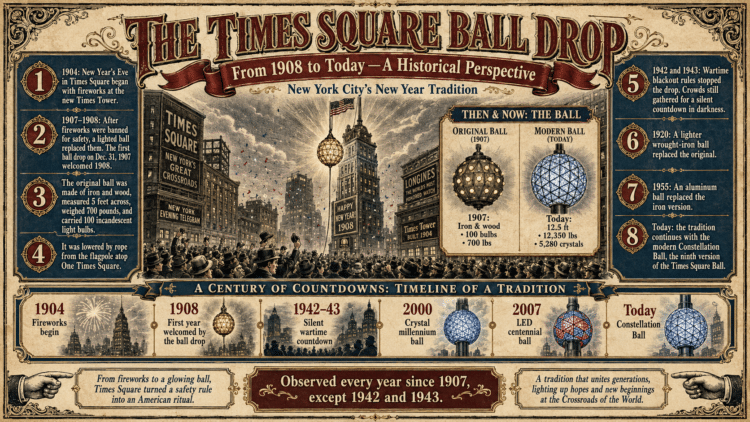
The ball drop on New Year’s Eve in Times Square — which had started on December 31, 1904, with fireworks — was replaced by a lighted ball on December 31, 1907, when the city banned fireworks due to safety concerns. The original ball was made of iron and wood, decorated with 100 incandescent light bulbs, and weighed 700 pounds. It was lowered by rope from the flagpole atop One Times Square. The tradition has been observed every year since, except 1942 and 1943, when wartime blackout restrictions required a silent countdown in darkness.
The Monongah Mining Disaster in West Virginia on December 6, 1907, killed 362 miners — the deadliest mining disaster in American history. The explosion in Monongah Coal Mine Nos. 6 and 8 left approximately 1,000 children fatherless. Grace Clayton, a Monongah resident who had lost her own father in the disaster, proposed a day to honor fathers. Her suggestion eventually led to the establishment of Father’s Day as a national holiday.
Scott Paper Company introduced paper towels in 1907 — initially for use in public bathrooms as a sanitary alternative to shared cloth towels. Kitchen paper towels came later, in 1931, when Sani-Towels were marketed for home use.
The first trial to be called the “Trial of the Century” was the 1907 murder trial of Harry K. Thaw for the shooting of Stanford White at Madison Square Garden in 1906. White, the celebrated architect, had been shot by Thaw on the rooftop of the building he himself had designed. The motive was Thaw’s obsession with White’s past affair with his wife Evelyn Nesbit. The trial was the first major media circus in American legal history — covered breathlessly by every newspaper in the country. Thaw was found not guilty by reason of insanity.
Harry Thaw was confined to the Matteawan State Hospital for the Criminally Insane. He escaped in 1913 by driving across the border to Canada, was extradited, declared sane, and released in 1915. He was committed again in 1916 after assaulting a teenager. He was released permanently in 1924. He outlived Stanford White, his victim, by 41 years.
Annette Kellerman — Australian swimmer and entertainer — was arrested at Revere Beach in Massachusetts in 1907 for wearing a one-piece bathing suit. The standard women’s bathing costume of the era covered from neck to ankle. Kellerman’s one-piece was considered indecent. She was undeterred, promoted the one-piece swimsuit throughout her career, and is largely credited with permanently changing women’s swimwear. She was also the first major actress to appear nude in a Hollywood film — Daughter of the Gods in 1916.
Joseph Stalin organized the Tiflis bank robbery on June 26, 1907, in what is now Tbilisi, Georgia — the most successful fundraising operation of the Bolshevik party to that point. A convoy of stagecoaches carrying money for the Imperial Bank was attacked in Yerevan Square with bombs and gunfire, killing approximately 40 people and wounding 50 others. Stalin had organized the operation; Maxim Litvinov — later Soviet Foreign Minister — was arrested in Paris trying to exchange some of the stolen banknotes. The theft netted approximately 250,000 rubles, equivalent to roughly $3.4 million today.
The Irish Crown Jewels — comprising a diamond star belonging to the Order of St. Patrick and several other royal jewels — were stolen from Dublin Castle in June or July 1907, days before King Edward VII was scheduled to visit Ireland. The crime was never solved, and the jewels were never recovered. The theft remains one of the greatest unsolved jewel heists in history.
From 1907 to 1922, American women who married foreign nationals automatically lost their U.S. citizenship under the Expatriation Act of 1907. The law applied regardless of where the couple lived. It was repealed by the Cable Act of 1922.
The word “blurb” was coined in 1907 by American humorist Gelett Burgess — the same man who had written, “I never saw a purple cow.” He created a mock book jacket for a parody book featuring a fictional woman named “Miss Blinda Blurb,” describing the cover blurb text as “blurb.” Publishers immediately adopted the word.
Rudyard Kipling won the Nobel Prize in Literature in 1907, becoming the first English-language writer to receive the honor. He was 41 — still the youngest person to win the Nobel Prize in Literature.
The Ringling Brothers circus purchased Barnum & Bailey in 1907, creating the largest circus organization in American history. The combined show eventually became Ringling Bros. and Barnum & Bailey — “The Greatest Show on Earth” — and toured America for over a century before closing in 2017.
Researcher George Soper published his investigation identifying Mary Mallon — “Typhoid Mary” — as the likely source of multiple typhoid outbreaks in New York. Mallon had been released from her first isolation in 1910 on the condition she stop working as a cook; she changed her name and immediately resumed cooking. She was apprehended again in 1915 and held in isolation for the rest of her life.
The Huia bird of New Zealand went extinct in 1907 due to hunting and habitat loss. Its song exists today because in 1949, an elderly Maori man named Henare Hamana sang what he remembered hearing as a child. The recording is the only surviving evidence of what the Huia sounded like.
Polio had existed throughout human history, but was rare. In 1907, an outbreak in New York State saw 2,700 cases — the first significant American epidemic. The disease would continue growing in severity until the Salk vaccine in 1955.
The AA battery was invented in 1907. The standardized designation came later, but the cell size was introduced this year.
The Panic of 1907 had an unlikely Canadian dimension: the earthquake and fire in San Francisco in 1906 had drawn enormous quantities of gold out of global financial centers to pay insurance claims, creating a liquidity shortage that made the U.S. economy vulnerable to exactly the kind of speculative shock that hit in October 1907.
Nobel Prize Winners
Physics — Albert Abraham Michelson (first American to win the Nobel Prize in Physics — for precision optical instruments and spectroscopic and metrological investigations)
Chemistry — Eduard Buchner (for his discovery of cell-free fermentation)
Medicine — Charles Louis Alphonse Laveran (for work on the role of protozoa in causing diseases)
Literature — Rudyard Kipling (author of The Jungle Book and Kim — first English-language Nobel laureate in Literature)
Peace — Ernesto Moneta and Louis Renault
Economics — Prize not yet established
Popular and Best-Selling Books of 1907
The Lady of the Decoration — Frances Little
The Weavers — Gilbert Parker
The Shuttle — Frances Hodgson Burnett
Satan Sanderson — Hallie Erminie Rives
Also notable: Pragmatism by William James — one of the most important philosophical works in American intellectual history, arguing that the truth of an idea is determined by its practical consequences.
Broadway in 1907
The first Ziegfeld Follies opened July 8, 1907, at the Jardin de Paris roof theater — establishing an annual spectacle that would define Broadway glamour for two decades.
The Merry Widow by Franz Lehár opened on October 21, 1907, becoming one of the biggest musical hits of the decade and inspiring a worldwide fashion craze for the “Merry Widow hat.”
Top Films of 1907
(Still short films — feature-length narrative was still two to three years away)
Ben-Hur — Kalem Company (first silent film version of the story — made without the novel’s author’s permission; the resulting lawsuit established that film adaptations required copyright clearance)
The Adventures of Dollie — Biograph Company (D.W. Griffith’s first directorial effort)
Rescued from an Eagle’s Nest — Edison Manufacturing (early chase film)
Most Popular Entertainment of 1907
Vaudeville and nickelodeons competed for American leisure time. The Ziegfeld Follies debuted.
Baseball remained the national pastime.
The phonograph was standard in middle-class homes.
1907 Most Popular Songs
On the Road to Mandalay — Haydn Quartet
School Days — Byron Harlan and Arthur Collins
Harrigan — Billy Murray (from George M. Cohan’s 45 Minutes from Broadway)
Honey Boy — Billy Murray
The Grand Old Rag — Billy Murray (later renamed “You’re a Grand Old Flag”)
Glow Worm — Arthur Pryor’s Band
Bedelia — Billy Murray
Sports Champions of 1907
World Series: Chicago Cubs (swept Detroit Tigers 4-0 with one tie — the last Cubs World Series title for 108 years, until 2016)
Stanley Cup: Kenora Thistles and Montreal Wanderers (shared)
U.S. Open Golf: Alec Ross
U.S. Open Tennis — Men: William Larned | Women: Evelyn Sears
Wimbledon — Men: Norman Brookes | Women: May Sutton
NCAA Football: Yale
Kentucky Derby: Pink Star
Boston Marathon: Tom Longboat — 2:24:24
Sports Highlight: The Chicago Cubs won the World Series in 1907, sweeping the Detroit Tigers — the second of back-to-back World Series titles. It was the last Cubs championship for 108 years. Tom Longboat, a Canadian Onondaga runner, won the Boston Marathon in 2:24:24 — shattering the course record by nearly five minutes. He was celebrated as the greatest distance runner in the world, then subjected to years of racial discrimination and exploitation by the athletic establishment.
FAQs: 1907 History, Facts, and Trivia
Q: What was the Panic of 1907?
A: A financial crisis triggered in October 1907 when a failed attempt to corner the copper market caused bank runs across New York City, spreading nationally. The stock market lost nearly half its value. J.P. Morgan personally organized a private bailout, locking bankers in his library until they pledged millions to stabilize the system. The crisis directly led to the creation of the Federal Reserve System in 1913.
Q: How did J.P. Morgan stop the Panic of 1907?
A: Morgan summoned the leading bankers of New York to his private library on Madison Avenue, ordered them to open their books, locked the doors, and refused to let anyone leave until they pledged enough money to shore up failing institutions. At 70 years old, he became a one-man central bank. His intervention worked, but alarmed the country; the idea that one private citizen had that much power over the national economy was exactly what drove the creation of the Federal Reserve.
Q: What company started in 1907 still delivers your packages?
A: UPS — founded as the American Messenger Company in Seattle by 19-year-old Jim Casey with a $100 loan, two bicycles, and one telephone. It is now one of the world’s largest package delivery companies.
Q: What invention from 1907 changed the material world?
A: Bakelite — the first fully synthetic plastic, invented by Leo Baekeland in New York in 1907. It could be molded into any shape and did not conduct electricity. Every plastic object in the modern world traces its lineage to this discovery.
Q: What famous New Year’s Eve tradition started in 1907?
A: The Times Square ball drop — the lighted ball replacing fireworks on December 31, 1907. The original ball was made of iron and wood, with 100 light bulbs, and was lowered by a rope. It has dropped every year since, except 1942 and 1943, during wartime blackouts.
Q: Who was Jesús García?
A: A 26-year-old Mexican railroad brakeman who drove a burning train loaded with dynamite away from the town of Nacozari, Sonora, on November 7, 1907, before it exploded, killing him but saving the entire town. He is a national hero in Mexico; the town was renamed in his honor.
Q: What disaster inspired Father’s Day?
A: The Monongah Mining Disaster on December 6, 1907, the deadliest mining accident in American history, killed 362 miners and left approximately 1,000 children fatherless in West Virginia. In response, a local woman, Grace Clayton, proposed a day to honor fathers.
Q: What 1907 trial was called the “Trial of the Century”?
A: The murder trial of Harry K. Thaw for shooting architect Stanford White at Madison Square Garden in 1906. It was the first American trial to receive wall-to-wall media coverage and the first to be dubbed the “Trial of the Century” — a title that has been applied to roughly one major trial per decade ever since.
Q: What famous literary prize was established in 1907?
A: The Nobel Prize in Literature went to Rudyard Kipling in 1907, making him the first English-language writer to receive it, at age 41, still the youngest Nobel laureate in Literature.
Q: What swimwear pioneer was arrested in 1907?
A: Annette Kellerman, the Australian swimmer, was arrested at a Massachusetts beach for wearing a one-piece bathing suit. Standard women’s swimwear covered the entire body. Her promotion of the one-piece is largely credited with permanently changing women’s swimwear.
More 1907 History Resources
Most Popular Baby Names (BabyCenter.com)
Popular and Notable Books (popculture.us)
Broadway Shows that Opened in 1907
1907 Calendar, courtesy of Time and Date.com
Fact Monster
1907 in Movies (according to IMDB)
Wikipedia 1907