1925 History, Facts, and Trivia
Quick Facts from 1925
- World-Changing Event: Willis Carrier installed the first commercial air-conditioning system at the Rivoli Theater in Times Square during the summer of 1925, introducing the concept of cooling public spaces and inadvertently inventing the summer-blockbuster audience.
- World Communications-Changing Event: Calvin Coolidge’s presidential inauguration on March 4, 1925, was the first to be broadcast nationally on radio, reaching an estimated 23 million listeners across more than 20 stations.
- Top Songs: Sweet Georgia Brown by various artists and Tea for Two by Marion Harris.
- Must-See Movies: The Gold Rush, Ben-Hur: A Tale of the Christ, The Phantom of the Opera, The Big Parade, and Battleship Potemkin.
- The Most Famous Person in America: Charlie Chaplin.
- Notable Books: The Great Gatsby by F. Scott Fitzgerald.
- Brownie “Gift Box” Camera: $5.00; 1 oz. gold: $20.67 (unchanged since 1879).
- The Funny Guy: Charlie Chaplin.
- Chinese Zodiac: Year of the Ox, associated with diligence, honesty, and a stubborn refusal to be hurried.
- The Conversation: Have you read The Great Gatsby yet? Fitzgerald just published it. It’s about the Jazz Age. We’re living in the Jazz Age.
Top Ten Baby Names of 1925
Girls: Mary, Dorothy, Betty, Helen, Margaret
Boys: Robert, John, William, James, Charles
U.S. Life Expectancy in 1925
Males: 57.6 years; Females: 60.6 years
The Stars
Josephine Baker, Mary Pickford, Anna May Wong
The Quotes
“The business of America is business.” — Calvin Coolidge, January 1925, in a speech to the American Society of Newspaper Editors. It remains one of the most quoted and debated presidential statements of the 20th century.
Miss America
Fay Lanphier, Oakland, CA
We Lost in 1925
Sergei Yesenin, the celebrated Russian lyric poet, died December 28, 1925, in his room at the Hotel Angleterre in St. Petersburg, having taken his own life at age 30. He left a final poem written in his own blood, because no pen was available:
Goodbye, my friend, goodbye. Farewell, my good friend, farewell. In my heart, forever, you’ll stay. May the fated parting foretell that again we’ll meet up someday. Let no words, no handshakes ensue, No saddened brows in remorse, To die, in this life, is not new, And living’s no newer, of course.
Sun Yat-sen, the founding father of the Republic of China and the first president of the Chinese Nationalist Party, died on March 12, 1925, at age 58.
America in 1925 — The Context
The Roaring Twenties were at full roar. The economy was booming, automobile ownership was spreading rapidly, jazz filled the clubs and the radio, and the decade’s defining mood — part optimism, part recklessness, all forward motion — showed no signs of slowing. Prohibition was the law of the land, which meant speakeasies were the entertainment of choice. Flappers were redefining what women wore, how they moved, and what they were allowed to want. The stock market was rising. The crash was four years away, and nobody saw it coming.
Beneath the prosperity, the decade had a darker current. The Ku Klux Klan had swelled to an estimated 4 to 5 million members by 1925, with significant influence in Northern states as well as the South. Mussolini was consolidating fascist power in Italy. Hitler had published his manifesto. The world was celebrating, and warning signs were accumulating.
The Great Gatsby
F. Scott Fitzgerald published The Great Gatsby on April 10, 1925. Initial sales were modest and reviews mixed. Fitzgerald was disappointed. The novel sold roughly 20,000 copies in its first year — far below his expectations. It was not until after his death, when the U.S. Army distributed free copies to soldiers during World War II, that it found its massive audience. It is now considered one of the greatest American novels ever written and has never gone out of print.
Fitzgerald coined the term “the Jazz Age” to describe the era he was living through and capturing in fiction. He was 28 when Gatsby was published.
The Serum Run to Nome
In January 1925, a diphtheria epidemic broke out in Nome, Alaska. The nearest supply of antitoxin was in Anchorage — nearly 1,000 miles away, in the middle of winter. Railroad could get the serum to Nenana. From there, 20 mushers and 150 sled dogs ran a 674-mile relay through blizzard conditions and temperatures that dropped to minus 50 degrees Fahrenheit.
The final leg was run by musher Gunnar Kaasen, led by his dog Balto, who arrived in Nome on February 2, 1925. A statue of Balto stands in Central Park in New York City. What is less often noted is that another dog, Togo, led musher Leonhard Seppala through the most dangerous stretch of the run — 264 miles across open sea ice in a storm — and covered more total distance than any other dog in the relay. Balto got the statue. Togo got the better historical footnote.
The run is commemorated annually in the Iditarod Trail Sled Dog Race.
The Scopes Trial
In March 1925, Tennessee passed the Butler Act, making it illegal to teach evolution in public schools. John T. Scopes, a substitute biology teacher in Dayton, Tennessee, agreed to test the law by teaching evolution from the school’s state-approved textbook — the same textbook every biology teacher in the state was using. He was arrested, tried, and found guilty in July 1925. The verdict was later overturned on a technicality. The law remained on the books until 1967.
The trial drew national attention in part because of the opposing attorneys: three-time presidential candidate William Jennings Bryan for the prosecution and celebrated defense lawyer Clarence Darrow for the defense. H.L. Mencken covered it for the Baltimore Sun and did not hide his opinion of the proceedings. The Scopes Trial established the template for American culture-war courtroom drama that has been reused many times since.
The Tri-State Tornado
The deadliest tornado in American history struck Missouri, Illinois, and Indiana on March 18, 1925. The Tri-State Tornado traveled 219 miles on the ground — the longest continuous tornado track ever recorded — at speeds up to 73 miles per hour. It killed 695 people and injured 2,027 more. The town of Murphysboro, Illinois, lost 234 residents, the most of any single community in a U.S. tornado. The storm lasted 3.5 hours.
The KKK March on Washington
On August 8, 1925, an estimated 30,000 to 40,000 Ku Klux Klan members marched down Pennsylvania Avenue in Washington, D.C., in full regalia. The march was intended as a show of national political power during a period of peak Klan membership. Within two years, a series of financial and criminal scandals — most notably the conviction of Indiana Grand Dragon D.C. Stephenson for murder — had collapsed the organization’s membership and credibility almost completely.
Pop Culture Facts and History
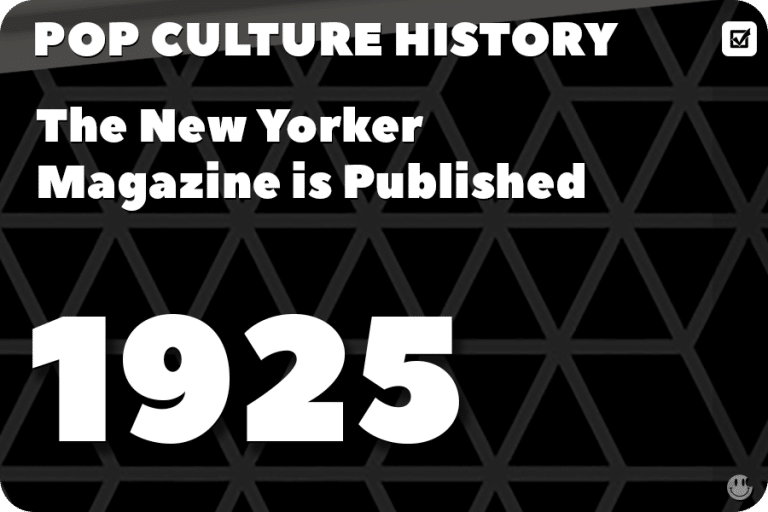
The New Yorker published its first issue on February 21, 1925, with a cover price of 15 cents. Editor Harold Ross had a specific target reader in mind: the sophisticated, urbane New Yorker who was not, as he put it, “the little old lady in Dubuque.” The magazine has been in continuous publication ever since.
The world’s first motel opened in 1925: the Milestone Mo-Tel in San Luis Obispo, California, built by Arthur Heineman. San Luis Obispo sits roughly halfway between Los Angeles and San Francisco — a two-day drive in 1925 — making it a natural overnight stop for early motorists. The word “motel,” a portmanteau of “motor” and “hotel,” was coined for the occasion.
Sears opened its first physical retail store in 1925, after 19 years of operating exclusively as a mail-order catalog business. The catalog had been transformative for rural Americans who had no access to city stores. The physical stores served a different customer: the growing urban and suburban population.
The Grand Ole Opry debuted on November 28, 1925, as a one-hour radio “barn dance” on WSM in Nashville, Tennessee. It was called the WSM Barn Dance until 1927, when announcer George Hay renamed it the Grand Ole Opry after it aired following NBC’s “Grand Opera.” It has been on the air every week since.
Sweet Georgia Brown was written in 1925 by Ben Bernie, Maceo Pinkard, and Kenneth Casey. It became a jazz standard and is best known today as the theme song of the Harlem Globetrotters, a connection that began in 1952.
Cecilia Payne-Gaposchkin, a 25-year-old British-American astronomer at Harvard, published her doctoral thesis in 1925, concluding that hydrogen and helium were by far the most abundant elements in stars, and therefore in the universe. Her committee urged her to soften the conclusion, calling it “clearly impossible.” She noted the objection in her thesis and left the finding intact. She was right. It took the scientific community several more years to agree.
The Art Deco movement came to international prominence in 1925 through the Exposition Internationale des Arts Decoratifs et Industriels Modernes in Paris — the exhibition that gave the style its name. Its influence on architecture, fashion, graphic design, and product design dominated the following decade.
The Harlem Renaissance — the flowering of Black American art, literature, music, and intellectual life centered in Harlem, New York — was at its height in 1925. Langston Hughes, Zora Neale Hurston, Countee Cullen, and others were producing work that would permanently shape American culture. The movement had grown directly from the Great Migration of Black Americans from the South to Northern cities in the previous decade.
The Federal Arbitration Act was passed in 1925 to help merchants resolve commercial disputes quickly before goods spoiled. It is now the reason most consumer contracts require arbitration rather than lawsuits — one of the more consequential unintended legacies of Depression-era commercial law.
Pete the Bear is Disney’s oldest recurring character, having debuted in the 1925 cartoon Alice Solves the Puzzle, three years before Mickey Mouse. He is still occasionally appearing in Disney properties today.
Ford introduced its first pickup truck in 1925: the Model T Runabout with Pickup Body. It was essentially a Model T with the rear seat removed and a small flat bed attached. The American truck industry had found its form.
Walter Chrysler founded the Chrysler Corporation in 1925, challenging Ford and General Motors in the American automobile market. Within three years, it was the third-largest automaker in the country.
The U.S. government began stockpiling helium in Amarillo, Texas, in 1925, accumulating reserves of roughly 1 billion cubic meters. The stockpile originated from post-World War I concerns about a shortage of helium for military airship use. The reserve was eventually sold off beginning in the 1990s, a decision that physicists and MRI technicians have been discussing ruefully ever since.
As a joke, senior engineers at General Electric assigned a new hire named Marvin Pipkin to the supposedly impossible task of frosting the inside of a lightbulb. Pipkin did not know it was considered impossible. He invented the frosted lightbulb in 1925. It became standard.
Until 1925, the Bill of Rights applied only to the federal government. State and local governments were not bound by it. The Supreme Court’s 1925 decision in Gitlow v. New York began the process of “incorporation,” extending First Amendment protections to the states. The full incorporation of the Bill of Rights into the states took decades of subsequent case law to complete.
George Bernard Shaw is the only person in history to have won both a Nobel Prize and an Academy Award. He won the Nobel Prize for Literature in 1925 and the Oscar for Best Adapted Screenplay for Pygmalion in 1938. He initially tried to refuse the Oscar.
Charles Gates Dawes, the 30th Vice President of the United States, shared the Nobel Peace Prize in 1925 for the Dawes Plan, which restructured German war reparations after World War I. He was also a self-taught pianist and composer who had written Melody in A Major in 1912. Tommy Edwards set it to lyrics and took it to #1 with “It’s All in the Game” in 1958. A sitting Vice President had a #1 pop hit 33 years later!
The first two female governors in American history were inaugurated within 15 days of each other in January 1925: Nellie Tayloe Ross of Wyoming on January 5, and Miriam “Ma” Ferguson of Texas on January 20.
Wearing a fez was banned in Turkey in 1925 by President Ataturk as part of his modernization campaign, which sought to replace Ottoman-era dress and customs with Western equivalents. The ban remains in effect.
A total solar eclipse on January 24, 1925, had its path of totality graze Manhattan. Residents below 96th Street could still see a partial sun; those above 96th Street experienced total darkness. The dividing line ran directly through the middle of the city.
Mount Rushmore’s groundbreaking is sometimes cited as 1925, as sculptor Gutzon Borglum had been involved in site surveys and planning since 1924. The actual groundbreaking ceremony took place on October 4, 1927.
The Suicide Poem
Russian poet Sergei Yesenin died December 28, 1925, at age 30, leaving a final poem written in his own blood in his hotel room in St. Petersburg, as no ink was available. The poem, Goodbye, My Friend, is among the most haunting final works in literary history. He was one of the most celebrated lyric poets of his generation.
Nobel Prize Winners
Physics — James Franck and Gustav Ludwig Hertz — for the discovery of the laws governing the impact of electrons on atoms, work that provided experimental confirmation of Niels Bohr’s quantum theory Chemistry — Richard Adolf Zsigmondy — for demonstrating the heterogeneous nature of colloid solutions and developing the ultramicroscope Medicine — not awarded in 1925 Literature — George Bernard Shaw — the only person to also win an Academy Award; Shaw initially attempted to decline the prize Peace — Austen Chamberlain and Charles Gates Dawes — for negotiating the Locarno Treaties and the Dawes Plan respectively; Dawes was simultaneously serving as U.S. Vice President
Broadway in 1925
No No Nanette opened September 16, 1925, at the Globe Theatre and ran for 321 performances. Its songs “Tea for Two” and “I Want to Be Happy” became jazz standards. The show’s out-of-town tryout costs were partly financed by the sale of Babe Ruth’s contract from the Red Sox to the Yankees in 1920 — an indirect connection that Red Sox fans have never found amusing.
The Garrick Gaieties opened in 1925, introducing the young songwriting team of Richard Rodgers and Lorenz Hart to Broadway audiences for the first time.
Top Movies of 1925
- The Big Parade
- Ben-Hur: A Tale of the Christ
- The Phantom of the Opera
- The Gold Rush
- The Unholy Three
- Battleship Potemkin
- The Lost World
- His People
- The Freshman
- Don Q, Son of Zorro
Popular and Best-Selling Books of 1925
Arrowsmith — Sinclair Lewis
The Carolinian — Rafael Sabatini
The Constant Nymph — Margaret Kennedy
Glorious Apollo — E. Barrington
The Great Gatsby — F. Scott Fitzgerald
The Green Hat — Michael Arlen
The Keeper of the Bees — Gene Stratton-Porter
The Little French Girl — Anne Douglas Sedgwick
The Mark of Zorro — Johnston McCulley
One Increasing Purpose — A.S.M. Hutchinson
The Perennial Bachelor — Anne Parrish
Soundings — A. Hamilton Gibbs
The Weary Blues — Langston Hughes
Biggest Pop Artists of 1925
Gene Austin, The Benson Orchestra of Chicago, Ben Bernie and His Orchestra, Eddie Cantor, Vernon Dalhart, Cliff Edwards, Carl Fenton and His Orchestra, Ernest Hare, Marion Harris, Lewis James, Al Jolson, Billy Jones, Isham Jones and His Orchestra, Ted Lewis and His Band, Vincent Lopez and His Orchestra, Nick Lucas, John McCormack, Billy Murray, Blossom Seeley, Bessie Smith, Aileen Stanley, Fred Waring’s Pennsylvanians, Paul Whiteman and His Orchestra
Sports Champions of 1925
World Series: Pittsburgh Pirates — defeated the Washington Senators 4-3; the Pirates became the first team to win a World Series after trailing 3 games to 1
Stanley Cup: Victoria Cougars — the last non-NHL team to win the Stanley Cup before the league consolidated control of the championship
U.S. Open Golf: W. MacFarlane
U.S. Open Tennis: Men/Women: Bill Tilden / Helen Wills
Wimbledon: Men/Women: Rene Lacoste / Suzanne Lenglen
NCAA Football Champions: Alabama and Dartmouth (co-champions)
Kentucky Derby: Flying Ebony
Boston Marathon: Charles Mellor, 2:33:00
Sports Highlight: Suzanne Lenglen of France won Wimbledon without losing a single set, a level of dominance that made her the most celebrated female athlete in the world. Bill Tilden won the U.S. Open for the sixth consecutive year, a streak of dominance in men’s tennis that has never been approached. The Pittsburgh Pirates’ World Series comeback from 3-1 down against the Senators was the first in Series history.
FAQ — 1925 Trivia, Fun Facts and Pop Culture History
Q: What was the World-Changing Event of 1925?
A: Willis Carrier installed the first commercial air conditioning system in the Rivoli Theater in Times Square during the summer of 1925. The ability to cool public spaces transformed architecture, city planning, productivity, and, eventually, where Americans chose to live — accelerating population growth in hot-weather states in a way no one anticipated.
Q: What novel published in 1925 is considered one of the greatest American books ever written?
A: The Great Gatsby by F. Scott Fitzgerald, published April 10, 1925. It sold modestly at first and did not find its massive audience until the U.S. Army distributed free copies to soldiers in World War II. It has never gone out of print since.
Q: What was the Serum Run to Nome?
A: In January 1925, 20 mushers and 150 sled dogs relayed diphtheria antitoxin 674 miles across Alaska in blizzard conditions to reach Nome before an epidemic could spread. Musher Gunnar Kaasen and his lead dog, Balto, completed the final leg. The run is commemorated annually in the Iditarod race.
Q: What was the Scopes Trial?
A: In July 1925, substitute teacher John Scopes was tried in Dayton, Tennessee, for teaching evolution in a public school, as taught in the state-approved textbook. He was found guilty and fined $100. The verdict was later thrown out on a technicality. The law banning the teaching of evolution remained on Tennessee’s books until 1967.
Q: What publication debuted in 1925 that is still considered the gold standard of American magazine journalism?
A: The New Yorker, which published its first issue on February 21, 1925. It was founded by Harold Ross and has been in continuous publication ever since.
Q: Who is the only person to have won both a Nobel Prize and an Academy Award?
A: George Bernard Shaw, who won the Nobel Prize for Literature in 1925 and the Oscar for Best Adapted Screenplay for Pygmalion in 1938. He tried to refuse both.
Q: What was the deadliest tornado in American history, and when did it occur?
A: The Tri-State Tornado of March 18, 1925, which traveled 219 miles across Missouri, Illinois, and Indiana, killing 695 people. It remains the deadliest and longest-tracked tornado in U.S. history.
Q: What dog is most famous for the 1925 Serum Run, and which dog actually did the most work?
A: Balto received the statue in Central Park and most of the public credit, as he led the final leg into Nome. Togo, led by musher Leonhard Seppala, covered the longest and most dangerous stretch of the relay — 264 miles across open sea ice — and logged more total miles than any other dog on the run.
More 1925 Facts & History Resources:
Most Popular Baby Names (BabyCenter.com)
Popular and Notable Books (popculture.us)
Broadway Shows that Opened in 1925
1925 Calendar, courtesy of Time and Date.com
Fact Monster
1920s Fads (BabyCenter.com)
1920s, Infoplease.com World History
1925 in Movies (according to IMDB)
Retrowaste Vintage Culture
1920s Slang
Wikipedia 1925