1912 History, Facts, and Trivia
Quick Facts from 1912
- World-Changing Event: The RMS Titanic struck an iceberg on the night of April 14, 1912, and sank in the early hours of April 15, killing more than 1,500 of the 2,240 people on board — the deadliest peacetime maritime disaster in history, and the one that permanently changed how the world thinks about the word “unsinkable.”
- Top Songs: Alexander’s Ragtime Band by Arthur Collins and Byron G. Harlan, Moonlight Bay by the Haydn Quartet, and Waiting for the Robert E. Lee by the Peerless Quartet
- Must-See Movies: The Musketeers of Pig Alley (D.W. Griffith), From the Manger to the Cross, and the first dramatic Titanic film, released 29 days after the sinking
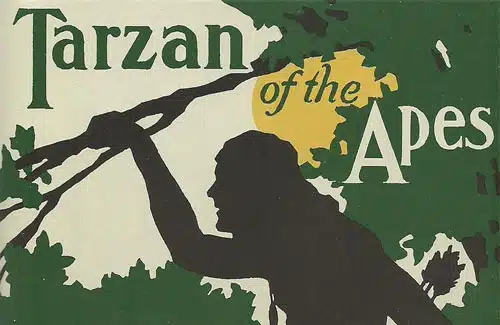
- Notable Books: Tarzan of the Apes by Edgar Rice Burroughs and The Montessori Method by Maria Montessori
- Chinese Zodiac: Year of the Rat, associated with intelligence, adaptability, and a talent for survival
- The Conversation: Did you hear about the Titanic? They said it couldn’t sink.
Top Ten Baby Names of 1912
Girls: Mary, Helen, Dorothy, Margaret, Ruth Boys: John, William, James, Robert, Joseph
U.S. Life Expectancy in 1912
Males: 51.5 years; Females: 55.9 years
We Lost in 1912
August Strindberg — Swedish playwright, novelist, and one of the founders of modern drama, died May 14, 1912, at age 63.
Lawrence Oates — British Army officer and Antarctic explorer, walked out of the expedition tent into a blizzard on March 17, 1912, saying “I am just going outside and may be some time.” He did not return. He was attempting to spare his companions the burden of caring for him after frostbite made him unable to continue. He was 32.
Born in 1912
Jim Thorpe won two Olympic gold medals in 1912. The North Korean calendar begins with Kim Il-sung’s birth year of 1912. And on a lighter note, the United States gained two states — New Mexico in January and Arizona in February — completing the contiguous 48.
America in 1912 — The Context
William Howard Taft was president, but barely. Theodore Roosevelt, dissatisfied with his chosen successor, ran against him on the Progressive “Bull Moose” Party ticket, splitting the Republican vote in one of the most dramatic elections in American history. Four candidates appeared on the ballot: Taft (Republican), Roosevelt (Progressive), Woodrow Wilson (Democrat), and Eugene V. Debs (Socialist). Wilson won with just 41.8% of the popular vote, one of the lowest winning percentages in presidential history, because Taft and Roosevelt together took 50% of the vote. Roosevelt finished second. A sitting president finished third. Debs received over 900,000 votes as a Socialist candidate, a result that has not been approached since.
The country was in the middle of an immigration wave unlike anything before or since. Ellis Island processed over a million arrivals in 1907 alone, and the communities forming in American cities were transforming the country’s culture, cuisine, language, and politics in ways that would take decades to fully absorb.
The Titanic
The RMS Titanic was the largest ship in the world when it departed Southampton, England, on its maiden voyage to New York on April 10, 1912. She carried 2,240 passengers and crew. She was described by her builders as “practically unsinkable” — a phrase that was not quite the same as “unsinkable,” though newspapers and public conversation generally dropped the qualifier.
At 11:40 p.m. on April 14, 1912, lookout Frederick Fleet spotted an iceberg dead ahead and rang the warning bell. The order was given to turn hard to port. The ship could not turn quickly enough. The iceberg scraped along the starboard side, buckling steel plates and opening five of the sixteen watertight compartments to the sea. The ship could survive four flooded compartments. It could not survive five.
The Titanic carried 20 lifeboats, enough for roughly half the people on board. In the chaos of evacuation, many boats were lowered only partially full. The water temperature was minus 2 degrees Celsius. Most of those who entered the water died of hypothermia within minutes. The ship sank at 2:20 a.m. on April 15, 1912. More than 1,500 people died. The Cunard liner Carpathia arrived at the scene at 4:10 a.m. and rescued 706 survivors.
The Titanic had received seven iceberg warnings in the hours before the collision. The ship was traveling at approximately 22 knots — close to full speed. This was standard maritime practice at the time: the prevailing belief was that ice could be spotted and avoided in clear weather. The disaster ended that belief permanently and led directly to the International Convention for the Safety of Life at Sea (SOLAS), which still governs maritime safety today.
J.P. Morgan, who controlled the White Star Line’s parent corporation, had been scheduled to travel on the Titanic’s maiden voyage but canceled at the last minute. Milton Hershey of Hershey’s Chocolate also had a booking and changed his plans. Both survived by not being there.
The steerage passengers, third class, largely immigrants, were segregated below decks by U.S. immigration law. Evidence suggests that in some areas, crew members actively hindered third-class passengers from reaching the lifeboats, though this remains disputed. Survival rates told their own story: 60% of first-class passengers survived; 42% of second-class passengers; 25% of third-class passengers.
Violet Jessop, a stewardess, was aboard the Olympic when it collided with a British warship in September 1911, aboard the Titanic when it sank in April 1912, and aboard the Britannic when it struck a mine and sank in November 1916. She survived all three sinkings. She lived to 83.
The first dramatic film about the sinking of the Titanic was released just 29 days after the disaster. It was written by and starred Dorothy Gibson, an actual survivor who wore the same dress she had worn on the night of the sinking.
The SOS distress signal was first used by a passenger liner during the Titanic disaster. The wireless operators initially sent the traditional CQD distress code and then switched to the newer SOS. Both were sent simultaneously.
Pop Culture Facts and History
The Famous Players Film Company was founded by Adolph Zukor in 1912, the company that eventually became Paramount Pictures. Its first production was a film about the Titanic. Paramount Pictures was formally incorporated under that name in 1914.
The Oreo cookie was introduced by the National Biscuit Company on March 6, 1912. The Hydrox cookie, made by Sunshine, had existed since 1908 and was the original sandwich cookie. Oreo borrowed the concept, outsold the original, and Hydrox spent the next century being mistakenly called the Oreo knockoff. The Oreo is now the best-selling cookie in the world.
Juliette Gordon Low founded the Girl Scouts of the United States of America in Savannah, Georgia, on March 12, 1912, inspired by her friendship with Lord Baden-Powell, founder of the Boy Scouts. The organization currently has approximately 1.8 million members.
Fenway Park opened on April 20, 1912, in Boston. It is the oldest active Major League Baseball stadium in the United States, still standing and still selling out.
The Scoville Scale, the measurement of capsaicin concentration used to quantify the heat of chili peppers, was created by pharmacist Wilbur Scoville in 1912. His original method involved human tasters, which was not the most scientifically precise arrangement but was certainly memorable for the participants.
Tarzan of the Apes by Edgar Rice Burroughs was published as a serial in The All-Story magazine in 1912. It introduced one of the most enduring characters in popular fiction and generated 25 sequels, multiple film adaptations, a Broadway musical, and an animated film.
Memphis Blues by W.C. Handy was published in 1912, generally recognized as one of the first blues compositions to be written down and published. Handy was the first to introduce blues structure into the formal music-publishing world, earning him the honorific “Father of the Blues.”
Arthur Rose Eldred, a 17-year-old from Rockville Centre, Long Island, became the first Eagle Scout in American history in 1912. The rank had been established the previous year when the Boy Scouts of America was incorporated.
The Chinese Empire — the longest-lasting empire in world history — ended in 1912 when the Qing Dynasty fell to the Xinhai Revolution. It had endured for 2,133 years across nine major dynasties, beginning in 221 BC. The Republic of China was established in its place, with Sun Yat-sen as its first provisional president.
Frederick Rodman Law was paid to jump off the Brooklyn Bridge for the film A Leap of Love in 1912, becoming the first professional movie stuntman in history. He survived, collected his fee, and the profession was born.
The Beverly Hills Hotel opened in 1912 on what was then an undeveloped stretch of land north of Los Angeles. The surrounding town of Beverly Hills was incorporated the following year, largely because enough people had moved in around the hotel to justify it.
The United States Post Office delivered mail on Sundays until 1912, when Sunday delivery was discontinued as a cost-cutting measure. The debate over whether to restore it has continued intermittently ever since.
The “Piltdown Man,” announced by amateur archaeologist Charles Dawson in 1912, was presented as a major missing link in human evolution — a skull with a human cranium and ape-like jaw found in a gravel pit in Piltdown, East Sussex, England. It was accepted by much of the scientific community and influenced paleoanthropology for decades. In 1953, it was conclusively proven to be a forgery: a human skull combined with an orangutan’s jaw, with the teeth filed down and the bones chemically treated to appear ancient. It remains the most famous scientific hoax in history.
Franz Reichelt, an Austrian-born tailor living in Paris, had designed a combination coat and parachute and wanted to demonstrate it by jumping from the Eiffel Tower. He had previously obtained permission to test it using a dummy. When he arrived on February 4, 1912, with police and press present, he announced he would jump. Friends and police urged him not to. He jumped from the first platform, approximately 187 feet up. The parachute did not open. He died on impact.
Under the provisions of the Scottish Protection of Animals Act of 1912, should the Loch Ness Monster actually exist, it is a legally protected species. The Loch Ness Monster has not yet been available to comment on this status.
The 1912 Olympics in Stockholm were the last in which gold medals were made of solid gold. Since then, Olympic gold medals have been primarily silver with gold plating. Today’s gold medals are approximately 92.5% silver.
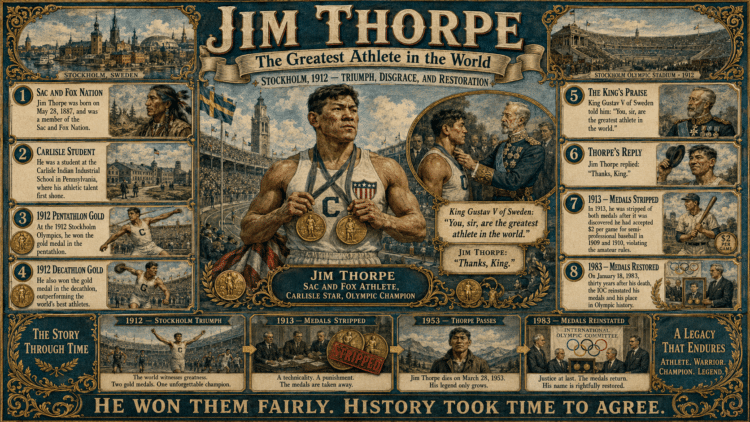
Jim Thorpe, a member of the Sac and Fox Nation and a student at the Carlisle Indian Industrial School in Pennsylvania, won gold medals in both the pentathlon and decathlon at the 1912 Stockholm Olympics. King Gustav V of Sweden told him, “You, sir, are the greatest athlete in the world.” Thorpe replied: “Thanks, King.” He was stripped of both medals in 1913 for having accepted $2 per game playing semi-professional baseball in 1909 and 1910, which violated amateur rules. The medals were reinstated in 1983, thirty years after his death.
Marathon runner Shizo Kanakuri of Japan collapsed from heat exhaustion during the 1912 Olympic marathon, sought refuge in a Swedish family’s home, and quietly returned to Japan without notifying race officials. He was officially listed as a missing person in Sweden for 50 years. In 1966, Swedish television tracked him down and invited him to complete the race. He crossed the finish line in Stockholm. His official time: 54 years, 8 months, 6 days, 5 hours, 32 minutes, and 20.379 seconds. It remains the longest marathon in Olympic history.
Oscar Swahn of Sweden won a gold medal in shooting at the 1912 Olympics at the age of 64 years and 258 days, making him the oldest Olympic gold medalist in history. He competed again in 1920, at age 72, becoming the oldest Olympic competitor.
The Beverly Hills Hotel opened on May 12, 1912. The surrounding community incorporated as the City of Beverly Hills the following year, in part because enough residents had settled around the hotel to meet the population requirement.
Japan sent 3,020 cherry trees to Washington, D.C., in 1912 as a gesture of friendship between the two nations. They were planted along the Tidal Basin and the East Potomac Park. The annual National Cherry Blossom Festival, which began in 1935, celebrates their arrival.
The North Korean calendar — the Juche calendar — counts years from 1912, the birth year of Kim Il-sung. The year 2027 is Juche 116 in North Korea.
In a 1912 Broadway production of Snow White and the Seven Dwarfs, the dwarfs were named Blick, Flick, Glick, Plick, Quee, Snick, and Whick. Disney clearly improved on this in 1937.
A 400-pound meteor exploded over Holbrook, Arizona, on July 19, 1912, scattering thousands of small stones across the desert. It is known as the Holbrook meteorite, and its fragments have been collected and sold by rockhounds ever since.
Nobel Prize Winners
Physics — Nils Gustaf Dalen — for the invention of automatic regulators used with gas accumulators for illuminating lighthouses and buoys; Dalen was blind by the time he received the prize, having been injured in an explosion during his own experiments
Chemistry — Victor Grignard and Paul Sabatier, for the discovery of the Grignard reagent, fundamental to organic synthesis, and for the method of hydrogenating organic compounds
Medicine — Alexis Carrel, for his work on vascular suture and the transplantation of blood vessels and organs, making him a pioneer of techniques used in modern surgery and organ transplantation
Literature — Gerhart Hauptmann, German dramatist, for his fruitful, varied, and outstanding production in the realm of dramatic art
Peace — Elihu Root, American statesman and former Secretary of State, for his work in international arbitration
Broadway in 1912
The Passing Show of 1912 opened July 22, 1912, at the Winter Garden Theatre, launching one of Broadway’s most popular annual revue series of the decade.
The Firefly opened December 2, 1912, with music by Rudolf Friml — his Broadway debut — and became one of the season’s most successful operettas.
The Helen Hayes Theater opened at 240 West 44th Street in 1912, named for the actress who would go on to be called the First Lady of American Theater.
Top Movies of 1912
- From the Manger to the Cross
- The Musketeers of Pig Alley
- The Cry of the Children
- Oliver Twist
- Richard III
- A Lodging for the Night
- Dante’s Inferno (Italian)
- In the North Woods
- The Prisoner of Zenda
- Saved from the Titanic
Popular and Best-Selling Books of 1912
The Harvester — Gene Stratton-Porter
The Street Called Straight — Basil King
Their Yesterdays — Harold Bell Wright
The Melting of Molly — Maria Thompson Daviess
A Hoosier Chronicle — Meredith Nicholson
The Winning of Barbara Worth — Harold Bell Wright
The Just and the Unjust — Vaughan Kester
The Net — Rex Beach
Tante — Anne Douglas Sedgwick
Fran — J. Breckenridge Ellis
The Promised Land — Mary Antin
The Montessori Method — Maria Montessori
South America — James Bryce
A New Conscience and an Ancient Evil — Jane Addams
How to Live on Twenty-Four Hours a Day — Arnold Bennett
Tarzan of the Apes — Edgar Rice Burroughs
Autobiography of an Ex-Colored Man — James Weldon Johnson
Elementary Forms of Religious Life — Emile Durkheim
Ripostes — Ezra Pound
Biggest Pop Artists of 1912
The American Quartet, Elsie Baker, Henry Burr, Albert Campbell, Enrico Caruso, Arthur Collins, The Columbia Stellar Quartet, Dolly Connolly, Alma Gluck, Byron G. Harlan, Al Jolson, Ada Jones, Harry Lauder, Christie MacDonald, Harry Macdonough, John McCormack, Reed Miller, Billy Murray, Will Oakland, The Peerless Quartet, Prince’s Orchestra, Walter Van Brunt, Victor Light Opera Company
Sports Champions of 1912
World Series: Boston Red Sox — defeated the New York Giants 4-3 in an eight-game Series (one game ended in a tie); Fenway Park had opened that same April, and the Red Sox won the championship in its first season
Challenge Cup: Quebec Bulldogs
U.S. Open Golf: John McDermott — defending his 1911 title, becoming the first player to win back-to-back U.S. Opens since Willie Anderson in 1903-1905
U.S. Open Tennis: Men/Women: Maurice McLoughlin / Mary Browne
Wimbledon: Men/Women: Anthony Wilding / Ethel Larcombe
NCAA Football Champions: Harvard and Penn State (co-champions)
Kentucky Derby: Worth
Boston Marathon: Michael J. Ryan, 2:21:18
Note: The source data listed Wimbledon men’s champion as Laurence Doherty, who had retired from competitive tennis by 1906. Anthony Wilding of New Zealand won the men’s title at Wimbledon in 1912, his third of four consecutive championships from 1910 to 1913.
Sports Highlight: The 1912 World Series was played at the newly opened Fenway Park, and the Red Sox won it. One game was tied and had to be replayed, making it an eight-game series. Jim Thorpe’s double gold at the Stockholm Olympics stands as one of the greatest individual athletic performances in Olympic history, made more remarkable by the fact that his medals were unjustly stripped and not restored until 1983.
FAQs: 1912 History, Facts, and Trivia
Q: How many people died when the Titanic sank?
A: More than 1,500 of the 2,240 people on board died when the Titanic sank on April 15, 1912. The ship carried enough lifeboats for roughly half its passengers, and many boats were launched under capacity in the chaos. Water temperature was near freezing, and most who entered the water died within minutes.
Q: Who was Jim Thorpe, and what happened to his Olympic medals?
A: Jim Thorpe, a Native American athlete from the Sac and Fox Nation, won gold medals in both the pentathlon and decathlon at the 1912 Stockholm Olympics. The medals were stripped in 1913 because he had accepted small payments to play semi-professional baseball before the Games, violating the amateur rules. They were restored posthumously in 1983, thirty years after his death.
Q: What cookie was introduced in 1912 that became the best-selling cookie in the world?
A: The Oreo, introduced by the National Biscuit Company on March 6, 1912. The Hydrox sandwich cookie had existed since 1908 and came first; Oreo borrowed the format and eventually outsold it so completely that Hydrox is now widely — and incorrectly — remembered as the imitation.
Q: What was the Piltdown Man?
A: Announced by Charles Dawson in 1912 as a major discovery of early human remains in East Sussex, England, the Piltdown Man was accepted by the scientific community as a genuine fossil for over 40 years. In 1953, it was proven to be a forgery: a human skull combined with an orangutan’s jaw, artificially aged. It remains the most famous hoax in the history of paleoanthropology.
Q: Who was Violet Jessop?
A: A ship stewardess who survived three separate disasters involving the same class of ocean liner. She was aboard the Olympic when it collided with a warship in 1911, aboard the Titanic when it sank in 1912, and aboard the Britannic when it sank in 1916. She lived to age 83.
Q: What election happened in 1912 that split the Republican Party?
A: Theodore Roosevelt, unhappy with his chosen successor, William Howard Taft, ran against him on the Progressive “Bull Moose” Party ticket. With the Republican vote split between them, Democrat Woodrow Wilson won the presidency with just 41.8% of the popular vote. Taft, a sitting president, finished third.
Q: When did Fenway Park open?
A: April 20, 1912. The Boston Red Sox won the World Series that same season, the first year the park was open.
More 1912 Facts & History Resources:
Most Popular Baby Names (BabyCenter.com)
Popular and Notable Books (popculture.us)
Broadway Shows that Opened in 1912
1912 Calendar, courtesy of Time and Date.com
Fact Monster
1912 in Movies (according to IMDB)
Wikipedia 1910