2009 Pop Culture History
In 2009, a man landed a commercial airliner on the Hudson River and became an instant American hero. A 47-year-old Scottish woman walked out onto a television stage and sang a song that made the internet cry. Bitcoin was invented and was worth essentially nothing. Avatar made more money than any film in history. Michael Jackson died, and for several days, the internet barely functioned under the weight of the response. It was a year that moved fast and felt significant even as it happened.
Quick Facts from 2009
- World-Changing Event: Bitcoin was created by the pseudonymous Satoshi Nakamoto and released as open-source software in January 2009; it had virtually no monetary value at launch
- Top Song: I Gotta Feeling by The Black Eyed Peas, the best-performing single of the year on the Billboard Year-End Hot 100
- Influential Songs: The Fear by Lily Allen, I Dreamed a Dream by Susan Boyle, The Climb by Miley Cyrus, Chasing Pavements by Adele
- Must-See Movies: Avatar, The Hurt Locker, Up, Harry Potter and the Half-Blood Prince, The Hangover, District 9, and Sherlock Holmes
- Most Famous Person in America: Chesley “Sully” Sullenberger, who landed US Airways Flight 1549 on the Hudson River on January 15, 2009, saving all 155 people aboard
- People’s Sexiest Man Alive: Johnny Depp
- Notable Book: The Help by Kathryn Stockett and SuperFreakonomics by Stephen Dubner and Steven Levitt
- Price of a 4GB Element MP3 Player: $39.99
- Apple iPod Nano: $149.00
- Federal Minimum Wage: $7.25 per hour (some states were higher)
- The Funny Guy: Larry the Cable Guy
- The Funny Late Night Host (half a year): Conan O’Brien, who took over The Tonight Show from Jay Leno in June 2009
- The Viral Video: The JK Wedding Entrance Dance — the wedding procession of Jill Peterson and Kevin Heinz of St. Paul, Minnesota, choreographed to Forever by Chris Brown, viewed over 26 million times in its first month
- Fun Fact: After 74 years of production, Kodak discontinued Kodachrome color slide film in 2009, ending an era of photography that had defined how the 20th century documented itself
- Chinese Zodiac: Year of the Ox, associated with hard work, determination, and honesty; people born in ox years are said to be reliable, patient, and constitutionally incapable of cutting corners
- The Conversion Rate: A performer was reportedly offered 200,000 Bitcoin for a 2009 concert appearance, worth approximately $2,000 at the time. At Bitcoin’s 2017 peak, that would have been worth over $1.3 billion. The offer was declined
- The Conversation: Did you hear about the plane on the Hudson? And have you seen that Scottish woman sing on YouTube?
Top Ten Baby Names of 2009
Girls: Isabella, Emma, Olivia, Sophia, Ava Boys: Jacob, Ethan, Michael, Alexander, William
Isabella had claimed the top spot for girls, a position it would hold for several years. Jacob had been number one for boys for eleven consecutive years, a run that showed no signs of ending. Michael, a perennial fixture in the top ten for decades, was making what turned out to be one of its final appearances near the top.
Fashion Icons and Sex Symbols of 2009
Bar Refaeli, Adriana Lima, Jordana Brewster, Megan Fox, Jessica Biel, Christina Aguilera, Mila Kunis, Olivia Wilde, Eliza Dushku, Malin Akerman, Rihanna, Jennifer Love Hewitt, Leighton Meester
Megan Fox was at the absolute peak of her cultural visibility following Transformers: Revenge of the Fallen, a film that was not particularly well-reviewed but did extraordinary business. Rihanna was simultaneously at the center of one of the year’s most serious and widely discussed stories for entirely different reasons.
The Leading Men of 2009
Taylor Lautner, Channing Tatum, Hugh Jackman, David Beckham, Joe Manganiello, Ryan Reynolds, Robert Pattinson, Tim Tebow, and Antonio Sabàto Jr.
Robert Pattinson owed his presence on this list almost entirely to The Twilight Saga: New Moon, which opened in November to an audience that had been waiting with considerable intensity. Taylor Lautner was in the same film and benefited similarly.
The Quotes
“If you like your doctor, you will be able to keep your doctor. Period. If you like your health care plan, you will be able to keep it. Period. No one will take it away. No matter what.” — President Barack Obama, on the Affordable Care Act, a promise whose complexity would become apparent over the following years
“I tend to think of myself as a one-man wolf pack. But when my sister brought Doug home, I knew he was one of my own. And my wolf pack… it grew by one.” — Alan, The Hangover, a film that generated more quoted dialogue per dollar of production than almost any comedy of the decade
Time Magazine’s Person of the Year
Ben Bernanke, Chairman of the Federal Reserve, for his management of the 2008 financial crisis. Bernanke, a scholar of the Great Depression who had spent his academic career studying how central banks had failed in the 1930s, applied that knowledge in real time. The Fed’s interventions — unprecedented in scale and speed — were widely credited with preventing the recession from collapsing. Whether the longer-term consequences of those interventions were equally positive remained a matter of debate.
Miss America and Miss USA
Miss America: Katie Stam, Seymour, Indiana
Miss USA: Kristen Dalton, Wilmington, North Carolina
We Lost in 2009
Michael Jackson, the most commercially successful solo recording artist in history, died June 25, 2009, at age 50, at his home in Holmby Hills, California. The cause of death was acute propofol and benzodiazepine intoxication, administered by his personal physician, Conrad Murray, who was later convicted of involuntary manslaughter. Jackson had been in rehearsal for a 50-date comeback concert series called This Is It at the O2 Arena in London. The response to his death was unlike anything the internet had previously experienced. Wikipedia, Google, and Twitter all experienced service disruptions from the volume of traffic generated within minutes of the announcement. Conrad Murray was convicted of involuntary manslaughter in 2011 and sentenced to four years.
Farrah Fawcett, actress and cultural icon whose poster was one of the most recognizable images of the 1970s, died June 25, 2009, at age 62, of anal cancer. She had documented her battle with the disease in a television special that aired three days before her death. Her death was largely overshadowed in media coverage by Jackson’s, which occurred the same afternoon.
Patrick Swayze, actor whose roles in Dirty Dancing and Ghost made him one of the defining leading men of the 1980s, died September 14, 2009, at age 57, of pancreatic cancer. He had been diagnosed in January 2008 and continued working throughout his illness.
Ed McMahon, the longtime announcer and sidekick on The Tonight Show with Johnny Carson, died June 23, 2009, at age 86. He had been a fixture of American late-night television for three decades.
Walter Cronkite, the CBS News anchor who had been known as “the most trusted man in America” during his tenure from 1962 to 1981 and whose on-air reporting had shaped American understanding of events from the Kennedy assassination to the moon landing to the Vietnam War, died on July 17, 2009, at age 92.
Bea Arthur, actress and comedian best known for her roles in Maude and The Golden Girls, died April 25, 2009, at age 86. She had been one of the sharpest comic presences on American television for two decades.
Billy Mays, the television pitchman whose enthusiastic infomercial delivery for products including OxiClean made him a pop culture figure in his own right, died June 28, 2009, at age 50. His death, just three days after Jackson and Fawcett, led to dark jokes about celebrity deaths in threes, and then in sixes.
America in 2009 — The Context
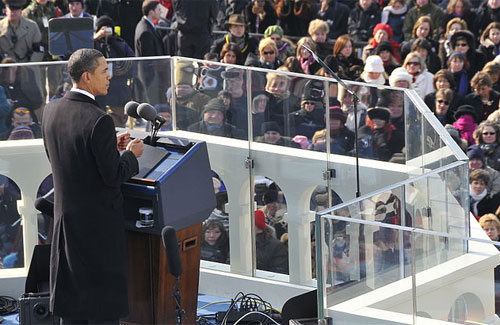
Barack Obama was inaugurated as the 44th President of the United States on January 20, 2009, the first Black president in American history. The ceremony drew an estimated 1.8 million people to the National Mall in Washington, the largest gathering in the capital’s history. Obama inherited an economy in freefall, two active wars, and the highest level of public expectation attached to any incoming president in modern memory.
The financial crisis that had begun with the collapse of Lehman Brothers in September 2008 was still working its way through the economy. The unemployment rate climbed throughout 2009, reaching 10 percent in October. The federal government’s stimulus package, the American Recovery and Reinvestment Act, was passed in February at a cost of $787 billion. Whether it was adequate, excessive, or misdirected was debated immediately and endlessly.
The push for comprehensive health care reform dominated the political calendar for most of the year. Town hall meetings during the August congressional recess became flashpoints, with angry confrontations over the proposed legislation generating extensive media coverage. The Tea Party movement, which had begun as a loose network of anti-tax, anti-spending protest groups earlier in the year, found its most visible and photographed expression at these events.
On January 15, 2009, US Airways Flight 1549, an Airbus A320 departing LaGuardia Airport with 155 people aboard, struck a flock of Canada geese two minutes after takeoff, disabling both engines. Captain Chesley “Sully” Sullenberger made the decision to land the aircraft on the Hudson River rather than attempt to reach an airport. The aircraft was successfully ditched, everyone aboard survived, and Sullenberger became an immediate national hero. He later testified before Congress that pilot training and experience standards needed to be maintained at the highest possible level and that years of cost-cutting in the airline industry had reduced both.
The Miracle on the Hudson
The successful ditching of US Airways Flight 1549 on January 15, 2009, is the most dramatic aviation story of the modern era. The sequence of events from bird strike to water landing took 208 seconds. Sullenberger made the decision to ditch almost immediately, performed a textbook water landing in a commercial aircraft at 150 mph, and then walked the length of the cabin twice to confirm no passengers remained before exiting himself. All 155 aboard survived. The water temperature was 36 degrees. Ferries and Coast Guard vessels reached the aircraft within minutes. New York Governor David Paterson called it “the miracle on the Hudson.” Sullenberger was 57 years old and had been flying for 40 years. He later said the 208 seconds were “the most sickening, pit-of-your-stomach, falling-through-the-floor feeling” of his career.
Susan Boyle
On April 11, 2009, a 47-year-old woman from the small Scottish village of Blackburn, West Lothian, walked onto the stage of Britain’s Got Talent and introduced herself to the panel of judges. The audience laughed. The judges smiled the way judges do when managing expectations. Then she opened her mouth and sang I Dreamed a Dream from Les Misérables. The audience rose to its feet before she had finished the first verse. Simon Cowell’s expression changed visibly. The clip was uploaded to YouTube and reached 100 million views within nine days — a record at the time. It remains one of the most-viewed audition clips in television history. Susan Boyle’s debut album, I Dreamed a Dream, released in November 2009, became the best-selling album of the year in the UK and debuted at number one in more than twenty countries.
The Scandals
Tiger Woods, the most dominant golfer of his generation and one of the most commercially valuable athletes in history, was involved in a single-car accident outside his Florida home on November 27, 2009. The subsequent investigation revealed a series of extramarital affairs that would eventually be reported to involve multiple women. His wife, Elin Nordegren, filed for divorce. His sponsors began reconsidering their relationships with him. Woods withdrew from golf to address personal matters. His return in 2010 was one of the most anticipated and scrutinized comebacks in sports history. The Woods scandal demonstrated, among other things, how comprehensively the celebrity tabloid model had been replaced by continuous social media reporting.
On February 8, 2009, a photograph of Rihanna showing injuries consistent with assault was leaked to the media. Her then-boyfriend, Chris Brown, had assaulted her on the night before the Grammy Awards, to which both were scheduled to attend. Brown was charged with felony assault and making criminal threats. He pleaded guilty to a reduced charge of assault, received five years’ probation and community service, and was ordered to stay away from Rihanna. The case prompted a significant and lasting public conversation about domestic violence.
On October 15, 2009, Richard and Mayumi Heene of Fort Collins, Colorado, reported that their six-year-old son Falcon had become trapped inside a homemade helium balloon that had drifted to altitudes of 7,000 feet. The story was covered live on news networks for hours. When the balloon was recovered and found empty, attention turned to Falcon, who was found hiding at home. During a live television interview, the boy said something that suggested the whole incident had been staged “for the show.” The parents had reportedly been trying to get a reality television program. Both were charged with false reporting and conspiracy. Richard Heene pleaded guilty and served 90 days in jail.
Kanye West interrupted Taylor Swift’s acceptance speech for Best Female Video at the MTV VMAs on September 13, 2009, taking her microphone to declare that Beyoncé’s Single Ladies should have won. The moment generated an immediate and enormous reaction, became one of the most replayed clips of the year, and established a cultural reference point for unwanted interruptions that persists to the present. President Obama, in an off-the-record comment that was recorded and leaked, called West a jackass.
Pop Culture Facts and History
Avatar, directed by James Cameron and released on December 18, 2009, became the highest-grossing film in history, surpassing Cameron’s own Titanic. The film used 3D technology on a scale not attempted before, and moviegoers paid a premium to see it in that format. It earned $2.9 billion worldwide. The film’s story was widely noted to resemble Dances with Wolves, FernGully, and several other existing narratives, a similarity Cameron acknowledged while arguing it was mythologically universal. It held the all-time box office record until Avengers: Endgame surpassed it in 2019.
The Hangover, directed by Todd Phillips and starring Bradley Cooper, Zach Galifianakis, and Ed Helms, opened June 5, 2009 and grossed $467 million on a $35 million budget. It was the highest-grossing R-rated comedy in history at the time of release. The film’s ensemble dynamic was compared favorably to classic 1980s comedies, and Galifianakis’s Alan became one of the year’s most quoted characters.
Bitcoin was introduced in a white paper published under the name Satoshi Nakamoto in October 2008 and launched as software in January 2009. The identity of Satoshi Nakamoto has never been established. On May 22, 2009, a programmer named Laszlo Hanyecz completed what is believed to be the first real-world commercial transaction using Bitcoin, paying 10,000 BTC for two Papa John’s pizzas. At the time, the value was negligible. At Bitcoin’s peak in November 2021, those 10,000 BTC were worth approximately $690 million. May 22 is now observed annually in the cryptocurrency community as Bitcoin Pizza Day.
The Hurt Locker, directed by Kathryn Bigelow, was a low-budget film about an American bomb-disposal unit in Iraq that received almost no theatrical attention at its initial release in the summer of 2009. It went on to win six Academy Awards, including Best Picture and Best Director at the 82nd ceremony in March 2010 — making Bigelow the first woman to win the Best Director Oscar. The film earned approximately $17 million at the box office and sparked roughly $250 million in cultural conversation.
The first Twilight sequel, The Twilight Saga: New Moon, opened on November 20, 2009, and grossed $142 million on its opening weekend, setting a new record for opening weekends in November. The Twilight franchise had created a level of pre-release fan intensity that was unusual even by blockbuster standards, with fans camping outside theaters days in advance.
Up, the Pixar film about an elderly widower who attaches thousands of balloons to his house to fly to South America, opened with a four-minute wordless montage of a marriage from beginning to end, widely described as one of the most emotionally effective sequences Pixar had ever produced. This observation was frequently accompanied by the admission that the person making it had cried in a movie theater about an animated balloon house.
Conan O’Brien took over The Tonight Show from Jay Leno on June 1, 2009, after having been promised the job seven years earlier. Leno immediately launched a primetime show, The Jay Leno Show, which performed poorly and began pulling audiences away from local late news affiliates, who then complained to NBC. NBC proposed moving Leno back to his old 11:35 time slot and pushing O’Brien to 12:05. O’Brien refused and was paid $45 million to leave. The entire sequence took approximately seven months. Leno returned to The Tonight Show in March 2010. O’Brien eventually landed at TBS.
District 9, the South African science-fiction film produced by Peter Jackson and directed by Neill Blomkamp, was released August 14, 2009, on a $30 million budget and earned $210 million worldwide. It was nominated for Best Picture at the Academy Awards, one of the few science fiction films to receive that recognition in recent decades.
The Westboro Baptist Church, known for protesting at military funerals with signs bearing anti-gay slogans, was increasingly visible in 2009. Counter-protest movements began organizing around the same time, and the legal and cultural arguments around protest and speech that the Church’s activities generated became a recurring feature of the national conversation.
Nobel Prize Winners in 2009
Physics was awarded to Charles Kao for his theoretical and practical work on fiber optic communication, and jointly to Willard Boyle and George Smith for the invention of the charge-coupled device (CCD), the technology at the heart of every digital camera and phone camera in the world.
Chemistry went to Venkatraman Ramakrishnan, Thomas Steitz, and Ada Yonath for studies of the structure and function of the ribosome — the molecular machine that translates genetic information into proteins in every living cell. Their work opened new possibilities for antibiotic development.
Physiology or Medicine was awarded to Elizabeth Blackburn, Carol Greider, and Jack Szostak for the discovery of how chromosomes are protected by telomeres and the enzyme telomerase. The work had implications for understanding aging, cancer, and cellular life spans.
Literature went to Herta Müller of Romania and Germany, for her writing that, with the concentration of poetry and the frankness of prose, depicts the landscape of the dispossessed. Her work drew on her experience growing up in the German-speaking minority in Ceaușescu’s Romania.
Peace was awarded to Barack Obama in recognition of his extraordinary efforts to strengthen international diplomacy and cooperation between peoples. The award, announced nine months into his presidency, was widely noted to be forward-looking rather than backward-looking. Obama himself acknowledged this in his acceptance speech, calling the award an affirmation of American leadership on behalf of aspirations held by all people.
Economics went to Elinor Ostrom and Oliver Williamson. Ostrom became the first woman to win the Economics prize, recognized for her analysis of how communities manage shared resources — challenging the assumption that common resources are inevitably depleted without private ownership or government control.
2009 Toys Inducted to the National Toy Hall of Fame
The Ball, the Game Boy, and the Big Wheel were inducted in 2009. The Ball’s inclusion was a philosophical statement as much as anything — the oldest and most universal play object in human history finally receiving formal recognition from an institution that had previously focused on manufactured products.
2009 Christmas Gifts and First Appearances
Zhu Zhu Pet robotic hamsters were the must-have toy of the 2009 holiday season, selling out nationwide by November and reaching resale prices of $60 or more for a toy that retailed at $9.99. Foldable speakers and Dyson’s bladeless fan made their commercial debuts. The bladeless fan worked by drawing air through its base and accelerating it through a circular aperture, creating a smooth airflow without exposed blades — a concept that seemed either ingenious or unnecessarily complicated depending on the observer.
Broadway in 2009
Rock of Ages, a jukebox musical built around the arena rock catalog of the 1980s, opened April 7, 2009 at the Brooks Atkinson Theatre and ran until January 18, 2015. The show celebrated the music of Styx, Journey, Bon Jovi, Twisted Sister, and others in a story set in a Sunset Strip rock club in 1987. Tom Cruise starred in the 2012 film adaptation.
Memphis, a musical set in the 1950s Memphis music scene, opened October 19, 2009, at the Shubert Theatre and ran until August 5, 2012. It won four Tony Awards, including Best Musical in 2010, a prize that came as something of a surprise given the competition that season.
Thriller Live, a celebration of Michael Jackson’s music, opened on January 26, 2009, in London’s West End, just months before Jackson’s death in June would make the show as much a memorial as a tribute.
Best Film Oscar Winner
The Hurt Locker, directed by Kathryn Bigelow, won Best Picture at the 82nd Academy Awards on March 7, 2010, for the 2009 film year. Bigelow became the first woman to win the Academy Award for Best Director, defeating her former husband, James Cameron, whose Avatar had been the box office phenomenon of the year. The two films were the top two contenders, and the contrast between them — a small, intense war film versus the most expensive and technologically elaborate movie ever made — made the awards race one of the more compelling in recent memory.
2009 Entries to the National Film Registry
Dog Day Afternoon (1975)
The Exiles (1961)
The Incredible Shrinking Man (1957)
Jezebel (1938)
The Lead Shoes (1949)
Little Nemo (1911)
The Mark of Zorro (1940)
Mrs. Miniver (1942)
The Muppet Movie (1979)
Once Upon a Time in the West (1968)
Pillow Talk (1959)
The Story of G.I. Joe (1945)
Michael Jackson’s Thriller (1983)
Under Western Stars (1938)
Top Movies of 2009
- Avatar
- Transformers: Revenge of the Fallen
- Harry Potter and the Half-Blood Prince
- The Twilight Saga: New Moon
- Up
- The Hangover
- Star Trek
- The Blind Side
- Alvin and the Chipmunks: The Squeakquel
- Sherlock Holmes
Avatar grossed $2.9 billion worldwide, a figure so far above anything previously achieved that the number two film of the year — Transformers: Revenge of the Fallen at $836 million — would have been considered a massive success in any other context. J.J. Abrams’s Star Trek reboot introduced the franchise to a new generation by starting over, casting younger actors, and not assuming the audience had seen the previous 40 years of material. The Blind Side grossed $256 million on a $29 million budget and gave Sandra Bullock the Best Actress Oscar.
Most Popular TV Shows of 2009
NCIS, Sunday Night Football, Dancing with the Stars, The Mentalist, NCIS: Los Angeles, CSI, Desperate Housewives, Grey’s Anatomy, House, and CBS NFL Postgame dominated broadcast television in 2009. NCIS reached the top of the ratings for the first time and would remain near the top for the next decade. Lost entered its penultimate season, Breaking Bad completed its second, and Mad Men won its second consecutive Emmy for Outstanding Drama Series.
2009 Billboard Number One Hits
December 6 – January 2, 2009: Low — Flo Rida featuring T-Pain
January 3 – January 9: Single Ladies (Put a Ring on It) — Beyoncé
January 10 – January 16: Just Dance — Lady Gaga featuring Colby O’Donis
January 17 – February 13: Poker Face — Lady Gaga February 14 –
March 6: Kiss Me Thru the Phone — Soulja Boy Tell ‘Em featuring Sammie
March 7 – March 13: Right Round — Flo Rida featuring Kesha
March 14 – April 3: Blame It — Jamie Foxx featuring T-Pain
April 4 – April 17: Just Dance — Lady Gaga featuring Colby O’Donis
April 18 – May 15: Boom Boom Pow — The Black Eyed Peas
May 16 – June 5: Love Story — Taylor Swift
June 6 – June 19: Boom Boom Pow — The Black Eyed Peas
June 20 – August 14: I Gotta Feeling — The Black Eyed Peas (8 weeks)
August 15 – September 11: I Gotta Feeling — The Black Eyed Peas (continuing)
September 12 – September 25: Party in the U.S.A. — Miley Cyrus
September 26 – October 9: Run This Town — Jay-Z featuring Rihanna and Kanye West
October 10 – October 23: You Belong with Me — Taylor Swift
October 24 – November 6: Bad Romance — Lady Gaga
November 7 – November 20: Need You Now — Lady Antebellum
November 21 – December 31: Empire State of Mind — Jay-Z featuring Alicia Keys
Lady Gaga dominated the early months of 2009 with remarkable efficiency for an artist who had released her debut album less than a year before. Poker Face spent four weeks at number one. Just Dance made two separate runs at the top. The Black Eyed Peas spent a combined 14 weeks at number one across two singles. Taylor Swift’s “Love Story” and “You Belong with Me” established her as a commercial force whose crossover from country to pop was essentially complete.
Sports Champions of 2009
World Series: The New York Yankees defeated the Philadelphia Phillies four games to two, winning their 27th World Series championship and their first since 2000. Alex Rodriguez, who had never previously won a title despite his individual statistics, hit .365 with six home runs and was named Series MVP. The victory was the first in the new Yankee Stadium, which had opened that season.
Super Bowl XLIII: The Pittsburgh Steelers defeated the Arizona Cardinals 27-23 on February 1, 2009, in Tampa. Santonio Holmes caught the game-winning touchdown pass with 35 seconds remaining and was named MVP. The Cardinals, under first-year starting quarterback Kurt Warner, had been a significant underdog. The game is widely considered one of the greatest Super Bowls ever played.
NBA Champions: The Los Angeles Lakers defeated the Orlando Magic four games to one. Kobe Bryant won his first championship without Shaquille O’Neal and was named Finals MVP. The victory was widely interpreted as the completion of Bryant’s transition from Shaq’s supporting player to the unquestioned leader of a championship team.
Stanley Cup: The Pittsburgh Penguins defeated the Detroit Red Wings four games to three, reversing the result of the previous year’s Final. Sidney Crosby, 21 years old, became the youngest captain in NHL history to win the Stanley Cup. Evgeni Malkin was named Conn Smythe Trophy winner as playoff MVP.
U.S. Open Golf: Lucas Glover won his only major at Bethpage Black in New York, finishing at four under par in difficult, rain-affected conditions. Glover had been a solid tour professional without a major; his victory at Bethpage was a genuine upset.
U.S. Open Tennis: Juan Martín del Potro of Argentina defeated Roger Federer in five sets in one of the great U.S. Open finals, ending Federer’s five-year grip on the title. Kim Clijsters, who had come out of retirement and was playing as an unseeded wild card, won the women’s title over Caroline Wozniacki, becoming the first unseeded player to win the U.S. Open in the Open Era.
Wimbledon: Roger Federer won the men’s title, defeating Andy Roddick in five sets in the longest Wimbledon final in history, 16-14 in the fifth set. The victory was Federer’s 15th Grand Slam, surpassing Pete Sampras’s record of 14. Serena Williams won the women’s title.
NCAA Football: Alabama, under first-year head coach Nick Saban, won the BCS National Championship in January 2010, defeating Texas 37-21. It was the beginning of a dynasty that would redefine college football dominance over the following decade.
NCAA Basketball: The North Carolina Tar Heels, led by Tyler Hansbrough, won the national championship, defeating Michigan State 89-72 in the final in Detroit. The margin was convincing. North Carolina entered the tournament as a number-one seed and never trailed by more than a few points in any game.
Kentucky Derby: Mine That Bird, a 50-1 longshot, won the Kentucky Derby in one of the greatest upsets in the race’s history, coming from last place with a furlong remaining and winning by 6.75 lengths under jockey Calvin Borel, who rode along the rail in a route that made most observers wonder what he thought he was doing until the final furlong when the answer became clear.
Frequently Asked Questions About 2009
Q: What was the Miracle on the Hudson?
A: On January 15, 2009, US Airways Flight 1549 struck a flock of Canada geese shortly after takeoff from LaGuardia Airport, disabling both engines. Captain Chesley Sullenberger decided to ditch the aircraft in the Hudson River rather than attempt an emergency landing. All 155 people aboard survived. The landing, accomplished in 208 seconds from bird strike to water contact, is considered one of the most remarkable feats of airmanship in commercial aviation history.
Q: What is Bitcoin Pizza Day?
A: On May 22, 2009, programmer Laszlo Hanyecz paid 10,000 Bitcoin for two Papa John’s pizzas in what is believed to be the first real-world commercial Bitcoin transaction. At the time, the value was negligible. At Bitcoin’s 2021 peak, those 10,000 BTC were worth approximately $690 million. May 22 is now observed as Bitcoin Pizza Day in the cryptocurrency community.
Q: What happened with Kanye West and Taylor Swift at the 2009 VMAs?
A: On September 13, 2009, Kanye West interrupted Taylor Swift’s acceptance speech for Best Female Video at the MTV VMAs, taking her microphone to argue that Beyoncé’s Single Ladies should have won. The moment became one of the most-replayed clips of the year and established a cultural reference point that both artists have responded to in various ways ever since. President Obama, in an unguarded moment captured on tape, called West a jackass.
Q: Who won the Best Director Oscar for 2009?
A: Kathryn Bigelow became the first woman to win the Academy Award for Best Director, for The Hurt Locker. She defeated her former husband, James Cameron, whose Avatar had grossed over $2.9 billion. The contrast between the two nominated films — one of the smallest and most intimate war films in recent memory, the other of the largest productions in cinema history — made the race one of the more compelling award-season narratives in years.
Q: What happened to Conan O’Brien in 2009?
A: Conan O’Brien took over The Tonight Show from Jay Leno on June 1, 2009, fulfilling a promise NBC had made him seven years earlier. Leno launched a primetime show that failed, began affecting local news ratings, and NBC proposed moving him back to 11:35 and bumping O’Brien to 12:05. O’Brien refused, was paid $45 million to leave, and the entire arrangement collapsed within seven months. Leno returned to The Tonight Show in March 2010.
Q: Who was Susan Boyle?
A: A 47-year-old woman from Blackburn, Scotland, whose audition on Britain’s Got Talent on April 11, 2009, singing I Dreamed a Dream from Les Misérables, became one of the most-watched clips in internet history, reaching 100 million views in nine days. Her debut album became the best-selling record of 2009 in the United Kingdom and debuted at number one in more than 20 countries.
In a year that began with a commercial aircraft landing on a river and ended with Jay-Z and Alicia Keys declaring their love for New York over the radio, 2009 was simultaneously terrifying, exhilarating, and occasionally absurd. The economy was broken, the president was new, Avatar was enormous, and a Scottish woman who had never been anywhere became the most-watched person on earth for a week. Bitcoin, meanwhile, was worth less than a penny and changing everything.