1914 History, Facts, and Trivia
Quick Facts from 1914
- World-Changing Event: Archduke Franz Ferdinand, heir to the Austro-Hungarian throne, was assassinated in Sarajevo on June 28, 1914. Within six weeks, the major powers of Europe were at war. By November, the Western Front had settled into trenches. The world that existed before June 28 never came back.
- America-Changing Event: Henry Ford announced a $5 minimum daily wage and an eight-hour workday on January 5, 1914, doubling the average industrial wage overnight. The decision transformed the economics of American labor and created the consumer class that would define the 20th century.
- Top Songs: By the Beautiful Sea by the Heidelberg Quintet, Missouri Waltz by Frederick Knight Logan, and The Aba Daba Honeymoon by Collins and Harlan
- Must-See Movies: Gertie the Dinosaur, The Perils of Pauline (serial), and Charlie Chaplin’s first appearance as the Tramp in Kid Auto Races at Venice
- Notable Books: Pygmalion by George Bernard Shaw and Penrod by Booth Tarkington
- Chinese Zodiac: Year of the Tiger, associated with courage, competitiveness, and a tendency to leap before looking
- The Conversation: Did you hear about Franz Ferdinand? Do you think we’ll get into it?
Top Ten Baby Names of 1914
Girls: Mary, Helen, Dorothy, Margaret, Ruth Boys: John, William, James, Robert, Joseph
U.S. Life Expectancy in 1914
Males: 52.0 years; Females: 56.8 years
We Lost in 1914
Martha, the last passenger pigeon on Earth, died September 1, 1914, at the Cincinnati Zoo. She was approximately 29 years old. John James Audubon once observed a flock of passenger pigeons so large it took three days to pass overhead. Alexander Wilson estimated a single flock he witnessed contained over two billion birds. Market hunting and habitat destruction eliminated the entire species in roughly 50 years. The final wild passenger pigeon was shot in 1901. Martha died alone. Her body was frozen in a block of ice and sent to the Smithsonian Institution, where she remains.
Pope Pius X, Vincenzo Sarto, the 257th pope, died August 20, 1914, reportedly of grief over the outbreak of the war in Europe. He was beatified in 1951 and canonized in 1954.
Born in 1914
Joe Louis — born May 13, 1914, in Lafayette, Alabama; heavyweight boxing champion from 1937 to 1949 and one of the most important athletes in American history.
America in 1914 — The Context
Woodrow Wilson was in the second year of his first term. The country’s attention in 1914 was split between its own industrializing economy — booming, restless, and increasingly organized by labor — and the war building in Europe that it desperately hoped to avoid. Wilson declared American neutrality on August 19, 1914. The declaration was sincere and, as events would prove, temporary.
At home, 1914 produced some of the most consequential domestic events of the early 20th century: Ford’s $5 wage, the opening of the Panama Canal, the Ludlow Massacre, the founding of the FTC, the first commercial airline, the first traffic light, and the first Mother’s Day. It was a year of firsts that would have dominated headlines in almost any other year. Instead, it shares the page with the beginning of the most destructive war in human history to that point.
The Assassination of Archduke Franz Ferdinand
On June 28, 1914, Archduke Franz Ferdinand of Austria, heir to the Austro-Hungarian throne, and his wife Sophie were shot and killed in Sarajevo by Gavrilo Princip, a 19-year-old Bosnian Serb nationalist and member of the Black Hand secret society. The assassination was the trigger — not the cause — of World War I. The underlying causes had been building for decades: alliance systems, imperial competition, nationalist movements, and a military culture in Germany and Austria-Hungary that viewed a general European war as manageable and perhaps desirable.
Austria-Hungary issued an ultimatum to Serbia on July 23. Serbia accepted most but not all of the demands. Austria-Hungary declared war on Serbia on July 28. Russia mobilized to defend Serbia. Germany declared war on Russia on August 1 and on France on August 3. Germany invaded neutral Belgium on August 4. Britain declared war on Germany the same day. The system of interlocking alliances, once triggered, ran automatically toward catastrophe.
The Western Front
By September 1914, the German advance through France had been halted at the First Battle of the Marne, shattering the Schlieffen Plan’s promise of a quick victory in the west. Both sides began digging. By October, a continuous line of trenches ran from the English Channel to the Swiss border — roughly 400 miles of fortified earthworks, barbed wire, and mud. This was the Western Front. It did not move significantly for the next three years. The distances gained and lost would be measured in hundreds of yards at a cost of hundreds of thousands of lives.
The Christmas Truce
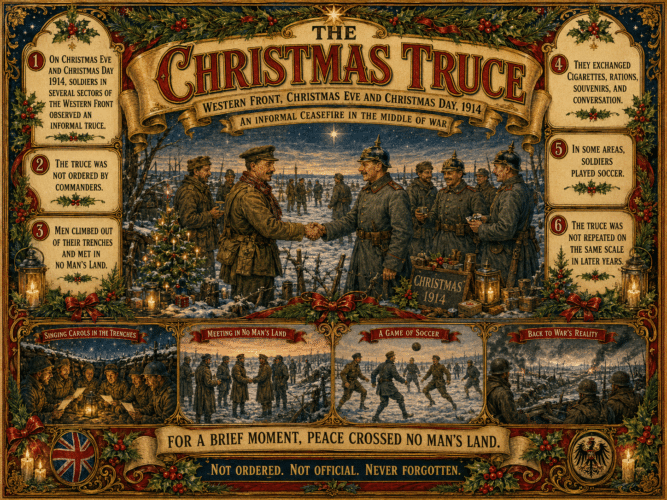
On Christmas Eve and Christmas Day 1914, an unofficial ceasefire broke out spontaneously along portions of the Western Front. German soldiers lit candles along their trench parapets and began singing carols. British soldiers heard them and responded. Men from opposing sides climbed out of their trenches, met in no man’s land, exchanged cigarettes and rations, and in some sections played soccer. The Germans reportedly won 3-2. The truce was not universal and was not repeated on the same scale in subsequent years. Military commanders on both sides were not pleased. The men who participated never forgot it.
The Ludlow Massacre
On April 20, 1914, the Colorado National Guard attacked a tent colony of approximately 1,200 striking coal miners and their families at Ludlow, Colorado, during the Colorado Coalfield War. Guardsmen set fire to the tents. When the fires were extinguished, the bodies of 11 children and 2 women were found in a pit beneath one of the tents where they had taken shelter. At least 19 people were killed in total. The mine owners — the Rockefeller family’s Colorado Fuel and Iron Company — were not prosecuted. The massacre prompted federal intervention and accelerated the national labor reform movement, though union recognition was not granted to the miners.
The Panama Canal
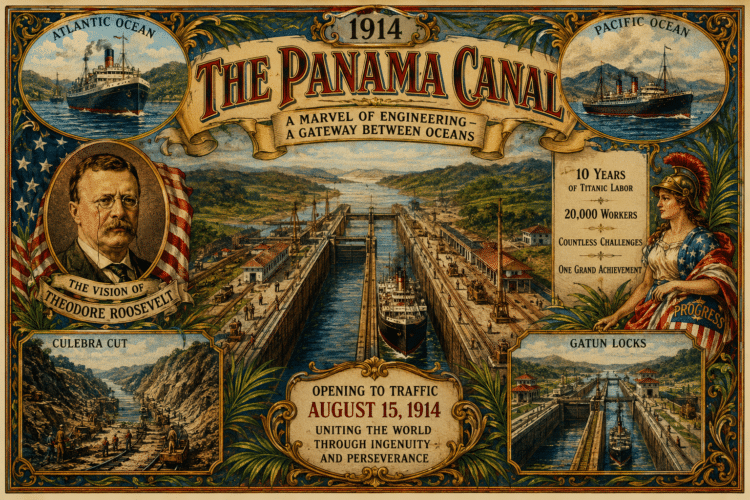
The Panama Canal opened to commercial traffic on August 15, 1914, when the steamship SS Ancon made the first official transit. The canal had taken over a decade to build, cost approximately $375 million, and claimed the lives of an estimated 5,600 workers during the American construction phase alone, following thousands more deaths during the earlier French attempt. It reduced the maritime journey between the Atlantic and Pacific coasts from roughly 14,000 miles around Cape Horn to 48 miles through Panama. The opening was largely overshadowed in the international press by the outbreak of World War I three weeks earlier.
The Ford $5 Workday
On January 5, 1914, the Ford Motor Company announced it was doubling its minimum daily wage to $5 for an eight-hour workday. The previous standard was $2.40 for a nine-hour day. The decision was widely called reckless by other industrialists and widely celebrated by workers. Ford’s reasoning was partly humanitarian and partly practical: high turnover on the assembly line was costly, and workers who earned more could afford to buy the cars they made.
The policy transformed American industrial labor relations. Other manufacturers were eventually forced to compete for workers by raising their own wages. The $5 workday is often cited as the moment the American working class became the American consumer class.
Henry Ford sold 248,000 cars in 1914. The Model T, available only in black from 1914 onward, had previously been sold in gray, green, blue, and red from 1908 to 1913. The switch to black was purely practical: black paint dried faster than other colors, allowing faster production on the new assembly line.
Pop Culture Facts and History
The world’s first scheduled commercial airline service began on January 1, 1914, when the St. Petersburg-Tampa Airboat Line flew its inaugural route across Tampa Bay, Florida, in a Benoist XIV flying boat piloted by Anthony Jannus. The former mayor of St. Petersburg, Abram Pheil, paid $400 for the first ticket at an auction. The flight covered 23 miles in 23 minutes. Over 3,000 people watched the departure. The airline operated for about four months before financial difficulties led to its end.
The world’s first electric traffic signal was installed at the corner of Euclid Avenue and East 105th Street in Cleveland, Ohio, on August 5, 1914. It used red and green lights and was operated manually by a police officer in a booth. The amber warning light was added later.
Charlie Chaplin made his first appearance as the Tramp character in Kid Auto Races at Venice on February 7, 1914. The costume — the bowler hat, the cane, the oversized shoes, the small mustache, the too-tight jacket — was assembled mostly from items Chaplin found in other actors’ dressing rooms. He had not planned the character in advance. Within months, it was the most recognized comedic persona in the world.
Gertie the Dinosaur, created by cartoonist Winsor McCay, premiered in 1914 as one of the earliest animated films. The 12-minute film consists of over 10,000 individually hand-traced frames and was the first animated film to use keyframes, animation loops, and character personality. McCay used it as part of a live vaudeville act in which he appeared to interact with Gertie on screen.
Harry Fox introduced the Foxtrot at the New Amsterdam Roof Garden in New York City in 1914. The dance was named after him and became one of the most popular ballroom dances of the 20th century.
The Perils of Pauline debuted as a movie serial in 1914, with Pearl White as the imperiled heroine. It established the cliffhanger serial format and the phrase “cliffhanger” itself, as episodes frequently ended with Pauline in mortal danger.
ASCAP — the American Society of Composers, Authors and Publishers — was founded on February 13, 1914, in New York City, to protect the copyrighted musical compositions of its members. It remains one of the two major performing rights organizations in the United States.
Mother’s Day was established as a national holiday by congressional act signed by President Wilson on May 9, 1914, designating the second Sunday in May. The holiday had been advocated for years by Anna Jarvis of West Virginia, who proposed a day to honor mothers. Jarvis later spent much of the rest of her life trying to abolish the holiday, having become disgusted by its commercialization. She died in 1948 in a sanitarium, broke and embittered, her expenses paid anonymously by the greeting card industry.
H.G. Wells coined the phrase “atomic bomb” in his 1914 novel The World Set Free, which described a future war fought with nuclear weapons that release energy through a chain reaction. The book was read by physicist Leo Szilard, who later credited it with inspiring him to think seriously about chain reactions. Szilard subsequently filed a patent for the chain reaction concept in 1933 and was a key figure in the Manhattan Project.
Seattle’s Smith Tower opened in 1914 as the tallest building on the West Coast — a title it held until the Space Needle opened in 1962. The Space Needle is not technically taller in the way that matters for office space, but it does have a rotating restaurant.
The RMS Empress of Ireland had a ship’s cat named Emmy who had never missed a voyage in her years aboard. On May 28, 1914, Emmy refused to leave the dock and would not board the ship. The crew left without her. The Empress of Ireland sank the following day after a collision in the St. Lawrence River, killing 1,012 of the 1,477 people on board — the deadliest maritime disaster in Canadian history.
Wrigley Field opened on April 23, 1914, as Weeghman Park, home of the Chicago Whales of the Federal League. It became Cubs Park in 1920 when the Cubs moved in, and was renamed Wrigley Field in 1926. It remains the second-oldest major league ballpark in continuous use, after Fenway Park.
Speedo swimwear originated in 1914 under the brand name Fortitude. The name Speedo was not adopted until 1928, when the company launched a new line with the slogan “Speed on in your Speedos.” The garment has been controversial at the beach ever since.
Thomas Edison’s laboratory and factory complex in West Orange, New Jersey, burned to the ground on December 9, 1914, destroying one-of-a-kind records, prototypes, and equipment representing decades of work, with losses estimated at over $7 million. Edison watched the fire from across the street. His reported reaction: “Thank goodness all our mistakes were burned up. Now we can start fresh again.” He was 67 years old. He rebuilt within months.
The “Lord Kitchener Wants You” British Army recruitment poster — featuring the Secretary of State for War pointing directly at the viewer — was created in 1914 and became the most imitated image in the history of military advertising. The American “Uncle Sam Wants You” poster and Smokey Bear’s “Only You Can Prevent Forest Fires” poster are both direct descendants of its design.
Oliver Hardy, of Laurel and Hardy fame, made his film debut in 1914. He went on to appear in 417 movies between 1914 and 1951, a record for credited appearances that stood for decades before being surpassed by voice actors and prolific supporting players.
A dismissed employee of architect Frank Lloyd Wright set fire to Wright’s home and studio, Taliesin, in Spring Green, Wisconsin, on August 15, 1914, killing seven people, including Wright’s companion, Mamah Borthwick, and her two children. Wright rebuilt Taliesin and continued working for another 45 years.
British WWI soldier Thomas Hughes tossed a beer bottle containing a letter to his wife into the English Channel in 1914. He was killed two days later. In 1999, a fisherman dredged the bottle from the River Thames. Hughes’ wife had died in 1979. The letter was delivered to his 86-year-old daughter.
The “Cup of Joe” — the American slang term for coffee — is said to have originated in 1914 after U.S. Secretary of the Navy Josephus Daniels banned alcohol aboard Navy vessels, replacing it with coffee. Sailors resentful of the policy supposedly began calling their coffee a “cup of Josephus” or “cup of Joe.” Etymologists debate how direct the connection is, but the timing lines up.
The 1914 Everett High School football team in Everett, Massachusetts, went 13-0, outscored its opponents 600-0 for the season, and won the national high school championship. No opposing team scored a single point all year. It is widely considered the greatest high school football team ever assembled.
The Christmas Truce Soccer Match
On Christmas Day 1914, German and Allied soldiers met in no man’s land, exchanged gifts and rations, and played soccer. The Germans reportedly won 3-2. No trophy was awarded.
Nobel Prize Winners
Physics — Max von Laue for his discovery of the diffraction of X-rays by crystals, proving simultaneously that X-rays were waves and that crystals had a regular atomic structure
Chemistry — Theodore William Richards, the first American to win the Nobel Prize in Chemistry, for his precise determination of the atomic weights of a large number of elements
Medicine — Robert Barany for his work on the physiology and pathology of the vestibular apparatus of the inner ear, though he received the prize while a prisoner of war in Russia
Literature — not awarded in 1914
Peace — not awarded; the Nobel Peace Prize was not given during World War I years 1914-1916; the International Committee of the Red Cross received it after the war ended
Broadway in 1914
Watch Your Step opened December 8, 1914, at the New Amsterdam Theatre, with music and lyrics entirely by Irving Berlin — his first full Broadway score. It starred Vernon and Irene Castle, the era’s most celebrated dance couple, and introduced ragtime rhythms to the Broadway musical stage.
The Passing Show of 1914 continued the Shuberts’ annual revue series at the Winter Garden, featuring future stars Marilyn Miller and Ed Wynn in early Broadway appearances.
Top Movies of 1914
- The Perils of Pauline
- Cabiria
- The Exploits of Elaine
- Tillie’s Punctured Romance
- Kid Auto Races at Venice
- Gertie the Dinosaur
- The Squaw Man
- In the Land of the Head Hunters
- Home Sweet Home
- The Battle of the Sexes
Popular and Best-Selling Books of 1914
The Eyes of the World — Harold Bell Wright
Pollyanna — Eleanor H. Porter
The Inside of the Cup — Winston Churchill
The Salamander — Owen Johnson
The Fortunate Youth — William J. Locke
T. Tembarom — Frances Hodgson Burnett
Penrod — Booth Tarkington
Diane of the Green Van — Leona Dalrymple
The Devil’s Garden — W.B. Maxwell
The Prince of Graustark — George Barr McCutcheon
Tender Buttons — Gertrude Stein
Other People’s Money — Louis Brandeis
Pygmalion — George Bernard Shaw
Drift and Mastery — Walter Lippmann
Behaviorism — John B. Watson
Biggest Pop Artists of 1914
The American Quartet, Nora Bayes, Henry Burr, Albert Campbell, Helen Clark, Arthur Collins, Byron G. Harlan, Charles Harrison, Joe Hayman, The Heidelberg Quartet, Irving Kaufman, Grace Kerns, George MacFarlane, John McCormack, Billy Murray, Will Oakland, The Peerless Quartet, Prince’s Orchestra, Walter Van Brunt, The Victor Military Band
Sports Champions of 1914
World Series: Boston Braves — defeated the Philadelphia Athletics 4-0 in a sweep; the Braves had been in last place on July 19 and won the pennant by 10.5 games, still the most remarkable stretch run in baseball history; they were called the “Miracle Braves.”
Stanley Cup: Toronto Hockey Club
U.S. Open Golf: Walter Hagen won his first major championship at age 21; he would go on to win 11 major titles
U.S. Open Tennis: Men/Women: Richard Norris Williams / Mary Browne
Wimbledon: Men/Women: Norman Brookes / Dorothea Lambert Chambers
NCAA Football Champions: Army
Kentucky Derby: Old Rosebud set a Derby track record of 2:03.4 that stood for 17 years
Boston Marathon: James Duffy, 2:25:14
Sports Highlight: The 1914 Boston Braves — the “Miracle Braves” — pulled off the greatest comeback in baseball history, going from last place in mid-July to World Series champions by October, then sweeping the heavily favored Philadelphia Athletics. Walter Hagen’s U.S. Open win launched one of the most celebrated professional golf careers of the early 20th century.
FAQs: 1914 History, Facts, and Trivia
Q: What single event started World War I?
A: The assassination of Archduke Franz Ferdinand of Austria and his wife Sophie in Sarajevo on June 28, 1914, by Bosnian Serb nationalist Gavrilo Princip. The assassination triggered a chain of alliance obligations, ultimatums, and declarations of war that brought the major European powers into conflict within six weeks.
Q: What was the Ford $5 workday, and why did it matter?
A: On January 5, 1914, Henry Ford announced a minimum wage of $5 for an eight-hour workday, doubling the standard industrial wage. It reduced worker turnover, gave Ford employees the means to buy the products they made, and set a standard that other manufacturers eventually had to follow, effectively creating the American consumer middle class.
Q: When did the Panama Canal open?
A: The Panama Canal opened to commercial traffic on August 15, 1914, with the SS Ancon making the first official transit. Construction had taken over a decade and cost approximately 5,600 American workers’ lives, following thousands more deaths during the earlier French construction attempt.
Q: What was the Ludlow Massacre?
A: On April 20, 1914, the Colorado National Guard attacked a tent colony of striking coal miners and their families in Ludlow, Colorado. Eleven children and two women were found burned to death beneath one of the tents. At least 19 people were killed. The mine owners were not prosecuted.
Q: What was the last passenger pigeon?
A: Martha, who died alone at the Cincinnati Zoo on September 1, 1914. Her species had once been the most numerous bird in North America, with flocks in the billions. Market hunting and habitat destruction eliminated the entire wild population within roughly 50 years. The last wild bird was shot in 1901. Martha was the end of the line.
Q: What was the Christmas Truce of 1914?
A: On Christmas Eve and Christmas Day 1914, soldiers on opposing sides of the Western Front declared an informal ceasefire in several sectors, climbed out of their trenches, and met in no man’s land to exchange cigarettes, rations, and conversation. In some areas, they played soccer. The truce was not ordered by commanders and was not repeated on the same scale in subsequent years.
Q: When did the first commercial airline fly? A: January 1, 1914, when the St. Petersburg-Tampa Airboat Line made its inaugural scheduled flight across Tampa Bay, Florida. The former mayor of St. Petersburg paid $400 for the first ticket. The flight took 23 minutes. The airline operated for about four months.
Q: What phrase did H.G. Wells coin in 1914?
A: “Atomic bomb,” in his novel The World Set Free, which described a future war fought with nuclear weapons. Physicist Leo Szilard read the book and credited it with inspiring his work on chain reactions, which became foundational to the Manhattan Project.
More 1914 Facts & History Resources:
Most Popular Baby Names (BabyCenter.com)
Popular and Notable Books (popculture.us)
Broadway Shows that Opened in 1914
1914 Calendar, courtesy of Time and Date.com
Fact Monster
1914 in Movies (according to IMDB)
Wikipedia 1914