World Changing Event: Dr. Robert Goddard launched the first liquid-fueled rocket on March 16, 1926, in Auburn, Massachusetts. It rose 41 feet, traveled 184 feet, and stayed in the air for 2.5 seconds. Twelve years later, the same principle would put humans on the moon.
Influential Songs: When the Red, Red Robin (Comes Bob, Bob, Bobbin’ Along) by Al Jolson, and Always by George Olson and His Orchestra
Must-See Movies: The Son of the Sheik, The Scarlet Letter, The Bat, Faust, and The General
Most Famous American: Charlie Chaplin
Notable Book: Winnie-the-Pooh by A.A. Milne, illustrated by E.H. Shepard — published October 14, 1926
Bayer Aspirin (100 tablets): 72 cents
Bacon: 50 cents per pound | Eggs: 56 cents per dozen | Maple syrup: 49 cents per pint
The Male Sex Symbol: Rudolph Valentino — who died this year at age 31
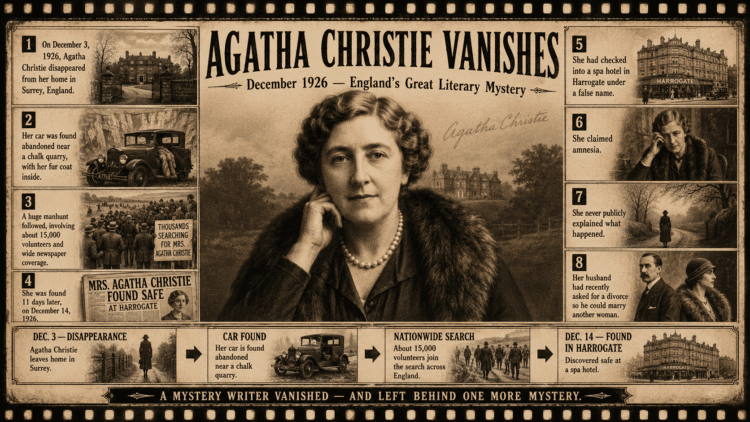
The Conversation: Where did Agatha Christie disappear to?
U.S. Life Expectancy: Males — 55.5 years | Females — 58.0 years
Top Ten Baby Names of 1926
Girls: Mary, Dorothy, Betty, Helen, Margaret Boys: Robert, John, William, James, Charles
The Stars
Josephine Baker, Dolores Costello, Marion Davies, Greta Garbo, Myrna Loy, Mary Pickford, Anna May Wong
Miss America
Norma Smallwood, Tulsa, OK — the first Native American to be crowned Miss America
The Quote
“We shall be able to communicate with one another instantly, irrespective of distance. Not only this, but we shall see and hear one another as perfectly as though we were face to face. A man will be able to carry one in his pocket.” — Nikola Tesla, 1926, describing what would become the smartphone — 81 years before the iPhone
We Lost in 1926
Rudolph Valentino, actor, died August 23, age 31, from complications of a perforated ulcer and peritonitis. The world’s most famous male sex symbol was gone in a matter of days. 100,000 people lined New York streets for his funeral. Fans rioted, smashed windows, and fought police to see his coffin. Reports of suicide attempts among distraught fans circulated widely. A mysterious “Lady in Black” left a red rose at his tomb every year on the anniversary of his death for decades. Annie Oakley, sharpshooter and Wild West performer, died on November 3 at the age of 66 Claude Monet, French Impressionist painter — died December 5, age 86 Eugene V. Debs, labor leader and five-time Socialist presidential candidate, died October 20, at age 70 Harry Houdini, escape artist and magician, died on October 31 (Halloween), age 52, from peritonitis following a ruptured appendix. A student had punched him repeatedly in the stomach on a dare on October 22. Houdini was famous for withstanding such blows, but this time he was unprepared. He performed several more shows before collapsing. Charles M. Russell, “cowboy artist” — died October 24, age 62
Born in 1926
An extraordinary collection of people arrived in 1926: Queen Elizabeth II (April 21) Harper Lee (April 28) Hugh Hefner (April 9) Jerry Lewis (March 16) Miles Davis (May 26) Tony Bennett (August 3) Andy Griffith (June 1) Mel Brooks (June 28) Marilyn Monroe (June 1, as Norma Jeane Baker)
The Conversation
Agatha Christie — already the world’s most popular mystery writer — vanished from her home in Surrey, England, on December 3, 1926. Her car was found abandoned near a chalk quarry with her fur coat inside. A massive manhunt involving 15,000 volunteers and several celebrity authors was launched. She was found 11 days later on December 14 and checked into a spa hotel in Harrogate under a false name. She claimed amnesia. She never explained what actually happened. The true reason for her disappearance has never been established. Her husband had recently asked for a divorce to marry another woman. Coincidence, presumably.
Firsts, Inventions, and Wonders
The first SATs were administered on June 23, 1926, called the Scholastic Aptitude Test. The name changed to Scholastic Assessment Test in 1990. The first college board exams were held in 1901.
The Oyster Watch — created by Rolex, not Timex — was the first waterproof wristwatch, unveiled in 1926. To demonstrate its waterproofing, a swimmer wore one across the English Channel.
The Brannock Device was patented in 1926 — the foot-measuring tool you step on at every shoe store in America. Its designer, Charles Brannock, spent seven years perfecting it. It has not changed significantly since.
Chock Full o’Nuts was founded in 1926 as a chain of nut shops. The coffee was added a few years later. The name stuck.
All Hass avocados in the world are descended from a single tree grafted by Rudolph Hass in La Habra Heights, California, in 1926. Every guacamole ever made traces back to that one tree.
Winnie-the-Pooh by A.A. Milne was published on October 14, 1926, with illustrations by E.H. Shepard. The bear was based on a real bear named Winnie, a Canadian black bear that had been a mascot of the Winnipeg regiment during WWI and lived at the London Zoo.
Stella Artois was launched in 1926 as a seasonal Christmas beer by a Belgian brewery in Leuven. It was intended as a one-time holiday product. It did not remain one.
U.S. Route 66 was established on November 11, 1926, running 2,448 miles from Chicago to Santa Monica. It became the most famous highway in America, the Main Street of the nation.
Maidenform’s modern brassiere was patented in 1926, introducing the concept of the shaped, supportive bra into mainstream fashion.
Phencyclidine — better known as PCP or angel dust — was first synthesized in 1926 as a research compound. Its recreational career came much later.
Scottish filmmaker John Grierson coined the word “documentary” in his 1926 review of Robert Flaherty’s film Moana.
Mercedes-Benz was founded on June 28, 1926, through the merger of Daimler and Benz, the two inventors who created the automobile.
The NBC radio network launched on November 15, 1926, with a four-hour gala broadcast from the Waldorf-Astoria ballroom in New York. It opened with 24 stations. Radio would now reach into virtually every American home.
The first commercial radio jingle aired on Christmas Eve 1926 on WCCO in Minneapolis — a Wheaties ad. The jingle format it established is still in use a century later.
The first pop-up toaster was introduced by the Waters-Genter Company in Minneapolis in 1926, ending the era of bread burned directly on open flames.
Kellogg’s Raisin Bran debuted in 1926. The two scoops came later.
The first canned ham was marketed by Hormel in Austin, Minnesota, in 1926. Spam would follow in 1937.
Kelley Blue Book was first published in 1926 by Leslie Kelley, establishing the standard reference for automobile valuations that is still used today.
The first automatic pop-up toaster — the Waters-Genter Toastmaster — went on sale in 1926, allowing Americans to stop burning their toast by hand.
Walter Varney founded United Airlines in 1926, beginning as a mail carrier before expanding to passenger service.
Ray-Ban was founded in 1926, originally producing anti-glare lenses for military aviators.
New words entering print for the first time in 1926: accident-prone, baguette, car park, deactivate, fantasize, hash browns, jumper cable, karate, little guy, and motor lodge.
Alan Turing — who would later break the Enigma code and found computer science — was born June 23, 1926.
The BBC, the British Broadcasting Corporation, formally became a public corporation in 1926, separating from private ownership.
Pop Culture Facts and History
America in 1926 was in full Roaring Twenties mode — Prohibition was the law, which meant speakeasies were everywhere, and Al Capone was effectively running Chicago. Jazz filled the air. Flappers danced the Charleston. The stock market was rising. Nobody was thinking about what was coming in 1929.
Rudolph Valentino — the first male sex symbol in Hollywood history — died August 23 at age 31, having been rushed to the hospital after collapsing at his New York hotel. He had been suffering from a perforated ulcer and appendicitis. The public reaction was unlike anything celebrity culture had seen before or would see again for decades. Riots outside the funeral home. Women fainting. Windows smashed. Fan suicide attempts reported. 100,000 mourners lined the streets of Manhattan. An estimated 200,000 people lined up to view his body. His estate at death included three Isotta Fraschini cars, a yacht, 40 suits, 50 pairs of shoes, 300 neckties, and 1,000 pairs of socks. He left his second ex-wife exactly $1.
A Chicago Tribune editorial had attacked Valentino months before his death as the cause of American male “effeminacy,” noting a powder puff dispenser in a hotel men’s room and blaming it on Hollywood in general and Valentino specifically. Valentino challenged the anonymous author to a boxing match. A surrogate showed up. Valentino knocked him to the ground. The exertion may have worsened his already deteriorating health.
On January 26, 1926, Scottish inventor John Logie Baird gave the first public demonstration of a working television system in London. The image was crude, flickering, and roughly the size of a postage stamp. It was television.
A BBC radio play broadcast in January 1926 — a comedy about a workers’ revolution in London — caused genuine public panic among listeners who missed the announcement that it was fiction. It was the first “War of the Worlds”-style broadcast panic in radio history, two years before anyone had heard of Orson Welles.
Gertrude Ederle became the first woman to swim the English Channel on August 6, 1926 — crossing the 21-mile strait in 14 hours, 31 minutes, breaking the men’s record by nearly two hours. She was 20 years old. New York gave her a ticker-tape parade.
Evangelist Aimee Semple McPherson disappeared from Venice Beach, Los Angeles, on May 18, 1926. A massive search was launched, and planes and ships were deployed. She reappeared in the Mexican desert five weeks later, claiming she had been kidnapped. Her story was widely disbelieved. The general consensus was that she had run off with her radio engineer. She was never charged and returned to her ministry.
Land at Broadway and Wall Street in New York City sold for a record $7 per square inch on February 1, 1926. The Manhattan real estate market was, apparently, already doing its thing.
On May 1, 1926, Ford Motor Company became the first major American employer to adopt a five-day, 40-hour workweek — paying $5 per day, which was considered very high at the time. The policy permanently transformed American labor expectations.
The Disney Brothers Cartoon Studio became the Walt Disney Studio in 1926.
The standard musical pitch — A = 440 Hz — became standardized in 1926. Before this, orchestras across the world tuned to slightly different pitches. Music has sounded the same ever since.
The Great Stork Derby was established by the will of Toronto eccentric Charles Vance Millar in 1926, offering $750,000 to whichever Toronto woman had the most babies in the decade following his death. Four women, each with nine children, shared the prize when the contest concluded in 1936, splitting the prize.
Ford’s Model T, produced from 1908 to 1927, was famously available in “any color you want, so long as it’s black.” This policy was actually relaxed starting in 1925 as competition from other manufacturers forced Ford’s hand.
In 1926, the U.S. federal government deliberately added toxic chemicals — including methanol, formaldehyde, and other poisonous substances — to industrial alcohol to deter people from drinking during Prohibition. The policy killed an estimated 10,000 Americans by the time Prohibition ended in 1933. The government knew it was lethal. It was deliberate.
Rin Tin Tin — a German Shepherd rescued from a WWI battlefield by an American soldier — was earning $6,000 per week as a film actor in 1926. He was reportedly the most popular film star in America and is widely credited with saving Warner Bros. from bankruptcy.
Sinclair Lewis declined the 1926 Pulitzer Prize for Arrowsmith, feeling that the selection criteria favored popularity over literary merit. He remains the only person ever to decline the Pulitzer Prize for fiction.
New York City passed laws in 1926 banning dancing in public establishments without a special cabaret license. The laws remained technically in force — and periodically enforced — for decades. The Footloose of their era.
Poland sent the United States a 150th birthday card in 1926 containing over 5 million signatures, 30,000 pages of art, poetry, photographs, and pressed flowers. Polish citizen Leopold Kotnowski personally presented it at the White House.
Arctic explorer Peter Freuchen was buried alive under an avalanche in 1926. He tunneled out by fashioning a makeshift tool from his own frozen feces and eventually had to amputate his own frozen foot. He survived, wrote a book about it, and later won a game show.
Bobby Jones won both the U.S. Open and the British Open golf championships in 1926 — becoming the first player to win both titles in the same year, cementing his reputation as the greatest golfer of the era.
Jack Dempsey lost the heavyweight championship to Gene Tunney on September 23, 1926, in one of the biggest upsets in boxing history to that point. Dempsey had been considered unbeatable.
Babe Ruth hit three home runs in a single World Series game on October 6, 1926 — a record that stood for decades. The Yankees still lost the Series to the Cardinals in seven games.
The First Radio Jingle
The first commercial jingle ever broadcast was a Wheaties ad aired on Christmas Eve 1926 on WCCO, Minneapolis. The four-man quartet sang about how good Wheaties tasted. The format immediately spread to every product sold in America.
The Habit
Listening to the radio, dancing the Charleston, reading The Great Gatsby(published 1925 but ubiquitous in 1926)
Christmas Gifts and Firsts of 1926
Winnie-the-Pooh books, erector sets, chemistry sets, bicycles, and the newly available pop-up toaster for the home
Nobel Prize Winners
Physics — Jean Baptiste Perrin Chemistry — Theodor Svedberg Medicine — Johannes Andreas Grib Fibiger Literature — Grazia Deledda Peace — Aristide Briand and Gustav Stresemann Economics — Prize not yet established (first awarded 1969)
Popular and Best-Selling Books of 1926
After Noon — Susan Ertz Beau Geste — P.C. Wren Beau Sabreur — P.C. Wren The Blue Window — Temple Bailey Gentlemen Prefer Blondes — Anita Loos The Hounds of Spring — Sylvia Thompson The Private Life of Helen of Troy — John Erskine Show Boat — Edna Ferber The Silver Spoon — John Galsworthy Sorrell and Son — Warwick Deeping Winnie-the-Pooh — A.A. Milne and E.H. Shepard
Broadway in 1926
Notable 1926 Broadway productions included The Desert Song — a Sigmund Romberg operetta that became one of the biggest hits of the decade — and Americana, a revue that helped launch the careers of several comedic talents.
Best Film Oscar Winner
The Academy Awards did not exist until 1929. The first ceremony honored films from 1927–1928. There is no Oscar winner for 1926.
The Bomb
Movie: Ben-Hur (1925 release, still dominating 1926) — was actually a spectacular success, not a bomb. The real bomb was nearly every imitation biblical epic that followed it. The Roaring Twenties themselves — an era of excess so complete that when it ended in 1929, it took the entire global economy with it.
Top Movies of 1926
The Son of the Sheik
The General
Beau Geste
What Price Glory?
The Scarlet Letter
Moana
The Bat
Faust
Don Juan
For Heaven’s Sake
Most Popular Radio Shows of 1926
(The NBC network launched on November 15, 1926 — before that, radio was a patchwork of local stations)
Sam ‘n’ Henry (WGN Chicago — debuted January 12, later became Amos ‘n’ Andy) The Eveready Hour (first variety show in radio history) The A&P Gypsies (NBC) The Happiness Boys (NBC) Local dance band broadcasts from ballrooms and hotels across the country.
Biggest Pop Artists of 1926
Gene Austin, Franklyn Baur, Ben Bernie and His Orchestra, Henry Burr, Vernon Dalhart, Ruth Etting, Johnny Hamp and His Orchestra, Al Jolson, Isham Jones and His Orchestra, Roger Wolfe Kahn and His Orchestra, Benny Krueger and His Orchestra, Ted Lewis and His Band, Vincent Lopez and His Orchestra, Nick Lucas, Johnny Marvin, John McCormack, George Olson and His Orchestra, The Revelers, Harry Richman, Bessie Smith, Whispering Jack Smith, Fred Waring’s Pennsylvanians, Ethel Waters, Paul Whiteman and His Orchestra
1926 Billboard — Most Popular Songs
(The Billboard Hit Parade chart did not launch until January 1936 — popularity in 1926 was tracked by sheet music sales, phonograph records, and radio airplay)
Most popular songs of 1926 included: When the Red, Red Robin (Comes Bob, Bob, Bobbin’ Along) — Al Jolson Always — George Olson and His Orchestra The Blue Room — The Revelers Someone to Watch Over Me — Gertrude Lawrence (from Oh, Kay! — Gershwin) Five Foot Two, Eyes of Blue — Gene Austin Baby Face — Jan Garber Valencia — Paul Whiteman I’d Climb the Highest Mountain — Ruth Etting Bye Bye Blackbird — Nick Lucas Clap Yo’ Hands — Fred Waring’s Pennsylvanians
Sports Champions of 1926
World Series: St. Louis Cardinals Stanley Cup: Montreal Maroons U.S. Open Golf: Bobby Jones U.S. Open Tennis — Men: René Lacoste | Women: Molla Bjurstedt Mallory Wimbledon — Men: Jean Borotra | Women: Kathleen Godfree NCAA Football: Alabama and Stanford (shared) Kentucky Derby: Bubbling Over Boston Marathon: Johnny Miles — 2:25:40
Sports Highlight: Gene Tunney defeated Jack Dempsey on September 23, 1926, for the heavyweight championship — one of the biggest upsets in boxing history. Dempsey had been considered unbeatable. Bobby Jones won both the U.S. and British Opens in the same year, the first golfer to do so.
NFL Trivia: One of only five NFL games ever to end 2–0 was played on November 21, 1926 — Kansas City Cowboys 2, Buffalo Rangers 0.
FAQ — 1926 Trivia, Fun Facts, and Pop Culture History
Q: What was the biggest scientific achievement of 1926? A: Robert Goddard launched the world’s first liquid-fueled rocket on March 16, 1926, in Auburn, Massachusetts. It flew 184 feet. The same principle carried humans to the moon 43 years later.
Q: What famous writer disappeared in 1926? A: Agatha Christie vanished from her home on December 3, 1926. She was found 11 days later at a hotel spa in Harrogate, registered under a false name. She claimed amnesia and never explained what had happened.
Q: What sex symbol died in 1926 and caused mass hysteria? A: Rudolph Valentino, Hollywood’s first male sex symbol, died August 23, 1926, at age 31. An estimated 100,000 people lined the streets of New York for his funeral. Mourners rioted outside the funeral home. Reported suicides among fans made international news.
Q: What major highway opened in 1926? A: U.S. Route 66 was established on November 11, 1926, running 2,448 miles from Chicago to Santa Monica. It became the most iconic road in American history.
Q: What famous children’s book debuted in 1926? A: Winnie-the-Pooh by A.A. Milne, illustrated by E.H. Shepard, was published on October 14, 1926. The bear was based on a real Canadian black bear named Winnie, who had lived at the London Zoo.
Q: What did Nikola Tesla predict in 1926? A: In a 1926 interview, Tesla described a future device that would allow instant wireless communication, seeing and hearing others “as perfectly as though we were face to face” — and predicted a man would be able to carry one in his pocket. He was describing the smartphone, 81 years early.
Q: What did the U.S. government do to alcohol in 1926? A: During Prohibition, the U.S. government deliberately poisoned industrial alcohol with toxic chemicals, including methanol, to deter drinking. The policy killed an estimated 10,000 Americans before Prohibition ended in 1933.
Q: What famous broadcaster launched in 1926? A: NBC launched on November 15, 1926, with a four-hour gala broadcast from the Waldorf-Astoria. It was the first national radio network in America.
Q: What revolutionary labor policy did Ford introduce in 1926? A: Ford Motor Company became the first major American company to adopt a five-day, 40-hour work week on May 1, 1926, paying workers $5 per day — permanently shifting expectations for American labor.
Q: What avocado fact traces back to 1926? A: Every Hass avocado in the world — the variety used in virtually all guacamole — is descended from a single tree grafted by Rudolph Hass in California in 1926.