1913 History, Facts, and Trivia
Quick Facts from 1913
- World-Changing Event: The Ford Motor Company introduced the moving assembly line on December 1, 1913, at its Highland Park plant in Michigan, reducing chassis assembly time from 12 hours and 30 minutes to 2 hours and 40 minutes — and permanently changing the relationship between workers, wages, and manufactured goods
- America-Changing Event: The 16th Amendment, ratified February 3, 1913, gave Congress the power to levy a federal income tax. The 17th Amendment, ratified on April 8, changed how senators were chosen, moving from appointment by state legislatures to direct popular election. Two constitutional amendments in one year, both still shaping daily American life
- Top Song: You Made Me Love You by Al Jolson
- Must-See Movies: Fantomas, Tarzan of the Apes (serial), and the first film adaptations of George Bernard Shaw’s Pygmalion
- Notable Books: Sons and Lovers by D.H. Lawrence and O Pioneers by Willa Cather
- Chinese Zodiac: Year of the Ox, associated with diligence, reliability, and a quiet resistance to being rushed
- The Conversation: Have you tried the new crossword puzzle in the World? And what do you make of this income tax business?
Top Ten Baby Names of 1913
Girls: Mary, Helen, Dorothy, Margaret, Ruth
Boys: John, William, James, Robert, Joseph
U.S. Life Expectancy in 1913
Males: 50.3 years; Females: 55.0 years
We Lost in 1913
Harriet Tubman, conductor of the Underground Railroad, Union spy, and one of the most consequential figures in American history, died March 10, 1913, at approximately age 90 or 91 in Auburn, New York. Her last words, to the friends gathered around her, were: “I go to prepare a place for you.”
Alfred Russell Wallace, a British naturalist who independently developed the theory of natural selection at the same time as Charles Darwin and prompted Darwin to finally publish On the Origin of Species, died January 7, 1913, at age 90.
Rudolf Diesel, inventor of the diesel engine, disappeared from the steamship Dresden on the night of September 29, 1913, while crossing the English Channel from Antwerp to Harwich. His body was found floating in the sea ten days later. Whether it was suicide, accident, or foul play has never been established.
Ambrose Bierce, journalist, satirist, and author of The Devil’s Dictionary, wrote a letter from Chihuahua, Mexico, in December 1913 describing his intentions and then vanished. He was traveling with Pancho Villa’s forces during the Mexican Revolution. He was never seen or heard from again. He was 71.
Born in 1913
Richard Nixon — born January 9, 1913, in Yorba Linda, California; the 37th President of the United States.
Gerald Ford — born July 14, 1913, in Omaha, Nebraska; the 38th President and the only person to serve as both Vice President and President without being elected to either office.
Rosa Parks — born February 4, 1913, in Tuskegee, Alabama; the civil rights activist whose refusal to give up her bus seat in Montgomery in 1955 became one of the defining moments of the American civil rights movement.
Vince Lombardi — born June 11, 1913, in Brooklyn, New York; the football coach whose name became synonymous with winning.
America in 1913 — The Context
Woodrow Wilson was inaugurated on March 4, 1913, as the 28th President of the United States, defeating the incumbent Taft and the insurgent Theodore Roosevelt in one of the most fractured elections in American history. Wilson moved quickly. By the end of the year, he had signed the Federal Reserve Act, creating the central banking system. The income tax had been ratified. The direct election of senators had become law. It was an unusually productive year for constitutional change, most of it still intact.
The country was industrializing at a pace that was producing enormous wealth and enormous misery simultaneously. The Ford assembly line that debuted in December 1913 would, within two years, double workers’ wages and halve the price of the Model T — a combination that effectively created the American middle class and the consumer economy that has defined the country since.
The Ford Assembly Line
Henry Ford did not invent the assembly line. He perfected it. On October 7, 1913, Ford’s Highland Park plant introduced a moving chassis assembly line for the Model T, inspired in part by the overhead trolley systems used in Chicago meatpacking plants. Assembly time fell from 12 hours 30 minutes to 2 hours 40 minutes almost immediately, and continued to drop. By 1914, Ford was paying workers $5 a day — double the industry standard — which he understood was necessary both to reduce turnover and to ensure his workers could afford to buy the cars they were building.
The price of a Model T fell from $850 in 1909 to $350 in 1915 and eventually to $250 in the 1920s. Mass production had created mass consumption. The 20th century had found its economic engine.
The Armory Show
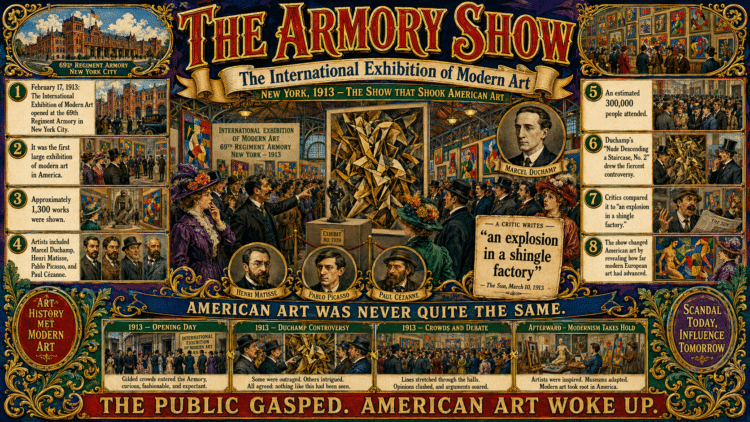
The International Exhibition of Modern Art opened on February 17, 1913, at the 69th Regiment Armory in New York City. It was the first large exhibition of modern art in America, showing approximately 1,300 works by artists including Marcel Duchamp, Henri Matisse, Pablo Picasso, and Paul Cézanne. An estimated 300,000 people attended.
Duchamp’s Nude Descending a Staircase, No. 2 drew the most controversy. Critics called it an explosion in a shingle factory. The public lined up to see it. American art was never quite the same after the show, largely because American artists realized the rest of the world had moved significantly further ahead than they had known.
The Great Gettysburg Reunion
In June and July 1913, on the 50th anniversary of the Battle of Gettysburg, more than 50,000 veterans from both the Union and Confederate armies gathered at the battlefield. Two veterans from opposing sides purchased a hatchet, walked together to the ground where their regiments had fought, and buried it. Union and Confederate veterans shook hands across the stone wall at Pickett’s Charge. No altercations were reported. The reunion is remembered as one of the most remarkable moments of American reconciliation in the century following the Civil War.
The Panama Canal
President Woodrow Wilson triggered the explosion of the Gamboa Dike on October 10, 1913, effectively completing construction of the Panama Canal, which connects the Atlantic and Pacific Oceans through Central America. The canal had taken ten years and an estimated 25,000 lives to build. It opened to commercial traffic in August 1914.
Pop Culture Facts and History
The first crossword puzzle was published on December 21, 1913, in the New York World newspaper, created by journalist Arthur Wynne. He called it a “word-cross.” The name was reversed to “crossword” in subsequent publications, apparently by typesetters. The New York Times famously refused to run crossword puzzles for decades, considering them beneath the paper’s dignity, before finally capitulating in 1942.
The Lincoln Highway was officially dedicated on October 31, 1913 — the first automobile road spanning the continental United States, running from Times Square in New York to Lincoln Park in San Francisco, approximately 3,389 miles. It was not yet fully paved and required considerable optimism to traverse in an era’s motor car.
Grand Central Terminal reopened on February 2, 1913, having been completely rebuilt. It remains the largest train station in the world by number of platforms: 44 platforms and 67 tracks. Its main concourse ceiling, painted with the constellations of the winter sky, is one of the most recognized interior spaces in America — rendered, perhaps intentionally, backward from how the constellations actually appear, as if viewed from outside the celestial sphere looking in.
The Federal Reserve System was created by President Wilson’s signature of the Federal Reserve Act on December 23, 1913, establishing the central banking system of the United States. The Fed has been the subject of controversy, conspiracy theories, and economic dissertations ever since, which suggests it has been consequential.
Before the income tax was enacted in 1913, the federal government derived up to 40% of its revenue from alcohol taxes. This dependence on alcohol revenue was one reason Prohibition, ratified in 1919, required that the income tax already be in place: the government needed a replacement revenue source before it could afford to ban the one it had been relying on.
Before the 17th Amendment, U.S. senators were chosen by state legislatures rather than by voters. The change to direct popular election was part of the Progressive Era’s broader effort to reduce the influence of political machines and corporate interests over government appointments.
Camel cigarettes went on sale for the first time in 1913, introduced by R.J. Reynolds. They were the first nationally branded cigarettes and helped create the modern American tobacco market. The iconic camel on the packaging was based on a dromedary named Old Joe, a circus animal photographed during a company promotional tour.
Cracker Jack added the toy surprise to its packages in 1913, after it had been sold without one since 1896. The phrase “prize inside” became part of the American commercial vernacular and has been associated with the product ever since.
Alfred Carlton Gilbert introduced the Erector Set in 1913, inspired by the steel-girder construction he had observed while riding a train past electrical towers. It became one of the best-selling toys in American history and is credited with inspiring a generation of engineers.
Krazy Kat by George Herriman debuted in the New York Evening Journal in 1913, initially as a subsidiary strip below another comic. It became one of the most celebrated American comic strips in history, beloved by artists and intellectuals for its surreal humor and its gentle, endlessly optimistic love story between a cat and a mouse.
The clothing zipper was invented in 1913, though it did not become widely used until the 1930s, when the fashion industry and the military both adopted it in quantity. The original design was called the “hookless fastener.”
The Actors’ Equity Association was founded in 1913 to protect theatrical performers’ labor rights. It remains the union representing professional stage actors and stage managers in the United States.
The term “lucid dreaming” was coined in 1913 by Dutch psychiatrist Frederik van Eeden, who had been keeping a detailed dream journal since 1898, and defined it to describe the state of being aware that one is dreaming while the dream is in progress.
The hottest temperature ever reliably recorded on Earth occurred on July 10, 1913, in Furnace Creek, Death Valley, California: 134 degrees Fahrenheit. The record still stands, though a 1922 reading in Libya of 136 degrees was discredited in 2012 after reanalysis.
The greatest single-day snowfall in recorded U.S. history occurred on December 4-5, 1913, in Georgetown, Colorado: 63 inches — five feet and three inches — in one day.
Owens Lake in southeastern California has been primarily dry since 1913, when the Los Angeles Department of Water and Power diverted the Owens River southward through the Los Angeles Aqueduct to supply the growing city. The dry lakebed is now the largest single source of dust pollution in the United States, generating thousands of tons of fine particulate matter annually.
Igor Stravinsky’s The Rite of Spring premiered at the Théâtre des Champs-Élysées in Paris on May 29, 1913, choreographed by Vaslav Nijinsky and performed by Sergei Diaghilev’s Ballets Russes. The audience rioted. Whether the disturbance was about the dissonant, percussive score, Nijinsky’s unconventional choreography, or simply the Parisian temperament that evening has never been definitively settled. The work is now considered one of the most important compositions of the 20th century.
Sigmund Freud, Joseph Stalin, Adolf Hitler, and Leon Trotsky were all living in Vienna in early 1913 and all, at various times, frequented the Café Central at Herrengasse 14 in the city’s first district. Whether they were ever all present simultaneously is not documented. The café is still open.
The Little Mermaid statue in Copenhagen, based on Hans Christian Andersen’s fairy tale and created by sculptor Edvard Eriksen, was completed in 1913 and unveiled on August 23 at the Langelinie promenade, where it has sat ever since — except for the numerous times it has been vandalized, beheaded, or temporarily removed for various reasons.
Wilson Sporting Goods was founded in 1913 to make use of animal by-products from New York slaughterhouses. Its first products were strings for tennis rackets and violins. It went on to become one of the world’s largest sporting goods companies. The relationship between livestock processing and professional tennis equipment is not something the company emphasizes in its current marketing.
Death Valley, California, recorded the highest temperature in recorded human history on July 10, 1913: 134.1 degrees Fahrenheit. No living thing that was not underground, underwater, or in a building with reasonable airflow was comfortable.
Thomas Jefferson had begun the practice of sending written State of the Union messages to Congress, rather than delivering them in person. Every president had followed his example for over a century. Woodrow Wilson broke with that tradition in 1913 and delivered his State of the Union address in person before a joint session of Congress, reviving George Washington’s original practice. Every president since has delivered it in person.
The Monte Carlo Fallacy — also known as the Gambler’s Fallacy — takes its name from a famous incident in 1913 at the Casino de Monte-Carlo, where the roulette ball landed on black 26 consecutive times. Gamblers, convinced that red was now “due,” lost enormous sums betting against black with each successive spin. The odds of black appearing 26 times in a row are approximately 1 in 136.8 million. The odds on the 27th spin were still exactly 50-50.
Rosa Parks was born on February 4, 1913. Gerald Ford was born on July 14, 1913. Richard Nixon was born on January 9, 1913. Three people whose lives would intersect with defining moments of American history — the civil rights movement, Watergate, and the only presidential resignation — were all born within six months of each other in 1913.
The Leo Frank Case
On April 26, 1913, 13-year-old Mary Phagan was murdered at the National Pencil Factory in Atlanta, Georgia. Leo Frank, the factory’s Jewish superintendent, was tried and convicted under circumstances widely considered a miscarriage of justice, with significant anti-Semitic sentiment driving the prosecution and the public response. He was sentenced to death. In 1915, the governor of Georgia commuted his sentence to life imprisonment. Two months later, a mob abducted Frank from the state prison farm and lynched him. The case directly contributed to the founding of the Anti-Defamation League in 1913 and the revival of the Ku Klux Klan in 1915.
Nobel Prize Winners
Physics — Heike Kamerlingh Onnes, for his investigations on the properties of matter at low temperatures, which led to the production of liquid helium and the discovery of superconductivity
Chemistry — Alfred Werner, for his work on the linking of atoms within molecules, laying the foundation for modern coordination chemistry
Medicine — Charles Richett, for his work on anaphylaxis, the discovery of severe allergic reactions, which remains the basis of allergy medicine today
Literature — Rabindranath Tagore, Indian poet, philosopher, and artist; the first non-European to win the Nobel Prize in Literature, recognized for his profoundly sensitive, fresh, and beautiful verse
Peace — Henri La Fontaine, Belgian international lawyer and president of the International Peace Bureau, was awarded for decades of work promoting international arbitration
Broadway in 1913
The Palace Theater opened on March 24, 1913, at 1564 Broadway, New York City, and quickly became the most prestigious vaudeville venue in America. Playing the Palace was the pinnacle of a vaudeville performer’s career. It remains in operation today.
Sweethearts opened September 8, 1913, with music by Victor Herbert and became one of the most successful operettas of the season, running 136 performances at the New Amsterdam Theatre.
Top Movies of 1913
- Fantomas
- The Student of Prague
- Judith of Bethulia
- The Mothering Heart
- The Battle at Elderbush Gulch
- The Reformers
- Suspense
- The House of Discord
- A Ride for a Bride
- The Vengeance of Durand
Popular and Best-Selling Books of 1913
The Inside of the Cup — Winston Churchill
V.V.’s Eyes — Henry Sydnor Harrison
Laddie — Gene Stratton-Porter
The Judgment House — Sir Gilbert Parker
Heart of the Hills — John Fox Jr.
The Amateur Gentleman — Jeffrey Farnol
Pollyanna — Eleanor H. Porter
The Woman Thou Gavest Me — Hall Caine
The Valiants of Virginia — Hallie Erminie Rives
T. Tembarom — Frances Hodgson Burnett
Crowds — Gerald Stanley Lee
Germany and the Germans — Price Collier
The New Freedom — Woodrow Wilson
Psychology and Industrial Efficiency — Hugo Munsterberg
Sons and Lovers — D.H. Lawrence
O Pioneers — Willa Cather
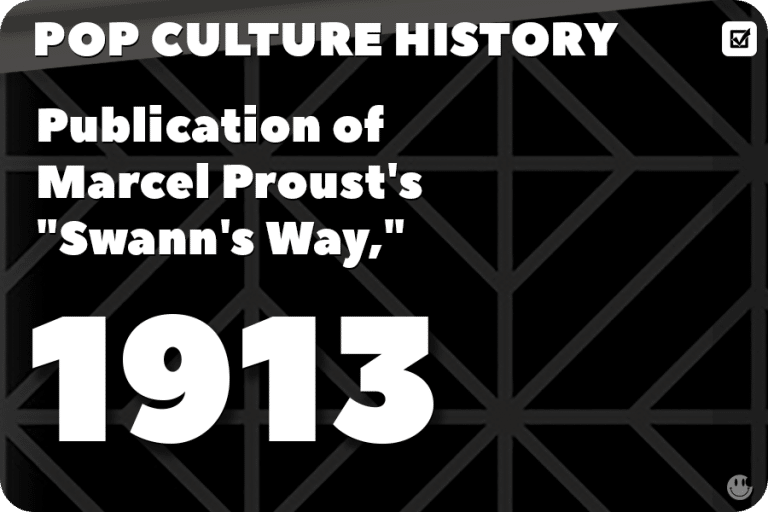
Swann’s Way — Marcel Proust
Principia Mathematica — Alfred North Whitehead and Bertrand Russell
An Economic Interpretation of the Constitution — Charles Beard
Biggest Pop Artists of 1913
The American Quartet, Elsie Baker, Henry Burr, Albert Campbell, Enrico Caruso, Helen Clark, Arthur Collins, Byron G. Harlan, Charles Harrison, The Hayden Quartet, Al Jolson, Ada Jones, Olive Kline, Christie MacDonald, Harry Macdonough, John McCormack, Billy Murray, Will Oakland, Chauncey Olcott, The Peerless Quartet, Walter Van Brunt, Reinald Werrenrath, Bert Williams
Sports Champions of 1913
World Series: Philadelphia Athletics — defeated the New York Giants 4-1; pitcher Chief Bender won twice; it was the third championship in four years for Connie Mack’s Athletics dynasty
Challenge Cup: Quebec Bulldogs — successfully defending their 1912 title
U.S. Open Golf: Francis Ouimet, a 20-year-old amateur and former caddy at The Country Club in Brookline, Massachusetts, defeated the two greatest professional golfers in the world, Harry Vardon and Ted Ray, in an 18-hole playoff to win the U.S. Open; the upset is considered the most important moment in American golf history
U.S. Open Tennis: Men/Women: Maurice McLoughlin / Mary Browne
Wimbledon: Men/Women: Anthony Wilding / Dorothea Lambert Chambers
NCAA Football Champions: Harvard (9-0)
Kentucky Derby: Donerail — at 91-1 odds, the longest-shot winner in Kentucky Derby history; a $2 bet paid $184.90
Boston Marathon: Fritz Carlson, 2:25:14
Sports Highlight: Francis Ouimet’s U.S. Open victory is one of the defining moments in the history of American golf. He was a 20-year-old former caddy who had learned the game at the course where the championship was being held. He defeated Vardon and Ray — the two dominant professionals of the era — in a playoff the day after the three finished tied. His caddy was a 10-year-old named Eddie Lowery who had skipped school to carry his bag. Donerail’s Kentucky Derby win at 91-1 remains the longest winning odds in race history.
FAQs: 1913 History, Facts, and Trivia
Q: What two constitutional amendments were ratified in 1913?
A: The 16th Amendment, ratified February 3, gave Congress the power to levy a federal income tax. The 17th Amendment, ratified April 8, established the direct election of U.S. senators by popular vote, replacing selection by state legislatures. Both remain in effect today.
Q: What did the Ford assembly line do in 1913?
A: Introduced at the Highland Park plant on October 7, 1913, it reduced chassis assembly time from 12 hours 30 minutes to 2 hours 40 minutes. Combined with the $5 daily wage Ford introduced the following year, it created the conditions for both mass production and mass consumption that defined 20th-century American economic life.
Q: What was the Armory Show, and why did it matter?
A: The International Exhibition of Modern Art, held at the 69th Regiment Armory in New York from February 17, 1913, was the first major exhibition of European modern art in America, featuring works by Picasso, Matisse, Cézanne, and Duchamp. It permanently changed American art by confronting artists and the public with developments in Europe they had not yet seen.
Q: What was the first crossword puzzle, and when was it published?
A: Arthur Wynne published a “word-cross” puzzle in the New York World on December 21, 1913. The name was later reversed to “crossword” by subsequent typesetters. The New York Times refused to publish crossword puzzles until 1942.
Q: What was Francis Ouimet’s significance in golf?
A: A 20-year-old amateur and former caddy at The Country Club in Brookline, Massachusetts, Ouimet defeated world-famous professionals Harry Vardon and Ted Ray in an 18-hole playoff to win the 1913 U.S. Open. The upset transformed golf from an elite sport associated with the wealthy into a game that ordinary Americans felt they could play and follow.
Q: What is the hottest temperature ever reliably recorded on Earth?
A: 134 degrees Fahrenheit, recorded on July 10, 1913, in Furnace Creek, Death Valley, California. The record still stands.
Q: Who were the famous people born in 1913?
A: Richard Nixon (January 9), Rosa Parks (February 4), Gerald Ford (July 14), and Vince Lombardi (June 11) were all born in 1913. Nixon and Ford both became presidents; Parks became one of the most important figures in the civil rights movement; Lombardi became the most celebrated coach in NFL history. It was a productive year for future American icons.
Q: What was the longest-shot winner in Kentucky Derby history?
A: Donerail in 1913, at odds of 91-1. A $2 bet returned $184.90. The record has never been broken.
More 1913 Facts & History Resources:
Most Popular Baby Names (BabyCenter.com)
Popular and Notable Books (popculture.us)
Broadway Shows that Opened in 1913
1913 Calendar, courtesy of Time and Date.com
Fact Monster
1913 in Movies (according to IMDB)
Wikipedia 1913