1917 History, Facts, and Trivia
Quick Facts from 1917
- World-Changing Event: The United States declared war on Germany on April 6, 1917, entering World War I after nearly three years of official neutrality. The Zimmermann Telegram — a secret German proposal offering Mexico its lost territories in exchange for joining the war against the U.S. — had been intercepted and published weeks earlier. The country that had elected Woodrow Wilson partly on the slogan “He kept us out of war” was now in it.
- Other World-Changing Event: The Russian Revolution of 1917 overthrew Czar Nicholas II in February and then, in October, brought Vladimir Lenin’s Bolsheviks to power, creating the Soviet Union and permanently dividing the world’s political map for the next 70 years
- Top Songs: Over There by George M. Cohan, For Me and My Gal by various artists, and They Go Wild Simply Wild Over Me by the American Quartet
- Must-See Movies: The Poor Little Rich Girl with Mary Pickford and Cleopatra with Theda Bara
- Notable Books: T.S. Eliot’s Prufrock and Other Observations and On Growth and Form by D’Arcy Wentworth Thompson
- Chinese Zodiac: Year of the Snake, associated with wisdom, intuition, and a talent for navigating complicated situations — a skill in high demand in 1917
- The Conversation: Did you hear the Germans offered Mexico Texas, Arizona, and New Mexico to fight us? And now we’re in the war.
Top Ten Baby Names of 1917
Girls: Mary, Helen, Dorothy, Margaret, Ruth Boys: John, William, James, Robert, Joseph
U.S. Life Expectancy in 1917
Males: 48.4 years; Females: 54.0 years
These numbers were about to get significantly worse. The Spanish Flu pandemic, which began in 1918, was so catastrophic that it caused average male life expectancy in the United States to drop from 48.4 years to 36.6 years, and female life expectancy from 54.0 years to 42.2 years — a collapse of more than a decade in a single year.
We Lost in 1917
Edgar Degas, a French Impressionist painter, one of the founders of the movement and its most celebrated practitioner of the human figure in motion, died September 27, 1917, at age 83 in Paris.
Auguste Rodin, a French sculptor, creator of The Thinker and The Kiss, and one of the most influential artists of the 19th century, died on November 17, 1917, at age 77.
Buffalo Bill Cody, William Frederick Cody, the showman, scout, and symbol of the American West whose Wild West shows had defined frontier mythology for three decades, died January 10, 1917, at age 70.
Born in 1917
John F. Kennedy — born May 29, 1917, in Brookline, Massachusetts; the 35th President of the United States.
Ella Fitzgerald — born April 25, 1917, in Newport News, Virginia; the First Lady of Song and one of the greatest jazz vocalists in American history.
America in 1917 — The Context
Woodrow Wilson was inaugurated for his second term on March 5, 1917, having won re-election the previous November partly on the strength of keeping the country out of war. The neutrality lasted about a month into his new term. Germany had resumed unrestricted submarine warfare in February, and the Zimmermann Telegram — intercepted by British intelligence and shared with the U.S. — confirmed that Germany was actively trying to open a second front against America through Mexico. Wilson asked Congress for a declaration of war on April 2. Congress voted yes on April 6. The war that had killed millions of Europeans for nearly three years had found its American chapter.
Puerto Ricans were granted U.S. citizenship by the Jones-Shafroth Act, signed on March 2, 1917, two months before the first draft registration, which would send many of them into military service.
The first Pulitzer Prizes were awarded on June 4, 1917, established under the terms of newspaper publisher Joseph Pulitzer’s will. The first journalism prize went to Herbert Bayard Swope of the New York World. The first history prize went to Jean Jules Jusserand. The prizes that would come to define American journalism and letters had begun.
The United States Enters World War I
Germany had announced in January 1917 that it would resume unrestricted submarine warfare — sinking any ship, including those of neutral nations, found in its declared war zones. American merchant ships began going down. Then British intelligence shared the Zimmermann Telegram, in which German Foreign Minister Arthur Zimmermann had secretly proposed to Mexico that if the U.S. entered the war, Germany would help Mexico recover Texas, Arizona, and New Mexico.
The telegram was published in American newspapers on March 1, 1917. Wilson severed diplomatic relations with Germany. Three weeks later, German submarines sank several American merchant vessels. Wilson went before Congress on April 2 and asked for a declaration of war, telling the chamber: “The world must be made safe for democracy.”
The Senate voted 82-6 in favor. The House voted 373-50. The only member of Congress to vote against war in both World War I and World War II was Jeannette Rankin of Montana — the first woman ever elected to Congress — who voted no in both 1917 and 1941 and served two non-consecutive terms. She remains the only person to have cast that vote twice.
When American troops arrived in Paris, they stopped at the grave of the Marquis de Lafayette — the French Revolutionary War hero who had helped win American independence — which had been filled with soil from the United States. Captain Charles Stanton of the American Expeditionary Forces declared, “Lafayette, we are here.”
The Russian Revolution
In February 1917, food riots and strikes in Petrograd escalated into a full-scale revolution. Czar Nicholas II abdicated on March 15, ending three centuries of Romanov rule. A provisional government took power. In October, Lenin’s Bolsheviks staged a second revolution, seizing control of the government and establishing what would become the Soviet Union. Russia signed an armistice with Germany in December 1917 and withdrew from the war entirely in 1918.
The collapse of the Russian Empire and the rise of Soviet communism reshaped the 20th century more profoundly than almost any other single event. The Cold War, the nuclear arms race, and the division of the world into competing ideological blocs all trace their origins to the events of October 1917 in Petrograd.
The Halifax Explosion
On December 6, 1917, the French cargo ship SS Mont-Blanc — loaded with approximately 2,900 tons of explosive materials including TNT, picric acid, and benzol — collided with the Norwegian vessel SS Imo in Halifax Harbour, Nova Scotia. The resulting fire and explosion killed approximately 2,000 people, injured 9,000 more, and destroyed a square mile of the city. It was the largest man-made explosion in history prior to the development of nuclear weapons. Windows were shattered 50 miles away. The explosion was felt 200 miles distant. The cities of Halifax and Boston have exchanged Christmas trees annually since then, with Halifax sending a tree to Boston in gratitude for the aid Boston provided in the immediate aftermath.
The Zimmermann Telegram
On January 19, 1917, German Foreign Minister Arthur Zimmermann sent a coded telegram to the German ambassador in Mexico City, proposing a military alliance. If the United States entered the war against Germany, Germany would help Mexico recover Texas, Arizona, and New Mexico. British intelligence intercepted and decoded the message. It was published in American newspapers on March 1. Whatever remained of American reluctance to enter the war largely evaporated.
The Cottingley Fairies
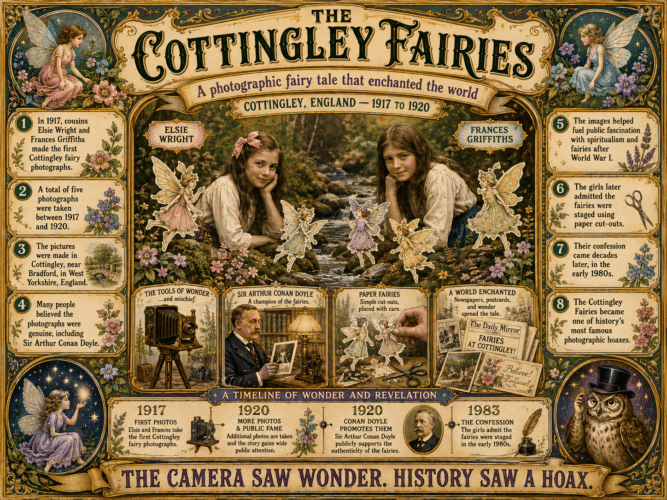
The Cottingley Fairies photographs were taken in the summer of 1917 by cousins Elsie Wright, 16, and Frances Griffiths, 10, in the beck behind the Wright family home in Cottingley, England. The photos appeared to show the girls surrounded by small winged fairies. The girls showed the photographs to Elsie’s mother, who showed them to a member of the Theosophical Society, who eventually got them to Arthur Conan Doyle — creator of Sherlock Holmes, committed spiritualist, and, in this particular instance, a man willing to set aside his fictional detective’s entire operating philosophy.
Doyle was convinced the photographs were genuine and used them as the centerpiece of a 1920 article in The Strand Magazine titled “Fairies Photographed.” The article caused a sensation. Photographic and optical experts examined the images and offered divided opinions. The public largely wanted to believe. Doyle wrote an entire book on the subject in 1922: The Coming of the Fairies.
The cousins maintained their story for over 60 years. Frances finally admitted the truth in a 1981 interview: the fairies were cardboard cutouts traced from a popular children’s book, Princess Mary’s Gift Book, propped up with hatpins. Elsie confirmed it shortly after. Frances, however, insisted to her death in 1986 that the fifth and final photograph — taken later than the others — was genuine. It was not.
The most celebrated fictional detective in the English language was created by a man who was fooled for six decades by two girls with scissors, cardboard, and hatpins. Sherlock Holmes would not have been amused.
Pop Culture Facts and History
The “I Want You” Uncle Sam recruitment poster was painted in 1917 by artist James Montgomery Flagg. The face of Uncle Sam is Flagg’s own, aged and given a goatee to suggest age. He used himself as a model to avoid the expense and trouble of finding one. The pose was inspired by the 1914 British “Lord Kitchener Wants You” poster. Flagg’s poster became the most-reproduced poster in American history, with an estimated 4 million copies printed.
The Converse All-Star basketball shoe was introduced in 1917 by the Converse Rubber Shoe Company of Malden, Massachusetts. Chuck Taylor, the basketball player and salesman whose name was added to the ankle patch in 1932, played a major role in popularizing the shoe nationally. The “Chuck Taylor All-Star” has been in continuous production ever since, making it one of the longest-running shoe designs in history.
The self-service grocery store concept was introduced by Clarence Saunders at Piggly Wiggly in Memphis, Tennessee, in 1916, and had spread significantly by 1917. Before Piggly Wiggly, customers handed a list to a clerk who retrieved everything from behind the counter. The idea of walking through a store and selecting items from shelves — an arrangement so fundamental to retail that it is now invisible — was new enough in 1917 to require explanation.
The first documented use of “OMG” as an abbreviation appeared in a letter from British Admiral John “Jacky” Fisher to Winston Churchill on September 9, 1917: “I hear that a new order of Knighthood is on the tapis — O.M.G (Oh! My God!) — Shower it on the Admiralty!” The phrase had to wait about 90 years to reach its full cultural moment.
The phrase “breakfast is the most important meal of the day” was popularized by cereal-company marketing campaigns after it appeared in a 1917 issue of Good Health Magazine. The magazine was edited by Dr. John Harvey Kellogg, of Kellogg’s Corn Flakes fame. The claim was not a scientific consensus. It was advertising.
The United States purchased the Danish West Indies on March 31, 1917, for $25 million. The territory was renamed the United States Virgin Islands. Denmark had been negotiating the sale for years, partly because it was concerned that Germany might seize the islands during the war.
The British Royal Family officially changed its surname from the German-origin Saxe-Coburg and Gotha to Windsor in 1917, as anti-German sentiment made the previous name politically untenable. King George V made the change by royal proclamation on July 17. Kaiser Wilhelm II of Germany, who was the King’s cousin, reportedly joked that he looked forward to seeing The Merry Wives of Saxe-Coburg and Gotha performed at the theater.
A Utah businessman arranged to have 80,000 bricks mailed via the U.S. Postal Service to his construction site in 1917, shipping them in 50-pound packages to avoid freight costs. It was technically legal. The Post Office changed its parcel post rules shortly afterward.
Cape Canaveral, under the 1917 Code of Canon Law, falls within the Diocese of Orlando. The same code states that any newly discovered territory is placed under the jurisdiction of the diocese from which the discovering expedition departed. This technically makes the Bishop of Orlando the Bishop of the Moon, as the Apollo missions launched from Cape Canaveral. The Vatican has not yet clarified this matter.
The Miracle of the Sun was reported at Fatima, Portugal, on October 13, 1917, when an estimated 30,000 to 100,000 people witnessed what they described as the sun dancing, spinning, and changing colors in the sky. The event had been preceded by a series of reported apparitions of the Virgin Mary to three shepherd children beginning in May 1917. The Catholic Church officially accepted the events at Fatima as worthy of belief in 1930.
Journalist H.L. Mencken published a fabricated newspaper article in 1917 claiming that President Millard Fillmore had popularized the bathtub in America by having one installed in the White House. It was entirely fictional. Mencken admitted it was a hoax in 1926. The article is still occasionally cited as fact today. Mencken regarded this as the most instructive result of his entire journalistic career.
Emily Grant Hutchings attempted to publish a novel titled Jap Herron in 1917, claiming it had been dictated to her from beyond the grave by Mark Twain via a Ouija board. Twain’s estate sued to stop publication. The lawsuit succeeded. Literary communication via the Ouija board has remained an unsettled legal area.
The Espionage Act of 1917 was signed by President Wilson on June 15, making it a federal crime to interfere with military operations or recruitment, to insubordinate the armed forces, or to support the nation’s enemies. It was used aggressively to prosecute anti-war speech and socialist organizing. It remains in effect today and has been used in high-profile cases, including those involving Julian Assange and Edward Snowden.
The U.S. government seized Bayer’s Aspirin trademark in 1917 under the Trading with the Enemy Act, along with millions of dollars in other German-owned American assets. The Bayer name on aspirin in the United States was auctioned off as war reparations in 1918 and purchased by Sterling Drug, an American company. Bayer did not regain rights to the Bayer name in the United States until 1994.
Lions Clubs International was founded in Chicago on June 7, 1917, by Melvin Jones, a businessman who believed civic club membership should come with a commitment to community service rather than purely professional networking.
The East St. Louis Massacre occurred July 1-3, 1917, when labor tensions between white workers and Black workers brought north by wartime industrial recruitment exploded into racial violence. An estimated 100 to 250 Black residents were killed, thousands were driven from their homes, and large sections of the city were burned. It was one of the deadliest episodes of racial violence in American history.
Nobel Prize Winners
Physics — Charles Glover Barkla for his discovery of the characteristic X-radiation of elements, advancing the understanding of atomic structure
Chemistry — not awarded in 1917
Medicine — not awarded in 1917
Literature — Karl Adolph Gjellerup and Henrik Pontoppidan, shared; both Danish authors, recognized together in a rare joint award
Peace — International Committee of the Red Cross, receiving its second Peace Prize, recognizing its extraordinary work maintaining humanitarian standards during World War I
Broadway in 1917
Oh, Boy! opened February 20, 1917, at the Princess Theatre, with music by Jerome Kern and book by P.G. Wodehouse and Guy Bolton. It ran 463 performances and was the most successful of the Princess Theatre musicals, perfecting the integrated musical comedy format that Kern and his collaborators had been developing since 1915.
Leave It to Jane opened August 28, 1917, another Kern-Wodehouse-Bolton collaboration, continuing one of the most productive creative partnerships in Broadway history.
Top Movies of 1917
- The Poor Little Rich Girl
- Cleopatra
- Rebecca of Sunnybrook Farm
- The Immigrant (Charlie Chaplin)
- Easy Street (Charlie Chaplin)
- The Adventurer (Charlie Chaplin)
- Wild and Woolly
- The Little American
- Panthea
- The Spirit of ’76
Charlie Chaplin released three of his most celebrated short films in 1917: The Immigrant, Easy Street, and The Adventurer. He was the most recognized entertainer on earth and was earning more per year than any other American except John D. Rockefeller.
Popular and Best-Selling Books of 1917
Mr. Britling Sees It Through — H.G. Wells
The Light in the Clearing — Irving Bacheller
The Red Planet — William J. Locke
The Road to Understanding — Eleanor H. Porter
Wildfire — Zane Grey Christine — Alice Cholmondeley
His Family — Ernest Poole
The Definite Object — Jeffrey Farnol
The Hundredth Chance — Ethel M. Dell
The First Hundred Thousand — Ian Hay
Over the Top — Arthur Guy Empey
Carry On — Coningsby Dawson
Prufrock and Other Observations — T.S. Eliot
On Growth and Form — D’Arcy Wentworth Thompson
A Book of Prefaces — H.L. Mencken
Biggest Pop Artists of 1917
The American Quartet, Elsie Baker, Nora Bayes, Henry Burr, Albert Campbell, Byron G. Harlan, Marion Harris, Charles Harrison, Al Jolson, Ada Jones, Lucy Isabelle Marsh, John McCormack, Billy Murray, The Original Dixieland Jazz Band, The Peerless Quartet, Prince’s Orchestra, Joseph C. Smith’s Orchestra, John Philip Sousa’s Band, The Sterling Trio, Van and Schenck, The Victor Military Band, Reinald Werrenrath, Anna Wheaton
The Original Dixieland Jazz Band recorded what is widely considered the first jazz record in February 1917 — Livery Stable Blues and Dixie Jass Band One-Step — for Victor Records. The recording is credited with introducing jazz to a national audience that had not yet heard it. Jazz was no longer just a New Orleans phenomenon.
Sports Champions of 1917
World Series: Chicago White Sox — defeated the New York Giants 4-2; it was the second championship in White Sox history and, in an irony that could not have been appreciated at the time, the last for many years; several members of this team would be implicated in the 1919 Black Sox scandal
Stanley Cup: Seattle Metropolitans — the first American team to win the Stanley Cup; they defeated the Montreal Canadiens 3-1
U.S. Open Golf: not held due to World War I
U.S. Open Tennis — Men/Women: Robert Lindley Murray / Molla Bjurstedt
Wimbledon: not held due to World War I
NCAA Football Champions: Georgia Tech, finishing with a perfect record and outscoring opponents 491-17; fullback Joe Guyon was one of the era’s most dominant players
Kentucky Derby: Omar Khayyam — the first foreign-bred horse to win the Kentucky Derby, having been foaled in England
Boston Marathon: Bill Kennedy, 2:28:37
Sports Highlight: The Seattle Metropolitans’ Stanley Cup victory made them the first American team to win the championship. The Chicago White Sox World Series win is remembered today with considerable sadness, as key members of that championship team — Shoeless Joe Jackson and seven others — were permanently banned from baseball two years later for accepting money to throw the 1919 World Series.
FAQ — 1917 Trivia, Fun Facts, and Pop Culture History
Q: Why did the United States enter World War I in 1917?
A: Two primary events pushed America into the war: Germany resumed unrestricted submarine warfare in February 1917, sinking American merchant ships, and the Zimmermann Telegram — a secret German proposal offering Mexico an alliance and help recovering Texas, Arizona, and New Mexico — was intercepted by British intelligence and published in American newspapers. Wilson asked Congress for a declaration of war on April 2. Congress voted yes on April 6.
Q: Who was Jeannette Rankin, and why is she significant?
A: Jeannette Rankin of Montana was the first woman elected to the U.S. Congress, taking her seat in 1917. She is the only member of Congress to have voted against U.S. entry into both World War I and World War II, casting no votes in 1917 and 1941. She served two non-consecutive terms.
Q: What was the Halifax Explosion?
A: On December 6, 1917, a French munitions ship and a Norwegian vessel collided in Halifax Harbor, Nova Scotia, causing the largest man-made explosion in history before the atomic bomb. Approximately 2,000 people were killed, and 9,000 were injured. The city of Halifax and Boston have exchanged Christmas trees annually since then, with Halifax honoring Boston’s immediate relief efforts.
Q: What was the Zimmermann Telegram?
A: A coded message sent by German Foreign Minister Arthur Zimmermann to the German ambassador in Mexico City in January 1917, proposing that if the U.S. entered the war, Germany would help Mexico recover Texas, Arizona, and New Mexico. British intelligence intercepted it. Its publication in American newspapers in March 1917 was a decisive factor in swelling public support for entering the war.
Q: What is the first documented use of “OMG”?
A: A letter from British Admiral John “Jacky” Fisher to Winston Churchill dated September 9, 1917, in which Fisher wrote “O.M.G (Oh! My God!)” while discussing a proposed honor. The abbreviation had to wait nearly a century to become ubiquitous.
Q: What happened to Bayer’s Aspirin trademark in 1917?
A: The U.S. government seized it under the Trading with the Enemy Act, along with other German-owned American assets. The Bayer name on aspirin in the United States was auctioned off as war reparations in 1918 and not recovered by the original company until 1994.
Q: What significant jazz recording was made in 1917?
A: The Original Dixieland Jazz Band recorded Livery Stable Blues and Dixie Jass Band One-Step for Victor Records in February 1917, widely considered the first commercial jazz recordings. The release introduced jazz to a national audience outside New Orleans for the first time.
Q: What shoe debuted in 1917 that is still sold today?
A: The Converse All-Star basketball shoe, introduced in 1917, and later given Chuck Taylor’s name on the ankle patch in 1932. It has been in continuous production ever since, making it one of the longest-running shoe designs in history.
More 1917 Facts & History Resources:
Most Popular Baby Names (BabyCenter.com)
Popular and Notable Books (popculture.us)
Broadway Shows that Opened in 1917
1917 Calendar, courtesy of Time and Date.com
Fact Monster
1917 in Movies (according to IMDB)
Wikipedia 1917