

1928 History, Facts, and Trivia
Quick Facts from 1928
- World-Changing Event: Alexander Fleming discovered penicillin on September 28, 1928, when he returned to his London laboratory after vacation and noticed that a mold had contaminated one of his bacterial cultures — and killed the bacteria around it. The antibiotic derived from that mold went on to save an estimated 200 million lives in the 20th century alone.
- Top Songs: Mack the Knife by Bertolt Brecht and Kurt Weill, and I Wanna Be Loved by You by Helen Kane
- Must-See Movies: The Passion of Joan of Arc, The Circus, The Crowd, and The Cameraman
- The Biggest Movie Star: Lon Chaney
- The Most Famous Person in America: Charles Lindbergh
- Notable Books: The House at Pooh Corner by A.A. Milne and Ernest Shepard
- Oreo cookies (1 lb.): 35 cents; loaf of bread: 9 cents; dozen bananas: 23 cents; Model A Ford: $325
- Chinese Zodiac: Year of the Dragon, associated with vitality, confidence, and a tendency to make everything feel significant, which 1928 obliged
- The Conversation: Have you heard Mickey Mouse? And what do you think of Herbert Hoover?
Top Ten Baby Names of 1928
Girls: Mary, Betty, Dorothy, Helen, Margaret Boys: Robert, John, James, William, Charles
U.S. Life Expectancy in 1928
Males: 55.6 years; Females: 58.3 years
The Stars
Josephine Baker, Clara Bow, Dolores Costello, Louise Brooks, Joan Crawford, Marion Davies, Dolores Del Rio, Greta Garbo, Myrna Loy, Mary Pickford, Anna May Wong
Time Magazine’s Man of the Year
Walter Chrysler, founder of the Chrysler Corporation, recognized for building one of America’s largest industrial companies in less than a decade and for completing the Chrysler Building in New York, then under construction and destined to be briefly the world’s tallest building.
Miss America
No Miss America was crowned in 1928. The pageant was suspended due to financial and organizational difficulties.
We Lost in 1928
Thomas Hardy, the English novelist and poet whose works, including Tess of the d’Urbervilles and Far from the Madding Crowd, defined late Victorian fiction, died January 11, 1928, at age 87. His heart was buried in his hometown of Dorset; his ashes were placed in Westminster Abbey. The heart was reportedly stolen by the family cat, leading to considerable difficulty in the burial arrangements.
Arnold Rothstein, the New York gambler and organized crime financier widely believed to have orchestrated the Black Sox scandal of 1919, was shot on November 4, 1928, at the Park Central Hotel in Manhattan during a dispute over a poker debt. He died the following day. He refused to identify his shooter. His death left a significant organizational vacuum in New York’s underworld that took years to fill.
Born in 1928
Andy Warhol — August 6, 1928, in Pittsburgh, Pennsylvania. He became the defining artist of the Pop Art movement and one of the most influential cultural figures of the 20th century.
Shirley Temple — April 23, 1928, in Santa Monica, California. She became the biggest box office star in America by age six.
Fred Rogers — March 20, 1928, in Latrobe, Pennsylvania. He became Mister Rogers. The neighborhood was always glad he was there.
Fats Domino — February 26, 1928, in New Orleans, Louisiana. His piano-driven rhythm-and-blues style was foundational to rock and roll.
Burt Bacharach — May 12, 1928, in Kansas City, Missouri. He wrote some of the most elegant popular songs of the 1960s.
America in 1928 — The Context
Calvin Coolidge announced in August 1927 that he did not choose to run for reelection. Herbert Hoover, his Secretary of Commerce, was the Republican nominee and won the November 1928 election over Democratic New York Governor Al Smith by a wide margin — 444 electoral votes to 87. Smith was the first Catholic presidential nominee of a major party, and anti-Catholic sentiment was a significant factor in his loss.
The economy was still roaring. Stock prices were at historic highs, consumer credit was widely available, and the mood was one of permanent prosperity. The Federal Reserve had raised interest rates to cool speculation; instead, speculation accelerated. Almost no one recognized what was coming. Herbert Hoover, in his inaugural address in March 1929, described the American situation as one of “almost unlimited hope.”
The 1928 election was notable for something else: it was the first in which the radio played a dominant role, with major speeches broadcast nationally. American politics was no longer primarily a print medium.
The Discovery of Penicillin
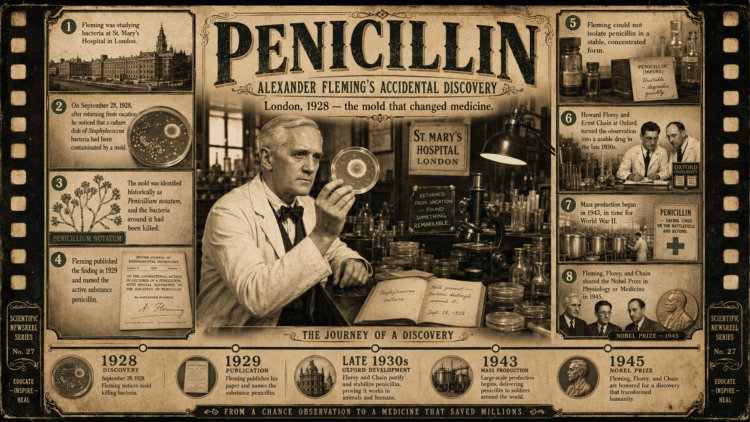
Alexander Fleming had been studying bacteria at St. Mary’s Hospital in London. On September 28, 1928, returning from a vacation, he noticed that a petri dish of Staphylococcus bacteria he had left on a bench had been contaminated by a mold — Penicillium notatum — and that the bacteria in the area surrounding the mold had been killed. He published his findings in 1929, calling the active substance penicillin.
Fleming could not isolate penicillin in a stable, concentrated form. The work of converting the observation into a usable drug took another decade, accomplished by Howard Florey and Ernst Chain at Oxford in the late 1930s. Mass production began in 1943 in time for World War II. The three men shared the Nobel Prize in Medicine in 1945. The discovery had been accidental in the truest sense: Fleming had simply failed to clean his workspace before leaving for vacation.
Mickey Mouse and Steamboat Willie
Mickey Mouse appeared for the first time in the silent animated short Plane Crazy on May 15, 1928 — a film inspired by Charles Lindbergh’s 1927 transatlantic flight. Mickey and Minnie were both introduced, but the film was not widely distributed.
Mickey’s public debut came on November 18, 1928, with Steamboat Willie — the first Disney cartoon with synchronized sound and music. Walt Disney voiced Mickey himself, from his debut in 1928 through 1946, when his schedule made it impossible to continue. The combination of the character and synchronized sound created a sensation. November 18 became Mickey Mouse’s official birthday.
Steamboat Willie received credit as the first sound cartoon, though Paul Terry had actually released the sound cartoon Dinner Time on October 14, 1928 — a month earlier. Steamboat Willie got the attention, the distribution, and the history. Dinner Time got a footnote.
The Kellogg-Briand Pact
The Kellogg-Briand Pact was signed in Paris on August 27, 1928, by the United States, France, and 13 other nations, and was eventually joined by 62 countries. It formally renounced war as an instrument of national policy and committed signatories to resolving all disputes by peaceful means. U.S. Secretary of State Frank Kellogg and French Foreign Minister Aristide Briand were its principal architects. Kellogg received the Nobel Peace Prize for his role.
World War II began eleven years later. The pact had no enforcement mechanism and no consequences for violation. Its legacy was largely symbolic — but the symbol persisted in the development of international law and the eventual framework of the United Nations Charter.
Pop Culture Facts and History
Sliced bread was introduced commercially for the first time on July 7, 1928, at the Chillicothe Baking Company in Chillicothe, Missouri, using a bread-slicing machine invented by Otto Rohwedder. It was advertised as “the greatest forward step in the baking industry since bread was wrapped.” Bagged bread had preceded it; sliced bread’s slogan described itself as the best thing since its own packaging. The phrase “the best thing since sliced bread” entered the language in the years that followed and has been applied to almost nothing that deserved it.
Gerber baby foods went on sale in 1928, after Dorothy Gerber began straining solid foods for her daughter in 1927 and convinced her husband to industrialize the process. Gerber Products Company initially sold seven items. Babies had been eating the results ever since.
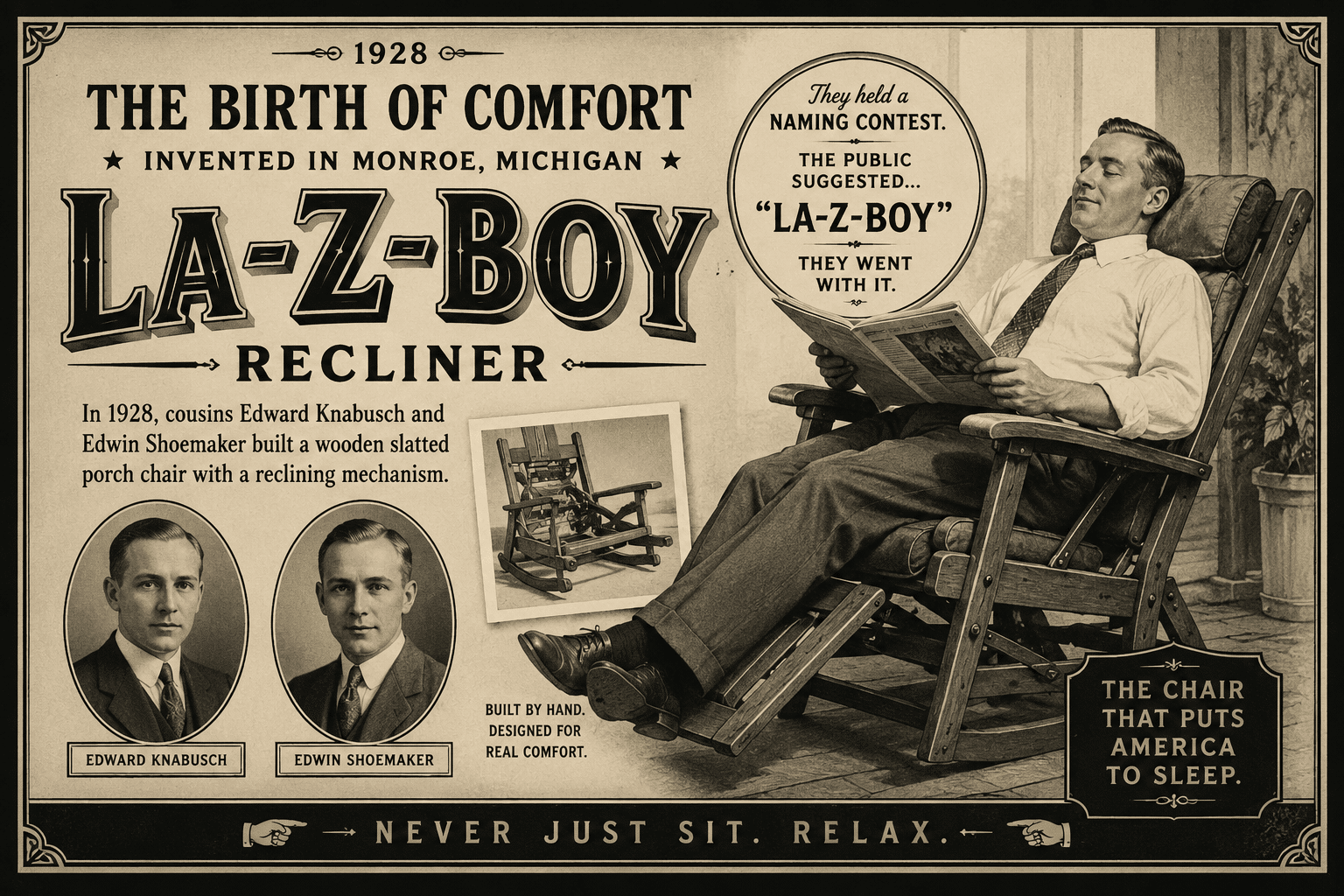
The LaZBoy recliner was invented in 1928 by cousins Edward Knabusch and Edwin Shoemaker of Monroe, Michigan, who built a wooden slatted porch chair with a reclining mechanism. They held a naming contest. The public suggested “LaZBoy.” They went with it.
Reese’s Peanut Butter Cups were introduced in 1928 by Harry Burnett Reese, a former Hershey employee who had left to start his own candy company. He originally sold them for a penny each — hence the early name “penny cups.” He made them by hand in his basement. Reese’s became one of the best-selling candy items in the United States, and the Hershey company eventually acquired the brand in 1963 for $23.5 million — the most successful exit from a basement candy operation in history.
Velveeta cheese went on sale for the first time in 1928, made by the Monroe Cheese Company of Monroe, New York. It was initially marketed as a nutritious processed cheese with a longer shelf life than natural cheese. The FDA later required that it be labeled “pasteurized prepared cheese product” rather than “cheese”. Sales continued regardless.
Chef Boyardee was founded in 1928 by Hector Boiardi, the Italian-American chef who had, at age 17, catered President Woodrow Wilson’s wedding reception in 1915. He opened a restaurant in Cleveland, began selling his tomato sauce in milk bottles to customers who asked for the recipe, and eventually industrialized the operation. He simplified the spelling of his name phonetically for the American market.
The Threepenny Opera premiered in Berlin on August 31, 1928, with music by Kurt Weill and text by Bertolt Brecht. It featured the original version of Mack the Knife, which Brecht added at the last minute at the actor playing Mack’s request. Louis Armstrong recorded a jazz version in 1955; Bobby Darin’s version hit #1 in 1959. The song has never left the standard American songbook since.
George Gershwin’s An American in Paris premiered at Carnegie Hall on December 13, 1928, conducted by Walter Damrosch. Gershwin had visited Paris earlier that year and collected the sounds of the city — including taxi horns, which he incorporated into the score. He brought back four specific French taxi horns. The piece became one of the most celebrated American orchestral compositions and later served as the basis for the 1951 Gene Kelly film.
The iron lung, a large cylindrical machine that enclosed a patient’s body and used pressure changes to force breathing when the respiratory muscles were paralyzed, was first used on a human patient at Boston Children’s Hospital on October 12, 1928, to treat a child with polio. It was invented by Philip Drinker and Louis Agassiz Shaw. The machine kept polio patients alive until their recovery or until the Salk vaccine made the disease rare.
The 1928 Summer Olympics in Amsterdam were the first to feature the Olympic flame, lit at the opening ceremony. They were also the first to include women competing in track and field events. Women had been competing in swimming and other sports at previous Games, but 1928 was the first time women ran and threw on an Olympic track. Coca-Cola became a sponsor of the Games in 1928 — a relationship it has maintained at every Olympics since.
The first regular television programming schedule began on May 10, 1928, at General Electric’s station W2XB in Schenectady, New York, broadcasting to three private homes equipped with experimental receivers. The programming was experimental, and the images were primitive, but the principle was demonstrated. The television industry, which eventually displaced radio as the dominant home entertainment medium, took its first scheduled steps in Schenectady in 1928.
Philo Farnsworth demonstrated the first all-electronic television system in San Francisco on September 7, 1928, transmitting a recognizable image without mechanical scanning — the approach that became standard. Farnsworth was 22 years old. His demonstration was the direct technological ancestor of every television screen built since.
Amelia Earhart became the first woman to fly across the Atlantic Ocean, as a passenger, in June 1928, aboard a Fokker trimotor piloted by Wilmer Stultz and Louis Gordon. She described herself as “just baggage” on the flight. She went on to make the first solo transatlantic flight by a woman in May 1932.
The Okeechobee Hurricane struck Florida on September 16, 1928, killing an estimated 2,500 to 4,000 people — most of them Black migrant farm workers living in communities around Lake Okeechobee whose dike failed. It was the second-deadliest hurricane in U.S. history. The dead were buried in mass graves, some unmarked. A memorial was established in 2003.
Columbia Records founded the Columbia Broadcasting System in 1928 as a radio network to promote its phonograph records. CBS was purchased from Columbia by William Paley the same year. Columbia Records was then sold to CBS in 1938, reversing the ownership — the parent had become the child.
Delta Air Lines was founded in 1928 as a crop-dusting operation in Macon, Georgia, called Huff Daland Dusters. It began carrying passengers in 1929. It is now one of the world’s largest airlines.
Maidenform was founded in 1928 by Ida Rosenthal, who introduced standardized bra cup sizing — A, B, C, D — to the American market. Before Rosenthal, bras were sized by chest measurement only. Her sizing system became the global standard.
The visual design of the Joker, Batman’s most famous villain, was directly inspired by the 1928 silent film The Man Who Laughs, in which actor Conrad Veidt played a man with a permanent rictus smile carved into his face. Bob Kane and Bill Finger acknowledged the influence when creating the character in 1940. The film itself was a German Expressionist masterwork nearly lost to history.
The Passion of Joan of Arc, directed by Carl Theodor Dreyer and released in 1928, was rejected by the French government that had commissioned it. A fire destroyed the original negative. The film was considered permanently lost in its original form until 1981, when a complete print was discovered in a storage closet at a Norwegian mental institution — a recovery as implausible as anything in the film itself.
Scotch Tape was introduced by 3M in 1928 — initially clear cellophane tape with adhesive on one side, developed after 3M engineer Richard Drew noticed that auto workers in body shops were frustrated by masking tape that stuck too aggressively. He spent two years developing a less aggressive adhesive. The product he created became one of the most used office supplies in history.
The Speedo swimwear brief was invented in 1928 by Scottish underwear maker Alexander MacRae in Sydney, Australia, under the Speedo brand. The brief design dramatically reduced drag in competitive swimming and has since been the subject of considerable public commentary about swimwear standards.
Humorist Will Rogers ran a mock presidential campaign in 1928, with only one campaign promise: if elected, he would immediately resign. He received enough write-in votes to make the stunt visible. His actual influence on American political culture through his newspaper columns and radio commentary was more durable than that of most serious candidates of his era.
Words appearing in print for the first time in 1928 included “astronaut,” “boogie-woogie,” “cheeseburger,” “dime store,” “gas-guzzler,” “jalopy,” and “layaway.” The car culture was developing its vocabulary at speed.
Nobel Prize Winners
Physics — Owen Willans Richardson — for his work on thermionic emission and especially for the discovery of the law named after him (Richardson’s Law), foundational to vacuum tube and electron technology Chemistry — Adolf Windaus — for the services rendered to science through his research into the constitution of the sterols and their connection with the vitamins, work that helped explain vitamin D deficiency diseases Medicine — Charles Nicolle — for his work on typhus, proving that the body louse was the vector of transmission and enabling practical prevention measures Literature — Sigrid Undset — Norwegian novelist, for her powerful descriptions of Northern life during the Middle Ages; best known for Kristin Lavransdatter Peace — not awarded in 1928
Broadway in 1928
Strange Interlude by Eugene O’Neill opened January 30, 1928, at the John Golden Theatre. The play ran approximately five hours and included intermissions for dinner. O’Neill’s characters spoke their inner thoughts directly to the audience while other characters onstage could not hear them — a theatrical technique that had never been used on this scale before. It won the Pulitzer Prize for Drama.
Whoopee! opened December 4, 1928, at the New Amsterdam Theatre, starring Eddie Cantor and featuring Florenz Ziegfeld’s spectacular production values. It ran 407 performances and produced the standard Makin’ Whoopee.
Top Movies of 1928
- The Singing Fool
- The Circus
- The Crowd
- Steamboat Willie
- The Cameraman
- The Patriot
- Lights of New York
- Speedy
- The Man Who Laughs
- Beggars of Life
The Patriot won the Academy Award for Best Writing Achievement and was nominated for Best Director, Best Actor, and Best Picture at the 2nd Academy Awards in 1930. No copies of it survive. It is one of the most prominent examples of a Best Picture-nominated film that is permanently lost.
Lights of New York, released July 6, 1928, was the first full-length all-talking motion picture — every scene filmed with synchronized dialogue, not just selected sequences as in The Jazz Singer. It was a gangster film. It ran 57 minutes. The dialogue was not universally praised, but the technology worked.
Popular and Best-Selling Books of 1928
All Kneeling — Anne Parrish
Bad Girl — Vina Delmar
The Bridge of San Luis Rey — Thornton Wilder
Claire Ambler — Booth Tarkington
The Greene Murder Case — S.S. Van Dine
The House at Pooh Corner — A.A. Milne and Ernest Shepard
Jalna — Mazo de la Roche
Now We Are Six — A.A. Milne and Ernest Shepard
The Bridge of San Luis Rey by Thornton Wilder won the Pulitzer Prize for the Novel in 1928. It asked why five specific people happened to be on a Peruvian rope bridge the moment it collapsed. Wilder’s answer — exploring fate, love, and meaning through five separate narratives — established him as one of the major American writers of the century.
Biggest Pop Artists of 1928
Al Jolson, Gene Austin, Paul Whiteman, Guy Lombardo, Ted Lewis, Rudy Vallee, Nick Lucas, Helen Kane, The Carter Family, Jimmy Rodgers, Duke Ellington, Marion Harris, Cliff Edwards, Frank Crumit
Sports Champions of 1928
World Series: New York Yankees swept the St. Louis Cardinals 4-0 for their third championship; Babe Ruth hit .625 with three home runs in the Series; Lou Gehrig hit .545 with four home runs; the Cardinals were largely helpless
Stanley Cup: New York Rangers defeated the Montreal Maroons 3-2
U.S. Open Golf: Johnny Farrell defeated Bobby Jones in a 36-hole playoff by a single stroke
U.S. Open Tennis: Men/Women: Henri Cochet / Helen Wills
Wimbledon: Men/Women: Rene Lacoste / Helen Wills
NCAA Football Champions: Georgia Tech and USC (co-champions)
Kentucky Derby: Reigh Count
Boston Marathon: Clarence DeMar, 2:37:07
Sports Highlight: Babe Ruth hit 54 home runs in 1928, second only to his own record of 60 set the previous year. His World Series performance – .625 batting average, three home runs — was statistically one of the greatest individual Series performances in baseball history. Clarence DeMar won the Boston Marathon for the fourth time in 1928 and went on to win it three more times, for a total of seven, a record that stood for decades.
The 1928 Olympics in Amsterdam featured the debut of the Olympic flame and the first women’s track-and-field events. Betty Robinson of the United States won the inaugural women’s 100 meters at age 16. She was later severely injured in a plane crash in 1931, left for dead, and woke from a coma seven months later. She returned to win a gold medal in the relay in 1936.
FAQs: 1928 History, Facts, and Trivia
Q: How was penicillin discovered?
A: Alexander Fleming returned to his London laboratory on September 28, 1928, after vacation and noticed that a contaminating mold had killed the bacteria in a petri dish he had left behind. He identified the mold as Penicillium notatum and named the active substance penicillin. Mass production of the antibiotic began in 1943. The discovery has been credited with saving an estimated 200 million lives.
Q: When did Mickey Mouse debut?
A: Mickey appeared for the first time in the silent short Plane Crazy on May 15, 1928. His public debut came on November 18, 1928, in Steamboat Willie — the first Disney sound cartoon. November 18 is Mickey’s official birthday. Walt Disney voiced him from 1928 until 1946.
Q: What was sliced bread, and when was it introduced?
A: The first commercially sliced bread was sold on July 7, 1928, by the Chillicothe Baking Company in Missouri, using a machine invented by Otto Rohwedder. It was advertised as “the greatest forward step in the baking industry since bread was wrapped.” The phrase “the best thing since sliced bread” entered the language shortly after and has been applied generously ever since.
Q: What was the Kellogg-Briand Pact? A: An international treaty signed on August 27, 1928, renouncing war as a means of national policy. It was eventually signed by 62 countries. It had no enforcement mechanism. World War II began eleven years later. It nonetheless influenced the development of international law and the UN Charter.
Q: Who was the first woman to fly across the Atlantic?
A: Amelia Earhart flew as a passenger on a transatlantic flight in June 1928, becoming the first woman to cross the Atlantic by air. She described herself as “just baggage” during the flight. She completed the first solo transatlantic flight by a woman four years later, in May 1932.
Q: What consumer products were introduced in 1928?
A: Sliced bread, Reese’s Peanut Butter Cups, Gerber baby food, Velveeta cheese, Chef Boyardee canned pasta, the LaZBoy recliner, Scotch Tape, Double Bubble bubble gum, Kellogg’s Rice Krispies, and Charmin bath tissue all debuted in 1928. The year was unusually productive for things Americans still buy.
Q: What famous character’s visual design was inspired by a 1928 film?
A: The Joker from Batman was directly inspired by Conrad Veidt’s character in the 1928 silent film The Man Who Laughs, in which a man has a permanent grin carved into his face. Bob Kane and Bill Finger acknowledged the influence when creating the character in 1940.
Q: What was the first all-electronic television demonstration?
A: Philo Farnsworth demonstrated the first fully electronic television system in San Francisco on September 7, 1928, at age 22. His system used no mechanical scanning
More 1928 Facts & History Resources:
Most Popular Baby Names (BabyCenter.com)
Popular and Notable Books (popculture.us)
Broadway Shows that Opened in 1928
1928 Calendar, courtesy of Time and Date.com
Fact Monster
1920s Fads (BabyCenter.com)
1920s, Infoplease.com World History
1928 in Movies (according to IMDB)
Retrowaste Vintage Culture
1920s Slang
Wikipedia 1928


