July 9 Trivia, Fun Facts and Pop Culture History
July 9 Observances
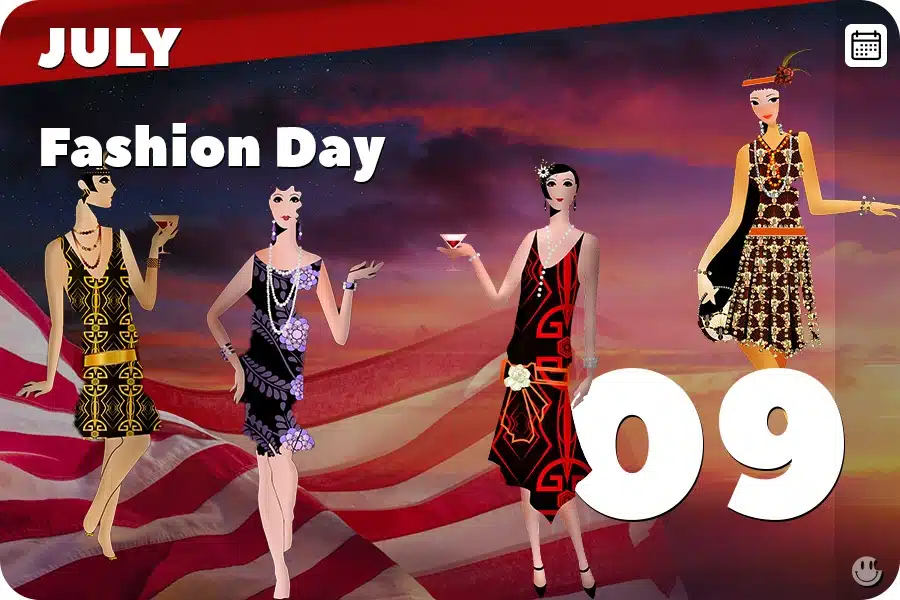
July 9 offers an eclectic mix of things to celebrate: Fashion Day, International Town Criers Day, National Sugar Cookie Day, National Don’t Put All Your Eggs in One Omelet Day, National No Bra Day, and Martyrdom of the Bab, a solemn holy day in the Baha’i faith commemorating the 1850 execution of the faith’s forerunner figure. Also, Nude Recreation Week typically falls in the second week of July, which pairs interestingly with Fashion Day. The calendar contains multitudes.
What Happened on July 9?
July 9 is the day Catherine the Great seized power in Russia, the day the 14th Amendment was ratified, the day the first open-heart surgery was performed in Chicago, and the day a tsunami the height of a 170-story building hit Alaska. It is also technically the birthday of Ray Palmer, better known as The Atom in DC Comics, though the exact year remains classified.
If you were born on July 9, you were likely conceived the week of October 16 of the prior year.
July 9 History Highlights
1540 — King Henry VIII of England annulled his marriage to his fourth wife, Anne of Cleves, after just six months. Henry reportedly found her unattractive in person after approving the match based on a flattering portrait by Hans Holbein. Anne wisely accepted a generous settlement and outlived Henry by ten years. She is generally considered to have gotten the best deal of all six wives.
1595 — Johannes Kepler published Mysterium Cosmographicum (Mystery of the Cosmos), his first major astronomical work, in which he attempted to explain the geometry of the solar system using nested Platonic solids. He was wrong about the geometry, but he asked exactly the right questions, which eventually led to his Laws of Planetary Motion.
1762 — Catherine the Great became Empress of Russia following a coup that deposed her husband, Peter III. She ruled for 34 years, overseeing a dramatic expansion of the Russian Empire and a flourishing of Enlightenment culture. Peter III was dead within a week of the coup. Officially from “hemorrhoidal colic.” Sure.
1776 — George Washington ordered the Declaration of Independence read aloud to members of the Continental Army in New York City, just three days after it was first publicly read in Philadelphia. Shortly afterward, a crowd tore down a gilded statue of King George III on Broadway and melted it into musket balls. Efficient.
1815 — The first developed natural gas well in the United States was discovered at Burning Springs, near Charleston, West Virginia. Natural gas had been observed seeping from the ground for centuries, but this marked the beginning of intentional extraction.
1868 — The 14th Amendment to the United States Constitution was ratified, granting citizenship to all persons born or naturalized in the United States and guaranteeing due process and equal protection under the law. It was primarily aimed at securing the rights of formerly enslaved people following the Civil War and remains one of the most litigated amendments in American constitutional history. See the full text in the special section below.
1877 — The inaugural Wimbledon Tennis Championships began at the All England Club in London. The first champion was Spencer Gore, who won the men’s singles in front of about 200 spectators. Today Wimbledon draws around 500,000 visitors over two weeks. Gore never defended his title, reportedly saying he didn’t think tennis would catch on.
1893 — Dr. Daniel Hale Williams performed the first successful open-heart surgery at Provident Hospital in Chicago, repairing a stab wound to the pericardium of a patient named James Cornish. Cornish survived and lived another 50 years. Dr. Williams was African American and had founded Provident Hospital in 1891 as one of the first interracial hospitals in the United States. He did it without antibiotics, without blood transfusions, and without modern anesthesia.
1922 — Johnny Weissmuller, future star of the Tarzan films, swam the 100-meter freestyle in 58.6 seconds, breaking the world record and becoming the first person to swim the distance in under one minute. He went on to win five Olympic gold medals before Hollywood came calling.
1933 — Construction began on the San Francisco-Oakland Bay Bridge. It opened on November 12, 1936 (your source lists May 29, 1937, which is the opening of the Golden Gate Bridge). The Bay Bridge actually opened six months before the Golden Gate and carried more traffic on its first day than the Golden Gate did on its first week.
1937 — The silent film archives of Fox Film Corporation were destroyed in a vault fire. Decades of irreplaceable early cinema were lost permanently. Film preservation was not taken seriously until it was far too late, and an estimated 70% of all silent films are now gone forever.
1958 — A massive landslide triggered by an earthquake sent 90 million tons of rock and ice crashing into Lituya Bay, Alaska, generating a 1,720-foot megatsunami — the tallest wave ever recorded in modern history. Three fishing boats were in the bay. One sank immediately. The other two, remarkably, rode the wave and survived. The wave stripped trees from hillsides, reaching heights of over 500 meters.
1962 — Andy Warhol’s Campbell’s Soup Cans exhibition opened at the Ferus Gallery in Los Angeles, marking the public debut of Pop Art as a movement. The gallery owner reportedly hung the 32 canvases in a row, like products on a shelf. A neighboring gallery displayed a can of soup with a sign reading “Get the real thing for 29 cents.” Warhol loved it.
1979 — Voyager 2, launched in 1977, passed Jupiter, sending back extraordinary images of the giant planet and its moons. The spacecraft is now in interstellar space, over 12 billion miles from Earth, and is still transmitting data. Both Voyager probes carry a golden record containing sounds and images of Earth, in case anyone out there is curious.
1981 — Donkey Kong, created by Nintendo, was released in North America, featuring the debut of a character then called “Jumpman” — later renamed Mario. Nintendo designer Shigeru Miyamoto originally wanted to make a Popeye game but couldn’t get the license, so he invented his own characters instead. One of the more consequential licensing failures in entertainment history.
The 14th Amendment: What It Actually Says
Ratified on July 9, 1868, the 14th Amendment is one of the most consequential — and most argued-over — additions to the U.S. Constitution. Here are its four operative sections:
Section 1: Citizenship and Equal Protection
All persons born or naturalized in the United States and subject to the jurisdiction thereof are citizens of the United States and of the State wherein they reside. No State shall make or enforce any law which shall abridge the privileges or immunities of citizens of the United States; nor shall any State deprive any person of life, liberty, or property, without due process of law; nor deny to any person within its jurisdiction the equal protection of the laws.
Section 2: Apportionment of Representatives
Representatives shall be apportioned among the several States according to their respective numbers, counting the whole number of persons in each State, excluding Indians not taxed. Penalties are established for States that deny voting rights to male citizens over 21.
Section 3: Disqualification from Office
No person who previously took an oath to support the Constitution and then engaged in insurrection or rebellion against the United States may hold federal or State office. Congress may remove this disability by a two-thirds vote of each House.
Section 4: Public Debt
The validity of the public debt of the United States shall not be questioned. Neither the United States nor any State shall assume or pay any debt incurred in aid of insurrection or rebellion, or any claim for the loss or emancipation of a slave. All such debts and claims are held illegal and void.
Trivia: Section 3 of the 14th Amendment became a subject of major national debate in 2023 and 2024, as courts considered whether it applied to candidates who had allegedly engaged in or encouraged the January 6, 2021 Capitol riot. The Supreme Court ultimately ruled that only Congress, not individual states, can enforce Section 3 disqualification.
Billboard Number One on July 9
- 1955: “(We’re Gonna) Rock Around the Clock” — Bill Haley and His Comets (No. 1: July 9 through September 2, 1955). Eight weeks at the top. Widely credited as the song that brought rock and roll to mainstream America, especially after it appeared in the film Blackboard Jungle. Haley was 30 years old, wore a spit curl, and looked nothing like a rock star. It did not matter.
- 1966: “Strangers in the Night” — Frank Sinatra (No. 1: July 9-15, 1966). Sinatra reportedly hated the song and called it “the worst song I ever heard.” It won the Grammy for Record of the Year. The “dooby dooby doo” ending was improvised in the studio.
- 1977: “Undercover Angel” — Alan O’Day (No. 1: July 9-15, 1977). One of the more unexpected chart-toppers of the decade. O’Day was primarily a songwriter who had written hits for others; “Undercover Angel” was his only solo No. 1.
- 1988: “The Flame” — Cheap Trick (No. 1: July 9-22, 1988). A power ballad from a band better known for hard rock. It became their only No. 1 hit and remains a source of complicated feelings for longtime fans.
- 2011: “Give Me Everything” — Pitbull featuring Ne-Yo, Afrojack, and Nayer (No. 1: July 9-15, 2011).
- 2022: “As It Was” — Harry Styles (No. 1: July 9-29, 2022). Three more weeks at the top during this stretch; the song spent a total of 15 weeks at No. 1 in 2022, making it one of the longest-running No. 1 hits of the decade so far.
Born on July 9
- Elias Howe (1819) — American inventor who patented the modern sewing machine in 1846. Isaac Singer later infringed on his patent, and Howe won a landmark legal battle that earned him royalties on every Singer machine sold. By the time he died in 1867, he was wealthy. Singer’s name is still on the machines.
- Basil Wolverton (1909) — American cartoonist and illustrator known for grotesquely detailed, bizarrely funny artwork that influenced generations of underground comic artists. Also a devoted lay minister of the Radio Church of God. A man of wide-ranging interests.
- Ed Ames (1927) — American singer and actor, member of the Ames Brothers and later known for playing Mingo on the TV series Daniel Boone. His 1967 Tonight Show tomahawk-throwing demonstration produced one of the longest laughs in late-night television history.
- Lee Hazlewood (1929) — American singer, songwriter, and producer who wrote and produced some of Nancy Sinatra’s biggest hits, including “These Boots Are Made for Walkin’.” His baritone duets with Nancy Sinatra are genuinely strange and genuinely great.
- Donald Rumsfeld (1932) — American politician and twice-confirmed Secretary of Defense (under Ford and George W. Bush). Best remembered for his “known knowns” press conference statement during the Iraq War, which was either profound philosophy or elaborate word salad, depending on your perspective.
- Brian Dennehy (1938-2020) — American actor with a commanding physical presence and a resume that spanned from First Blood (1982) to Broadway, where he won two Tony Awards. One of the more underappreciated major actors of his generation.
- Richard Roundtree (1942-2023) — American actor who defined cool as John Shaft in 1971. The film’s theme by Isaac Hayes won the Academy Award for Best Original Song. Roundtree continued working steadily for five decades.
- Dean Koontz (1945) — American author who has sold over 500 million books worldwide. He published his first novel in 1968 and has rarely slowed down since. His golden retriever Trixie appeared in three of his books and had her own fan club.
- O.J. Simpson (1947-2024) — American football player, actor, and felon. One of the greatest running backs in NFL history, a two-time rushing yards champion, and the subject of the most-watched criminal trial in American television history. He was acquitted of murder in 1995 and later found liable in a civil suit. He passed away in April 2024.
- Tom Hanks (1956) — American actor and filmmaker, two-time Academy Award winner (Philadelphia, 1993; Forrest Gump, 1994) and one of the few actors to win back-to-back. Also a serious typewriter collector, which is either endearing or alarming depending on available storage space.
- Jimmy Smits (1955) — American actor known for L.A. Law, NYPD Blue, The West Wing, and a stretch of the Star Wars prequel trilogy as Bail Organa. A reliable presence in prestige television for four decades.
- Kelly McGillis (1957) — American actress best known for Top Gun (1986) and Witness (1985). The role of Charlie in Top Gun required her to be taller than Tom Cruise on screen, which required some creative camera work.
- Courtney Love (1964) — American singer, songwriter, actress, and lead vocalist of Hole. Her album Live Through This (1994) is widely regarded as one of the defining rock records of the decade. She has also dated a billionaire, which she recommends mainly for the story.
- Jack White (1975) — American guitarist, singer, and producer, best known as half of The White Stripes. Born John Anthony Gillis; took his wife’s surname when they married. Also founded Third Man Records in Nashville, which operates an actual record-pressing plant open to the public. Genuinely committed to the bit.
- Fred Savage (1976) — American actor and director, best known as Kevin Arnold on The Wonder Years (1988-1993), which he began at age 11. Later became a prolific TV director.
- Marc Almond (1957) — British singer and songwriter, lead vocalist of Soft Cell, best known for their 1981 synth-pop cover of “Tainted Love,” which spent 43 weeks on the Billboard Hot 100 — a record at the time.
Birthday Quotes from July 9 Birthdays
“The safe and cultural method of eating crackers in bed is to wear a diver’s suit instead of pajamas.”
“Writing isn’t a source of pain. It’s psychic chemotherapy. It reduces your psychological tumors and relieves your pain.”
“I don’t know how often I can discuss one incident in my entire life, but I’ll continue to do that.”
“There are known knowns; there are things we know we know. We also know there are known unknowns; that is to say we know there are some things we do not know. But there are also unknown unknowns — the ones we don’t know we don’t know.”
“We are still in the position of waking up and having a choice. Do I make the world better today somehow, or do I not bother?”
“I’ve discreetly dated a lot of people. I once dated a billionaire, mostly because it was fun to say ‘I’m dating a billionaire,’ but we did not have the same taste in music, and it was doomed.”
“If you were born by the sea, there’s always a magnet that draws you back there.”
Random Trivia and Shower Thoughts for July 9
- If you Google your name followed by “the hedgehog,” there’s probably something out there for you.
- The military of San Marino still has an active crossbow corps that has existed uninterrupted since 1295. San Marino has a population of about 34,000 people and has never been conquered, which may be related.
- Frasier and Darth Vader share the same accent: Mid-Atlantic English, a dialect invented by American aristocrats in the early 20th century to sound vaguely British without committing to it.
- The star with the most screen credits is John Carradine (1906-1988), who appeared in over 230 films. He played Dracula at least four times and reportedly memorized all of Shakespeare for fun.
- The word “checkmate” comes from the Persian phrase Shah Met, meaning “the King is Dead.” Chess terminology is mostly Persian, routed through Arabic, routed through medieval Latin. The King never had a chance.
- The airplane Buddy Holly died in was named the “American Pie.” Don McLean confirmed this was the inspiration for the song’s title.
- The North Country Trail starts in upstate New York and ends in North Dakota, covering 4,600 miles. It is the longest National Scenic Trail in the United States and is largely ignored in favor of the Appalachian Trail, which is less than half as long.
- Between 1900 and 1920, Tug of War was an Olympic event. Great Britain won it in 1908. The U.S. complained about the British team’s boots. The boots were found to be legal. Great Britain kept the gold.
- There are 403,291,461,126,605,635,584,000,000 different ways to arrange the 26 letters of the alphabet. You are currently reading just one of them.
- Topher Grace is reportedly the only person who has ever used “Topher” as a nickname for Christopher. He has not explained this and does not appear to owe anyone an explanation.
- Dr. Seuss wrote Green Eggs and Ham using exactly 50 words, on a bet with his editor Bennett Cerf that he couldn’t write a book with fewer words than The Cat in the Hat (which used 236). He won. Cerf reportedly never paid up.
- “Use of unnecessary violence in the apprehension of the Blues Brothers has been approved.” — Police Dispatcher, The Blues Brothers (1980)
- I care more about my grammar online than I ever did in school.