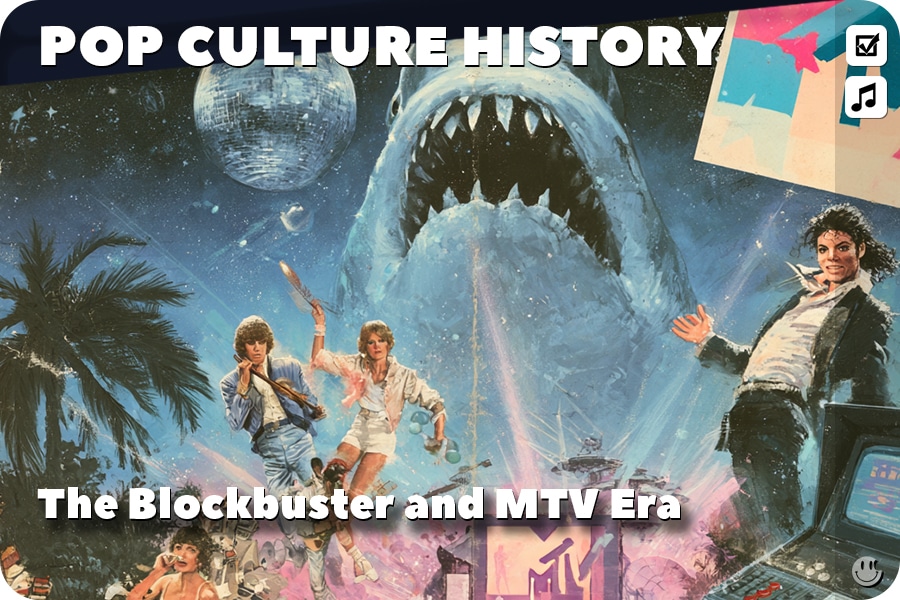
The Blockbuster and MTV Era: Pop Culture from 1975 to 1989
In the summer of 1975, Jaws made audiences afraid to go into the water and invented the summer blockbuster. Two years later, Star Wars turned movies into merchandise empires. Then cable TV, the VCR, the Walkman, and MTV changed how Americans watched and listened, and Pac-Man, Atari, and Nintendo turned the living room into an arcade. It was the era of disco and punk, Michael Jackson and Madonna, pet rocks and Rubik’s Cubes, CB radios and Cabbage Patch Kids, leg warmers and big hair. It ended in November 1989 with crowds dancing on the Berlin Wall, broadcast live around the world. For a nation of trivia lovers, it even gave us Trivial Pursuit, which was no trivial matter.
Quick Facts About the Blockbuster and MTV Era
Defining Media: Blockbuster movies, cable TV (HBO, ESPN, CNN, MTV), the VCR, the Sony Walkman, the compact disc, arcade games, and home video game consoles
Presidents: Gerald Ford, Jimmy Carter, Ronald Reagan, and George H.W. Bush
U.S. Population: About 216 million in 1975, growing to about 247 million by 1989
Biggest Events: The Bicentennial (1976), the Iran hostage crisis (1979–1981), the Challenger disaster (1986), and the fall of the Berlin Wall (November 9, 1989)
Biggest Stars: Michael Jackson, Madonna, Harrison Ford, John Travolta, Farrah Fawcett, Bruce Springsteen, Prince, and Tom Cruise
Biggest Songs: Stayin’ Alive, Billie Jean, Like a Virgin, Born in the U.S.A., When Doves Cry, and We Are the World
The Conversation: Who shot J.R.? And did you see the new video on MTV?
How the Medium Changed Everything: Blockbusters, Cable, and the VCR
Jaws (June 20, 1975) opened in hundreds of theaters at once with national TV ads, a new way to launch a movie. Star Wars (May 25, 1977) broke every record, and its toys made more money than the movie. The toys sold out so fast that for Christmas 1977, Kenner sold an empty box with an IOU for the action figures. E.T. (1982) sent Reese’s Pieces sales soaring, kicking off modern product placement.
HBO began beaming programming by satellite in 1975, ESPN launched in 1979, CNN on June 1, 1980, and MTV on August 1, 1981, with Video Killed the Radio Star. The VCR let people record shows and rent movies, and the Betamax-versus-VHS format war ended in a VHS victory. Network TV still drew huge audiences: about 83 million people watched to learn “Who shot J.R.?” on Dallas in November 1980, and about 106 million watched the final episode of M*A*S*H on February 28, 1983. Saturday Night Live premiered in 1975, and Jane Fonda’s 1982 workout tape became one of the best-selling videos ever.
Sony’s Walkman (1979) made music personal and portable, and the compact disc arrived in the U.S. in 1983. Arcades filled with Space Invaders (1978) and Pac-Man (1980), the Atari 2600 (1977) brought games home, and the Nintendo Entertainment System revived the industry in 1985 with Super Mario.
The Music of the Era
Disco peaked with Saturday Night Fever (1977), whose soundtrack became one of the best-selling albums ever, and crashed after Chicago’s “Disco Demolition Night” on July 12, 1979. Punk arrived with the Ramones, new wave with Blondie and the Cars, and hip-hop broke through with the Sugarhill Gang’s Rapper’s Delight (1979) and Run-DMC’s Walk This Way with Aerosmith (1986). Michael Jackson’s Thriller (1982) became the best-selling album of all time, and he unveiled the moonwalk on the Motown 25 TV special in 1983. Madonna, Prince, Whitney Houston, Bruce Springsteen, and hair-metal bands ruled MTV. Live Aid, on July 13, 1985, was watched by an estimated 1.5 billion people.
Fads and Crazes of the Blockbuster and MTV Era
Pet rocks: Advertising man Gary Dahl sold more than a million ordinary stones in boxes for Christmas 1975 at $3.95 each, a solid investment.
Mood rings: The color-changing rings were a 1975 sensation.
CB radio: Truckers’ citizens band radios became a national craze around 1976, inspired by C.W. McCall’s No. 1 song Convoy and Smokey and the Bandit (1977). Everyone had a “handle” and said “10-4, good buddy.”
Roller disco: Roller rinks played disco, and the craze inspired the 1980 movie Xanadu.
Rubik’s Cube: The Hungarian puzzle reached America in 1980 and sold tens of millions within a few years.
Trivial Pursuit: The Canadian board game became a huge American hit in 1984.
Cabbage Patch Kids: Shoppers fought in stores over the dolls during the Christmas 1983 shortage.
Toys and cartoons: Star Wars figures, the Smurfs, Strawberry Shortcake, Care Bears, Transformers, Teddy Ruxpin, Garbage Pail Kids, and the electronic game Simon.
Fitness and fashion: Aerobics, leg warmers inspired by Flashdance (1983), parachute pants, Members Only jackets, jelly shoes, Swatch watches, shoulder pads, and very big hair.
Valley Girl talk: Frank Zappa and daughter Moon Unit’s 1982 song popularized “gag me with a spoon,” “totally,” and “like, whatever.”
Catchphrases: “Where’s the beef?” from Wendy’s 1984 commercials, “I want my MTV,” and “Just say no.”
New Coke: Coca-Cola changed its formula on April 23, 1985. After a public outcry, Coca-Cola Classic returned 79 days later.
Stars, Sex Symbols, and Heartthrobs
Farrah Fawcett‘s 1976 red swimsuit poster sold millions of copies and her feathered hair was copied everywhere. Cheryl Tiegs, Bo Derek in 10 (1979), Lynda Carter as Wonder Woman, Christie Brinkley, Heather Locklear, Kathleen Turner, Kim Basinger, Michelle Pfeiffer, and Madonna were the decade’s sex symbols.
The heartthrobs were John Travolta in his white disco suit, Burt Reynolds, Harrison Ford as Han Solo and Indiana Jones, Tom Selleck in Magnum, P.I., Richard Gere, Mel Gibson, Don Johnson in Miami Vice, Tom Cruise in Top Gun (1986), Patrick Swayze in Dirty Dancing (1987), Jon Bon Jovi, and action stars Sylvester Stallone and Arnold Schwarzenegger.
Sports of the Era
Muhammad Ali and Joe Frazier fought the “Thrilla in Manila” on October 1, 1975.
The U.S. Olympic hockey team beat the Soviet Union in the “Miracle on Ice” on February 22, 1980.
Larry Bird’s Celtics and Magic Johnson’s Lakers revived the NBA, and Michael Jordan arrived in 1984, with his first Air Jordans in 1985.
Wayne Gretzky scored 92 goals in the 1981–1982 season and was traded to Los Angeles in 1988.
Hulk Hogan headlined the first WrestleMania on March 31, 1985, helped by MTV’s “Rock ‘n’ Wrestling” connection.
The 1985 Chicago Bears won the Super Bowl and released The Super Bowl Shuffle. Pete Rose broke Ty Cobb’s hit record in 1985 and was banned from baseball in 1989.
Myth vs. Fact: The Blockbuster and MTV Era
Myth: Little Mikey from the Life cereal commercials died from eating Pop Rocks and drinking soda. Fact: The actor, John Gilchrist, grew up to work in advertising sales.
Myth: Atari’s buried E.T. cartridges were an urban legend. Fact: They were real. In 2014, diggers in Alamogordo, New Mexico, unearthed copies of E.T. and other games Atari dumped in 1983, though not the millions of the legend.
Myth: New Coke was a deliberate stunt to boost sales of the original. Fact: Coca-Cola insists it was a genuine mistake, and its executives were blindsided by the backlash.
Myth: Disco died at Disco Demolition Night. Fact: Disco’s chart dominance faded, but its beat lived on in dance music, pop, and house.
Firsts and Milestones of the Era
America celebrated its Bicentennial on July 4, 1976, 100 years after Philadelphia’s Centennial Exposition. Elvis Presley died on August 16, 1977, and John Lennon was killed on December 8, 1980. Lady Diana Spencer married Prince Charles on July 29, 1981, before a TV audience of about 750 million. Apple’s “1984” Super Bowl ad launched the Macintosh. Millions of students watched the Challenger break apart on January 28, 1986, with teacher Christa McAuliffe aboard. The Berlin Wall fell on November 9, 1989.