
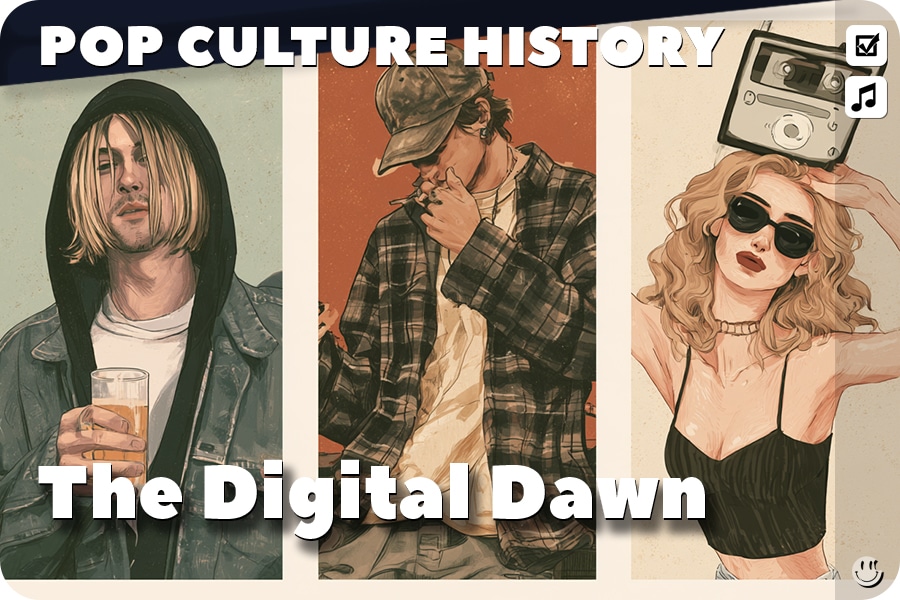
The Digital Dawn: Pop Culture from 1990 to 2000
The 1990s began with the Berlin Wall in pieces and ended with the whole world worrying that computers would crash at midnight on January 1, 2000. In between, the World Wide Web went public, AOL told millions of Americans “You’ve got mail,” and a whole generation learned the screech of a dial-up modem. It was the decade of grunge and gangsta rap, boy bands and the Spice Girls, Friends and Seinfeld, Titanic and Toy Story, Michael Jordan and Tiger Woods, Beanie Babies, Tickle Me Elmo, Furbies, Pokémon, and the Macarena. Pop culture was still shared on TV and radio, but more and more of it was happening online. Americans were finally connected, at 56 kilobits per second.
Quick Facts About the Digital Dawn
- Defining Media: The World Wide Web, AOL and email, cable TV, the CD, the PlayStation and Game Boy, pagers and early cell phones, and the DVD
- Presidents: George H.W. Bush and Bill Clinton
- U.S. Population: 249 million in 1990, growing to 281 million by 2000
- Biggest Events: The Gulf War (1991), the end of the Soviet Union (1991), the O.J. Simpson trial (1995), the death of Princess Diana (1997), the Clinton impeachment (1998–1999), Y2K, and the 2000 presidential election recount
- Biggest Stars: Michael Jordan, the cast of Friends, Jerry Seinfeld, Nirvana, Mariah Carey, Tupac Shakur, Leonardo DiCaprio, and Oprah Winfrey
- Biggest Songs: Smells Like Teen Spirit, I Will Always Love You, Macarena, Wannabe, My Heart Will Go On, and Livin’ la Vida Loca
- The Conversation: What’s your screen name? And did you see last night’s Friends?
How the Medium Changed Everything: Going Online
Tim Berners-Lee made the World Wide Web available to the public in August 1991, and the Mosaic browser (1993) and Netscape, which went public in a blockbuster IPO in August 1995, made it easy to explore. AOL mailed out millions of free trial discs and grew into the largest online service, with chat rooms, buddy lists, and its famous “You’ve got mail” greeting, which became the title of a 1998 movie. Amazon started selling books in 1995, eBay launched that same year, Google was founded on September 4, 1998, and Napster’s free music sharing, starting in 1999, shook the music business. The dot-com bubble peaked in March 2000 and then burst.
Television fragmented into dozens of cable channels, but network hits still drew giant audiences. About 76 million people watched the Seinfeld finale on May 14, 1998. MTV’s The Real World (1992) launched reality TV, and Survivor and Who Wants to Be a Millionaire made it prime time’s hottest genre by 2000. The Simpsons, Friends, The X-Files, ER, South Park, and HBO’s The Sopranos (1999) defined the decade. In theaters, Jurassic Park (1993) brought CGI dinosaurs to life, Toy Story (1995) was the first fully computer-animated feature, and Titanic (1997) became the highest-grossing film ever at the time. The Blair Witch Project (1999) showed the power of internet marketing.
The Music of the Digital Dawn
Nirvana’s Nevermind (1991) knocked Michael Jackson off the top of the album chart in January 1992 and made grunge and flannel shirts mainstream. Hip-hop became America’s dominant youth culture, from Dr. Dre’s The Chronic to Tupac Shakur and the Notorious B.I.G., both killed within six months of each other in 1996 and 1997. Whitney Houston’s I Will Always Love You spent 14 weeks at No. 1, and the Macarena had everyone dancing at weddings. The late 1990s brought teen pop and boy bands, the Spice Girls’ “Girl Power,” the Latin pop explosion led by Ricky Martin, and Shania Twain’s crossover country. CD sales hit an all-time high in 2000, just as file sharing arrived.
Fads and Crazes of the Digital Dawn
- Beanie Babies: Ty’s bean-filled animals became a collecting mania in the mid-to-late 1990s, and McDonald’s gave away about 100 million Teenie Beanie Babies in about ten days in 1997.
- Tickle Me Elmo: Shoppers fought over the giggling doll during the Christmas 1996 shortage after Rosie O’Donnell promoted it on TV.
- Furby: The chattering owl-like robot was the must-have toy of Christmas 1998.
- Tamagotchi: Kids carried virtual pets on keychains starting in 1997, until schools banned them.
- Pokémon: The Game Boy games, cartoon, and trading cards arrived in the U.S. in 1998 and 1999 and set off “Pokémania.”
- Pogs and slap bracelets: Both were schoolyard crazes, and both got banned from many schools.
- Magic Eye pictures: Hidden 3-D images in colorful patterns topped bestseller lists in 1993 and 1994.
- Fashion: Flannel shirts, Doc Martens, overalls with one strap, scrunchies, butterfly clips, choker necklaces, Hypercolor shirts, JNCO jeans, frosted tips, and “The Rachel” haircut from Friends.
- Snacks and drinks: Crystal Pepsi, Zima, Surge, Dunkaroos, Gushers, Lunchables, and the “Got Milk?” mustache ads (1993).
- Catchphrases: “Not!” (Wayne’s World), “As if!” (Clueless), “Show me the money!” (Jerry Maguire), “Is that your final answer?”, “Talk to the hand,” “Yada, yada, yada,” and Budweiser’s “Wassup!”
- Razor scooters: The folding aluminum scooters zipped everywhere in 2000.
Stars, Sex Symbols, and Heartthrobs
The supermodels, Cindy Crawford, Naomi Campbell, Linda Evangelista, Claudia Schiffer, and Tyra Banks, were as famous as movie stars. Pamela Anderson made Baywatch one of the most-watched shows in the world, Julia Roberts starred in Pretty Woman (1990), Sharon Stone in Basic Instinct (1992), and Jennifer Aniston, Halle Berry, Salma Hayek, and Jennifer Lopez became icons. Lopez’s green Versace dress at the February 2000 Grammys drew so many searches that Google later cited it as the inspiration for Google Image Search.
Brad Pitt, Johnny Depp, Leonardo DiCaprio in Titanic, George Clooney on ER, Keanu Reeves, Will Smith, Denzel Washington, Luke Perry and Jason Priestley of Beverly Hills, 90210, Ricky Martin, and Mark Wahlberg, in his 1992 Calvin Klein underwear ads, were the heartthrobs.
Sports of the Digital Dawn
- Michael Jordan won six NBA titles with the Bulls, led the 1992 “Dream Team,” and co-starred with Bugs Bunny in Space Jam (1996).
- The Tonya Harding–Nancy Kerrigan saga made the 1994 Winter Olympics a TV ratings sensation.
- About 95 million people watched O.J. Simpson’s slow-speed Bronco chase on June 17, 1994, and his 1995 murder trial became the “Trial of the Century.”
- A players’ strike canceled the 1994 World Series. Cal Ripken Jr. broke Lou Gehrig’s consecutive-games record in 1995, and Mark McGwire and Sammy Sosa’s 1998 home run race won fans back.
- Tiger Woods won the 1997 Masters by 12 strokes at age 21.
- Muhammad Ali lit the Olympic cauldron in Atlanta in 1996, and the U.S. women’s soccer team won the 1999 World Cup in front of more than 90,000 fans at the Rose Bowl.
Myth vs. Fact: The Digital Dawn
- Myth: Y2K was a hoax because nothing happened. Fact: Little went wrong because governments and businesses spent many billions of dollars fixing computer code before the deadline.
- Myth: Bill Gates said 640K of memory ought to be enough for anybody. Fact: No evidence shows he ever said it, and he has denied it.
- Myth: Furbies could secretly record conversations. Fact: They had no recording ability, but the National Security Agency banned them from its offices in 1999 anyway.
- Myth: The year 2000 was the first year of the new millennium. Fact: Because there was no year zero, the 21st century technically began on January 1, 2001.
Firsts and Milestones of the Era
The Hubble Space Telescope launched in 1990. Milli Vanilli lost their Grammy in November 1990 after admitting they didn’t sing on their records. Vanilla Ice’s Ice Ice Baby became the first hip-hop single to top the Billboard Hot 100. Dolly the sheep, the first cloned mammal, was announced in 1997, the same year an estimated 2.5 billion people watched Princess Diana’s funeral. Mars Pathfinder’s July 4, 1997, landing set records for website traffic.
The Digital Dawn Year by Year
1990 | 1991 | 1992 | 1993 | 1994 | 1995 | 1996 | 1997 | 1998 | 1999 | 2000
FAQs: Pop Culture from 1990 to 2000
When did the internet become popular?
The World Wide Web opened to the public in 1991, and use exploded after graphical browsers like Mosaic (1993) and Netscape (1994) and services like AOL made it easy.
What were the biggest toy crazes of the 1990s?
Beanie Babies, Tickle Me Elmo, Furby, Tamagotchi, Pokémon cards, Pogs, and slap bracelets.
What was the first fully computer-animated movie?
Pixar’s Toy Story, released November 22, 1995.
What was Y2K?
The fear that computers storing years as two digits would fail when 1999 rolled over to 2000. Massive repair efforts prevented most problems.
What is “The Rachel”?
The layered shoulder-length haircut Jennifer Aniston wore as Rachel Green on Friends, copied by millions of women in the mid-1990s.
Keep exploring: « The Blockbuster and MTV Era | The iPod and Social Media Era »
More Digital Dawn Resources
CERN: The Birth of the Web
Wikipedia: 1990s in Music
Wikipedia: Year 2000 Problem


