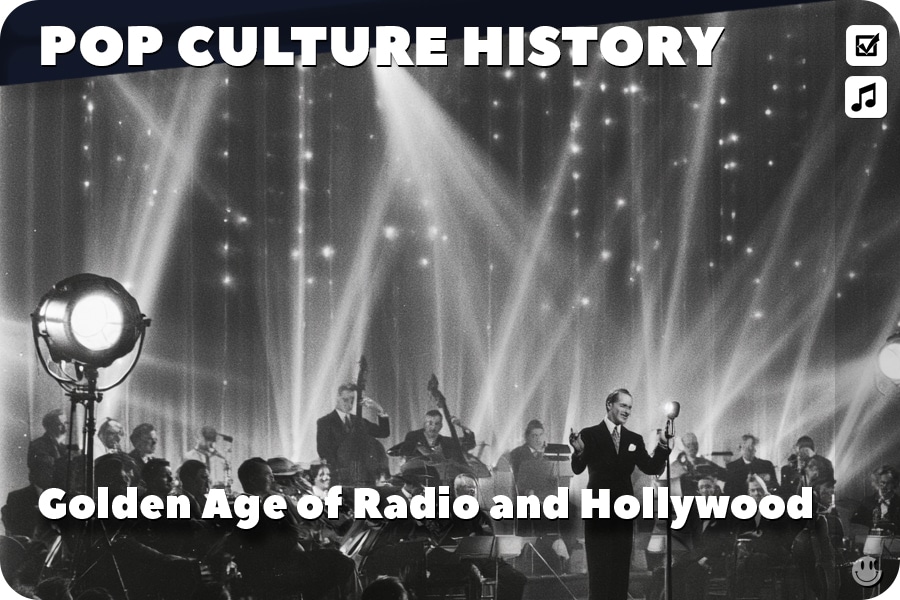
The Golden Age of Radio and Hollywood: Pop Culture from 1930 to 1941
The Great Depression left a quarter of American workers jobless at its worst, but it was a golden age for entertainment. For a dime or a quarter, families escaped into the movies: King Kong, Fred Astaire and Ginger Rogers, the Marx Brothers, Snow White, The Wizard of Oz, and Gone with the Wind. At home, the radio was free once you owned one, and the whole country tuned in to FDR’s fireside chats, The Lone Ranger, Jack Benny, and Orson Welles’s Martian invasion. Superman and Batman were born in comic books, swing music filled the dance halls, and Americans played Monopoly, swallowed goldfish, and lined up to buy nylon stockings. When money was tight, the silver screen was golden.
Quick Facts About the Golden Age of Radio and Hollywood
Defining Media: Network radio, Hollywood’s studio system, Technicolor, jukeboxes, and comic books
Presidents: Herbert Hoover and Franklin D. Roosevelt
U.S. Population: 123 million in 1930, growing to 132 million by 1940
Biggest Events: The Great Depression, the Dust Bowl, the New Deal, the end of Prohibition (December 5, 1933), the Hindenburg disaster (1937), and the 1939 New York World’s Fair
Biggest Stars: Clark Gable, Shirley Temple, Fred Astaire and Ginger Rogers, Jean Harlow, Bing Crosby, Benny Goodman, Jack Benny, and Joe Louis
Biggest Songs: Brother, Can You Spare a Dime?, Who’s Afraid of the Big Bad Wolf?, Over the Rainbow, God Bless America, In the Mood, and A-Tisket, A-Tasket
The Conversation: Did you hear the president on the radio last night? And what’s playing at the picture show this week?
How the Medium Changed Everything: The Radio in Every Living Room
By 1940, more than 80 percent of American homes had a radio. Families planned their evenings around the schedule: comedians Jack Benny, George Burns and Gracie Allen, and Fibber McGee and Molly; adventure shows like The Lone Ranger, which used Rossini’s William Tell Overture as its theme; and The Shadow, whose narrator asked who knew what evil lurked in the hearts of men. Daytime dramas sponsored by soap companies became known as “soap operas.” President Franklin D. Roosevelt’s first fireside chat, on March 12, 1933, used the radio to talk to Americans as if he were sitting in their living room.
Radio’s power became clear on October 30, 1938, when Orson Welles’s Mercury Theatre broadcast a realistic adaptation of H.G. Wells’s The War of the Worlds as a series of news bulletins about a Martian landing in Grovers Mill, New Jersey. Radio also carried the live description of the Hindenburg airship exploding in Lakehurst, New Jersey, on May 6, 1937, with reporter Herbert Morrison’s anguished “Oh, the humanity!”
Hollywood’s Golden Age
Five major studios controlled stars, writers, and theaters, and as many as 80 million Americans went to the movies every week. Universal’s monster movies began with Dracula and Frankenstein in 1931, the same characters born in Mary Shelley’s and Bram Stoker’s novels. King Kong climbed the Empire State Building in 1933, two years after the building opened. Disney’s Snow White and the Seven Dwarfs (December 21, 1937) was the first full-length cel-animated feature, and 1939, the year of The Wizard of Oz, Gone with the Wind, and Mr. Smith Goes to Washington, is often called Hollywood’s greatest year. In 1934, the industry began strictly enforcing the Production Code, ending the racy “pre-Code” era.
The world’s first drive-in movie theater opened in Camden County, New Jersey, on June 6, 1933, and popcorn, cheap and filling, became the official snack of the moviegoing Depression.
Fads and Crazes of the Era
Monopoly: Parker Brothers began selling the real-estate board game in 1935, and it became a Depression-era hit for players dreaming of riches.
Goldfish swallowing: In March 1939, a Harvard freshman swallowed a live goldfish on a bet, and college students across the country competed to swallow more.
Jigsaw puzzles: Cheap weekly puzzles sold at newsstands became a huge craze around 1932 and 1933.
Chain letters: The “Send a Dime” chain letter swept the country in 1935, swamping post offices.
Pinball: Coin-operated games like Baffle Ball (1931) spread through drugstores and bars. Many cities later banned pinball as gambling.
Comic books and superheroes: Superman debuted in Action Comics No. 1 in 1938, followed by Batman (1939), Captain America (1940), and Wonder Woman (1941).
Radio premiums: Kids mailed in cereal box tops and Ovaltine seals for Little Orphan Annie decoder pins, Lone Ranger rings, and Buck Rogers ray guns.
Swing dancing: Jitterbugs and Lindy Hoppers turned ballrooms like Harlem’s Savoy into acrobatic shows.
Nylon stockings: When nylons went on sale nationwide on May 15, 1940, women bought millions of pairs in just a few days.
Shirley Temple everything: Dolls, dresses, and coloring books of the dimpled child star were bestsellers, and she was Hollywood’s top box-office draw from 1935 to 1938.
New foods: Twinkies (1930), Snickers (1930), Fritos and Lay’s (1932), Ritz Crackers (1934), Kraft Macaroni and Cheese and Spam (1937), and the Toll House chocolate chip cookie (around 1938).
Slang: Swell, hep, in the groove, jitterbug, and “keen.”
Stars, Sex Symbols, and Heartthrobs
Jean Harlow, the “Platinum Blonde,” set off a run on peroxide before her death at 26 in 1937. Mae West was the queen of double meanings in She Done Him Wrong (1933). Marlene Dietrich, Greta Garbo, Carole Lombard, Ginger Rogers, and Rita Hayworth were the screen’s great beauties, and Hedy Lamarr was also an inventor who co-patented a frequency-hopping technology in 1942 that helped lead to Wi-Fi and Bluetooth. Fan dancer Sally Rand was the sensation of Chicago’s 1933 World’s Fair.
The leading men were Clark Gable, the “King of Hollywood”; Errol Flynn, whose The Adventures of Robin Hood (1938) became the definitive Robin Hood movie; Cary Grant; Gary Cooper; Tyrone Power; and Olympic swimmer Johnny Weissmuller, whose Tarzan yell debuted in 1932.
Spotlight: The 1939 New York World’s Fair
Opening on April 30, 1939, in Queens, New York, the “World of Tomorrow” drew about 44 million visits over two seasons. Visitors saw General Motors’ Futurama ride, which imagined the superhighways of 1960, a smoking robot named Elektro, nylon stockings, and RCA’s television. President Roosevelt became the first president to appear on television at the opening. The fair’s Trylon and Perisphere became icons of streamlined modern design.
The Swing Era
Benny Goodman’s August 1935 performance at the Palomar Ballroom in Los Angeles is often counted as the start of the Swing Era, and his January 16, 1938, concert brought jazz to Carnegie Hall. Count Basie, Duke Ellington, Artie Shaw, Tommy Dorsey, and Glenn Miller, whose In the Mood came out in 1939, led the big bands. Ella Fitzgerald and Billie Holiday became stars, and Bing Crosby was the most popular singer in America. Jukeboxes in diners and bars helped decide the hits. Kate Smith introduced Irving Berlin’s God Bless America on the radio on November 10, 1938.
Sports of the Era
Jesse Owens won four gold medals at the 1936 Berlin Olympics.
Joe Louis knocked out Germany’s Max Schmeling in 124 seconds on June 22, 1938, before a huge radio audience.
Seabiscuit beat War Admiral in their famous match race on November 1, 1938, with an estimated 40 million people listening.
Baseball held its first All-Star Game in 1933, opened the Hall of Fame in Cooperstown in 1939, and had its first televised game that May. Lou Gehrig called himself the luckiest man on the face of the earth on July 4, 1939.
In 1941, Joe DiMaggio hit in 56 straight games and Ted Williams batted .406.
Myth vs. Fact: The Golden Age of Radio and Hollywood
Myth:The War of the Worlds broadcast caused nationwide panic. Fact: Most listeners weren’t fooled, and newspapers, eager to discredit radio, greatly exaggerated the panic.
Myth: Undershirt sales crashed after Clark Gable went bare-chested in It Happened One Night (1934). Fact: It’s a popular Hollywood story, but no one has found sales data to prove it.
Myth: Charles Darrow invented Monopoly. Fact: It was based on The Landlord’s Game, patented by Lizzie Magie in 1904.
Myth: Babe Ruth “called his shot” in the 1932 World Series. Fact: He gestured toward the field, but whether he was pointing at the bleachers is still debated.
Firsts and Milestones of the Era
The Empire State Building opened on May 1, 1931, and the Golden Gate Bridge on May 27, 1937. The Star-Spangled Banner became the official national anthem on March 3, 1931. Nancy Drew (1930), Dick Tracy (1931), Life magazine (1936), The Hobbit (1937), Dr. Seuss’s first book (1937), Gone with the Wind (novel, 1936), and The Grapes of Wrath (1939) all arrived. Amelia Earhart vanished over the Pacific on July 2, 1937. The era ended on December 7, 1941, when Japan attacked Pearl Harbor.
The Golden Age of Radio and Hollywood Year by Year