1936 Pop Culture Headlines
Top Events in January 1936 Pop Culture History
1. King George V Dies; Edward VIII Becomes King (January 20, 1936): The death of Britain’s longtime monarch at Sandringham House brought his eldest son to the throne, beginning a reign that would last less than a year before ending in one of the most scandalous royal abdications in British history. Trivia: George V’s death was reportedly hastened by his physician, who administered a fatal dose of morphine and cocaine specifically timed so the news would break in the morning papers rather than the less prestigious evening editions, a detail that only came to light decades later through the doctor’s own private diary.
2. Baseball Hall of Fame’s First Inductees Announced (January 29, 1936): Ty Cobb, Babe Ruth, Honus Wagner, Christy Mathewson, and Walter Johnson became the very first class inducted into the National Baseball Hall of Fame in Cooperstown, New York. Trivia: Cobb actually received the highest vote total of the five, edging out even Babe Ruth, a fact that still surprises many baseball fans given how thoroughly Ruth’s legend has since eclipsed nearly everyone else from the era.
3. Billboard Publishes Its First Music Hit Parade (January 4, 1936): The trade magazine began tracking and publishing the popularity of recorded songs, an early forerunner of the chart system that would eventually evolve into the modern Billboard Hot 100 more than two decades later. Trivia: These earliest charts looked nothing like today’s data-driven rankings, relying instead on a loose mix of sheet music sales, jukebox play reports, and orchestra bookings to gauge a song’s popularity.
4. State Funeral of King George V (January 28, 1936): Following a solemn procession through London, the late king was buried at St. George’s Chapel in Windsor Castle, drawing enormous crowds of mourners along the funeral route. Trivia: George V’s four surviving sons, including new King Edward VIII, walked directly behind the coffin during the procession, a formal mourning tradition that royal watchers still reference when discussing modern royal funerals.
5. Reza Shah Bans the Hijab in Iran (January 8, 1936): Iran’s ruler issued the Kashf-e hijab decree banning Islamic veils along with several forms of traditional male clothing, part of his sweeping campaign to forcibly modernize and Westernize Iranian society. Trivia: the ban proved so controversial and difficult to enforce that police were reportedly instructed to physically remove veils from women in public, a heavy-handed approach that fueled lasting resentment toward the policy for decades afterward.
Top Events in February 1936 Pop Culture History
1. Modern Times Premieres (February 5, 1936): Charlie Chaplin’s comedy about a factory worker struggling against the dehumanizing pace of industrial machinery became one of the last great films of the silent era’s visual comedy style, even as sound pictures had already fully taken over Hollywood. Trivia: Chaplin famously refused to let his Tramp character speak any actual dialogue in the film, aside from a single gibberish song, a deliberate artistic choice that made the movie something of a farewell letter to silent cinema.
2. The First NFL Draft Is Held (February 8, 1936): At Philadelphia’s Ritz-Carlton Hotel, the Philadelphia Eagles used the very first overall pick to select University of Chicago halfback Jay Berwanger, the inaugural winner of the Heisman Trophy. Trivia: Berwanger never actually played a single down in the NFL, turning down a contract offer and instead pursuing a business career, making him one of the more unusual number-one picks in professional sports history.
3. Radium E Becomes the First Synthetic Radioactive Element (February 4, 1936): Scientists successfully created this radioactive isotope of bismuth artificially for the first time, an early milestone in the young field of nuclear physics that would help lay groundwork for later atomic research. Trivia: This breakthrough came less than a decade before the far more consequential, and far more famous, nuclear research that would produce the atomic bomb during World War II.
4. The Phantom Debuts in Newspapers (February 17, 1936): Lee Falk’s comic strip introduced audiences to the purple-costumed jungle crimefighter, widely considered the first costumed superhero to wear a form-fitting mask and full-body suit in American comics. Trivia: The Phantom predates both Superman and Batman by a couple of years, making him a genuine pioneer of the superhero costume archetype that would soon come to dominate the entire comic book industry.
Top Events in March 1936 Pop Culture History
1. 8th Academy Awards (March 5, 1936): Mutiny on the Bounty, starring Clark Gable and Charles Laughton, won Best Picture, while Victor McLaglen took home Best Actor for The Informer and Bette Davis won Best Actress for Dangerous. Trivia: Mutiny on the Bounty remains the only film in Academy Awards history to win Best Picture with three separate competing Best Actor nominations from its own cast, since Gable, Laughton, and co-star Franchot Tone were all nominated in the same category that year.
2. Nazi Germany Reoccupies the Rhineland (March 7, 1936): German troops marched into the demilitarized Rhineland zone in direct violation of both the Treaty of Versailles and the Locarno Treaties, an early and largely unchallenged test of how far Hitler could push before facing real consequences from Britain and France. Trivia: Hitler himself later admitted privately that the French army alone could easily have crushed the operation at the time, and that the entire gamble had been an enormous bluff that simply happened to pay off.
3. The Pittsburgh “St. Patrick’s Day Flood” (March 17-18, 1936): Torrential rains and rapid snowmelt caused the worst flooding in Pittsburgh’s history, submerging much of the city’s downtown business district and causing dozens of deaths across the region. Trivia: the flood’s devastation directly spurred a decades-long federal flood-control project along the region’s rivers, a system of dams and reservoirs still credited with protecting the city from similarly catastrophic flooding today.
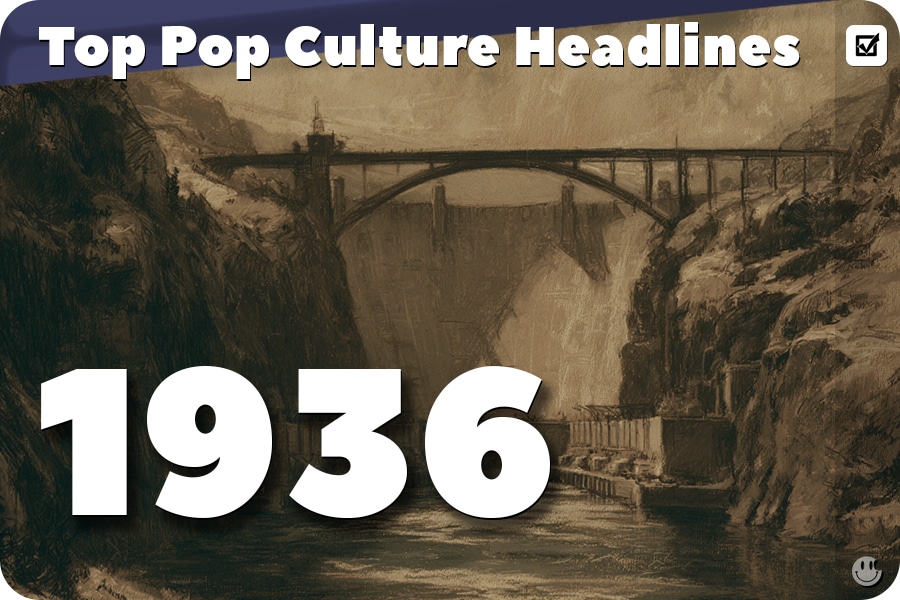
4. Construction of Hoover Dam Is Completed (March 1, 1936): The massive Colorado River dam project, known at the time as Boulder Dam, finished construction, standing as one of the most ambitious civil engineering achievements of the Depression era. Trivia: the dam wouldn’t officially begin sending electricity to Los Angeles until that October, and it wasn’t formally renamed Hoover Dam by Congress until more than a decade later, in 1947.
5. The Longest Game in NHL History (March 24-25, 1936): The Montreal Maroons and Detroit Red Wings played a scoreless marathon that finally ended at 2:25 in the morning, 16 and a half minutes into the sixth overtime period, when Detroit’s Mud Bruneteau scored the winning goal. Trivia: this remains, to this day, the longest game ever played in NHL history, a record that has stood for nearly a century.
Top Events in April 1936 Pop Culture History
1. Richard Hauptmann Is Executed (April 3, 1936): The German immigrant convicted of kidnapping and murdering aviator Charles Lindbergh’s infant son in 1932 was put to death by electrocution at New Jersey State Prison, closing out one of the most sensationalized criminal cases of the entire decade. Trivia: Hauptmann maintained his innocence right up until his execution, and questions about the fairness of his trial and the strength of the evidence against him have continued to fuel debate among historians and true-crime researchers ever since.
2. The Tupelo-Gainesville Tornado Outbreak (April 5-6, 1936): A devastating series of tornadoes tore through the southern United States over two days, with the strongest twisters striking Tupelo, Mississippi and Gainesville, Georgia, killing more than 450 people combined and injuring thousands more. Trivia: the Tupelo tornado alone remains, to this day, the fourth-deadliest tornado in recorded U.S. history, and the disaster’s severity directly spurred the development of more sophisticated early tornado warning systems in the years that followed.
Top Events in May 1936 Pop Culture History
1. The Santa Fe Super Chief Debuts (May 12, 1936): The railroad inaugurated its luxurious all-Pullman passenger train service between Chicago and Los Angeles, quickly becoming known as “The Train of the Stars” for its popularity with Hollywood celebrities traveling between the two cities. Trivia: the Super Chief’s glamorous reputation was such a draw that several classic films from the era actually used footage or references to the train specifically to signal wealth and sophistication to audiences.
2. The Petrified Forest Released (May 1936): This tense drama, adapted from the Broadway play, gave Humphrey Bogart his breakout film role as an escaped gangster holed up in a remote desert diner, a performance that finally began pulling him out of years of minor supporting parts. Trivia: Bogart had actually already played the same role on Broadway, and it was star Leslie Howard’s insistence that the studio cast Bogart in the film version, rather than a bigger name, that gave Bogart his crucial big-screen breakthrough.
3. The Remington Rand Strike Begins (May 25, 1936): Workers at the typewriter and business machine manufacturer launched a major labor strike that would stretch on for more than a year, part of the broader wave of organized labor unrest sweeping American industry during the mid-1930s. Trivia: the prolonged, often bitter dispute became one of the notable labor conflicts cited in later Congressional hearings investigating the era’s corporate strikebreaking tactics.
Top Events in June 1936 Pop Culture History
1. Joe Louis Loses to Max Schmeling in a Stunning Upset (June 19, 1936): The German boxer knocked out the previously undefeated Louis in the twelfth round at Yankee Stadium, a result the Nazi propaganda machine eagerly seized upon as proof of supposed Aryan superiority. Trivia: Louis would get his revenge two years later in a legendary rematch, knocking Schmeling out in just over two minutes in a fight widely remembered as one of the most politically charged sporting events of the entire century.
2. Gone with the Wind Is Published (June 30, 1936): Margaret Mitchell’s sprawling Civil War-era romance became an instant sensation, going on to win the Pulitzer Prize and eventually becoming the basis for one of the most successful films in Hollywood history just a few years later. Trivia: Mitchell reportedly worked on the manuscript in near-total secrecy for years, and she was initially so hesitant about the book’s quality that she nearly didn’t submit it to a publisher at all.
3. The Steel Workers Organizing Committee Is Founded (June 7, 1936): This labor organization, formed to unionize the American steel industry, represented a major escalation in the broader push for industrial unionism that was reshaping American labor relations during the Depression. Trivia: The committee’s organizing efforts would eventually evolve into the United Steelworkers union, which remains one of the largest and most influential labor unions in the country today.
4. The BBC Broadcasts Live Tennis from Wimbledon (June 1936): The corporation’s coverage of the tournament is widely considered the world’s very first live television broadcast of a sporting event, a genuinely novel technological feat for the small handful of Britons who owned a television set at the time. Trivia: the total television audience for this broadcast was almost comically tiny by modern standards, likely numbering only in the hundreds or low thousands given how few receivers existed in Britain in 1936.
Top Events in July 1936 Pop Culture History
1. The Triborough Bridge Opens in New York City (July 11, 1936): This massive, three-way bridge complex connecting Manhattan, Queens, and the Bronx became one of the signature infrastructure achievements of Robert Moses’s sweeping New York City building projects. Trivia: The bridge was actually a complex of three separate spans built as a single interconnected system, an engineering approach so ambitious that it required its own dedicated construction authority to manage.
2. The Spanish Civil War Begins (July 17-18, 1936): A military uprising led by General Francisco Franco against Spain’s Republican government erupted into a brutal, prolonged conflict that would draw in international volunteers and foreign intervention over the following three years. Trivia: American writer Ernest Hemingway was among the many international volunteers and journalists who traveled to Spain during the war, an experience that directly inspired his later novel For Whom the Bell Tolls.
3. A Record-Breaking Heat Wave Grips the Midwest (July 13-14, 1936): One of the most severe and deadly heat waves in North American history set new all-time temperature records across Wisconsin, Michigan, and Indiana, with the town of Mio, Michigan reaching a scorching 113 degrees Fahrenheit. Trivia: this heat wave, layered atop the ongoing Dust Bowl drought, is estimated to have contributed to thousands of heat-related deaths across the country that summer.
4. “Pennies from Heaven” Is Recorded (July 1936): Bing Crosby’s recording of the title song from his new film became one of the biggest hits of the entire year, holding the top spot on the era’s popularity charts for a full ten weeks. Trivia: the song was nominated for the Academy Award for Best Original Song that year but ultimately lost to another 1936 standard, “The Way You Look Tonight,” from the film Swing Time.
Top Events in August 1936 Pop Culture History
1. The 1936 Summer Olympics Open in Berlin (August 1, 1936): Adolf Hitler personally opened the Games in front of a packed stadium of 100,000 spectators, hoping to showcase Nazi Germany’s vision of Aryan supremacy to a worldwide television and radio audience for the very first time in Olympic history. Trivia: These Games marked the first live television coverage of any international sporting event in world history, though the broadcast only reached a small number of public viewing rooms set up around Berlin itself.
2. Jesse Owens Wins Four Gold Medals (August 3-9, 1936): The African American track star won gold in the 100-meter dash, the long jump, the 200-meter dash, and the 4×100-meter relay, delivering a resounding, very public rebuke to Hitler’s plans to use the Games as Nazi propaganda. Trivia: Owens’s relay team set a world record of 39.8 seconds that stood unbroken for 20 years, underscoring just how dominant his performance in Berlin truly was.
3. The United States Wins Its First Olympic Basketball Gold (August 1936): The American men’s national team defeated Canada 19-8 in the final, in the very first year basketball was included as an official Olympic sport. Trivia: the low-scoring final was reportedly played outdoors on a dirt-and-sand court in the pouring rain, conditions that made high-scoring, fast-paced basketball essentially impossible that day.
4. Swing Time Released, Featuring “The Way You Look Tonight” (August 1936): Fred Astaire and Ginger Rogers starred in this beloved musical, whose signature song went on to win the Academy Award for Best Original Song and become one of the most enduring romantic standards of the entire decade. Trivia: Astaire reportedly recorded his vocal for the song in a single, understated take, feeling the melody was strong enough that he didn’t want to oversing it with unnecessary vocal flourishes.
Top Events in September 1936 Pop Culture History
1. Hoover Dam Is Formally Renamed (September 7, 1936): The massive Colorado River dam project, completed that March under the name Boulder Dam, was ceremonially rededicated in honor of former President Herbert Hoover’s role in championing its construction. Trivia: the renaming proved controversial for years, as the Roosevelt administration’s Interior Department continued to officially refer to it as Boulder Dam until Congress finally settled the matter permanently in 1947.
2. My Man Godfrey Released (September 1936): William Powell and Carole Lombard starred in this beloved screwball comedy about a wealthy family’s scavenger hunt “forgotten man,” a film now widely regarded as one of the finest examples of the entire screwball comedy genre. Trivia: Powell and Lombard had already been married and divorced by the time this film was made, yet their on-screen chemistry remained so strong that both were nominated for Academy Awards for their performances.
3. The 1936 NFL Season Kicks Off (September 10, 1936): The Boston Redskins defeated the Philadelphia Eagles to open the season, part of a still-young and steadily growing professional football league years away from the massive popularity it would eventually achieve. Trivia: the Redskins franchise itself was brand new to Boston that season, having relocated from Boston the following year to Washington, D.C., where it would remain for decades afterward.
4. Babe Ruth Honored at Yankee Stadium (September 22, 1936): The recently retired baseball legend was celebrated in a special ceremony at the ballpark where he’d built much of his legacy, just two years removed from his final major league game. Trivia: Ruth’s larger-than-life popularity remained so strong even in retirement that ceremonies and tributes honoring him continued regularly throughout the late 1930s, long before his eventual Hall of Fame induction that January.
Top Events in October 1936 Pop Culture History
1. New York Yankees Win the World Series (October 6, 1936): The Yankees defeated their crosstown rivals, the New York Giants, four games to two, capturing their fifth World Series title behind a lineup anchored by a young Joe DiMaggio in his rookie season. Trivia: This championship kicked off a remarkable stretch in which the Yankees would go on to win four consecutive World Series titles through the end of the decade.
2. Hoover Dam Begins Sending Electricity to Los Angeles (October 9, 1936): The dam’s hydroelectric generators started transmitting power across 266 miles of mountains and desert, bringing electricity to the lights, radios, and stoves of a rapidly growing Los Angeles. Trivia: This transmission project was, at the time, one of the longest-distance electrical power transmission systems ever built anywhere in the world.
3. H.R. Ekins Wins the Round-the-World Air Race (October 19, 1936): The New York World-Telegram reporter beat two rival journalists, including Dorothy Kilgallen of the New York Journal, in an 18-and-a-half-day race to circle the globe using only commercial airline flights. Trivia: the competition was staged largely as a publicity stunt by competing newspapers, but it also served as a genuine, closely watched demonstration of just how far commercial aviation had advanced by the mid-1930s.
4. Francisco Franco Named Head of State in Spain (October 1936): The Nationalist military leader consolidated formal political authority over Spain’s rebel government just months into the ongoing civil war, a position of power he would go on to hold as dictator for nearly four decades until his death in 1975. Trivia: Franco’s Nationalist forces wouldn’t actually complete their conquest of Spain until 1939, meaning he governed as the recognized rebel head of state for years before formally winning the war itself.
Top Events in November 1936 Pop Culture History
1. Franklin D. Roosevelt Reelected in a Landslide (November 3, 1936): FDR crushed Republican challenger Alf Landon, winning 46 of the 48 states and one of the most lopsided electoral victories in American presidential history, a powerful public endorsement of his New Deal programs. Trivia: Landon’s crushing defeat was so total that it gave rise to a lasting political joke of the era, “As Maine goes, so goes Vermont,” a wry twist on the old political saying since those were the only two states Landon actually managed to carry.
2. The San Francisco-Oakland Bay Bridge Opens (November 12, 1936): The massive bridge span connecting San Francisco and Oakland opened to traffic, at the time one of the longest and most expensive bridges ever constructed, predating the more famous Golden Gate Bridge’s own opening by several months. Trivia: despite its immense engineering significance, the Bay Bridge has always lived somewhat in the shadow of its more photogenic neighbor, the Golden Gate Bridge, which opened the following spring.
3. The First Issue of Life Magazine (November 23, 1936): Henry Luce launched this new weekly photojournalism magazine, which would go on to define visual storytelling in American journalism for decades through its striking, large-format photography. Trivia: the very first issue sold out its entire print run almost immediately, a strong early signal of just how hungry American readers were for this new, image-driven style of news coverage.
4. The Anti-Comintern Pact Is Signed (November 25, 1936): Nazi Germany and Imperial Japan formally signed this agreement aimed at opposing international communism, an early diplomatic building block toward the Axis alliance that would eventually draw the world into a second global war. Trivia: Italy would join this same pact just one year later, formally cementing the three-way alliance that came to be known as the Axis powers.
5. The Crystal Palace Destroyed by Fire (November 30, 1936): London’s famous glass-and-iron exhibition hall, originally built for the 1851 Great Exhibition, burned down in a spectacular blaze visible for miles across the city. Trivia: the fire was so massive and visible that it reportedly drew crowds of onlookers from across London, including Winston Churchill himself, who watched the historic structure’s destruction from a nearby vantage point.
Top Events in December 1936 Pop Culture History
1. King Edward VIII Abdicates the Throne (December 11, 1936): Just months after inheriting the crown, Edward gave up the British throne entirely in order to marry American divorcée Wallis Simpson, a union the government and church of the time refused to sanction for a reigning monarch. Trivia: Edward’s younger brother, who became King George VI, was so unprepared and reluctant to become king that his own stammering and public-speaking struggles later became the subject of the Academy Award-winning film The King’s Speech.
2. Wallis Simpson Named Time’s Woman of the Year (December 1936): Time magazine selected Simpson, the American divorcée at the center of Edward VIII’s abdication crisis, becoming the first woman ever chosen for what the magazine then called its “Man of the Year” honor. Trivia: Simpson’s selection was widely seen at the time as a somewhat scandalous, tongue-in-cheek choice by the magazine, reflecting just how thoroughly the abdication crisis had dominated global headlines throughout the back half of the year.
3. The Flint Sit-Down Strike Begins (December 30, 1936): Autoworkers at a General Motors Fisher Body plant in Flint, Michigan, began occupying the factory itself rather than simply picketing outside it, a bold new labor tactic demanding recognition of the United Auto Workers union. Trivia: This now-legendary 44-day strike, which stretched into the following year, is widely credited by labor historians as the pivotal moment that finally forced major American automakers to formally recognize industrial labor unions.