
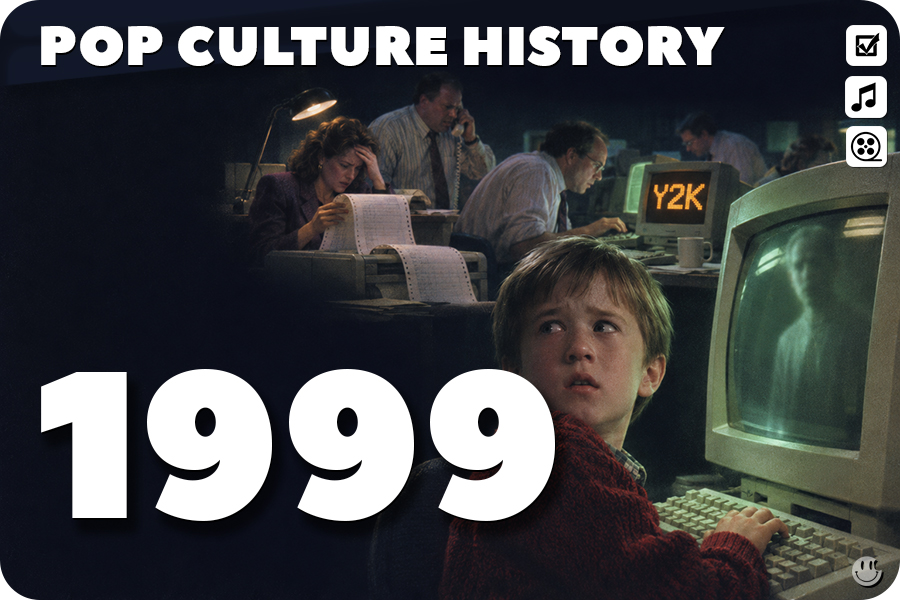
In 1999, America spent the whole year wondering whether every computer on Earth would crash at midnight on December 31. The Y2K bug turned out to be mostly a non-event, thanks largely to programmers who quietly fixed things nobody noticed because the fixes worked. Meanwhile, The Sixth Sense terrified everyone, The Matrix rewired action movies, Carlos Santana teamed up with Matchbox Twenty’s Rob Thomas for the biggest song of the fall, and a 15-year-old hacked NASA from his bedroom. The millennium ended mostly intact.
Quick Facts from 1999
- World Wide Worry: The Y2K bug, the fear that computers storing years as two digits would read 2000 as 1900 and fail at midnight on December 31, drove years of repair work and plenty of public anxiety before passing without major incident
- Top Song: Believe by Cher, the #1 single on the Billboard Year-End Hot 100; Santana and Rob Thomas’s Smooth began a 12-week run at #1 in October and finished #2 on Billboard’s 2000 year-end chart
- Must-See Movies: The Sixth Sense, The Matrix, Star Wars: Episode I – The Phantom Menace, Toy Story 2, The Blair Witch Project, American Beauty, and Austin Powers: The Spy Who Shagged Me
- Most Famous Person in America: Bill Gates, whose Microsoft antitrust trial dominated business news all year
- Notable Books: Harry Potter and the Prisoner of Azkaban by J.K. Rowling and From Hell by Alan Moore and Eddie Campbell
- Price of a Postage Stamp: 33 cents
- Sony Discman: $59.00
- Crayola Crayons, 64-Pack: $1.79
- The Funny Guys: Chris Rock and Mitch Hedberg
- The Funny Late Late Night Host: Craig Kilborn
- Myth Becomes Reality: For years, people swore American Express had a secret black card for the super-rich. In 1999, AmEx made the urban legend real with the invitation-only Centurion Card.
- Chinese Zodiac: Year of the Rabbit, associated with elegance, caution, and good judgment, all handy in a year spent wondering whether the computers would stop working
- The Habits: Collecting Pokémon cards; watching The Blair Witch Project and arguing about whether it was real; and playing along with Who Wants to Be a Millionaire at home
- The Conversation: Are you ready for Y2K? And have you seen The Sixth Sense yet? Don’t tell me anything.
Top Ten Baby Names of 1999
Girls: Emily, Hannah, Alexis, Sarah, Samantha
Boys: Jacob, Michael, Matthew, Joshua, Nicholas
Emily held the top spot for girls for the fourth straight year. Jacob finally ended Michael’s 38-year run at #1 for boys and would hold the top spot through 2012.
Fashion Icons and Sex Symbols of 1999
Gisele Bündchen, Angelina Jolie, Salma Hayek, Claudia Schiffer, Jennifer Love Hewitt, Shania Twain, Denise Richards, Rebecca Romijn, Heidi Klum, Jennifer Lopez, Halle Berry, Catherine Zeta-Jones, Jennifer Aniston, Pamela Anderson, Sarah Michelle Gellar
Gisele Bündchen, discovered at 14 at a São Paulo mall, was becoming the world’s top model. Angelina Jolie was filming Girl, Interrupted, which won her an Oscar the following year, and Shania Twain’s Come On Over was on its way to becoming the best-selling country album by a female artist.
Leading Men and Hollywood Hunks of 1999
Richard Gere (People‘s Sexiest Man Alive 1999), David Beckham, Christian Bale, Justin Timberlake, George Clooney, Brad Pitt, Keanu Reeves, Ricky Martin, Matt Damon, Will Smith
The Quotes
“I see dead people.” – Haley Joel Osment as Cole Sear, The Sixth Sense
“Is that your final answer?” – Regis Philbin, Who Wants to Be a Millionaire, a phrase that went straight into everyday use
Time Magazine’s Person of the Year
Jeff Bezos, founder of Amazon, which had grown from an online bookstore into the company that best showed what internet shopping could be. Bezos was 35. Time called him the “king of cyber-commerce,” which now sounds like a bit of an understatement.
Miss America and Miss USA
Miss America: Nicole Johnson, Virginia Beach, Virginia, who used her reign to raise awareness about diabetes
Miss USA: Kimberly Pressler, New York
We Lost in 1999
John F. Kennedy Jr. was killed on July 16, 1999, when the small plane he was piloting crashed into the Atlantic off Martha’s Vineyard, Massachusetts. He was 38. His wife, Carolyn Bessette-Kennedy, and her sister, Lauren Bessette, also died. Kennedy was a relatively new pilot with limited experience flying at night in hazy conditions. The search took five days and was covered nonstop on TV.
Wrestler Owen Hart of the famous Hart wrestling family died on May 23, 1999, during the WWF’s Over the Edge pay-per-view at Kemper Arena in Kansas City, when a harness release triggered as he was being lowered from the rafters for his entrance. He fell 78 feet. He was 34. The WWF continued the event after a delay, a decision that drew heavy criticism.
Golfer Payne Stewart died October 25, 1999, when the Learjet carrying him and five others lost cabin pressure after leaving Orlando. Everyone aboard lost consciousness, and the plane flew on autopilot for about four hours before running out of fuel and crashing near Aberdeen, South Dakota. Famous for his knickers and tam o’shanter caps, Stewart had won his second U.S. Open that June. He was 42.
Dana Plato, Kimberly Drummond on Diff’rent Strokes, died May 8, 1999, at age 34, of an accidental prescription drug overdose.
Shel Silverstein, the poet and author behind Where the Sidewalk Ends and The Giving Tree, died May 10, 1999, at age 68.
Also lost in 1999:
Gene Siskel, film critic: February 20, age 53
Dusty Springfield, singer: March 2, age 59
Stanley Kubrick, director: March 7, age 70
Joe DiMaggio, Yankees legend: March 8, age 84
Wilt Chamberlain, NBA legend: October 12, age 63
Walter Payton, NFL legend: November 1, age 45
Madeline Kahn, actress: December 3, age 57
America in 1999: The Context
In 1999, the United States was prosperous, at peace, and fixated on whether its president should be removed from office. The Senate trial of Bill Clinton, impeached in December 1998 for perjury and obstruction of justice related to Monica Lewinsky, ended on February 12, 1999, with acquittal on both counts. His approval ratings stayed high throughout.
The Microsoft antitrust case, brought by the Justice Department and 20 states, reached a turning point in November 1999, when Judge Thomas Penfield Jackson found that Microsoft had illegally protected its Windows monopoly and tried to extend it into web browsers. A proposed breakup was later overturned, and the case was settled in 2001, but it shaped debates over Big Tech’s power for decades.
The Columbine High School shooting on April 20, 1999, in Littleton, Colorado, killed 12 students and a teacher and wounded more than 20 others before the two shooters took their own lives. It was the deadliest high school shooting in U.S. history at the time and set off a national debate about guns, school safety, violent video games, and bullying. It permanently changed how American schools approach security.
NATO began bombing Yugoslavia on March 24, 1999, to stop Serbian attacks on ethnic Albanians in Kosovo. The 78-day campaign, the largest military operation in NATO’s history to that point, ended with Serbian forces withdrawing from Kosovo. It was carried out without a UN Security Council mandate, which made it controversial.
The Y2K Bug
The Year 2000 problem came from an old programming shortcut: storing years as two digits to save memory. When 2000 arrived, computers might read “00” as 1900, scrambling banking, power, aviation, and military systems. Governments and companies spent an estimated $300 billion worldwide fixing the problem, programmers worked nights and weekends, and survivalists stocked up on canned goods. When midnight struck on December 31, 1999, almost nothing happened. Whether that was because the fixes worked or the danger was overblown is still debated.
The Matrix
The Matrix, written and directed by the Wachowskis and starring Keanu Reeves, Laurence Fishburne, and Carrie-Anne Moss, opened March 31, 1999. Its “bullet time” effect, shot with a ring of still cameras around the actors, was imitated everywhere almost immediately, and its mix of kung fu and philosophy got college professors talking about an action movie. It grossed about $463 million on a $63 million budget. Eerie footnote: Neo’s passport in the film expires on September 11, 2001.
Star Wars Returns
Star Wars: Episode I – The Phantom Menace opened May 19, 1999, the first new Star Wars film in 16 years. One consulting firm estimated that 2.2 million workers skipped work to see it, costing about $293 million in lost productivity. It grossed $431 million in the U.S., the most of any 1999 film, though reviews were mixed and Jar Jar Binks was not universally beloved.
The Sixth Sense
M. Night Shyamalan’s The Sixth Sense, starring Bruce Willis and Haley Joel Osment, opened August 6, 1999, and grossed about $293 million in the U.S., second only to Phantom Menace. Osment, 11, earned an Oscar nomination, and the film was nominated for Best Picture. The twist ending will not be described here, on the off chance someone hasn’t seen it.
The Blair Witch Project
The Blair Witch Project, shot in eight days in 1997 for about $60,000, opened July 14, 1999, and grossed $248 million worldwide, one of the most profitable films ever. Its website treated the footage as real evidence of a disappearance, one of the first viral internet marketing campaigns, and many viewers believed it. The found-footage genre it popularized is still going.
Pop Culture Facts and History
Santana’s Supernatural, released in June 1999, brought Carlos Santana roaring back after years away from the charts. Smooth, featuring Matchbox Twenty singer Rob Thomas, spent 12 weeks at #1 and was later named the #2 song of the Hot 100’s first 60 years. Santana won eight Grammys for the album in February 2000, tying Michael Jackson’s record for one night. He was 51 when it came out.
Who Wants to Be a Millionaire premiered on ABC on August 16, 1999, and soon became TV’s biggest hit, airing several nights a week. Contestants answered multiple-choice questions for up to $1 million with lifelines like “phone a friend” and “ask the audience,” and Regis Philbin’s monochrome shirt-and-tie combos became a fashion trend.
Britney Spears released her debut album, …Baby One More Time, on January 12, 1999, at age 17. The title single hit #1 in the U.S. and around the world, its schoolgirl-uniform video drew both controversy and huge ratings, and the album became one of the best-selling debuts ever.
Christina Aguilera’s debut single, Genie in a Bottle, spent five weeks at #1 in the summer of 1999. She was 18, and her debut album went on to sell more than 17 million copies worldwide.
Ricky Martin’s electrifying performance of La Copa de la Vida at the February 1999 Grammys made him an overnight American star. His English-language single Livin’ la Vida Loca spent five weeks at #1 and kicked off a Latin pop explosion.
Toy Story 2, released November 24, 1999, began life as a direct-to-video sequel before being promoted to theaters. It grossed nearly $500 million worldwide and is one of the rare sequels many critics consider better than the original.
The Kyocera VP-210, released in Japan in May 1999, is often cited as the first commercial camera phone. Its 0.11-megapixel camera could store 20 photos. Within a decade, camera phones had all but replaced point-and-shoot cameras.
They Might Be Giants released Long Tall Weekend in 1999 as a download-only album through eMusic, often cited as the first album by a major-label act released exclusively as MP3s. The music industry spent the next decade trying to figure out what that meant.
Billy Mitchell recorded the first perfect score in Pac-Man, 3,333,360 points, on July 3, 1999, at Funspot in New Hampshire, after about six hours of play. A perfect game means clearing all 255 playable boards, eating every dot, energizer, fruit, and ghost, without losing a life.
Jonathan James was 15 in 1999 when he hacked into NASA and Department of Defense computers, downloading software that helped run the International Space Station’s living environment. NASA shut down its computers for three weeks to investigate, at a cost of about $41,000. Because he was a juvenile, James was sentenced to house arrest.
On December 30, 1999, an intruder broke into George Harrison’s home in Henley-on-Thames, England, and stabbed him repeatedly. Harrison’s wife, Olivia, fought the attacker off with a fireplace poker and a lamp. Harrison recovered and later quipped, “He wasn’t a burglar, and he certainly wasn’t auditioning for the Traveling Wilburys.”
Susan Lucci won the Daytime Emmy for Outstanding Lead Actress in a Drama Series in 1999, on her 19th nomination since 1978. The audience gave her a long standing ovation, part celebration and part relief.
When Volkswagen used Nick Drake’s Pink Moon in a 1999 TV commercial, his U.S. album sales jumped from about 6,000 copies in 1999 to about 74,000 in 2000. Drake had died in 1974, having sold very few records in his lifetime.
A Las Vegas couple who couldn’t agree on how to split their Beanie Baby collection in their divorce ended up in court, where a judge had them spread the toys on the floor and take turns choosing one at a time. The Beanie Baby market collapsed soon after, making the whole fight somewhat academic.
The Scottish Parliament reconvened on May 12, 1999, for the first time since 1707. Winnie Ewing opened the session by declaring that the Parliament, adjourned in March 1707, was “hereby reconvened.” Nobody could fault the understatement.
Skydiver Joan Murray survived a 14,500-foot fall in 1999 when both her main and reserve parachutes failed, landing in a fire ant mound. Doctors believe the hundreds of ant stings may have helped jolt her heart and keep her alive until help arrived. She later returned to skydiving.
Nobel Prize Winners in 1999
Physics: Gerardus ‘t Hooft and Martinus Veltman, for work on the quantum structure of electroweak interactions
Chemistry: Ahmed Zewail, for using ultrafast lasers to watch chemical bonds form and break, founding the field of femtochemistry
Physiology or Medicine: Günter Blobel, for discovering the “postal codes” that route proteins inside cells
Literature: Günter Grass of Germany, author of The Tin Drum. In 2006 he revealed that he had served in the Waffen-SS as a teenager, sparking controversy.
Peace: Médecins Sans Frontières (Doctors Without Borders), for its humanitarian medical work around the world
Economics: Robert Mundell, whose work on currency areas helped lay the groundwork for the euro, launched as a currency in 1999
Chemistry went to Ahmed Zewail for his studies of the transition states of chemical reactions using femtosecond spectroscopy: essentially, photography fast enough to capture the moment chemical bonds are made or broken. Zewail founded the field of femtochemistry, observing processes that occur in millionths of a billionth of a second.
Physiology or Medicine was awarded to Günter Blobel for the discovery that proteins have intrinsic signals that govern their transport and localization in the cell: essentially, the cellular postal code system that routes newly made proteins to the correct destinations within and outside cells.
Literature went to Günter Grass of Germany, because in his frolicsome black fables, he portrays the forgotten face of history. His novel The Tin Drum, published in 1959, remained his best-known work. The prize was awarded despite longstanding controversy over Grass’s wartime membership in the Waffen-SS, which he did not publicly disclose until 2006.
Peace was awarded to Médecins Sans Frontières (Doctors Without Borders) for its pioneering humanitarian work across several continents, providing medical care during acute crises. The organization was founded in 1971 and has operated in conflict zones and during humanitarian disasters worldwide.
Economics turned to Robert Mundell for his analysis of monetary and fiscal policy under different exchange rate regimes and of optimum currency areas. His theoretical work laid the intellectual foundation for the Euro, which was launched as a financial instrument in 1999, though coins and banknotes would not arrive until 2002.
The National Toy Hall of Fame
The National Toy Hall of Fame, founded in 1998, spent its early years enshrining the classics: Barbie, Crayola crayons, the Erector Set, the Etch A Sketch, the Frisbee, LEGO, Lincoln Logs, marbles, Monopoly, Play-Doh, the Radio Flyer wagon, roller skates, Tinkertoys, and the yo-yo.
1999 Christmas Gifts and First Appearances
Furby Babies, Pokémon merchandise of every kind, and Mary-Kate and Ashley and Britney Spears dolls ruled the season. The Pokémon Trading Card Game arrived in the U.S. in January 1999, and by fall schoolyard trading was run with the seriousness of a commodities exchange.
Broadway in 1999
Fosse, a celebration of choreographer Bob Fosse’s work, opened January 14, 1999, at the Broadhurst Theatre, ran until August 25, 2001, and won the Tony Award for Best Musical.
The revival of Irving Berlin’s Annie Get Your Gun, starring Bernadette Peters, opened March 4, 1999, at the Marquis Theatre and ran until September 1, 2001. Peters won the Tony for Best Actress in a Musical.
Mamma Mia!, built around ABBA’s greatest hits, opened April 6, 1999, at London’s Prince Edward Theatre and is still running in the West End more than 25 years later. Here we go again. It opened on Broadway in 2001 and ran 14 years, and the 2008 film was a smash.
Julie Taymor’s stage version of The Lion King, already a Broadway hit since 1997, opened in London’s West End on October 19, 1999, at the Lyceum Theatre, where its puppets, masks, and African-inspired designs are still wowing audiences.
Best Film Oscar Winner
Shakespeare in Love, directed by John Madden and starring Gwyneth Paltrow and Joseph Fiennes, won Best Picture at the 71st Academy Awards on March 21, 1999, beating Steven Spielberg’s Saving Private Ryan in one of the most debated upsets in Oscar history. Paltrow won Best Actress, and Spielberg won Best Director.
1999 Entries to the National Film Registry
Civilization (1916)
Do the Right Thing (1989)
The Docks of New York (1928)
Duck Amuck (1953)
The Emperor Jones (1933)
Gunga Din (1939)
In the Land of the Head Hunters (1914)
Jazz on a Summer’s Day (1959)
King: A Filmed Record… Montgomery to Memphis (1970)
The Kiss (1896)
Kiss Me Deadly (1955)
Lambchops (1929)
Laura (1944)
Master Hands (1936)
My Man Godfrey (1936)
Night of the Living Dead (1968)
The Plow That Broke the Plains (1936)
Raiders of the Lost Ark (1981)
Roman Holiday (1953)
The Shop Around the Corner (1940)
A Streetcar Named Desire (1951)
The Ten Commandments (1956)
Trance and Dance in Bali (1936)
The Wild Bunch (1969)
Woman of the Year (1942)
Top Movies of 1999
- Star Wars: Episode I – The Phantom Menace
- The Sixth Sense
- Toy Story 2
- Austin Powers: The Spy Who Shagged Me
- The Matrix
- Tarzan
- Big Daddy
- The Mummy
- Runaway Bride
- The Blair Witch Project
The Phantom Menace topped the box office, The Matrix was the most influential, and The Blair Witch Project was the most profitable, turning a roughly $60,000 budget into $248 million worldwide. American Beauty, nowhere near the top ten, won Best Picture.
Most Popular TV Shows of the 1999–2000 Season
- Who Wants to Be a Millionaire (ABC)
- ER (NBC)
- Friends (NBC)
- Frasier (NBC)
- 60 Minutes (CBS)
- The Practice (ABC)
- Touched by an Angel (CBS)
- Law and Order (NBC)
- Everybody Loves Raymond (CBS)
- Jesse (NBC)
Who Wants to Be a Millionaire arrived in August and within months had knocked ER and Friends from the top of the ratings. The Sopranos premiered on HBO on January 10, 1999, and The West Wing followed on NBC on September 22. Together they kicked off TV’s prestige drama era.
1999 Billboard Number One Hits
December 5, 1998: I’m Your Angel: R. Kelly and Celine Dion (6 weeks)
January 16: Have You Ever?: Brandy (2 weeks)
January 30: …Baby One More Time: Britney Spears (2 weeks)
February 13: Angel of Mine: Monica (4 weeks)
March 13: Believe: Cher (4 weeks)
April 10: No Scrubs: TLC (4 weeks)
May 8: Livin’ la Vida Loca: Ricky Martin (5 weeks)
June 12: If You Had My Love: Jennifer Lopez (5 weeks)
July 17: Bills, Bills, Bills: Destiny’s Child (1 week)
July 24: Wild Wild West: Will Smith featuring Dru Hill and Kool Moe Dee (1 week)
July 31: Genie in a Bottle: Christina Aguilera (5 weeks)
September 4: Bailamos: Enrique Iglesias (2 weeks)
September 18: Unpretty: TLC (3 weeks)
October 9: Heartbreaker: Mariah Carey featuring Jay-Z (2 weeks)
October 23: Smooth: Santana featuring Rob Thomas (12 weeks, into 2000)
1999 was a banner year for pop. Britney Spears, Christina Aguilera, Jennifer Lopez, and Destiny’s Child all scored their first #1 singles. Cher’s Believe turned Auto-Tune from a hidden pitch fixer into an obvious vocal effect, changing the sound of pop for the next two decades. Santana’s Smooth closed the year at #1 and carried into 2000, bookending the decade.
Sports Champions of 1999
World Series: The New York Yankees swept the Atlanta Braves for their second straight title and 25th overall. With wins in 1996, 1998, and 1999, they became the first team to win three of four World Series since the Oakland A’s of the early 1970s. Mariano Rivera was named Series MVP.
Super Bowl XXXIII: The Denver Broncos beat the Atlanta Falcons 34-19 on January 31, 1999, in Miami. John Elway was named MVP in the final game of his career and retired with back-to-back championships.
NBA Champions: The San Antonio Spurs defeated the New York Knicks four games to one in a lockout-shortened season that ran from February to June. Tim Duncan was named Finals MVP in his second NBA season. The Spurs’ victory established the franchise as a consistent championship contender that would win four more titles over the following fifteen years.
Stanley Cup: The Dallas Stars beat the Buffalo Sabres four games to two, winning their first Cup on Brett Hull’s triple-overtime goal in Game 6. Hull’s skate was in the crease, which had wiped out goals all season, but the goal stood. Buffalo fans have not let it go.
U.S. Open Golf: Payne Stewart won his second U.S. Open at Pinehurst No. 2 in North Carolina, sinking a 15-foot par putt on the final hole to beat Phil Mickelson by one stroke. His fist pump became one of golf’s most famous images. He died in a plane crash four months later.
U.S. Open Tennis: Andre Agassi won the men’s title. That June, his French Open win had completed his career Grand Slam, making him the first man to win all four majors on three different surfaces. Serena Williams, 17, won her first Grand Slam singles title, beating Martina Hingis in the final.
Wimbledon: Pete Sampras won his sixth Wimbledon title, and Lindsay Davenport beat Steffi Graf in the women’s final. It was Graf’s last Grand Slam final; she retired that August.
NCAA Football: Florida State won the BCS National Championship in January 2000 for the 1999 season, defeating Virginia Tech 46-29. Peter Warrick and Chris Weinke led the Seminoles. It was Bobby Bowden’s second national championship.
NCAA Basketball: Connecticut defeated Duke 77-74 in the national championship game in St. Petersburg, Florida. Richard Hamilton was named Most Outstanding Player. The Huskies, under Jim Calhoun, were 34-2 on the season.
Kentucky Derby: Charismatic won the Derby and the Preakness and was leading in the stretch at the Belmont when he fractured his left foreleg, finishing third. Jockey Chris Antley jumped off and held up the injured leg until help arrived, likely saving the horse’s life. Charismatic recovered and was retired to stud. The Triple Crown would go unclaimed for another 16 years.
Lance Armstrong won his first Tour de France in 1999, the first of seven straight. The U.S. Anti-Doping Agency stripped all seven titles in 2012 after finding systematic doping, and Armstrong admitted it in a 2013 interview with Oprah Winfrey.
Women’s World Cup: The United States beat China on penalty kicks at the Rose Bowl on July 10, 1999, before 90,185 fans, then the largest crowd ever for a women’s sporting event. Brandi Chastain scored the winning kick, ripped off her jersey, and dropped to her knees in celebration. The photo landed on magazine covers everywhere.
Frequently Asked Questions About 1999
What was the Y2K bug, and why didn’t it cause a disaster?
The Y2K bug came from storing years as two digits, so computers might read 2000 as 1900. Governments and companies spent an estimated $300 billion worldwide fixing affected systems. When January 1, 2000, arrived, there were only scattered minor glitches. Whether the fixes prevented disaster or the threat was exaggerated is still debated.
What happened to JFK Jr.?
John F. Kennedy Jr. died July 16, 1999, when the small plane he was piloting crashed into the Atlantic off Martha’s Vineyard. His wife, Carolyn Bessette-Kennedy, and her sister, Lauren Bessette, also died. Kennedy was a relatively new pilot with limited experience flying at night in hazy conditions. He was 38.
What was the Bobby Bonilla deal?
When the New York Mets cut Bobby Bonilla after the 1999 season, they owed him $5.9 million. Instead of paying it right away, they agreed to pay him about $1.19 million a year from 2011 through 2035, roughly $29.8 million in all, partly because the team’s owners expected big returns from investments with Bernie Madoff. That did not go as planned, and July 1 is now celebrated by fans as Bobby Bonilla Day.
What was notable about Cher’s Believe?
Believe, released in 1998, hit #1 in the U.S. in March 1999. It was one of the first big hits to use Auto-Tune as an obvious, deliberate vocal effect instead of a hidden correction, a sound that became known as the “Cher effect” and shaped pop music for two decades.
Why is the 1999 Women’s World Cup remembered?
The United States beat China on penalty kicks at the Rose Bowl on July 10, 1999, before 90,185 fans, then a record for a women’s sporting event. Brandi Chastain’s winning kick and jersey-off celebration became one of the decade’s most iconic sports photos and brought women’s soccer into the American mainstream.
What was the Microsoft antitrust case about?
The U.S. Justice Department and 20 states sued Microsoft in 1998, accusing it of illegally protecting its Windows monopoly and using it to dominate web browsers by bundling Internet Explorer and pressuring PC makers. Judge Thomas Penfield Jackson ruled against Microsoft, and a breakup was ordered in 2000, but an appeals court threw out that remedy and the case was settled in 2001.
As the clock struck midnight and the computers mostly kept running, 1999 closed out a century of world wars, moon landings, the atomic bomb, television, the internet, and Cher. Smooth was on the radio, The Matrix had everyone wondering if they were living in a simulation, and the new millennium was finally here. It was, on balance, quite a year.
Part of: The Digital Dawn (1990–2000) | 1990s pop culture hub
« 1998 | 2000 »


