1918 Trivia, Fun Facts, and Pop Culture History
Quick Facts from 1918
- World-Changing Event: World War I ended at 11:00 a.m. on November 11, 1918 — the 11th hour of the 11th day of the 11th month — when Germany signed the Armistice. After four years, 8.5 million soldiers dead, and a generation of European young men effectively erased, the guns went quiet on the Western Front. The date is still observed as Veterans Day in the United States and Remembrance Day across much of the world.
- Other World-Changing Event: The Spanish Flu pandemic — the deadliest in recorded history — infected an estimated 500 million people worldwide and killed between 50 and 100 million. It killed more Americans than all of the country’s 20th-century wars combined.
- Top Songs: K-K-K-Katy by Billy Murray, I’m Always Chasing Rainbows by Charles Harrison, and Over There by Nora Bayes
- Must-See Movies: Shoulder Arms (Charlie Chaplin), Hearts of the World (D.W. Griffith), and The Sinking of the Lusitania (Winsor McCay)
- Notable Books: My Antonia by Willa Cather and The Magnificent Ambersons by Booth Tarkington
- Chinese Zodiac: Year of the Horse, associated with energy, independence, and a strong desire to move forward — all qualities the world would need in quantity
- The Conversation: Is the flu getting worse? And did you hear — the war is over.
Top Ten Baby Names of 1918
Girls: Mary, Helen, Dorothy, Margaret, Ruth Boys: John, William, James, Robert, Charles
U.S. Life Expectancy in 1918
Males: 36.6 years; Females: 42.2 years
These numbers represent one of the most dramatic single-year drops in recorded American demographic history. The previous year’s figures were 48.4 for men and 54.0 for women. The Spanish Flu erased nearly 12 years of average life expectancy in 12 months. The numbers recovered the following year, but the dead did not.
We Lost in 1918
Manfred von Richthofen — the Red Baron, Germany’s most celebrated fighter pilot, with 80 confirmed aerial victories, was shot down and killed on April 21, 1918, over Morlancourt Ridge, France. He was 25. The British Army gave him a full military funeral with clergy, pallbearers drawn from the Royal Air Force, a gun salute, and a wreath inscribed: “To Our Gallant and Worthy Foe.”
Quentin Roosevelt, the youngest son of Theodore Roosevelt, a U.S. Army Air Service pilot, was shot down and killed over France on July 14, 1918. He was 20. His father, who had pushed hard for American entry into the war, never fully recovered from the loss. Theodore Roosevelt himself died six months later.
Claude Debussy, a French composer and one of the most influential figures in Western classical music, died March 25, 1918, in Paris during a German bombardment of the city. He was 55 and had been suffering from rectal cancer for several years.
Private George Edwin Ellison, the last British soldier killed in World War I, died at 9:30 a.m. on November 11, 1918, ninety minutes before the Armistice took effect. Private John Parr had been the first British soldier killed in the war in August 1914. By an unplanned coincidence, their graves face each other, just 15 feet apart, in the same Belgian cemetery.
America in 1918 — The Context
The United States had been at war for just over a year when 1918 began. American troops were arriving in France in significant numbers by spring, and their arrival — fresh, well-supplied, and representing the resources of an economy not yet exhausted by four years of fighting — tipped the balance of the war decisively toward the Allies. By summer, the German Spring Offensive had failed, the Second Battle of the Marne had turned the tide, and by autumn, the German military and political structure was collapsing from within.
At home, the war had reorganized American society in ways that would outlast it. Women were working in factories, in offices, and in the military itself. The Great Migration of Black Americans from the South to Northern industrial cities was accelerating. The Espionage and Sedition Acts made anti-war speech a federal crime. And the flu was killing people faster than the war ever had.
The Armistice
At 5:00 a.m. on November 11, 1918, German representatives signed the Armistice in a railway carriage in the Forest of Compiegne, France. Hostilities ceased six hours later at 11:00 a.m. In those six hours between the signing and the ceasefire, an estimated 11,000 men were killed or wounded — more casualties than on D-Day in World War II. Commanders on both sides continued offensive operations until the last possible minute. The reasons for doing so have never been satisfactorily explained.
When the ceasefire took effect, crowds flooded the streets of Paris, London, and American cities in celebration. The armistice celebrations contributed to a resurgence of the Spanish Flu in some cities, where thousands gathered in crowds at the worst possible moment of the pandemic.
French Marshal Ferdinand Foch, the Allied Supreme Commander, reviewed the terms of the peace settlement and reportedly said: “This is not a peace. It is an armistice for twenty years.” He was wrong by sixty-five days. World War II began twenty years and sixty-five days later.
The Spanish Flu
The first recorded cases of what became the Spanish Flu pandemic appeared at Camp Funston, a U.S. Army training base in Kansas, in early March 1918. The virus spread through military camps and then across the Atlantic with the troops. It returned to the United States in August 1918 in a more lethal form, entering through Boston Harbor. In October 1918 alone, the flu killed approximately 195,000 Americans.
It was called the Spanish Flu, not because it originated in Spain, but because Spain, a neutral country with an uncensored press, reported its cases openly while the warring nations suppressed bad news to maintain morale. Spanish officials were baffled. As one wrote in protest to the American Medical Association in October 1918: “This epidemic was not born in Spain, and this should be recorded as a historic vindication.” The French press had initially called it the “American flu.” They switched to “Spanish flu” to avoid offending an ally.
By 1920, the pandemic had infected roughly one-third of the entire world population. Estimated death tolls range from 50 to 100 million people worldwide. In the United States, 675,000 died. More American soldiers died of the flu than were killed in combat. Forty percent of the U.S. Navy and 36 percent of the Army were infected.
Philadelphia’s response became the cautionary tale of the pandemic. The city’s public health director dismissed mounting deaths as ordinary seasonal flu and allowed a Liberty Loan parade on September 28 attended by hundreds of thousands. Within three days, every hospital bed in the city was full. Over 11,000 Philadelphia residents died in October 1918 alone. At the peak, carts circled the streets with drivers calling out for people to bring out their dead.
The pandemic essentially vanished from public memory almost as quickly as it had arrived. The war dominated the historical record. It was not until the COVID-19 pandemic of 2020 that the Spanish Flu received sustained popular attention for the first time in a century.
The 1918 flu virus was reconstructed from tissue samples in 2005, making it one of several viruses that have been scientifically revived since their extinction. Virology has made this possible. Whether it was a good idea is a separate question.
The Red Baron
Manfred von Richthofen, Germany’s top ace with 80 aerial victories, was shot down on April 21, 1918, over the Somme. The question of exactly who shot him down — whether it was Canadian pilot Roy Brown from the air or Australian ground troops — has never been definitively settled. He was buried with full military honors by the British, which was a remarkable act of respect toward an enemy who had spent three years killing their pilots. His funeral was attended by officers and enlisted men who had been trying to shoot him down for years.
Stonehenge
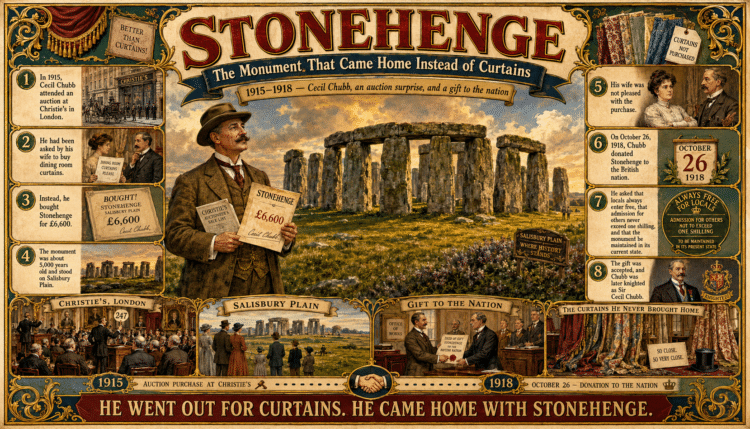
In 1915, Cecil Chubb attended an auction at Christie’s in London with instructions from his wife to buy a set of dining room curtains. He came home instead with Stonehenge, which he had purchased on impulse for £6,600. His wife was not pleased. She had not asked for a 5,000-year-old megalithic monument on Salisbury Plain, and her opinion of it did not improve with time. Three years later, on October 26, 1918, Chubb donated Stonehenge to the British nation, handing it over to the Office of Works with three conditions attached: that locals could always enter free of charge, that admission for everyone else could never exceed one shilling, and that the monument would be maintained in its current state. The British government accepted. Chubb was subsequently knighted — Sir Cecil Chubb — which suggests the nation considered the gift a reasonable exchange for the curtains his wife never got. Stonehenge is now a UNESCO World Heritage Site visited by over a million people a year.
Cher Ami
A carrier pigeon named Cher Ami — French for “dear friend” — delivered a critical message on October 3, 1918, while serving with the U.S. Army Signal Corps in France. The “Lost Battalion” of the 77th Division was surrounded by German forces and being accidentally shelled by their own artillery. Cher Ami was released with a message giving their position and begging the artillery to stop. She was shot through the breast, blinded in one eye, and lost a leg, which was still attached by a tendon when she landed. She delivered the message anyway. The artillery stopped. 194 soldiers were saved. Cher Ami was awarded the French Croix de Guerre with Palm. After her death in 1919, she was taxidermied and is on display at the Smithsonian Institution, wooden leg and all.
Pop Culture Facts and History
The Star-Spangled Banner was performed at a major league baseball game for the first time during Game 1 of the 1918 World Series between the Boston Red Sox and the Chicago Cubs, during the seventh-inning stretch. The band began playing because the country was at war. The crowd joined in. It became a tradition at the Series, then gradually at all games, and was eventually made the mandatory pregame ceremony it remains today.
Winsor McCay’s animated film The Sinking of the Lusitania was released in 1918, at 12 minutes, the longest animated film made to that point, consisting of 25,000 individually drawn frames. McCay spent two years making it. As a piece of anti-German war propaganda, it arrived three years after the actual sinking and was technically late to the argument, but as an animation, it was extraordinary.
Irving Berlin wrote God Bless America in 1918 while serving in the U.S. Army at Camp Upton in New York. He set it aside, deciding it was too solemn for the morale-boosting show he was writing. He pulled it out of a drawer in 1938, revised it, and gave it to singer Kate Smith, who debuted it on her radio program on Armistice Day, November 11, 1938. It has been a quasi-national anthem ever since.
Stars and Stripes, the U.S. Armed Forces newspaper, resumed publication in 1918, having previously been published during the Civil War. Among its staff writers during World War I was a young corporal named Harold Ross, who would go on to found The New Yorker in 1925.
Opha Mae Johnson became the first woman to enlist in the United States Marine Corps on August 13, 1918. She was 40 years old and worked as a clerk. The Marine Corps had reluctantly opened its ranks to women to free up male Marines for combat duty. 305 women served as Marine reservists during the war. They were all discharged when the war ended.
Ossip Bernstein, a renowned chess grandmaster, was arrested by the Bolsheviks in 1918 and sentenced to death. As he stood before a firing squad, a Russian officer heard his name and asked if he was the famous chess player. Bernstein confirmed it. The officer offered him his freedom if he could beat the officer at chess. Bernstein beat him. He was released. He lived until 1962.
In Russia, the day after January 31, 1918, was February 14 — not February 1. Russia’s transition from the Julian to the Gregorian calendar on February 1, 1918, jumped the calendar forward 13 days. February 1 through 13 simply did not exist on the Russian calendar that year.
Pink was for boys in 1918, and blue was for girls — the reverse of the current convention. Pink was considered a stronger, more assertive color appropriate for boys, while blue was considered delicate and suitable for girls. The switch to the current color coding became widespread only in the 1940s.
The United States Congress officially established time zones and formalized Daylight Saving Time through the Standard Time Act of March 19, 1918. Clocks were pushed forward one hour for the first time on March 31, 1918. The farming community objected immediately and has not fully stopped objecting since.
The geographic center of the contiguous United States was determined in 1918 by cutting out a cardboard map of the country and balancing it on a pin until it reached equilibrium. The center was identified as a location near Lebanon, Kansas. It was accurate to within approximately 20 miles, which is a reasonable result for a cardboard experiment and considerably more elegant than it sounds.
Over 100 waiters were arrested in Chicago in 1918 for poisoning bad tippers. The “Mickey Finn” — a drink doctored with a knockout substance — takes its name from Michael “Mickey” Finn, who operated the Lone Star Saloon in Chicago’s South Loop from 1896 to 1903 and was accused of drugging and robbing patrons. The phrase “slipping someone a Mickey” has remained in use as a result.
A bolt of lightning struck a mountain in Wasatch National Forest, Utah, on July 18, 1918, killing 654 sheep simultaneously. This remains the largest recorded loss of livestock to a single lightning strike.
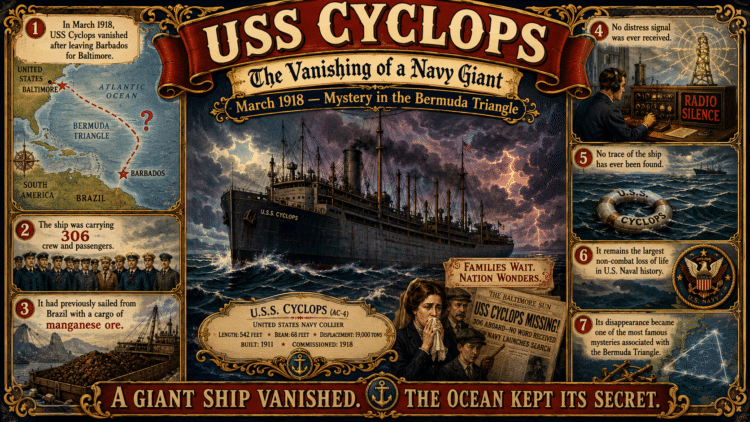
The USS Cyclops, a U.S. Navy collier carrying 306 crew and passengers and a cargo of manganese ore, disappeared somewhere between Barbados and Baltimore in March 1918. No distress signal was ever received. No wreckage was ever found. It remains the single largest loss of life in U.S. Naval history not involving combat, and one of the most enduring maritime mysteries in American history. The Bermuda Triangle has been implicated in popular accounts, though investigators have generally pointed to the ship’s known structural problems and its dangerous cargo.
Joe Hill — the Swedish-born labor organizer and songwriter executed by firing squad in Utah in 1915 — had his ashes held by the U.S. federal government beginning October 8, 1917, on the grounds that they were subversive. Hill had requested that his ashes be scattered in every state except Utah. The ashes were held for 71 years before finally being distributed.
Enrico Caruso, the greatest operatic tenor of his era, was paid $100,000 to appear in the silent film My Cousin. He was reportedly bewildered by the technical requirements of acting without singing.
The phrase “the First World War” appeared in print as early as 1918, used by Lt. Col. Charles à Court Repington in his diary, where he noted the need for a term that distinguished the conflict from any future wars of similar scale. He was, regrettably, correct that a more specific term would eventually be needed.
An Allied monument near Windsor Castle, UK, honors the approximately one million horses that served in World War I. Of one million horses deployed, only 62,000 returned home in 1918. The rest died in the field, were killed in combat, or were sold to local farmers and slaughterhouses at war’s end because the cost of shipping them home exceeded their assessed value. The British public was outraged when they learned of the sales. The outrage did not change the outcome.
Nobel Prize Winners
Physics — Max Planck, for the discovery of energy quanta, the foundational insight of quantum mechanics, changing the understanding of how energy behaves at the atomic scale
Chemistry — Fritz Haber, for the synthesis of ammonia from nitrogen and hydrogen, the Haber-Bosch process that made modern agricultural fertilizer possible and feeds roughly half the world’s population today; Haber also directed Germany’s chemical weapons program during WWI, making him one of the more morally complicated Nobel laureates in history
Medicine — not awarded in 1918
Literature — not awarded in 1918
Peace — not awarded in 1918; the Prize had been suspended during WWI years; the International Committee of the Red Cross received it after the war
Broadway in 1918
Lightnin’ opened August 26, 1918, and ran until August 27, 1921 — 1,291 performances, making it the longest-running Broadway show in history up to that point. It starred Frank Bacon as a lovable ne’er-do-well and was the kind of wholesome, unchallenging comedy that wartime audiences apparently needed in quantity.
Oh, Lady! Lady!! opened February 1, 1918, with music by Jerome Kern and book by P.G. Wodehouse, another entry in the Princess Theatre musical series that was quietly revolutionizing the American musical form.
Top Movies of 1918
- Hearts of the World
- Shoulder Arms
- Mickey
- The Whispering Chorus
- The Sinking of the Lusitania
- Amarilly of Clothes-Line Alley
- Blue Blazes
- The Hun Within
- My Cousin
- Hidden Pearls
Popular and Best-Selling Books of 1918
The U.P. Trail — Zane Grey
The Tree of Heaven — May Sinclair
The Amazing Interlude — Mary Roberts Rinehart
Dere Mable — Edward Streeter
Oh, Money! Money! — Eleanor H. Porter
Greatheart — Ethel M. Dell The Major — Ralph Connor
A Daughter of the Land — Gene Stratton-Porter
My Antonia — Willa Cather
The Magnificent Ambersons — Booth Tarkington
The Decline of the West, Vol. 1 — Oswald Spengler E
minent Victorians — Lytton Strachey
The Elements of Style — William Strunk Jr. (a private edition printed for his Cornell students in 1918; the widely known commercial edition, expanded with E.B. White’s contributions, was not published until 1959)
Biggest Pop Artists of 1918
Nora Bayes, Henry Burr, Enrico Caruso, Arthur Collins, Albert Campbell, The Farber Sisters, Arthur Fields, Byron G. Harlan, Marion Harris, Charles Harrison, Charles Hart, Lewis James, Al Jolson, Irving Kaufman, Olive Kline, John McCormack, Lambert Murphy, Billy Murray, The Original Dixieland Band, The Peerless Quartet, Oscar Seagle, The Shannon Four, Joseph C. Smith’s Orchestra, John Philip Sousa’s Band, Elizabeth Spencer, The Sterling Trio, Van and Schenck, The Victor Light Opera Company
Sports Champions of 1918
World Series: Boston Red Sox — defeated the Chicago Cubs 4-2; a 23-year-old pitcher named Babe Ruth pitched two complete-game wins and set a record for consecutive scoreless World Series innings that stood for 43 years; it would be the Red Sox’s last World Series championship until 2004
Stanley Cup: Toronto Arenas
U.S. Open Golf: not held due to World War I
U.S. Open Tennis: Men/Women: Robert Lindley Murray / Molla Bjurstedt Wimbledon: not held due to World War I
NCAA Football Champions: Pittsburgh and Michigan (co-champions)
Kentucky Derby: Exterminator, a last-minute substitute entry purchased for $1,500, who won at 30-1 odds and went on to one of the greatest racing careers in history, eventually winning 50 of 100 career races
Boston Marathon: Camp Devens relay team, 2:29:53 (run as a relay race due to wartime conditions)
Sports Highlight: Babe Ruth’s 1918 World Series performance established him as one of the best pitchers in baseball before he reinvented himself entirely as a hitter. The Red Sox sold his contract to the Yankees the following year for $100,000, the most ever paid for a player at the time. Boston did not win another World Series for 86 years. Exterminator’s Kentucky Derby victory launched one of the most remarkable careers in thoroughbred history — he raced until age nine and remains one of the most beloved horses in the sport’s history.
FAQ — 1918 Trivia, Fun Facts, and Pop Culture History
Q: When did World War I end?
A: At 11:00 a.m. on November 11, 1918, the Armistice between the Allies and Germany took effect. The ceasefire was signed six hours earlier at 5:00 a.m. In those six hours, an estimated 11,000 men were still killed or wounded.
Q: Why was the 1918 flu called the Spanish Flu if it didn’t start in Spain?
A: Because Spain was neutral in World War I and had no wartime censorship. Spanish newspapers freely reported flu cases — including King Alfonso XIII’s illness — while the warring nations suppressed the news to maintain morale. This gave the false impression that Spain was the source or epicenter. The first recorded cases actually appeared at a U.S. Army camp in Kansas in March 1918.
Q: How many people did the Spanish Flu kill?
A: Estimates range from 50 to 100 million people worldwide, infecting roughly one-third of the global population. In the United States alone, 675,000 died — more than in all of America’s 20th-century wars combined. The pandemic reduced U.S. male life expectancy from 48.4 years in 1917 to 36.6 years in 1918.
Q: What was Cher Ami?
A: A carrier pigeon who delivered a critical message under fire on October 3, 1918, saving 194 soldiers of the “Lost Battalion” after being shot through the breast, blinded, and having a leg nearly severed. She completed the mission. She is on display at the Smithsonian Institution.
Q: When was God Bless America written?
A: Irving Berlin wrote it in 1918 while serving in the U.S. Army, then set it aside for twenty years before giving it to Kate Smith, who debuted it on Armistice Day, November 11, 1938.
Q: What was notable about the 1918 World Series?
A: It was the last World Series the Boston Red Sox won until 2004 — an 86-year drought. Babe Ruth pitched two complete-game victories and set a World Series scoreless innings record that stood for 43 years. The Red Sox sold his contract to the Yankees the following year.
Q: What is the Fritz Haber Nobel Prize controversy?
A: Fritz Haber won the 1918 Nobel Prize in Chemistry for synthesizing ammonia, making modern fertilizer possible and enabling food production for billions. He also directed Germany’s chemical weapons program during WWI, overseeing the first large-scale use of poison gas in combat. His Nobel Prize remains one of the most debated in the award’s history.
Q: What happened to the USS Cyclops?
A: It disappeared with 306 people aboard somewhere between Barbados and Baltimore in March 1918, with no distress signal, no wreckage, and no confirmed explanation. It remains the largest non-combat loss of life in U.S. Naval history and one of the enduring mysteries of American maritime history.
More 1918 History Resources
Most Popular Baby Names (BabyCenter.com)
Popular and Notable Books (popculture.us)
Broadway Shows that Opened in 1918
1918 Calendar, courtesy of Time and Date.com
Fact Monster
1918 in Movies (according to IMDB)
Wikipedia 1918