

1910 History, Facts, and Trivia
Quick Facts from 1910
- World Changing Events: The Mexican Revolution began, lasting a decade and reshaping Latin American politics. Halley’s Comet made its closest approach to Earth in April, triggering the most widespread astronomical panic in modern history.
- Popular Songs: By the Light of the Silvery Moon, Let Me Call You Sweetheart, and Ah! Sweet Mystery of Life
- The first film versions of The Wizard of Oz and Frankenstein were released
- President Taft began the tradition of throwing out the ceremonial first pitch on MLB Opening Day
- Washington State became the 5th U.S. state in which women could vote
- U.S. Life Expectancy: Males 48.4 years; Females 51.8 years
- Average hourly wage: 22 cents; Average annual income: $200-$400; Speed limit in most cities: 12 mph
- Federal spending: $690 million; Unemployment: 5.9%; First-class stamp: 2 cents
- The Conversation: Halley’s Comet — would it poison the atmosphere and end all life? Spoiler: No.
Top Ten Baby Names of 1910
Girls: Mary, Helen, Margaret, Dorothy, Ruth, Anna, Elizabeth, Mildred, Marie, Alice
Boys: John, James, William, Robert, George, Joseph, Charles, Frank, Edward, Henry
The Stars
Mary Pickford, Florence Lawrence, Charlie Chaplin (still in vaudeville in 1910), Lillian Gish, Theda Bara
The Quotes
“The Great Illusion of 1910 is that wars are impossible because they would disrupt international commerce.” — paraphrase of Norman Angell’s bestselling 1910 book The Great Illusion — one of the worst predictions in publishing history, made four years before WWI
“I did not enter the public ring to make a reputation. I entered it to fight.” — Jack Johnson, heavyweight champion of the world, 1910
“I always thought that once the world settled down after the First Great War, things would get better. They haven’t.” — Mark Twain, who died April 21, 1910, at age 74
The Academy Awards
The Academy Awards did not exist until 1929. There is no Oscar winner for 1910.
Time Magazine Person of the Year
Time magazine did not exist until 1923. There is no 1910 Person of the Year.
We Lost in 1910
Mark Twain, author of The Adventures of Tom Sawyer and Adventures of Huckleberry Finn, died April 21, at age 74, in Redding, Connecticut. He had predicted his own death correctly, noting he had come in with Halley’s Comet in 1835 and expected to go out with it in 1910. He was right by one day — the comet made its closest approach on April 20.
Florence Nightingale, founder of modern nursing, died on August 13, at the age of 90
Leo Tolstoy, author of War and Peace and Anna Karenina, died on November 20, at the age of 82, at a remote railway station after fleeing his home in a final break from his family. He had refused to die anywhere comfortable.
William James, philosopher and psychologist, died on August 26 at age 68
King Edward VII of Great Britain died May 6, age 68, succeeded by George V O. Henry (William Sydney Porter), short story writer, died June 5, age 47
Henri Rousseau, French Post-Impressionist painter — died September 2, age 66
America in 1910 — The Context
America in 1910 was a nation in the middle of an extraordinary transformation. Cities were swelling with immigrants — the years between 1900 and 1914 saw 13 million people arrive through Ellis Island alone. Factories were expanding. The automobile was moving from novelty to necessity, though most Americans still traveled by horse and streetcar. About 30% of homes had a telephone; fewer than 20% had a stove; almost nobody had a refrigerator or radio.
The typical American spent one-third of his income on food. Nearly 20% of the population could not read or write. Only 14% had a high school diploma. Most births occurred at home with a midwife. Half of all Americans still lived in rural areas.
The United States was, by almost any measure, the world’s greatest industrial power. But the wealth was not evenly distributed. The average worker earned 22 cents an hour. The Triangle Shirtwaist Factory fire was a year away. The labor movement was building.
1910 was also a year of explicit racial violence and explicit racial courage. Both stories belong together.
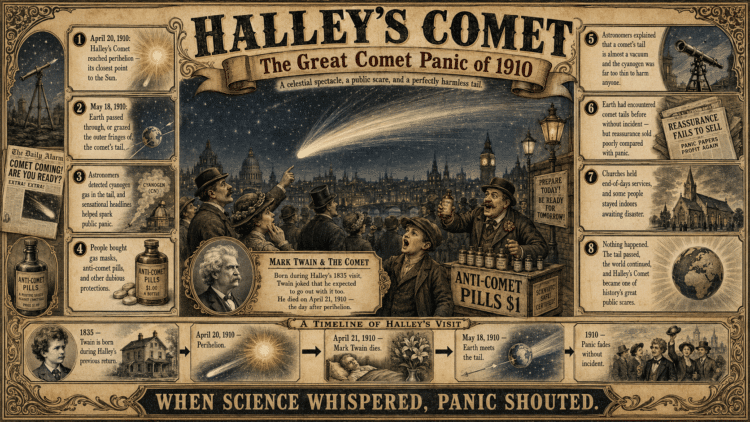
Halley’s Comet
Halley’s Comet reached perihelion — its closest approach to the sun — on April 20, 1910, becoming one of the most spectacular comet appearances in recorded history. On May 18, Earth passed through the comet’s tail.
Scientists had discovered cyanogen gas in the comet’s tail. This fact, when reported in newspapers with varying degrees of accuracy, produced widespread public panic. People bought gas masks. Entrepreneurs sold “anti-comet pills” for $1 each. Churches held end-of-days services. Some people refused to leave their homes.
Astronomers pointed out that the tail of a comet is essentially a near-vacuum, that Earth had passed through cometary tails before without incident, and that the concentration of cyanogen was so low as to be entirely harmless. These reassurances were largely ignored.
Mark Twain had noted that he was born in 1835 during Halley’s previous visit and expected to die during this one. He died April 21 — the day after perihelion. He was, as usual, right on schedule.
The Fight of the Century
On July 4, 1910, in Reno, Nevada, heavyweight champion Jack Johnson — the first Black world heavyweight champion — fought former champion James J. Jeffries, who had come out of retirement specifically because white America wanted a “Great White Hope” to defeat Johnson and reclaim the championship.
Johnson won decisively, knocking Jeffries down three times before the fight was stopped in the 15th round. It was a complete demolition.
The reaction across the United States was immediate and violent. Race riots erupted in at least 25 states and 50 cities. An estimated 23 Black Americans were killed by white mobs in the days that followed. The federal government banned the distribution of fight films across state lines, specifically to prevent Black Americans from watching Johnson’s victory.
Johnson’s victory was not just a sports result — it was a statement of Black excellence and physical dominance that white supremacist culture could not accommodate. He would be hounded, prosecuted, and eventually convicted on trumped-up charges under the Mann Act in 1913. He fled to Europe to avoid prison. His conviction was posthumously pardoned by President Trump in 2018.
Pop Culture Facts and History
America in 1910 had over 10,000 movie theaters — nickelodeons and slightly grander venues scattered across every city. Films were still silent, still short, and still mostly without named actors. Studios refused to credit performers by name, fearing they would demand higher salaries if audiences knew who they were. The strategy was already failing: Florence Lawrence, promoted by Carl Laemmle in a publicity stunt, became the first movie star known by name in 1910.
The first movie ever filmed in Hollywood was In Old California, directed by D.W. Griffith for Biograph Company in 1910 — a historical melodrama about southern California under Mexican rule. Hollywood was then a quiet suburb of Los Angeles with citrus groves and a few boarding houses. Within five years, it would become the film capital of the world.
Thomas Edison’s Frankenstein (1910) is the earliest known surviving film adaptation of Mary Shelley’s novel. Edison’s studio produced it in three days. It is 16 minutes long.
The first Wizard of Oz film was released in 1910, a silent production by the Selig Polyscope Company. It bears almost no resemblance to the 1939 MGM version most people know.
Charlie Chaplin was still performing in vaudeville in 1910, having arrived in America for the first time on tour with Fred Karno’s Keystone comedy troupe. He would not appear in his first film until 1914.
Hallmark Cards, Black and Decker, Hamilton Beach, and FTD Florists were all founded in 1910. The milkshake machine was invented. The binder clip was introduced. Consumer goods were multiplying rapidly.
Crisco — the first all-vegetable shortening, made from cottonseed oil — was patented by Procter & Gamble in 1910 and launched in 1911 with the most elaborate marketing campaign in American food history, including free samples sent to every grocer in the country and a cookbook mailed to home economics teachers.
The tango arrived in American ballrooms in 1910, having spread from Argentina through Paris to New York. It was immediately controversial — clergymen denounced it as immoral, and several cities attempted to ban it. This made it enormously popular.
New York City had more than 500 dance halls by 1910. Dancing was the primary social recreation for working-class Americans. The waltz and the two-step were dominant; the tango was the dangerous newcomer.
Georges Claude displayed neon lights publicly for the first time at the Paris Motor Show in 1910. He had discovered that running electrical current through neon gas in a glass tube produced a distinctive bright red-orange light that did not burn out like incandescent bulbs. American cities would be transformed by neon signage by the 1930s.
Alfa Romeo was founded in 1910 in Milan, Italy, as ALFA — Anonima Lombarda Fabbrica Automobili. The name was changed to Alfa Romeo in 1920 when entrepreneur Nicola Romeo took over the company.
Yellow Cab was founded in Chicago in 1910, introducing the concept of a metered taxi service with a standardized fare. The yellow color was chosen because research suggested it was the most visible color at long distances.
The first public radio broadcast was made in 1910 when Lee de Forest transmitted live performances of Cavalleria Rusticana and Pagliacci from the Metropolitan Opera House in New York — audible to the few hundred people in the city who owned radio receivers.
The first airship passenger service launched in Germany on June 22, 1910, aboard the Deutschland, a Zeppelin capable of carrying 20 passengers. It was the world’s first commercial airline, four years before heavier-than-air passenger aviation.
The Taft administration passed the Mann Act in 1910, making it a federal crime to transport women across state lines for “immoral purposes.” Originally aimed at human trafficking, it was almost immediately weaponized against Black men in interracial relationships — most notably Jack Johnson.
The Boy Scouts of America was founded on February 8, 1910, by William D. Boyce. It now has over 110 million members worldwide.
Alice Stebbins Wells was sworn in as the first female police officer in the United States by the Los Angeles Police Department in 1910, receiving a badge, a rulebook, a first-aid book, and a telephone book. She was not given a gun.
Raymonde de Laroche received Pilot’s License #36 from the Fédération Aéronautique Internationale in France on March 8, 1910, becoming the first woman in the world licensed to fly an airplane.
William Boeing attended his first air show in 1910 and asked every aviator for a ride. No one obliged. He went back to Seattle, taught himself to fly, and founded Boeing Aircraft in 1916. The refusal may have been the most consequential snub in aviation history.
Rayon — the first man-made fabric — was commercially produced in America for the first time in 1910, in Marcus Hook, Pennsylvania. It was blended from wood pulp and other natural materials and offered a silk-like appearance at a fraction of the cost.
The population of Manhattan peaked in 1910 at 2,331,542. It has never been that high since. The borough’s population declined as outer boroughs developed and middle-class families moved to the suburbs.
In 1910, roughly 75% of American children were attending school, but only 14% would earn a high school diploma. Nearly 20% of adults could not read or write. Only 3% had a college degree.
The Lakeview Gusher in Kern County, California, erupted in March 1910 when a drilled oil well lost control. It spewed for 544 consecutive days, releasing an estimated 9 million barrels of crude oil and creating the largest accidental oil spill in American history. It was eventually controlled by building earthen dikes around it and allowing the oil to congeal.
In December 1910, marksman Adolf Toepperwein shot 72,491 out of 75,000 tossed wooden blocks over three days — a world record for exhibition shooting that stood for decades.
Valentine Tapley had promised never to shave again if Abraham Lincoln was elected president in 1860. He died in 1910 with a beard measuring 12 feet 6 inches. He kept his word for 50 years.
The word “moron” was coined in 1910 by psychologist Henry H. Goddard from the Ancient Greek word moros, meaning “dull.” It was a clinical term for a specific IQ range — it did not become an insult until people started using it as one, which happened almost immediately.
Typhoid Mary — Mary Mallon, the first person in the United States identified as an asymptomatic carrier of typhoid fever — was released from her first period of forced isolation in 1910 on the condition that she stop working as a cook. She immediately began working as a cook again under assumed names, causing further outbreaks. She was apprehended again in 1915 and held in isolation for the rest of her life.
During the Great Idaho Fire of August 1910, also called the Big Blowup, three million acres burned across eastern Washington and western Montana in 48 hours, fueled by hurricane-force winds. Eighty-seven people died. The disaster led directly to the founding of the U.S. Forest Service’s fire suppression policy.
The Stevens Pass avalanche on March 1, 1910, buried two passenger trains near Cascade Tunnel, Washington, killing 96 people in the worst avalanche disaster in U.S. history. Passengers had been stranded on the tracks for days due to storms when the slide hit.
The book The Great Illusion by Norman Angell, published in 1910, argued that major wars between industrialized nations were impossible because modern economies were too interconnected for war to be profitable. It sold millions of copies and was widely praised as visionary. Four years later, WWI began. It was the best-selling wrong book in history.
Principia Mathematica — Bertrand Russell and Alfred North Whitehead’s monumental three-volume attempt to place all of mathematics on logical foundations, began publication in 1910. It includes a proof that takes several hundred pages to show that 1+1=2.
The Tragedies
The Wellington (Stevens Pass) avalanche on March 1, 1910, in Washington State, killed 96 people when two passenger trains were buried under 12-15 feet of snow. It remains the deadliest avalanche disaster in U.S. history.
The Pretoria Pit Disaster on December 21, 1910, in Bolton, England, an explosion at the Hulton Colliery killed 344 miners, not 360 as sometimes cited.
The Wellington Coal Mine disaster on April 21, 1910, near Manchester, killed 137 miners in an explosion.
The Great Fire of 1910 across Idaho, Montana, and Washington burned three million acres and killed 87 people, including many U.S. Forest Service firefighters in their first major test as an organized firefighting force.
Nobel Prize Winners
Physics — Johannes Diderik van der Waals (for his work on the equation of state for gases and liquids)
Chemistry — Otto Wallach (for his work in the field of alicyclic compounds)
Medicine — Albrecht Kossel (for work in cell chemistry, particularly proteins and nucleic acids) Literature — Paul Heyse (German writer)
Peace — Permanent International Peace Bureau
Economics — Prize not yet established (first awarded 1969)
Popular and Best-Selling Books of 1910
The Rosary — Florence Barclay
A Modern Chronicle — Winston Churchill (the American novelist, not the British politician)
The Wild Olive — Basil King
Max — Katherine Cecil Thurston
The Kingdom of Slender Swords — Hallie Erminie Rives
Simon the Jester — William J. Locke
Lord Loveland Discovers America — C.N. and A.M. Williamson
The Window at the White Cat — Mary Roberts Rinehart
Molly Make-Believe — Eleanor Abbott
When a Man Marries — Mary Roberts Rinehart
Also notable: Howards End by E.M. Forster, Twenty Years at Hull-House by Jane Addams, and Sigmund Freud’s Origin and Development of Psychoanalysis — all published in 1910.
Broadway in 1910
The Ziegfeld Follies of 1910 was in its fourth year; Florenz Ziegfeld’s annual spectacle of chorus girls, comedy, and music was the dominant attraction of Broadway.
Naughty Marietta by Victor Herbert opened in November 1910, featuring music that would influence American operetta for a generation.
Top Movies of 1910
(All silent short films — feature films did not yet exist in America)
Frankenstein — Edison Manufacturing Company
In Old California — Biograph Company (D.W. Griffith — first film shot in Hollywood)
The Wizard of Oz — Selig Polyscope Company
Ramona — Biograph Company
The Unchanging Sea — Biograph Company
Most Popular Entertainment of 1910
Vaudeville was the dominant form of live entertainment in America. By 1910, more than half the vaudeville audience was middle class. Film was competing with vaudeville for the first time and would eventually replace it entirely — but not yet.
Player pianos and phonographs were the primary in-home music technologies. Radio barely existed. Circuses, baseball, and boxing were the dominant spectator sports.
1910 Most Popular Songs
(Popularity tracked by sheet music sales and phonograph records — no formal chart existed)
Let Me Call You Sweetheart — written by Beth Slater Whitson and Leo Friedman; recorded by multiple artists
By the Light of the Silvery Moon — written by Edward Madden and Gus Edwards
Ah! Sweet Mystery of Life — Victor Herbert, from
Naughty Marietta Alexander’s Ragtime Band — Irving Berlin (written 1910, released 1911)
Chinatown, My Chinatown — Jean Schwartz
That’s-a-Plenty — Henry Lodge
Some of These Days — Sophie Tucker (her signature song)
Come, Josephine, in My Flying Machine — Fred Fischer
1910 United States Census
Total U.S. Population: 92,228,496
New York, NY — 4,766,883
Chicago, IL — 2,185,283
Philadelphia, PA — 1,549,008
St. Louis, MO — 687,029
Boston, MA — 670,585
Cleveland, OH — 560,663
Baltimore, MD — 558,485
Pittsburgh, PA — 533,905
Detroit, MI — 465,766
Buffalo, NY — 423,715
Notable: Los Angeles ranked 17th in 1910, with a population of 319,198 — smaller than Buffalo. Within 30 years, it would rank 5th. Manhattan’s population peaked this year at 2,331,542 — it has never been higher.
Sports Champions of 1910
World Series: Philadelphia Athletics (defeated the Chicago Cubs 4-1)
Stanley Cup: Ottawa Hockey Club and Montreal Wanderers (shared)
U.S. Open Golf: Alex Smith
U.S. Open Tennis — Men: William Larned | Women: Hazel Hotchkiss Wightman
Wimbledon — Men: Anthony Wilding | Women: Dorothea Lambert Chambers
NCAA Football: Harvard and Pittsburgh (shared)
Kentucky Derby: Donau
Boston Marathon: Fred Cameron — 2:28:52
Sports Highlight: The “Fight of the Century” between heavyweight champion Jack Johnson and former heavyweight champion James J. Jeffries on July 4, 1910, in Reno was the most racially charged sporting event in American history up to that point. Johnson won decisively; race riots erupted across the country. The federal government banned the distribution of the fight film across state lines to prevent Black Americans from watching the victory.
FAQs — 1910 History, Facts, and Trivia
Q: What were people afraid of in 1910?
A: Halley’s Comet — specifically, the cyanogen gas discovered in its tail. When Earth passed through the comet’s tail on May 18, many people believed all life would be destroyed. They bought gas masks and anti-comet pills at $1 each. Astronomers explained there was nothing to fear. The pills sold out anyway.
Q: What famous author died as he predicted in 1910?
A: Mark Twain, who had noted he was born in 1835 during Halley’s Comet’s previous appearance and expected to die when it returned. He died April 21, 1910 — the day after the comet reached its closest point to Earth.
Q: What was the Fight of the Century?
A: Jack Johnson vs. James J. Jeffries on July 4, 1910, in Reno, Nevada. Johnson — the first Black world heavyweight champion — knocked out Jeffries, who had come out of retirement as a “Great White Hope.” Race riots erupted in 25 states afterward. The federal government banned the distribution of the fight film.
Q: What movie was first filmed in Hollywood in 1910?
A: In Old California, a short film directed by D.W. Griffith for Biograph Company, is widely credited as among the first films shot in Hollywood — then a quiet suburb of Los Angeles with citrus groves rather than studios.
Q: What word was coined in 1910?
A: “Moron” — introduced by psychologist Henry Goddard as a clinical term for a specific IQ range, derived from the Greek word for “dull.” It became a general insult almost immediately.
Q: What companies were founded in 1910?
A: Hallmark Cards, Black and Decker, Hamilton Beach, FTD Florists, and Alfa Romeo were all founded in 1910. Yellow Cab introduced standardized metered taxi service. The milkshake machine was invented.
Q: What was the worst natural disaster in Washington State in 1910?
A: The Wellington avalanche on March 1, 1910, buried two passenger trains near Cascade Tunnel, killing 96 people — the deadliest avalanche in U.S. history. Passengers had been stranded for days in severe storms before the snow slide struck.
Q: What was the Typhoid Mary situation in 1910?
A: Mary Mallon — the first identified asymptomatic typhoid carrier in the U.S. — was released from isolation in 1910 on the condition she stop working as a cook. She immediately began working as a cook again under an assumed name. She was re-apprehended in 1915 and held in isolation for the rest of her life.
Q: What neon lights fact began in 1910?
A: Georges Claude first displayed neon lights publicly at the Paris Motor Show in 1910. Running electrical current through sealed tubes of neon gas produced a bright, reliable light unlike anything previously available. American cities were transformed by neon signage over the following decades.
Q: What future aviation giant was snubbed at a 1910 air show?
A: William Boeing attended his first air show in 1910 and asked every pilot for a ride. Everyone refused. He went home to Seattle, learned to fly himself, and founded Boeing Aircraft in 1916.
More 1910 History and Trivia Resources
Most Popular Baby Names (BabyCenter.com)
Popular and Notable Books (popculture.us)
Broadway Shows that Opened in 1910
1910 Calendar, courtesy of Time and Date.com
1910US Census Fast Facts
Fact Monster
1910 in Movies (according to IMDB)
Wikipedia 1910


