1908 History, Facts, and Trivia
Quick Facts from 1908
- World Changing Event: The Ford Model T went on sale on October 1, 1908, for $825. Before the Model T, cars were a luxury item: At the beginning of 1908, there were fewer than 200,000 on the road. Within 20 years, the Model T had put over 15 million cars on American roads and fundamentally changed how people lived, worked, and traveled.
- Popular Songs: Take Me Out to the Ball Game, Shine On, Harvest Moon, and By the Light of the Silvery Moon
- Must-See Films: Nickelodeons were showing one-reel shorts — The Adventures of Dollie marked D.W. Griffith’s first film as director
- Most Famous American: Henry Ford, by October 1
- U.S. Life Expectancy: Males 49.5 years; Females 52.8 years
- The Conversation: Did you hear about this new Ford automobile? 15,000 orders placed within two days of announcement.
Top Ten Baby Names of 1908
Girls: Mary, Helen, Margaret, Ruth, Anna, Elizabeth, Florence, Ethel, Emma, Marie
Boys: John, William, James, George, Robert, Charles, Joseph, Frank, Edward, Walter
The Stars
The Ziegfeld Follies was in its second year and defining American glamour. Enrico Caruso was the most famous voice in the world. Film actors remained unnamed by their studios.
The Quote
“This flag dips to no earthly king.” — Ralph Rose, U.S. flag bearer, refusing to dip the American flag to King Edward VII at the 1908 London Olympics — establishing a tradition the U.S. maintains to this day
“Any customer can have a car painted any color that he wants, so long as it is black.” — Henry Ford, though this policy didn’t actually begin until 1914; early Model Ts came in gray, green, blue, and red
The Academy Awards, Time Magazine, Miss America
None existed in 1908.
We Lost in 1908
Grover Cleveland, 22nd and 24th President of the United States — died June 24, age 71; until Donald Trump, the only president to serve two non-consecutive terms
Joel Chandler Harris, author of the Uncle Remus stories, died July 3, at the age of 59
Nikolai Rimsky-Korsakov, Russian composer, died June 21, at the age of 64
Ouida (Maria Louise Ramé), British novelist, died January 25, at age 69
America in 1908 — The Context
The country was emerging from the Panic of 1907 and preparing for a presidential election. Theodore Roosevelt, keeping his promise not to seek a third term, threw his support behind Secretary of War William Howard Taft, who defeated Democrat William Jennings Bryan in November. Roosevelt went on safari in Africa almost immediately after leaving office. The Progressive Era continued without its most energetic champion.
The biggest story of the year was not political. On October 1, Henry Ford unveiled a car that would change everything.
The Ford Model T
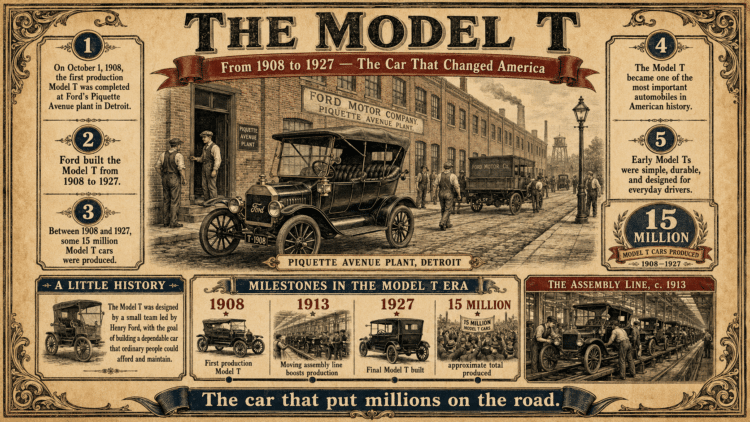
On October 1, 1908, the first production Model T Ford was completed at the company’s Piquette Avenue plant in Detroit. Between 1908 and 1927, Ford would build some 15 million Model T cars.
Though the Model T was fairly expensive at first — the cheapest one initially cost $825, or about $18,000 in today’s dollars — it was built for ordinary people to drive every day. It had a 20-horsepower four-cylinder engine, made of heat-treated vanadium steel, which made it lighter and stronger than its competitors. It had generous ground clearance for America’s terrible, unpaved roads. It could run on gasoline or ethanol. Within 2 days after release, 15,000 orders were placed.
The Model T was not immediately cheap — the $825 price was roughly 18 months’ wages for an average worker. But Ford’s explicit goal was to keep cutting the price as volume increased. By 1925, the same car cost $260.
Rural families reached markets, teachers covered greater districts, and doctors made house calls. By 1925, one in every two cars on U.S. roads was a Model T, driving demand for paved highways, gas stations, and roadside diners.
The popular legend that Model Ts only came in black is incorrect. In the first years of production, from 1908 to 1913, the Model T was available only in gray, green, blue, and red. Only in 1914 was the “any color so long as it is black” policy finally implemented.
The nickname “Tin Lizzie” appeared almost immediately. The Model T was also called the “flivver,” the “Detroit Special,” the “Spirit of Detroit,” and dozens of other regional nicknames. It became the subject of jokes, songs, and comedy films. Hundreds of songs were created as the Model T became part of pop culture.
The moving assembly line that would make the Model T truly affordable was not yet in operation in 1908 — Ford’s Highland Park plant, where the assembly line would be introduced, was still under construction. It opened in 1910.
The Tunguska Event
On June 30, 1908, at approximately 7:17 a.m. local time, an object from space — most likely a small asteroid or comet fragment — exploded in the atmosphere over the Tunguska region of Siberia at an altitude of approximately 5-10 kilometers. The explosion released energy equivalent to 1,000 times the atomic bomb dropped on Hiroshima, flattening an estimated 80 million trees over 2,150 square kilometers. The shockwave knocked people off their feet 60 kilometers away and was felt as far as 900 kilometers distant.
No crater was ever found because the object exploded before hitting the ground. No human deaths were confirmed, though the region was remote. The nearest settlement was Vanavara, about 65 kilometers away, where people were knocked off their feet and windows shattered.
The Tunguska event remains the largest impact event in recorded human history. It was not investigated scientifically until 1927, nearly 20 years later, because the region was so remote. Theories suggesting it was caused by a Nikola Tesla experiment, a miniature black hole, or antimatter have been proposed and rejected; the scientific consensus is that it was caused by a small asteroid or comet fragment. The lesson of Tunguska — that objects large enough to cause catastrophic damage can enter Earth’s atmosphere without warning — has informed planetary defense discussions ever since.
Pop Culture Facts and History
Take Me Out to the Ball Game was written by Jack Norworth and Albert Von Tilzer in 1908; neither had ever attended a baseball game when they wrote it. Norworth was inspired by a sign on a New York subway car advertising a game at the Polo Grounds. The song became the unofficial anthem of American baseball and is still sung during the seventh-inning stretch at every major league game. Its chorus begins “Take me out to the ball game” — but the verse, which is almost never performed, is about a woman named Katie who wants her boyfriend to take her to the game instead of the theater.
Mother’s Day was created by Anna Jarvis of Grafton, West Virginia, in 1908, following her mother’s death the previous year. She organized the first official Mother’s Day celebration on May 10, 1908, at Andrews Methodist Church in Grafton. The holiday spread rapidly. Within a decade, however, Jarvis was horrified by its commercialization — the greeting card, florist, and candy industries had transformed her personal act of remembrance into a commercial bonanza. She spent the rest of her life protesting the holiday she had created, attempting to have it removed from the calendar, and dying penniless in a sanitarium in 1948. The holiday she created remains one of the highest-grossing retail events in America.
Hydrox cookies were introduced by the Sunshine Biscuit Company in 1908 — the original sandwich cookie with chocolate wafers and cream filling. Oreo did not appear until 1912 and was widely considered a Hydrox imitation. Through aggressive marketing and improved distribution, Oreo eventually dominated the market, while Hydrox became obscure. Hydrox fans consider this a profound injustice.
Tootsie Rolls — introduced in 1896 — use a recipe that incorporates the previous day’s batch into each new batch. Theoretically, a small amount of every Tootsie Roll manufactured since 1896 is present in every Tootsie Roll made today. The Tootsie Roll recipe is one of the most carefully guarded in American food manufacturing.
The word “empathy” entered the English language in 1908, translated from the German Einfühlung by psychologist Edward Titchener. The German concept had been used in aesthetics — the idea of projecting oneself into a work of art. Titchener adapted it for psychology. The word did not exist in English before 1908.
Rolex was named in 1908 by founder Hans Wilsdorf, who later said he tried combining letters of the alphabet in every possible way until “a genie whispered ‘Rolex’ in my ear while riding on the upper deck of a horse-drawn omnibus along Cheapside.” The name had the advantage of being pronounceable in every European language and short enough to fit on a watch face.
The term “melting pot” entered American political discourse through Israel Zangwill’s 1908 play The Melting Pot, depicting immigrant assimilation into American society. The play premiered in Washington D.C. with President Theodore Roosevelt in the audience. Roosevelt reportedly stood and shouted approval from his box. The metaphor became the defining description of American immigration policy for decades — and has been disputed and debated ever since.
Sears, Roebuck and Company launched its Modern Homes program in 1908, selling complete house kits by mail order. A catalog offered 44 different house designs ranging from a simple bungalow to a two-story Colonial Revival. All materials arrived by railroad flatcar — lumber, windows, doors, hardware, nails, even paint. Buyers provided their own labor. Between 1908 and 1940, Sears sold approximately 75,000 mail-order houses. Many are still standing in American cities and suburbs.
Gideon Bibles began appearing in hotel rooms in 1908, placed by the Gideons International society, founded in 1899. The Bibles were first placed at the Superior Hotel in Iron Mountain, Montana. The practice has continued for over 100 years in hotels worldwide.
The Phaistos Disc was discovered by Italian archaeologist Luigi Pernier in 1908 at the palace site of Phaistos on Crete — a fired clay disc from approximately 1700 BC, covered with spiral symbols impressed with stamps. Despite over a century of study, the symbols have never been definitively deciphered, and the disc’s purpose remains unknown. It is one of the most famous undeciphered artifacts in archaeology.
Adolph Spreckels — the heir to the Spreckels Sugar fortune — married Alma de Bretteville in 1908, despite being 24 years her senior. Alma nicknamed him her “Sugar Daddy” — the first recorded use of the term in its modern sense. The term entered popular usage. Alma went on to become one of San Francisco’s most celebrated art patrons and philanthropists.
The American term for the phenomenon of immigrant assimilation was permanently established by Israel Zangwill’s play. But the reality of American immigration in 1908 was more complicated — discrimination, exclusion laws, and segregation meant the melting pot was considerably less welcoming to some groups than to others.
The Wind in the Willows by Kenneth Grahame was published in 1908, introducing Mole, Rat, Badger, and the irrepressible Mr. Toad to the world. Grahame had been telling the stories orally to his son Alastair for years. A Room with a View by E.M. Forster was also published in 1908.
Umami — the fifth basic taste, beyond sweet, sour, salty, and bitter — was identified in 1908 by Japanese chemist Kikunae Ikeda, who noticed that the taste of kombu seaweed broth could not be explained by the four accepted flavors. He isolated the source as glutamate and named the taste umami from the Japanese words for “delicious” and “taste.” Western food science did not formally accept umami as a distinct basic taste until the 1980s. Ikeda’s discovery explains why MSG, Parmesan cheese, tomatoes, and mushrooms all make food taste deeply satisfying in ways that go beyond the other four flavors.
SOS was officially adopted as the international maritime distress signal in 1908, replacing the CQD signal established in 1904. SOS was chosen not for its meaning — it has no inherent meaning — but because its Morse code pattern (three dots, three dashes, three dots) was unmistakably simple and distinct from other signals. “Save Our Souls” and “Save Our Ship” are backronyms invented afterward.
The 1908 London Olympics were moved from Rome after the 1906 eruption of Mount Vesuvius devastated the Italian economy, making hosting impossible. London stepped in with only two years to prepare. The marathon distance was permanently set at 26.2 miles (42.195 km) because Queen Alexandra requested the course be extended so it could start beneath the nursery window of Windsor Castle and finish in front of the royal box at the Olympic stadium.
The United States has never dipped its flag to a host nation at the opening ceremony of the Olympics. The tradition began at the 1908 London Games, when flag-bearer Ralph Rose declined to dip the flag for King Edward VII, reportedly saying, “This flag dips to no earthly king.” The U.S. Olympic Committee formalized the policy. It remains in effect.
From 1907 to 1908, Philadelphia City Hall was the tallest building in the United States — until the Singer Building in New York surpassed it. Philadelphia City Hall’s height had also constrained the city’s skyline for decades; a gentleman’s agreement (not an actual law) held that no building in Philadelphia should exceed the height of the statue of William Penn on City Hall’s tower. This “gentlemen’s agreement” was finally broken in 1987.
The Collinwood School Fire in Cleveland, Ohio, on March 4, 1908, killed 172 students and 2 teachers when a fire trapped students inside a building with inward-opening doors that became jammed by the crush of panicking children. The disaster, combined with the 1903 Iroquois Theatre fire in Chicago, directly led to nationwide requirements for outward-opening emergency exit doors in public buildings.
HIV — the virus that causes AIDS — made the jump from chimpanzees to humans in approximately 1908 in what is now the Democratic Republic of the Congo, according to genetic analysis conducted in the early 2000s. The virus circulated in small populations for decades before spreading globally. It was not identified as a distinct disease until 1981.
General Motors was founded in Flint, Michigan, on September 16, 1908, by William C. Durant — just two weeks before Ford introduced the Model T. Durant’s strategy was to buy up multiple car companies; Ford’s was to perfect one. Both approaches defined American business strategy for a century.
The spork was patented in 1908 — the combined spoon and fork that has since appeared in every fast food restaurant and school cafeteria in America, invariably less useful than either utensil it combines.
Nobel Prize Winners
Physics — Gabriel Lippmann (for his method of reproducing colors photographically based on the phenomenon of interference)
Chemistry — Ernest Rutherford (for investigations into the disintegration of elements and the chemistry of radioactive substances — Rutherford is the only person to have done his most important work after winning the Nobel Prize)
Medicine — Élie Metchnikoff and Paul Ehrlich (for work on immunity)
Literature — Rudolf Christoph Eucken (German philosopher)
Peace — Klas Pontus Arnoldson and Fredrik Bajer
Economics — Prize not yet established
Ernest Rutherford won the Nobel Prize in Chemistry in 1908 — ironic, because he had once said that of all the transformations he had observed, “the most surprising was his own transformation from a physicist to a chemist.” He later did the work that proved the existence of the atomic nucleus, for which he received no prize, having already received one.
Popular and Best-Selling Books of 1908
Mr. Crewe’s Career — Winston Churchill (American novelist)
The Trail of the Lonesome Pine — John Fox Jr.
The Shuttle — Frances Hodgson Burnett
Also notable: The Wind in the Willows by Kenneth Grahame, A Room with a View by E.M. Forster, The Old Wives’ Tale by Arnold Bennett, and The Melting Pot by Israel Zangwill.
Broadway in 1908
The Merry Widow — the Viennese operetta that had been the smash of 1907 — continued its run.
The Ziegfeld Follies of 1908 opened June 15, the second annual production of what would become Broadway’s most famous revue series.
Best Film Oscar Winner
The Academy Awards did not exist until 1929.
Top Films of 1908
(Still short films — all under 20 minutes)
The Adventures of Dollie — D.W. Griffith’s directorial debut for Biograph.
Rescued from an Eagle’s Nest — Edison Manufacturing (starring D.W. Griffith as an actor before he became a director).
The Fairylogue and Radio-Plays — L. Frank Baum’s elaborate multimedia presentation, combining film with live actors and hand-colored footage
Most Popular Entertainment of 1908
Nickelodeons had spread to approximately 8,000 venues across America. Vaudeville remained dominant in live entertainment. Baseball was the national pastime. The phonograph was standard in middle-class homes. The automobile was becoming less exotic.
1908 Most Popular Songs
Take Me Out to the Ball Game — Edward Meeker
Shine On, Harvest Moon — Ada Jones and Billy Murray
By the Light of the Silvery Moon — Billy Murray and Haydn Quartet
Smarty — Billy Murray Grand Old Rag — Billy Murray
The Grand Old Rag — Billy Murray
Sports Champions of 1908
World Series: Chicago Cubs (defeated Detroit Tigers 4-1 — their second consecutive World Series title and last until 2016, a span of 108 years) Stanley Cup: Montreal Wanderers U.S. Open Golf: Fred McLeod U.S. Open Tennis — Men: William Larned | Women: Maud Barger-Wallach Wimbledon — Men: Arthur Gore | Women: Charlotte Sterry NCAA Football: Pennsylvania and LSU (shared) Kentucky Derby: Stone Street Boston Marathon: Thomas Morrissey — 2:25:43
Sports Highlight: The 1908 Chicago Cubs became the last Cubs team to win the World Series for 108 years, defeating the Detroit Tigers for the second consecutive year. Merkle’s Boner — rookie Fred Merkle of the New York Giants failing to advance to second base on what should have been a pennant-winning hit — cost the Giants the National League pennant and gave the Cubs their shot at the Series.
The 1908 London Olympics featured the permanent establishment of the marathon distance at 26.2 miles — the result of Queen Alexandra’s request to extend the course. London, as the first city to host the Olympics three times (1908, 1948, 2012), also introduced pistol dueling as an Olympic sport, with contestants using wax bullets and metal masks.
FAQs: 1908 History, Facts, and Trivia
Q: What was the Ford Model T, and why was it important? A: The Model T was the earliest effort to make a car that most people could actually buy. Introduced on October 1, 1908, at $825, it was built for durability and ease of repair on America’s unpaved roads. Ford sold 15 million over 19 years, transformed manufacturing, created the middle class, and changed how Americans lived, traveled, and connected.
Q: What famous song was written in 1908 without the writers ever attending a baseball game?
A: Take Me Out to the Ball Game by Jack Norworth and Albert Von Tilzer — Norworth was inspired by a subway sign advertising a game. Neither man had ever attended a baseball game when they wrote it. It became the unofficial anthem of American baseball.
Q: What created Mother’s Day — and why did its creator later regret it?
A: Anna Jarvis of West Virginia created Mother’s Day in 1908 to honor her late mother. It spread rapidly and became enormously popular. Jarvis then spent the rest of her life protesting its commercialization, fighting to have it removed from the calendar, and dying penniless in 1948, mourning what she called the “Hallmark holiday” that had replaced her original intention.
Q: What exploded in Siberia in 1908 with the force of 1,000 atomic bombs?
A: The Tunguska Event — on June 30, 1908, a small asteroid or comet fragment exploded in the atmosphere over Siberia, releasing energy equivalent to 1,000 Hiroshima bombs and flattening 80 million trees. No crater was found because it exploded before impact. It remains the largest impact event in recorded history.
Q: What flavor was scientifically identified in 1908 that we now find in every good meal?
A: Umami — the fifth basic taste, beyond sweet, sour, salty, and bitter — was identified by Japanese chemist Kikunae Ikeda in 1908. He found it in glutamate and named it from the Japanese for “delicious taste.” It explains why Parmesan, tomatoes, mushrooms, and MSG all make food taste deeply satisfying.
Q: What cookie came first — Hydrox or Oreo?
A: Hydrox, introduced in 1908 by the Sunshine Biscuit Company. Oreo appeared in 1912 and was an imitation. Through marketing and distribution, Oreo became dominant, and Hydrox became the obscure one. Hydrox fans have not gotten over this.
Q: What famous novel about talking animals was published in 1908?
A: The Wind in the Willows by Kenneth Grahame, introducing Mole, Rat, Badger, and Mr. Toad. Grahame had been telling the stories to his son for years before writing them down.
Q: Why is the marathon 26.2 miles?
A: Because Queen Alexandra of Britain wanted the 1908 London Olympic marathon to start under the nursery window at Windsor Castle and finish in front of the royal box at the Olympic stadium — a distance that worked out to 26.2 miles. The distance was later formalized as the official marathon standard.
Q: What company was founded two weeks before Ford introduced the Model T?
A: General Motors, founded on September 16, 1908, in Flint, Michigan, by William C. Durant. Ford’s strategy was to perfect one car; Durant’s was to buy multiple companies. Both approaches shaped American business for a century.
Q: Why do emergency exit doors open outward in America?
A: The Collinwood School Fire in Cleveland on March 4, 1908, killed 172 students when inward-opening doors became jammed by the crush of panicking children. Combined with the 1903 Iroquois Theatre fire, the disaster led to nationwide fire codes requiring emergency exits to open outward.
More 1908 History Resources
Most Popular Baby Names (BabyCenter.com)
Popular and Notable Books (popculture.us)
Broadway Shows that Opened in 1908
1908 Calendar, courtesy of Time and Date.com
Fact Monster
1908 in Movies (according to IMDB)
Wikipedia 1908