
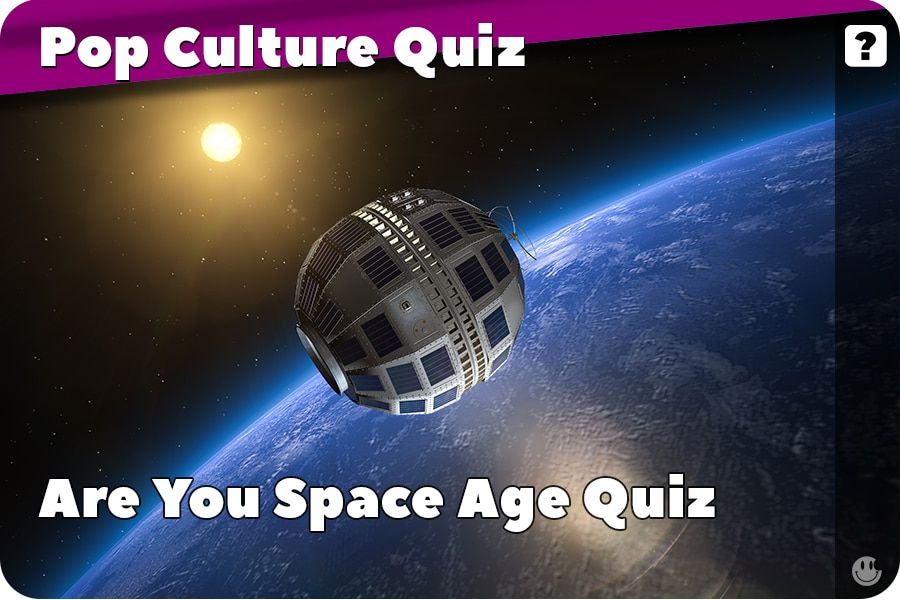

Telstar 1: The Satellite That Shrunk the World
On July 10, 1962, a shiny little orb named Telstar 1 launched into space aboard a NASA Delta rocket from Cape Canaveral. It didn’t carry humans or weapons — just possibility. And within days, it would beam television signals across the Atlantic, making it the first satellite to relay live television, telephone, and telegraph transmissions between continents.
Before smartphones. Before GPS. Before “global village” became a buzzword. There was Telstar.
(How “Space Age” Are You? – Take Our Quiz)
The First Transatlantic Television Broadcast
That moment came on July 23, 1962, just 13 days after launch. The broadcast was coordinated across CBS, NBC, and ABC in the U.S., along with BBC in the UK and ORTF (Office de Radiodiffusion Télévision Française) in France. For the first time ever, live images were sent from one continent to another via space, not through undersea cables or recorded film reels flown across the ocean.
Walter Cronkite (CBS) and Chet Huntley (NBC) co-anchored from the U.S., while BBC presenters joined in from across the pond. The broadcast began with live shots of the Eiffel Tower and the Statue of Liberty — symbolic icons of the old and new world, now united by a signal traveling at the speed of light.
They planned for President Kennedy to deliver a speech — but he wasn’t quite ready. So instead, viewers got a slice of real life: a live baseball game between the Phillies and the Cubs. From there, cameras bounced between Cape Canaveral, Quebec, the Seattle World’s Fair, and various European feeds.
“The White House and the Kremlin… No Farther Apart Than the Speed of Light”
That line, spoken by Cronkite during the broadcast, captured the gravity of the moment. With one orbiting machine, the world had gotten smaller. And not in a science fiction way — in an “I can see you live” kind of way.
People often say something is “the best thing since sliced bread.”
But this was the best thing before the moon landing.
Telstar Was More Than a One-Time Event
Telstar wasn’t just a blip on the screen. It was the first satellite of its kind, designed and built by Bell Telephone Laboratories and funded in part by AT&T, NASA, and several European partners. It used microwave signals, solar panels (a novelty at the time), and was relatively tiny — about 34 inches in diameter and weighing just 170 pounds.
Its technology laid the groundwork for:
Global live television
International phone service
Satellite communication that powers modern GPS
The very idea of live-streaming and real-time news sharing
We take FaceTime and WhatsApp calls for granted today, but the very first step toward this instant connectivity happened in 1962, with a blinking ball of science beaming the Eiffel Tower into living rooms in Detroit.
Why Doesn’t Telstar Get the Credit It Deserves?
In a word: 1962.
It was a jam-packed year:
John Glenn orbited the Earth in February
Marilyn Monroe died in August
The Cuban Missile Crisis unfolded in October
And we were still just months away from the Beatles invading America
Most of all, people were living under the shadow of Cold War anxiety. Nuclear threats felt real. The idea of watching a Frenchman talk live from Paris felt like a novelty — not a revolution.
But hindsight shows us that Telstar wasn’t just a cool science project — it was a hinge point in communication history.
You Had to Be There — And Telstar Let Us Be There
Every generation has “you had to be there” moments:
But Telstar was the first technology that let the whole world share in something live. It was the beginning of the “we all saw that together” era — and it happened on a random Monday afternoon in July.
Before Telstar, the world was connected by wires and waiting. After Telstar, we were connected by signal and seconds.
The Future, Launched in 1962
Today, we bounce messages off satellites without even thinking. GPS pinpoints your location to within inches. You can watch someone cooking in Singapore or dancing in São Paulo, all from your phone. But that chain of tech miracles started with a tiny ball floating above us.
Telstar didn’t land on the moon. It didn’t orbit a person.
But it did something just as meaningful — it brought us together.
And that, my friends, was the first step in living in the future.