1945 Trivia, History, and Fun Facts
In 1945, World War II ended. Germany surrendered in May, the atomic bombs fell on Hiroshima and Nagasaki in August, and Japan signed the formal surrender aboard the USS Missouri on September 2. Franklin Roosevelt died weeks before victory in Europe, Harry Truman inherited the presidency and the bomb, and the liberation of the camps revealed the full horror of the Holocaust. Millions of servicemen came home, the United Nations was founded, and the Baby Boom was about to begin.
Quick Facts from 1945
- World-Changing Events: Germany surrendered on May 8, 1945, V-E Day. The United States dropped atomic bombs on Hiroshima and Nagasaki on August 6 and 9, and Japan formally surrendered on September 2. World War II was over. Somewhere between 70 and 85 million people had died, roughly 3% of the world’s population.
- Popular Songs: There! I’ve Said It Again by Vaughn Monroe, I’m Beginning to See the Light, and Ac-Cent-Tchu-Ate the Positive
- Must-See Movies: The Lost Weekend, Spellbound, They Were Expendable, State Fair, Anchors Aweigh, The Picture of Dorian Gray, and And Then There Were None
- Most Famous American: Bob Hope, who had spent years entertaining troops around the world
- U.S. Life Expectancy: Males 63.6 years; Females 67.9 years
- Price of 1 pound of Ritz Crackers: 21 cents; Gallon of gas: 21 cents; First-class stamp: 3 cents
- The Conversation: Is it really over? And when is he coming home?
Top Ten Baby Names of 1945
Girls: Mary, Linda, Barbara, Patricia, Carol, Sandra, Nancy, Judith, Sharon, Betty
Boys: James, Robert, John, William, Richard, David, Charles, Thomas, Michael, Ronald
The Stars
Lauren Bacall, Ingrid Bergman, Joan Crawford, Olivia de Havilland, Betty Grable, Rita Hayworth, Katharine Hepburn, Hedy Lamarr, Vivien Leigh, Myrna Loy, Gene Tierney, Lana Turner, Jane Wyman
Hollywood Hunks and Leading Men
Humphrey Bogart, Van Johnson, Gene Kelly, Frank Sinatra, James Stewart, Gregory Peck, Cary Grant, John Wayne, Bing Crosby
The Quotes
“The only thing we have to fear is fear itself.” – Franklin D. Roosevelt, from his 1933 inaugural address, quoted widely after his death on April 12, 1945
“Kilroy was here.” – the graffiti doodle, a bald head peeking over a wall, that American GIs left everywhere they went during the war
“I have a terrific pain in the back of my head.” – Franklin D. Roosevelt’s final words, April 12, 1945
“The world will note that the first atomic bomb was dropped on Hiroshima, a military base. That was because we wished in this first attack to avoid, insofar as possible, the killing of civilians.” – President Harry S. Truman, radio address, August 9, 1945 (Hiroshima was not primarily a military base; approximately 70,000 civilians died in the initial blast)
“Now I am become Death, the destroyer of worlds.” – J. Robert Oppenheimer, recalling the line from the Bhagavad Gita that came to him at the Trinity test on July 16, 1945
17th Academy Awards
The ceremony was held on March 15, 1945, at Grauman’s Chinese Theatre in Hollywood, and Bob Hope hosted.
Going My Way (a musical drama about a young priest) swept the evening with seven awards, including Best Picture, Best Director (Leo McCarey), Best Actor (Bing Crosby), and Best Supporting Actor (Barry Fitzgerald).
Ingrid Bergman won Best Actress for Gaslight.
Barry Fitzgerald became the only person ever nominated for both Best Actor and Best Supporting Actor for the same role, which the rules allowed at the time. He won Supporting Actor, and the Academy changed the rules right after.
Time Magazine Person of the Year
Harry S. Truman, who became president when FDR died after just 82 days as vice president, had never been told about the atomic bomb project, and then had to decide whether to use it.
Miss America
Bess Myerson, New York City, the first Jewish woman to win the Miss America title. Pageant officials asked her to change her name to something less obviously Jewish. She refused, and went on to become a TV personality and New York City’s consumer affairs commissioner.
We Lost in 1945
Franklin D. Roosevelt, 32nd President of the United States, died April 12, at age 63, of a cerebral hemorrhage at Warm Springs, Georgia. He had been president for 12 years, led the country through the Depression and through World War II, and died 26 days before Germany surrendered. He never knew.
Adolf Hitler, died by suicide on April 30, age 56, in his underground bunker in Berlin as Soviet forces closed in. He shot himself; Eva Braun, whom he had married the previous day, took cyanide. Their bodies were burned at his instruction.
Benito Mussolini, Italian dictator, was captured and shot by Italian partisans on April 28 and hanged upside down at a Milan gas station.
Ernie Pyle, beloved war correspondent, was killed April 18 by Japanese machine-gun fire on the island of Ie Shima off Okinawa. American infantrymen braved enemy fire to recover his body. He is described on his memorial simply as “a buddy.”
Dietrich Bonhoeffer, German theologian and resistance leader, was hanged at Flossenbürg concentration camp on April 9, just days before American forces liberated it. His last words: “This is the end, for me, the beginning of life.”
Anne Frank, diarist, died of typhus at Bergen-Belsen concentration camp in February or March 1945, age 15. Her diary, found by her father Otto Frank (the only member of the family to survive) was published in 1947.
Béla Bartók, Hungarian composer, died September 26, age 64
Käthe Kollwitz, German artist, died April 22, age 77
Theodore Dreiser, American novelist, died December 28, age 74
Jerome Kern, composer of Show Boat, died November 11, age 60
General George S. Patton died December 21, age 60, after a car accident in Germany
The End of World War II
Europe:
January 27, 1945: Soviet forces liberated the Auschwitz concentration camp. What they found, and what Allied forces subsequently found at Bergen-Belsen, Buchenwald, Dachau, and other camps, was the full revelation of the Holocaust. Six million Jews had been systematically murdered. The world had not previously understood the full scope.
April 12: President Franklin D. Roosevelt died of a cerebral hemorrhage at Warm Springs, Georgia. Harry S. Truman, who had been vice president for 82 days and had never been briefed on the Manhattan Project, was sworn in as president.
April 25: American and Soviet forces met at the Elbe River in Germany, a linkup that effectively cut what remained of the Third Reich in two. The soldiers embraced. Within a few years, their countries would be Cold War adversaries.
April 30: Adolf Hitler died by suicide in his Berlin bunker. The Thousand-Year Reich had lasted twelve years.
May 8, 1945, V-E Day: Germany’s unconditional surrender took effect. German General Alfred Jodl had signed it in a schoolhouse in Reims, France, early on May 7. Crowds erupted across the Allied world. In London, the crowd outside Buckingham Palace was so dense that the royal family came out on the balcony eight times, once joined by Churchill. In New York, an estimated two million people flooded Times Square.
The Pacific:
The battles of Iwo Jima (February-March) and Okinawa (April-June) were among the bloodiest of the Pacific War. Iwo Jima cost about 6,800 American lives, and Okinawa more than 12,000. Japanese forces fought almost to the last man, and American planners estimated that invading Japan itself could cost as many as a million Allied casualties.
February 23, 1945: U.S. Marines raised the American flag on Mount Suribachi on Iwo Jima, and Associated Press photographer Joe Rosenthal captured it in one of the most reproduced photographs in history. After Marine Corps reviews in 2016 and 2019, the six flag raisers are identified as Michael Strank, Harlon Block, Franklin Sousley, Ira Hayes, Harold Schultz, and Harold Keller. Three were killed before the battle ended.
August 6, 1945: The United States dropped an atomic bomb called “Little Boy” on Hiroshima, Japan. The bomb was equivalent to 15,000 tons of TNT. The explosion instantly killed an estimated 70,000 people; by the end of 1945, the death toll from burns, radiation, and injuries exceeded 140,000.
August 9: A second bomb, “Fat Man,” was dropped on Nagasaki. Approximately 40,000 people died immediately; 80,000 by year’s end.
August 15, V-J Day: Emperor Hirohito announced Japan’s surrender on the radio. It was the first time most Japanese citizens had ever heard his voice, and many couldn’t follow his formal court Japanese and learned the news from announcers afterward.
September 2, 1945: Japan signed the formal surrender documents aboard the USS Missouri in Tokyo Bay. General Douglas MacArthur presided. The ceremony lasted 23 minutes. World War II was officially over.
The total death toll: approximately 70-85 million people: soldiers, civilians, Holocaust victims, and those killed by famine and disease caused by the war. It was the deadliest conflict in human history.
The Atomic Bomb
The Manhattan Project began in 1942, with J. Robert Oppenheimer directing the scientific work at Los Alamos, New Mexico, and huge facilities at Oak Ridge, Tennessee, and Hanford, Washington. It employed more than 130,000 people and cost about $2 billion. Most of the workers had no idea what they were building.
On July 16, 1945, the first atomic bomb test (code-named Trinity) was detonated in the New Mexico desert near Alamogordo. Oppenheimer later said that a line from the Hindu scripture the Bhagavad Gita came to his mind as he watched: “Now I am become Death, the destroyer of worlds.” He never fully reconciled himself to what followed.
The decision to use the bomb fell to President Truman, who learned of the Manhattan Project only after becoming president. He was advised that invading Japan could cost huge numbers of Allied casualties, and he authorized the bombings. Whether the decision was justified, and whether alternatives existed, have been debated by historians ever since.
Pop Culture Facts and History
The famous “V-J Day Kiss” photograph, Alfred Eisenstaedt’s image of a sailor kissing a woman in a white uniform in Times Square on August 14, 1945, became one of the most iconic images of the 20th century. The pair are now generally identified as sailor George Mendonsa and Greta Zimmer Friedman, a dental assistant, who later said the kiss was not her choice, and the photo has been reexamined accordingly.
The first issue of Ebony magazine was published in November 1945 by John H. Johnson, celebrating Black life, achievement, and culture in a glossy format no mainstream magazine offered. It became one of the most influential magazines in American history, with a circulation that eventually topped a million.
Percy Spencer, a Raytheon engineer working on radar magnetrons, noticed in 1945 that a candy bar in his pocket had melted while he stood near active radar equipment. He experimented with popcorn kernels and then an egg (which exploded), realized microwaves could cook food, and Raytheon filed for a patent in 1945. The first commercial microwave, sold in 1947, stood about six feet tall and weighed some 750 pounds. Customers took a while to warm up to it.
3 Musketeers bars originally came in three pieces (chocolate, strawberry, and vanilla), hence the name. Wartime rationing made the strawberry and vanilla too hard to produce, and by 1945 the bar had been simplified to chocolate only. It has stayed that way ever since. One flavor for all, all for one flavor.
A B-25 Mitchell bomber crashed into the Empire State Building in heavy fog on July 28, 1945, killing 14 people. Elevator operator Betty Lou Oliver survived a fall of about 75 stories when her damaged elevator’s cables gave way during the rescue, still a Guinness World Record for the longest survived elevator fall.
The United Nations was formally established on October 24, 1945, with 51 founding member nations signing the UN Charter. The date is now observed annually as United Nations Day. It replaced the League of Nations, which had failed to prevent the war.
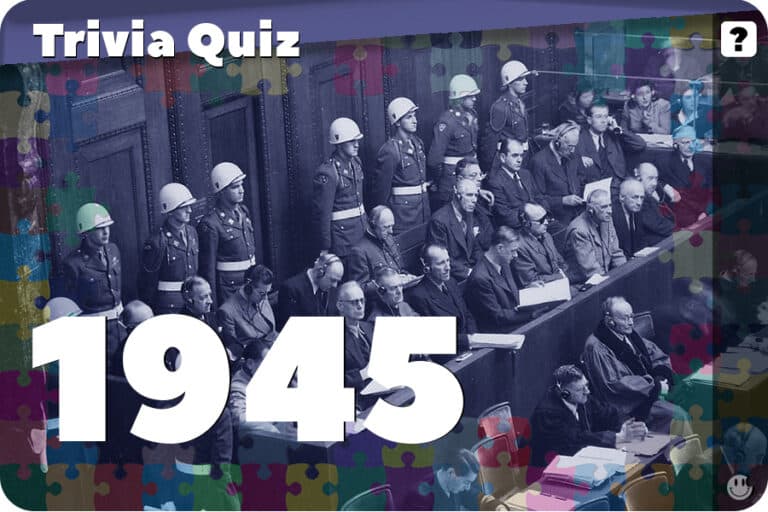
The Nuremberg Trials began on November 20, 1945, prosecuting senior Nazi officials for war crimes and crimes against humanity. Of 24 men indicted, 22 were tried, and 12 were sentenced to death. The trials established the principle that “following orders” is no defense for taking part in atrocities.
The term “cold war” was coined by George Orwell in his October 19, 1945, essay “You and the Atom Bomb,” which predicted a world divided among a few nuclear-armed superstates locked in permanent tension that never quite erupted into open war. He was remarkably close.
The GI Bill (Servicemen’s Readjustment Act of 1944) began paying out in earnest in 1945 as veterans returned. It provided low-cost mortgages, college tuition, and business loans to returning servicemen. By 1956, it had provided education and training to 7.8 million veterans and helped 2.4 million buy homes. It helped build the postwar American middle class.
Approximately 4 million American servicemen and women returned home in 1945. The marriage rate immediately surged. The birth rate surged nine months later. The Baby Boom had begun.
Bing Crosby’s recording of White Christmas, first released in 1942, was reissued and dominated the 1945 Christmas season. It has sold an estimated 50 million copies worldwide, making it the best-selling physical single of all time.
Abbott and Costello’s The Naughty Nineties (1945) contains the most complete filmed version of their famous “Who’s on First?” routine, a bit they had performed so many times by then that they reportedly could do it in their sleep.
Harry Truman left the White House in 1953 with little money and no presidential pension, living modestly in Independence, Missouri, and turning down corporate board seats so as not to “commercialize” the presidency. His situation helped prompt the Former Presidents Act of 1958, which created presidential pensions.
The 1945 Food and Nutrition Board recommendation that “humans require roughly 2.5 liters of water per day” was the origin of the “8 glasses a day” rule, but the full recommendation noted that most of this fluid comes from food and other beverages, not drinking water alone. The second half of the sentence has been omitted in health advice ever since.
The Nobel Prize in 1945
Physics: Wolfgang Pauli, for the discovery of the Exclusion Principle
Chemistry: Artturi Ilmari Virtanen, for research in agricultural chemistry
Medicine: Sir Alexander Fleming, Ernst Boris Chain, and Howard Walter Florey, for the discovery of penicillin, which had been mass-produced during the war and saved countless lives
Literature: Gabriela Mistral, Chilean poet and the first Latin American to win the prize
Peace: Cordell Hull, U.S. Secretary of State, for his work toward establishing the United Nations
Economics: Prize not yet established (first awarded 1969)
Popular and Best-Selling Books of 1945
Animal Farm: George Orwell (published August 17, 1945)
Black Boy: Richard Wright
Captain from Castile: Samuel Shellabarger
Cannery Row: John Steinbeck
A Tree Grows in Brooklyn: Betty Smith (published 1943, still a bestseller)
Forever Amber: Kathleen Winsor
Hungry Hill: Daphne du Maurier
The Robe: Lloyd C. Douglas
Stuart Little: E.B. White
Animal Farm was finished by George Orwell in 1944 but rejected by publisher after publisher, including Victor Gollancz and T.S. Eliot at Faber & Faber (another publisher backed out on the advice of a British government official). When it finally appeared in August 1945, just as the true nature of Soviet totalitarianism was becoming clear, it became a sensation.
Broadway in 1945
Carousel by Rodgers and Hammerstein opened April 19, 1945, and is considered by many the greatest American musical ever written. The Glass Menagerie by Tennessee Williams opened March 31, 1945, launching Williams’s career and a new kind of American drama.
Best Film Oscar Winner
Going My Way, directed by Leo McCarey and starring Bing Crosby, won Best Picture at the 17th Academy Awards in 1945, presented for the 1944 film year. It won seven Oscars, and Crosby won Best Actor for playing a priest, following Spencer Tracy, who had won for playing Father Flanagan in Boys Town.
The Bomb
Movie: Nob Hill, a Technicolor period musical about old San Francisco that critics mostly shrugged at. Radio: Every war-themed drama became instantly dated when the war ended, and producers scrambled to switch to peacetime content almost overnight.
Top Movies of 1945
- The Lost Weekend
- Anchors Aweigh
- Spellbound
- Mildred Pierce
- State Fair
- A Bell for Adano
- The Bells of St. Mary’s
- The Picture of Dorian Gray
- National Velvet
- And Then There Were None
Most Popular Radio Shows of 1945
- Fibber McGee and Molly (NBC)
- Jack Benny Program (NBC)
- Bob Hope Show (NBC)
- The Bing Crosby Show (NBC)
- Charlie McCarthy Show (NBC)
- Lux Radio Theatre (CBS)
- The Lone Ranger (ABC)
- The Life of Riley (NBC)
- Suspense (CBS)
- The Fred Allen Show (NBC)
Top Songs of 1945
(Billboard tracked record sales, radio play, and jukebox plays on separate charts.)
There! I’ve Said It Again: Vaughn Monroe (dominant through early 1945)
Ac-Cent-Tchu-Ate the Positive: Johnny Mercer and the Pied Pipers
Sentimental Journey: Les Brown with Doris Day (the defining song of servicemen’s homecomings)
Rum and Coca-Cola: The Andrews Sisters
I’m Beginning to See the Light: Harry James
It’s Been a Long, Long Time: Harry James with Kitty Kallen (released for returning veterans and #1 by year’s end)
Till the End of Time: Perry Como
Laura: various artists
On the Atchison, Topeka and the Santa Fe: Johnny Mercer and the Pied Pipers
If I Loved You: Perry Como (from Carousel)
White Christmas: Bing Crosby (reissued and #1 again for the Christmas season)
Sentimental Journey by Les Brown, featuring a 22-year-old Doris Day, became the unofficial anthem of the returning soldier in 1945. It’s Been a Long, Long Time, recorded for the end of the war, was the #1 song in America by year’s end.
Sports Champions of 1945
World Series: Detroit Tigers (defeated the Chicago Cubs, whose next World Series appearance came 71 years later)
NFL Champions: Cleveland Rams
Stanley Cup: Toronto Maple Leafs
U.S. Open Golf: Not held due to World War II
U.S. Open Tennis: Men: Sgt. Frank Parker | Women: Sarah Palfrey Cooke
Wimbledon: Not held due to World War II
NCAA Football: Army (led by Doc Blanchard and Glenn Davis, who won the Heisman Trophy in 1945 and 1946)
NCAA Basketball: Oklahoma A&M
Kentucky Derby: Hoop Jr.
Sports Highlight: The 1945 World Series pitted the Detroit Tigers against the Chicago Cubs, two rosters full of players who were too old, too young, or otherwise ineligible for military service, since many regulars were still in uniform. Detroit won in seven games, and Cubs fans would wait 71 years for another Series appearance.
FAQ: 1945 Trivia, Fun Facts, and Pop Culture History
When did World War II end?
In two stages. Germany surrendered unconditionally on May 8, 1945 (V-E Day, Victory in Europe). Japan announced its surrender on August 15 after the atomic bombings of Hiroshima and Nagasaki and formally signed on September 2 aboard the USS Missouri in Tokyo Bay (V-J Day, Victory over Japan).
What were the atomic bombs dropped on Japan?
On August 6, 1945, the United States dropped a uranium bomb called “Little Boy” on Hiroshima, killing approximately 140,000 people by year’s end. On August 9, a plutonium bomb called “Fat Man” was dropped on Nagasaki, killing approximately 80,000. Japan announced its surrender on August 15. The bombings ended the war but opened the Atomic Age.
Who became president when FDR died?
Harry S. Truman, who had been vice president for only 82 days when Roosevelt died on April 12, 1945. Truman had not been told about the Manhattan Project. He learned of the bomb after taking office and decided to use it.
What were the Nuremberg Trials?
Beginning November 20, 1945, senior Nazi officials were tried by an international military tribunal for war crimes and crimes against humanity, and twelve were sentenced to death. The trials established the principle that following orders does not excuse taking part in atrocities.
What famous magazine launched in 1945?
Ebony magazine published its first issue in November 1945, founded by John H. Johnson. It became a fixture in Black American households and one of the most influential publications of the 20th century.
What invention was accidentally discovered in 1945?
The microwave oven. Raytheon engineer Percy Spencer noticed that a candy bar in his pocket had melted near radar equipment, realized the microwaves were cooking it, and Raytheon filed a patent in 1945. The first commercial microwave stood about six feet tall and weighed some 750 pounds.
Who was Bess Myerson?
Miss America 1945, the first Jewish woman to win the title. Pageant officials asked her to change her name to avoid antisemitic backlash. She refused, and went on to a long career in television and public service.
What song defined the end of the war in 1945?
Sentimental Journey by Les Brown featuring Doris Day became the anthem of returning servicemen, and It’s Been a Long, Long Time by Harry James with Kitty Kallen, recorded for the war’s end, reached #1 by year’s end.
What famous photograph was taken in Times Square in 1945?
Alfred Eisenstaedt’s photograph of a sailor kissing a woman in Times Square on V-J Day, August 14, 1945. It became one of the most reproduced photographs in history, and the identities of both people were disputed for decades.
What organization was founded in 1945 that still exists today?
The United Nations was formally established on October 24, 1945, with 51 founding member nations. It replaced the failed League of Nations. October 24 is now observed annually as United Nations Day.
More 1945 History and Trivia Resources
Most Popular Baby Names (BabyCenter.com)
Popular and Notable Books (popculture.us)
Broadway Shows that Opened in 1945
1945 Calendar, courtesy of Time and Date.com
Fact Monster
Forties Nostalgia
1940s, Infoplease.com World History
1945 in Movies (according to IMDB)
Retrowaste Vintage Culture
1940s Slang
Wikipedia 1945
Atomic Bombing of Hiroshima and Nagasaki
Part of: World War II on the Home Front (1941–1945) | 1940s pop culture hub
« 1944 | 1946 »