1903 History, Facts, and Trivia
Quick Facts from 1903
- World Changing Event: On December 17, 1903, Orville Wright piloted the Wright Flyer I at Kitty Hawk, North Carolina, for 12 seconds and 120 feet. Wilbur ran alongside holding a wingtip. The New York Times had predicted, two weeks earlier, that a flying machine would be possible in 1 to 10 million years. The brothers made four flights that day.
- Popular Songs: Sweet Adeline, Ida! Sweet as Apple Cider, and Dear Old Girl
- Must-See Film: The Great Train Robbery — the first American action film and the first film to tell a complete story with editing, camera movement, and a chase sequence
- Most Famous American: Theodore Roosevelt, who was camping in Yosemite with John Muir and suing J.P. Morgan simultaneously
- U.S. Life Expectancy: Males 49.1 years; Females 52.0 years
- First box of Crayola crayons: 5 cents, eight colors
- The Conversation: Did those two bicycle mechanics from Ohio actually fly?
Top Ten Baby Names of 1903
Girls: Mary, Helen, Anna, Margaret, Ruth, Elizabeth, Florence, Ethel, Emma, Marie
Boys: John, William, James, George, Charles, Robert, Joseph, Frank, Edward, Walter
The Stars
Lillian Russell, Anna Held, Maude Adams as Peter Pan, and the emerging film personalities of Edison’s nickelodeon shorts — still unnamed by their studios.
The Quote
“The problem of flight with a machine which weighs more than air cannot be solved, and it is only a dream.” — The French Académie des Sciences, rejecting Romanian engineer Traian Vuia’s flying machine proposal in 1903. The Wright Brothers flew nine months later.
“We have actually flown.” — Orville Wright, telegram to his father, December 17, 1903
The Academy Awards, Time Magazine, Miss America
None existed in 1903.
We Lost in 1903
Camille Pissarro, a French Impressionist painter, died on November 13 at the age of 73
Herbert Spencer, philosopher and originator of Social Darwinism, died on December 8, at the age of 83
Paul Gauguin, Post-Impressionist painter — died May 8, age 54, in the Marquesas Islands
Calamity Jane (Martha Jane Cannary), frontierswoman and folk hero, died on August 1, at approximately age 51
Pope Leo XIII =died July 20, age 93, after a 25-year pontificate
James McNeil Whistler, American painter, died July 17, at age 69
The Wright Brothers Fly
On December 17, 1903, at Kill Devil Hills near Kitty Hawk, North Carolina, Orville Wright piloted the Wright Flyer I for 12 seconds, covering 120 feet at an altitude of about 10 feet. Wilbur ran alongside at the wingtip. The brothers made four flights that day — the longest, piloted by Wilbur, lasted 59 seconds and covered 852 feet.
The engine had been built by their bicycle shop mechanic, Charlie Taylor, in six weeks after they were rejected by every automobile manufacturer they approached. The total cost of the aircraft was approximately $1,000. The Langley Aerodrome — the U.S. government’s competing flying machine project, backed by $70,000 in federal funding — had crashed into the Potomac River nine days earlier.
They telegraphed their father that evening. The message was relayed to a local newspaper reporter, who misread “57 minutes” as the longest flight. The actual record was 59 seconds. The Associated Press offered the story to major newspapers; most declined to run it, considering it implausible. The Dayton Journal ran three paragraphs on page five.
The New York Times had published an editorial on December 9 — eight days before the flight — predicting that a flying machine would require the combined efforts of mathematicians and engineers working for one to ten million years to produce. They did not print a correction.
Wilbur and Orville flew home to Dayton, Ohio, for Christmas. Nobody recognized them.
Pop Culture Facts and History
The Great Train Robbery, directed by Edwin S. Porter for Edison Manufacturing Company, was released in December 1903 and is considered the first American action film, the first Western film, and one of the most influential films ever made. It ran 12 minutes — longer than almost any film previously produced in America. It used editing, camera movement, parallel action, and on-location photography in ways that had never been combined before. Its final shot — a bandit firing his gun directly at the camera — was so startling that some audiences reportedly ducked. The film drove the growth of nickelodeons across America. By 1905, there were 1,000 nickelodeons in American cities; by 1907, over 5,000.
The first stuntman in film history was Frank Hanaway, a former U.S. Cavalryman who was cast in The Great Train Robbery specifically for his ability to fall off a horse without injury. He had no acting training; he had falling training. The profession was born.
The Ford Motor Company was incorporated on June 16, 1903, by Henry Ford and eleven investors — including John and Horace Dodge — with $28,000 in cash. Ford had previously failed twice in the automotive industry. The Model A went on sale July 23, 1903. The company’s first sale was to a Chicago dentist. The Ford Motor Company would go on to transform the automobile from a rich man’s toy to a working-class necessity, the American landscape, the concept of the assembly line, the 40-hour work week, and the entire 20th century.
President Theodore Roosevelt and naturalist John Muir camped together for three nights in Yosemite Valley in May 1903, without staff, reporters, or security. Roosevelt later wrote that it was “the grandest day of my life.” Muir, who had been fighting to protect Yosemite from commercial exploitation, used the camping trip to argue directly for federal protection. Roosevelt returned to Washington and set aside 150 million acres of national forests within the next five years — the foundation of the American National Park system.
The first box of Crayola crayons was sold in 1903 for 5 cents and contained eight colors: red, orange, yellow, green, blue, violet, brown, and black. The name “Crayola” was coined by Alice Stead Binney, wife of company co-founder Edwin Binney, combining the French word for chalk (craie) with ola from oleaginous. Over 100 billion Crayola crayons have been produced since. The original eight colors are still in the box.
The Iroquois Theatre fire in Chicago on December 30, 1903, killed at least 602 people — making it the deadliest single-building fire in American history, surpassing the 1871 Great Chicago Fire in terms of lives lost in one structure. The theater had opened only five weeks earlier and was advertised as “absolutely fireproof.” When a spotlight ignited a curtain during a performance of the musical Mr. Bluebeard, the fire spread rapidly. Exit doors were locked or blocked by unfamiliar European-style bascule latches that panicking audiences couldn’t open. The comedian Eddie Foy tried to calm the audience from the stage while the fire spread behind him. Over 600 people were killed, most by suffocation and trampling in the exits.
The Iroquois Theatre disaster directly led to sweeping changes in fire codes, exit door design (the push-bar exit device was patented the following year), and theater safety regulations across America. Every time you push a panic bar to exit a building, you are using a device invented in response to this fire.
Mary Anderson of Alabama received U.S. Patent #743,801 for windshield wipers on November 10, 1903. She had designed the device after noticing that trolley drivers in New York had to open their windows in sleet to see. Her patent was rejected by a Canadian firm as lacking commercial value. The device was standard on all American cars within a decade. Her patent had expired by then, and she made nothing from it.
Harley-Davidson was founded in Milwaukee, Wisconsin, in 1903 by William Harley and Arthur Davidson, who built their first motorcycle in a 10×15-foot wooden shed. The shed door bore the words “Harley-Davidson Motor Company” before the company formally existed. They produced three motorcycles in 1903. By 1920, Harley-Davidson was the largest motorcycle manufacturer in the world.
Joseph Pulitzer donated $1 million to Columbia University in 1903, with the stipulation that a portion be used to establish prizes for excellence in journalism and the arts. The Pulitzer Prize was first awarded in 1917. It remains the most prestigious award in American journalism.
The Tour de France bicycle race was organized in 1903 by Henri Desgrange, editor of the sports newspaper L’Auto, specifically to boost his paper’s circulation. The first race lasted 19 days, covered 2,428 kilometers, and was won by Maurice Garin. Desgrange later admitted he expected it to be a one-time event.
Enrico Caruso made his American debut at the Metropolitan Opera in New York on November 23, 1903, singing in Verdi’s Rigoletto. The audience response was rapturous. Caruso, who had made his first phonograph recordings in 1902, was already famous on record before Americans heard him in person. His voice — and his recordings — helped establish the phonograph as a serious device for reproducing music.
The Landlord’s Game was created by Lizzie Magie in 1903 and patented in 1904. It was designed to expose the economic injustice of landlordism and how property ownership concentrated wealth in the hands of the few at the expense of the many. It had two sets of rules — one in which everyone benefited from land development, and one in which monopolists could crush their opponents. Players preferred the monopoly rules. Thirty years later, Charles Darrow claimed the game as his own invention and sold it to Parker Brothers as Monopoly. Lizzie Magie received $500 and no royalties.
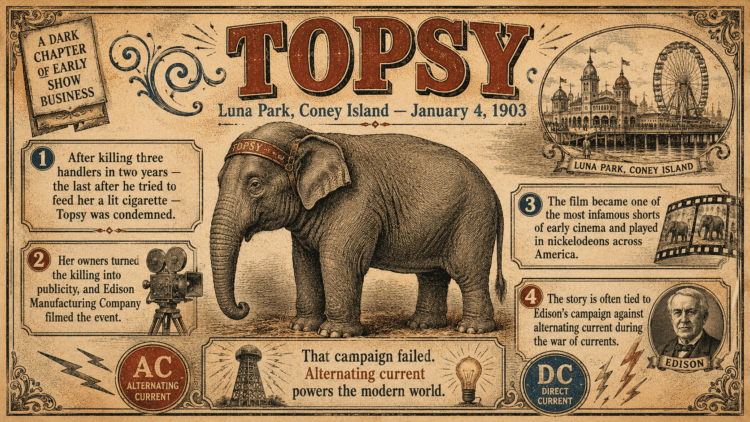
Topsy the elephant was electrocuted at Luna Park on Coney Island on January 4, 1903, after killing three of her handlers over two years — the last of whom had tried to feed her a lit cigarette. Her owners, seeking publicity, decided to electrocute her publicly. Thomas Edison’s company filmed the event as part of his ongoing campaign to discredit Nikola Tesla’s alternating current by demonstrating its danger. The film was shown in nickelodeons across the country. Edison’s campaign against AC failed; alternating current powers the world.
Cocaine was formally removed from the Coca-Cola recipe in 1903, having been a minor ingredient since 1886. The caffeine — and the name — remained.
Guantanamo Bay was leased to the United States by Cuba under the Cuban-American Treaty of 1903 in perpetuity, for an annual payment of $4,085. Cuba has not cashed the checks since 1959. The U.S. has continued sending them.
Horatio Nelson Jackson completed the first automobile cross-country trip on July 26, 1903, driving from San Francisco to New York City in 63 days in a 1903 Winton touring car, accompanied by his mechanic, Sewall Crocker, and a dog named Bud, who wore goggles for eye protection against dust and insects. The trip cost approximately $8,000, including the purchase of the car. Jackson had made a $50 bet in a San Francisco hotel that it could be done.
The first World Series was played in October 1903 between the Boston Americans (American League) and the Pittsburgh Pirates (National League). Boston won 5-3 in what was then a best-of-nine series. The series was organized by the team owners themselves; there was no commissioner, no official structure, and no guarantee it would ever be played again. It has been played every year except 1904 and 1994.
The Souls of Black Folk by W.E.B. Du Bois was published on April 27, 1903 — one of the most important works in American history, introducing the concept of “double consciousness” and arguing directly against Booker T. Washington’s policy of accommodation. Du Bois argued that Black Americans should demand full civil and political equality rather than accept second-class status in exchange for economic opportunity. The book sold out its first printing in four days.
The Call of the Wild by Jack London was published in 1903 and became an immediate bestseller. London was paid $2,000 for full rights, approximately $68,000 in today’s dollars. The publisher made millions. The Story of My Life by Helen Keller was also published in 1903, serialized first in the Ladies’ Home Journal. Keller was 22 years old.
The Oxnard Strike of 1903 was the first labor action in U.S. history organized by a multiracial union — Japanese and Mexican field workers in California’s sugar beet industry walked out together against the Western Agricultural Contracting Company. They won their demands. When the American Federation of Labor offered to charter their union on the condition that they exclude Japanese workers, union leader J.M. Lizarras refused, writing: “We will refuse any other kind of charter, except one which will wipe out race prejudice.” The AFL declined to charter the union.
The “Wreck of the Old 97” — Southern Railway Fast Mail Train No. 97 — crashed at Stillhouse Trestle near Danville, Virginia, on September 27, 1903, after the engineer pushed the train beyond its speed limit trying to make up time. The locomotive plunged 75 feet into a ravine, killing 11 people. A folk song about the wreck, based on an existing melody, became one of the first country music recordings. The subsequent legal dispute over ownership of the song — the first copyright case involving a recorded song — helped establish modern music copyright law.
A barge named The Harold capsized off Staten Island in 1903, dropping 7,700 silver and lead bars to the seafloor. Most were recovered; approximately 1,400 bars were never found. They remain on the bottom.
Victor Herbert’s Babes in Toyland premiered in Chicago in 1903 and moved to Broadway. Its March of the Toys became one of the most recognized instrumental pieces of the Christmas season and has been played every holiday season since.
Nobel Prize Winners
Physics — Antoine Henri Becquerel, Pierre Curie, and Marie Curie (for their discovery of spontaneous radioactivity — Marie Curie was the first woman to win a Nobel Prize)
Chemistry — Svante August Arrhenius (for his theory of electrolytic dissociation)
Medicine — Niels Ryberg Finsen (for treatment of lupus vulgaris with concentrated light radiation)
Literature — Bjørnstjerne Bjørnson (Norwegian novelist and playwright)
Peace — William Randal Cremer (English pacifist and founder of the Inter-Parliamentary Union)
Economics — Prize not yet established
Marie Curie became the first woman to win a Nobel Prize when the Physics Prize was awarded in 1903. The French Academy of Sciences had refused to consider her for membership because she was a woman.
Popular and Best-Selling Books of 1903
Lady Rose’s Daughter — Mary Augusta Ward
Gordon Keith — Thomas Nelson Page
The Pit — Frank Norris
The Virginian — Owen Wister (second year on bestseller list)
Mrs. Wiggs of the Cabbage Patch — Alice Hegan Rice
Letters of a Self-Made Merchant to His Son — George Horace Lorimer
Also notable: The Souls of Black Folk by W.E.B. Du Bois, The Call of the Wild by Jack London, The Story of My Life by Helen Keller, and Principles of Mathematics by Bertrand Russell.
Broadway in 1903
Babes in Toyland by Victor Herbert moved from Chicago to Broadway in 1903, becoming one of the most successful musical productions of the decade.
The Lyceum Theatre and New Amsterdam Theatre both opened on West 42nd Street, establishing the theater district that would define Broadway for the next century.
Best Film Oscar Winner
The Academy Awards did not exist until 1929.
Top Films of 1903
The Great Train Robbery — Edwin S. Porter for Edison Manufacturing (first American action film, first Western, most influential film to date)
Alice in Wonderland — Cecil Hepworth (early British narrative film)
Life of an American Fireman — Edwin S. Porter (early example of parallel editing)
The Runaway Match — Walter R. Booth
Sports Champions of 1903
World Series: Boston Americans (defeated Pittsburgh Pirates 5-3 in the first World Series — best of nine series)
American League Baseball: Boston Americans
National League Baseball: Pittsburgh Pirates
Stanley Cup: Ottawa Hockey Club and Montreal Hockey Club (shared)
U.S. Open Golf: Willie Anderson
U.S. Open Tennis — Men: Laurence Doherty | Women: Elisabeth Moore
Wimbledon — Men: Laurence Doherty | Women: Dorothea Douglass
NCAA Football: Princeton and Michigan (shared)
Kentucky Derby: Judge Himes
Boston Marathon: John Lorden — 2:41:29
Sports Highlight: The first World Series in October 1903 was organized directly by the owners of the Boston Americans and Pittsburgh Pirates without any league authorization. Boston won on the strength of pitcher Cy Young and outfielder Patsy Dougherty. The series was so successful that it immediately became an annual tradition — except in 1904, when the Giants’ owner John McGraw refused to play, calling the American League “inferior.”
FAQs — 1903 Trivia, Fun Facts, and Pop Culture History
Q: When did the Wright Brothers fly?
A: December 17, 1903, at Kill Devil Hills near Kitty Hawk, North Carolina. Orville piloted the first flight — 12 seconds, 120 feet. They made four flights that day. The longest lasted 59 seconds. The New York Times had predicted, eight days earlier, that a flying machine would require one to ten million years to develop.
Q: What was the most important film of 1903?
A: The Great Train Robbery, directed by Edwin S. Porter, released December 1903 — the first American action film and the first film to use editing, camera movement, and parallel action to tell a complete story. It drove the growth of nickelodeons across America. The film profession of “stuntman” was born with it.
Q: What company was incorporated in 1903 that changed the world?
A: The Ford Motor Company was incorporated on June 16, 1903, by Henry Ford and eleven investors with $28,000 in cash. Its first sale was a Model A to a Chicago dentist. The company’s assembly line methods eventually made the automobile affordable to ordinary Americans.
Q: What toy was created in 1903?
A: The first box of Crayola crayons sold for 5 cents with eight colors. Over 100 billion Crayola crayons have been produced since. The original eight colors are still in the box.
Q: What deadliest theater fire happened in 1903?
A: The Iroquois Theatre fire in Chicago, December 30, 1903, killed at least 602 people — the deadliest single-building fire in American history. The theater had been open five weeks and was advertised as fireproof. The disaster led to the invention of the push-bar emergency exit device.
Q: Who invented windshield wipers in 1903?
A: Mary Anderson of Alabama, who patented the device on November 10, 1903, after noticing trolley drivers had to open windows in sleet to see. Her patent was rejected as having no commercial value. It became standard on all American cars within a decade. Her patent expired before the industry adopted it.
Q: What game was invented in 1903 that became Monopoly?
A: The Landlord’s Game, created by Lizzie Magie in 1903, was designed to expose the injustice of property monopolies. Thirty years later, Charles Darrow claimed it as his invention and sold it to Parker Brothers as Monopoly. Magie received $500 and no royalties.
Q: What was the first World Series?
A: Played in October 1903 between the Boston Americans and the Pittsburgh Pirates. Boston won 5 games to 3. It was organized directly by team owners with no official league structure, and there was no guarantee it would ever happen again. It has been played every year except 1904 and 1994.
Q: What happened to Topsy the elephant in 1903?
A: Topsy was publicly electrocuted at Luna Park on Coney Island on January 4, 1903, after killing three handlers. Thomas Edison’s company filmed it to demonstrate the dangers of alternating current as part of his campaign against Nikola Tesla’s AC system. Edison lost the argument. Alternating current powers the modern world.
Q: What important book was published by W.E.B. Du Bois in 1903?
A: The Souls of Black Folk, published April 27, 1903 — one of the most important works in American history, introducing the concept of “double consciousness” and arguing for full civil and political equality for Black Americans. It sold out its first printing in four days.
More 1903 Facts & History Resources:
Most Popular Baby Names (BabyCenter.com)
Popular and Notable Books (popculture.us)
Broadway Shows that opened in 1903
1903 Calendar, courtesy of Time and Date.com
Fact Monster
1903 in Movies (according to IMDB)
Wikipedia 1903