1890s History, Facts, and Trivia: Pop Culture of the Gay Nineties
The 1890s were the decade America learned how to have fun on a national scale. Chicago built a gleaming White City for the World’s Columbian Exposition and put the world’s first Ferris wheel in the middle of it. Americans hummed After the Ball and Daisy Bell, pedaled bicycles by the millions, read about Sherlock Holmes and the Yellow Kid, and lined up at Kinetoscope parlors to watch the first moving pictures. They called it the Gay Nineties, but it was also the decade of Wounded Knee, the Panic of 1893, Plessy v. Ferguson, and the Spanish-American War. Pop culture as we know it, mass-produced, nationally shared, and sold for a nickel, was born right here. It was a wheel-y big decade.
Quick Facts from the 1890s
- World-Changing Event: The World’s Columbian Exposition opened in Chicago on May 1, 1893, and drew more than 27 million visits in six months
- Presidents: Benjamin Harrison (1889–1893), Grover Cleveland (1893–1897, his second, non-consecutive term), and William McKinley (1897–1901)
- U.S. Population: 62.9 million in 1890, growing to 76.2 million by 1900
- U.S. Life Expectancy: Roughly 47 years by 1900
- Top Songs: After the Ball, Daisy Bell (Bicycle Built for Two), Ta-ra-ra Boom-de-ay, The Band Played On, The Sidewalks of New York, and Maple Leaf Rag
- Notable Books: The Adventures of Sherlock Holmes, The Red Badge of Courage, The Jungle Book, Dracula, The Time Machine, and The War of the Worlds
- The Craze: The safety bicycle, which put men and women on two wheels and in bloomers
- The Look: The Gibson Girl, drawn by illustrator Charles Dana Gibson
- The Conversation: Have you ridden the Ferris wheel? And have you seen those moving pictures at the Kinetoscope parlor?
Top Ten Baby Names of the 1890s
Boys: John, William, James, George, Charles, Joseph, Frank, Robert, Edward, Henry
Girls: Mary, Anna, Margaret, Helen, Elizabeth, Ruth, Florence, Ethel, Emma, Marie
Source: Social Security Administration decade data
Spotlight: The 1893 World’s Columbian Exposition
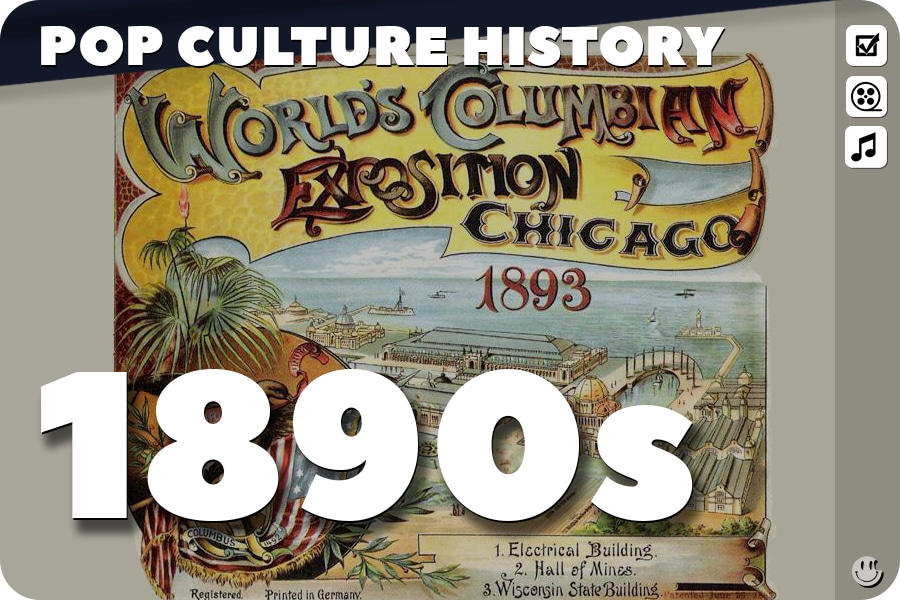
Chicago won the right to host the fair marking the 400th anniversary of Columbus’s voyage, and then set out to beat Paris, whose 1889 fair had unveiled the Eiffel Tower. Architect Daniel Burnham and landscape designer Frederick Law Olmsted turned swampy Jackson Park into the “White City,” a dreamlike collection of gleaming neoclassical buildings, lagoons, and electric lights. The fair ran from May 1 to October 30, 1893, and recorded more than 27 million visits at a time when the entire country held about 65 million people.
The answer to the Eiffel Tower was George Washington Gale Ferris Jr.’s wheel, about 264 feet tall, with 36 cars that each held 60 riders. A ride cost 50 cents, ten times the price of a merry-go-round, and about 1.5 million people paid it anyway. It was the original big wheel, and it kept the fair rolling financially.
The fair also launched a shopping list of American brands and inventions:
- Juicy Fruit gum, Cream of Wheat, and Shredded Wheat
- Aunt Jemima pancake mix, demonstrated by Nancy Green, a formerly enslaved woman who served thousands of pancakes and brought home some 50,000 orders
- Pabst beer, whose prize-winning showing helped inspire the “Blue Ribbon” name
- The Rueckheim brothers’ popcorn-and-molasses treat, named Cracker Jack a few years later
- The first U.S. commemorative postage stamps and commemorative coins, and the first picture postcards sold in America
- A moving sidewalk, a fully electric kitchen, and Josephine Cochrane’s dishwasher
Westinghouse and Nikola Tesla won the contract to light the fair with alternating current, a public victory over Thomas Edison’s direct current. The fair’s entertainment strip, the Midway Plaisance, gave Americans the word “midway” for every carnival since. Historian Frederick Jackson Turner delivered his famous “frontier thesis” at a related congress that July, arguing that the closing of the frontier marked the end of an era. Buffalo Bill set up his Wild West show just outside the gates and reportedly outdrew some of the fair’s official attractions.
The fair had its shadows. African Americans were largely shut out of planning, prompting Ida B. Wells and Frederick Douglass to publish a pamphlet of protest. Chicago Mayor Carter Harrison was assassinated two days before closing, and serial killer H.H. Holmes preyed on visitors from his nearby hotel. Most of the White City burned in 1894. The Palace of Fine Arts survives today as the Museum of Science and Industry.
Spotlight: Nellie Bly
Journalist Nellie Bly (Elizabeth Cochrane Seaman) set out to beat the fictional Phileas Fogg’s 80-day trip around the world and stepped off the train in New Jersey on January 25, 1890, after 72 days. Newspapers followed her every move, and a board game was made in her honor. She had already made her name in 1887 by faking insanity to expose conditions in a New York asylum, inventing modern undercover reporting in the process.
Spotlight: Annie Oakley and Buffalo Bill’s Wild West
William F. “Buffalo Bill” Cody’s Wild West show was the biggest touring spectacle of the decade, a traveling myth machine that taught the world what the American West was supposed to look like, cowboys, stagecoach robberies, and all. Its star was sharpshooter Annie Oakley, billed as “Little Sure Shot,” who could split a playing card edge-on and shoot the ash off a cigarette. In 1894 she and other Wild West performers were filmed for Thomas Edison’s Kinetoscope, making her one of the first women ever recorded on film. She was a straight shooter in every sense.
Spotlight: John Philip Sousa, the March King
After leading the U.S. Marine Band, John Philip Sousa formed his own touring band in 1892 and became the most famous musician in America. He composed The Washington Post march (1889), The Liberty Bell (1893), and The Stars and Stripes Forever, written around Christmas 1896 and later named the official national march of the United States. Sousa famously distrusted recorded music, warning that “canned music” would kill amateur playing, even as his band became one of the best-selling acts of the phonograph age.
Spotlight: Scott Joplin and the Ragtime Craze
Ragtime, a syncopated piano style rooted in African American music, swept the country in the late 1890s. Its king was Scott Joplin, whose Maple Leaf Rag, published in Sedalia, Missouri, in 1899, became one of the first instrumental pieces to sell a million copies of sheet music. The rag craze put pianos in parlors across America and set the stage for jazz.
Spotlight: Harry Houdini
Born Erik Weisz in Budapest, Harry Houdini spent most of the 1890s as a struggling dime-museum magician, performing “Metamorphosis,” a trunk-swap illusion, with his wife Bess. In 1899, vaudeville manager Martin Beck spotted his handcuff act and booked him on the Orpheum circuit as “The King of Handcuffs.” The next decade would make him the most famous escape artist in history.
Celebrities and Idols of the 1890s
Lillian Russell, the reigning beauty of the American stage; Lillie Langtry; Sarah Bernhardt; Anna Held, brought to New York by Florenz Ziegfeld in 1896; Maude Adams; Ethel Barrymore; dancer Loie Fuller; and the Gibson Girl ideal
Idols: Strongman Eugen Sandow, promoted by a young Ziegfeld at the 1893 fair; boxers John L. Sullivan and “Gentleman Jim” Corbett; Buffalo Bill Cody; and actors William Gillette and Richard Mansfield
Legends, Fables, and Folk Heroes
Stagger Lee: On Christmas night 1895, Lee Shelton shot William Lyons in a St. Louis saloon after a quarrel over a Stetson hat. The killing became the folk ballad Stagger Lee, recorded by everyone from Mississippi John Hurt to Lloyd Price to Nick Cave.
Frankie and Johnny: In October 1899, Frankie Baker shot her lover Allen Britt in St. Louis. The story became Frankie and Johnny, one of the most recorded songs in American history. Baker spent years insisting the song had the facts wrong.
Lizzie Borden: Andrew and Abby Borden were killed with a hatchet in Fall River, Massachusetts, on August 4, 1892. Daughter Lizzie was tried and acquitted in 1893, but the schoolyard rhyme (“Lizzie Borden took an axe”) convicted her in popular memory anyway. The rhyme also exaggerates the number of blows considerably.
Yes, Virginia: On September 21, 1897, the New York Sun answered eight-year-old Virginia O’Hanlon’s letter with the editorial “Yes, Virginia, there is a Santa Claus,” written by Francis Church. It became the most reprinted editorial in American newspaper history.
Uncle Sam and Columbia: The 1890s were the heyday of America’s two national personifications. Columbia, the robed female symbol of the nation, presided over the Columbian Exposition, while Uncle Sam, drawn into his familiar stars-and-stripes look by Thomas Nast and other cartoonists, starred in political cartoons about Hawaii, Cuba, and the Philippines.
The Real McCoy: Boxer Norman Selby, fighting as “Kid McCoy” in the 1890s, is one of several people credited with inspiring the phrase “the real McCoy.” Most etymologists think the phrase is older, but the Kid never minded the publicity.
What Happened in the 1890s?
On December 29, 1890, U.S. troops killed some 250 to 300 Lakota men, women, and children at Wounded Knee Creek, South Dakota, two weeks after the killing of Sitting Bull. It was the last major armed conflict of the Indian Wars. That same year, the Census Bureau reported that the frontier line could no longer be traced.
Ellis Island opened on January 1, 1892. The first immigrant processed was Annie Moore, a teenager from County Cork, Ireland, who received a $10 gold piece. More than 12 million people would pass through.
The Panic of 1893 triggered the worst depression America had yet seen, with unemployment estimated near 18%. In 1894, “Coxey’s Army” of jobless men marched on Washington, and the Pullman Strike shut down railroads across the West until federal troops broke it.
In 1896, the Supreme Court’s Plessy v. Ferguson decision upheld “separate but equal” segregation, a ruling that stood until Brown v. Board of Education in 1954.
The Klondike Gold Rush began after gold was found in Canada’s Yukon in August 1896. When a ship carrying a “ton of gold” docked in Seattle in July 1897, about 100,000 people set out for the Klondike. Only a few thousand struck it rich.
On February 15, 1898, the USS Maine exploded in Havana Harbor, killing 260 sailors. Pushed by the “yellow journalism” of William Randolph Hearst and Joseph Pulitzer, the United States went to war with Spain that April. The war lasted less than four months. Theodore Roosevelt’s Rough Riders charged up the San Juan Heights, and the U.S. gained Puerto Rico, Guam, and the Philippines. Hawaii, whose queen had been overthrown in 1893, was annexed that same year.
Firsts, Inventions, and Wonders of the 1890s
- Basketball was invented by James Naismith at the YMCA training school in Springfield, Massachusetts, in December 1891, using peach baskets. The first game ended 1–0.
- Volleyball followed in 1895, invented by William G. Morgan in Holyoke, Massachusetts, as “Mintonette.”
- The Kinetoscope parlor opened in New York on April 14, 1894, letting customers peer into Edison’s machines to watch short films.
- The Lumière brothers held their first public paid film screening in Paris on December 28, 1895, often called the birth of cinema.
- Edison’s Vitascope projected films for a paying American audience at Koster and Bial’s Music Hall in New York on April 23, 1896. Later that year, The Kiss, an 18-second close-up, scandalized moral crusaders.
- X-rays were discovered by Wilhelm Röntgen in November 1895.
- Radio: Guglielmo Marconi began sending wireless signals in 1895 and patented his system in Britain in 1896.
- Charles and Frank Duryea built one of America’s first gasoline automobiles in 1893, and America’s first car race was held in Chicago on Thanksgiving Day 1895. Henry Ford drove his Quadricycle in 1896.
- Rudolf Diesel patented his engine in 1892 and had a working version by 1897.
- Whitcomb Judson patented his “clasp locker,” an early ancestor of the zipper, in 1893.
- Brands born in the 1890s: Fig Newtons (1891), Coca-Cola Company (incorporated 1892), Pepsi (created in 1893 as “Brad’s Drink,” renamed in 1898), Tootsie Roll (1896), Cracker Jack (named 1896), Jell-O (1897), Campbell’s condensed soup (1897), and Kellogg’s flaked cereal (developed 1894).
- The Pledge of Allegiance, written by Francis Bellamy, was published in 1892 for Columbus Day celebrations tied to the fair.
- Good Morning to All, a song by sisters Mildred and Patty Hill published in 1893, supplied the melody for Happy Birthday to You.
- Katharine Lee Bates wrote America the Beautiful after an 1893 trip to the top of Pikes Peak. The poem was first published on July 4, 1895.
Pop Culture Facts and History
The bicycle was the great craze of the decade. The new “safety bicycle,” with two equal-size wheels and pneumatic tires, put Americans of every age on wheels, and by the mid-1890s more than a million bicycles a year were being sold. Susan B. Anthony said the bicycle had done more to emancipate women than anything else in the world, and women traded corsets and long skirts for bloomers to ride.
The comic strip was born in the 1890s. Richard Outcault’s Hogan’s Alley, starring the Yellow Kid, ran in Pulitzer’s New York World starting in 1895. When Hearst lured Outcault away, both papers ran a Yellow Kid, and the bitter circulation war gave us the term “yellow journalism.” Rudolph Dirks’s The Katzenjammer Kids followed in 1897 and is still running today.
Sherlock Holmes became a sensation when The Strand Magazine began running Arthur Conan Doyle’s short stories in 1891. Doyle killed Holmes off at Reichenbach Falls in 1893, and readers were so upset that some reportedly wore black armbands in mourning. Doyle would bring him back a decade later. In 1899, actor William Gillette created the deerstalker-and-pipe stage Holmes that every portrayal since has borrowed.
Charles K. Harris’s ballad After the Ball (1892) sold millions of copies of sheet music, more than any song before it, and turned New York’s Tin Pan Alley into a hit factory. Daisy Bell, better known as “A Bicycle Built for Two,” became the first song sung by a computer in 1961, which is why HAL 9000 sings it in 2001: A Space Odyssey.
Mail-order catalogs brought the city to the countryside. Sears, Roebuck and Co. took its name in 1893, and its catalog, nicknamed the “Wish Book,” grew to more than 500 pages by the end of the decade. Rural Free Delivery began in 1896, bringing mail straight to farm families’ doors.
Oscar Wilde published The Picture of Dorian Gray in 1890 and premiered The Importance of Being Earnest in 1895, the same year his trials and imprisonment ended his career. Bram Stoker’s Dracula (1897), H.G. Wells’s The Time Machine (1895) and The War of the Worlds (1898), Rudyard Kipling’s The Jungle Book (1894), and Stephen Crane’s The Red Badge of Courage (1895) all arrived in a single remarkable decade for popular fiction.
Minstrel shows, in which white (and later Black) performers in blackface played racist caricatures, remained among the most popular entertainments of the era, alongside the rising vaudeville circuits. At the same time, Black performers such as Bert Williams and George Walker were beginning to break through, and the 1898 musical Clorindy, or the Origin of the Cakewalk brought an all-Black creative team to Broadway’s doorstep.
Broadway and the Stage in the 1890s
Charley’s Aunt (1893), Trilby (1895), which introduced the hypnotist Svengali, and William Gillette’s Sherlock Holmes (1899) were among the biggest hits. Vaudeville impresarios B.F. Keith and Edward Albee built a national chain of theaters with “continuous” shows, and the Floradora girls were just over the horizon in 1900.
Sports in the 1890s
- “Gentleman Jim” Corbett knocked out John L. Sullivan on September 7, 1892, in New Orleans, in the first heavyweight title fight with gloves under Queensberry rules.
- William “Pudge” Heffelfinger became the first known professional football player on November 12, 1892, when he was paid $500 to play for the Allegheny Athletic Association.
- The Stanley Cup was first awarded in 1893, to the Montreal Hockey Club.
- The first U.S. Open golf championship was played in 1895, won by Horace Rawlins.
- The first modern Olympic Games were held in Athens in 1896. American James Connolly won the triple jump to become the first Olympic champion in more than 1,500 years.
- The first Boston Marathon was run on April 19, 1897, and won by John J. McDermott.
- Baseball’s Temple Cup series (1894–1897) was an early forerunner of the World Series, and Cy Young was piling up the wins that would make him the all-time leader.
We Lost in the 1890s
Vincent van Gogh, painter, July 29, 1890, age 37
Sitting Bull, Lakota leader, December 15, 1890, age 59
P.T. Barnum, showman, April 7, 1891, age 80
Herman Melville, author of Moby-Dick, September 28, 1891, age 72
Walt Whitman, poet of Leaves of Grass, March 26, 1892, age 72
Edwin Booth, America’s greatest Shakespearean actor, June 7, 1893, age 59
Robert Louis Stevenson, author of Treasure Island, December 3, 1894, age 44
Frederick Douglass, abolitionist and statesman, February 20, 1895, age 77
Louis Pasteur, scientist, September 28, 1895, age 72
Harriet Beecher Stowe, author of Uncle Tom’s Cabin, July 1, 1896, age 85
Alfred Nobel, inventor of dynamite and founder of the Nobel Prizes, December 10, 1896, age 63
Johannes Brahms, composer, April 3, 1897, age 63
Lewis Carroll, author of Alice’s Adventures in Wonderland, January 14, 1898, age 65
Johann Strauss II, the Waltz King, June 3, 1899, age 73
Born in the 1890s
Groucho Marx (1890), Agatha Christie (1890), Dwight D. Eisenhower (1890), Cole Porter (1891), Mary Pickford (1892), Mae West (1893), Bessie Smith (1894), Babe Ruth (1895), Buster Keaton (1895), Jack Dempsey (1895), F. Scott Fitzgerald (1896), Amelia Earhart (1897), George Gershwin (1898), Ernest Hemingway (1899), Alfred Hitchcock (1899), Duke Ellington (1899), Humphrey Bogart (1899), and Fred Astaire (1899)
FAQs: 1890s History, Facts, and Trivia
What was the 1893 World’s Columbian Exposition?
A world’s fair held in Chicago from May 1 to October 30, 1893, to mark the 400th anniversary of Columbus’s voyage. It drew more than 27 million visits and introduced the Ferris wheel, Juicy Fruit gum, Cream of Wheat, Shredded Wheat, and Aunt Jemima pancake mix.
How tall was the first Ferris wheel?
About 264 feet. It had 36 cars, each holding 60 riders, and a ride cost 50 cents. Roughly 1.5 million people rode it during the fair.
Why are the 1890s called the Gay Nineties?
The nickname, coined decades later, looked back on the 1890s as a carefree era of bicycles, ragtime, and vaudeville. In reality, the decade also saw a severe depression, labor violence, and war.
When was basketball invented?
James Naismith invented basketball in December 1891 in Springfield, Massachusetts, nailing peach baskets to a balcony railing. The first game ended 1–0.
Where did the term “yellow journalism” come from?
From the Yellow Kid, star of the comic strip Hogan’s Alley. When Joseph Pulitzer’s World and William Randolph Hearst’s Journal both ran versions of the character during their sensational circulation war, critics named the style after him.
When did movies first appear in America?
Edison’s Kinetoscope parlors opened in 1894, letting one viewer at a time watch short films. The first projected films for a paying American audience were shown at Koster and Bial’s Music Hall in New York on April 23, 1896.
What was the biggest hit song of the 1890s?
After the Ball by Charles K. Harris, published in 1892, which sold millions of copies of sheet music and launched the Tin Pan Alley era.
Who was the first Olympic champion of the modern era?
American James Connolly, who won the triple jump at the 1896 Athens Olympics.
Keep exploring: « Pop culture of the 1880s | 1800s Pop Culture: The 19th Century Decade by Decade | 1900s pop culture | The Nickelodeon Era »
More 1890s History and Trivia Resources
Wikipedia: 1890s
Wikipedia: World’s Columbian Exposition
National Park Service: Inventions from the World’s Columbian Exposition
Field Museum: Fun Facts About the World’s Columbian Exposition
Social Security Administration: Popular Names of the 1890s