1950 Trivia, Fun Facts, and Pop Culture History
Quick Facts from 1950
- World Changing Event: The Korean War began on June 25, 1950, when North Korean forces crossed the 38th parallel. It drew in American troops within days, Chinese forces by October, and eventually cost over 36,000 American lives. It ended in a stalemate in 1953. It is still sometimes called “The Forgotten War,” wedged between WWII and Vietnam in American memory — but 1.5 million people died.
- Influential Songs: Goodnight, Irene by The Weavers with Gordon Jenkins, Daddy’s Little Girl by The Mills Brothers, and Here Comes Peter Cottontail by Gene Autry
- Must-See Movies: Father of the Bride, Harvey, All About Eve, Sunset Boulevard, Rio Grande, The Asphalt Jungle, and Cinderella
- Most Famous American: John Wayne
- Notable Books: The Lion, the Witch and the Wardrobe by C.S. Lewis and Kon-Tiki: Across the Pacific by Raft by Thor Heyerdahl
- Minimum Wage: 75 cents per hour; Stromberg-Carlson TV: $279.95; Gallon of gas: 18 cents; First-class stamp: 3 cents
- U.S. Life Expectancy: Males 65.6 years; Females 71.1 years
- Federal spending: $42.56 billion; Federal debt: $256.9 billion; Unemployment: 5.9%
- The Funny Guy: Milton Berle
- The Funniest TV Duo: Sid Caesar and Imogene Coca
- Fun Fact: Since 1950, Academy Award winners must agree never to sell their Oscar statuette without first offering it back to the Academy for $1. Winners who refuse to agree don’t receive the statuette.
- The U.S. Army rank of Five-Star General remains technically active; Omar Bradley was the last person to hold it, in 1950. No one has been promoted to that rank since.
- The FBI’s “10 Most Wanted Fugitives” program began in 1950 — Willie Sutton was #11.
Top Ten Baby Names of 1950
Girls: Linda, Mary, Patricia, Barbara, Susan, Nancy, Deborah, Sandra, Carol, Kathleen Boys: James, Robert, John, Michael, David, William, Richard, Thomas, Charles, Gary
Fashion Icons and Sex Symbols
Lauren Bacall, Martine Carol, Doris Day, Ava Gardner, Rita Hayworth, Eartha Kitt, Marilyn Monroe, Jane Russell, Elizabeth Taylor, Lana Turner
Hollywood Hunks and Leading Men
Humphrey Bogart, Montgomery Clift, Gregory Peck
The Quotes
“Most human beings have an almost infinite capacity for taking things for granted.” — Aldous Huxley
“Fasten your seat belts. It’s going to be a bumpy night.” — Bette Davis as Margo Channing, All About Eve
“All right, Mr. DeMille, I’m ready for my close-up.” “I am big! It’s the pictures that got small.” — Gloria Swanson as Norma Desmond, Sunset Boulevard
“Why did I rob banks? Because I enjoyed it. I loved it. I was more alive inside a bank than at any other time in my life.” — Willie Sutton, bank robber, clarifying what he actually said
22nd Academy Awards
The ceremony took place on March 23, 1950, at the RKO Pantages Theatre in Hollywood.
All the King’s Men won Best Picture. Broderick Crawford won Best Actor; Olivia de Havilland won Best Actress for The Heiress; Mercedes McCambridge won Best Supporting Actress for All the King’s Men.
This was the first year all five Best Picture nominees were color films. It was also the final year the Best Sound category was limited to original musicals only.
2nd Primetime Emmy Awards
Held January 27, 1950, at the Ambassador Hotel in Los Angeles, hosted by Bill Welsh. The Life of Riley, starring Jackie Gleason, won Best New Program. Alan Young became the first actor to win a Primetime Emmy for acting.
Time Magazine Person of the Year
The American Fighting-Man — recognizing U.S. troops serving in the Korean War
Miss America
Yolande Betbeze, Mobile, Alabama — crowned September 1950. She famously refused to pose in a Catalina swimsuit for publicity photos, leading Catalina to withdraw its sponsorship and create the Miss USA pageant as a rival contest.
We Lost in 1950
Edna St. Vincent Millay, poet — died October 19, age 58
Edgar Rice Burroughs, author of Tarzan, died on March 19, at the age of 74
George Orwell, author of 1984 and Animal Farm, died January 21, age 46, from tuberculosis; 1984 had been published just seven months earlier
George Bernard Shaw, playwright — died November 2, age 94
Al Jolson, entertainer — died October 23, age 64, of a heart attack shortly after returning from entertaining U.S. troops in Korea
Vaslav Nijinsky, the greatest male ballet dancer of the early 20th century, died on April 8, at the age of 60
Fanny Brice, comedian and actress, died May 29, at age 59
Walter Huston, actor, died April 7, age 66
Emil Jannings, German actor, first person to win the Academy Award for Best Actor, died January 2, age 65
America in 1950 — The Context
The surface of America in 1950 looked like prosperity. World War II was over. Soldiers had come home, married, bought houses in the suburbs using the G.I. Bill, and started families in numbers that would define an entire generation. By 1950, 4.4 million American families owned a television set. New cars gleamed in driveways. The economy was booming.
Beneath the surface, the country was frightened. The Soviet Union had detonated its first atomic bomb in 1949. China had gone communist the same year. Korea erupted in June 1950. Senator Joseph McCarthy gave a speech in February claiming the State Department was full of communists. The Red Scare was underway, and it would consume the decade.
The 1950s that Americans remember nostalgically — sock hops, drive-ins, I Love Lucy, suburban lawns, Chevy Bel Airs — were all real. So was the fear, the racism, the McCarthyism, the nuclear anxiety, and the 54,000 Americans who never came home from a peninsula most of them had never heard of before 1950.
The Korean War
On June 25, 1950, approximately 75,000 North Korean troops crossed the 38th parallel into South Korea, backed by Soviet equipment. The UN Security Council, with the Soviets boycotting, authorized a military response. President Truman committed U.S. forces within 48 hours without a formal declaration of war, calling it a “police action.”
Private Kenneth Shadrick was the first U.S. combat casualty, killed July 5, 1950.
General Douglas MacArthur’s amphibious assault at Inchon on September 15, 1950, drove North Korean forces back across the border. UN forces pushed toward China. On October 19, Chinese forces crossed the Yalu River in massive numbers. By December, UN forces were in full retreat in brutal winter conditions. The Battle of Chosin Reservoir became one of the most harrowing engagements in American military history — 15,000 UN troops surrounded by 120,000 Chinese troops in temperatures of -35°F. They fought their way out.
The war would grind on until 1953, ending in an armistice, not a peace treaty, at virtually the same line where it began. No peace treaty has ever been signed. Korea remains technically at war.
McCarthyism
Senator Joseph McCarthy delivered a speech to the Republican Women’s Club in Wheeling, West Virginia on February 9, 1950, waving a piece of paper and claiming to have a list of 205 known Communists currently working in the U.S. State Department. The number changed in subsequent speeches. The list was never produced.
McCarthy had stumbled onto the most powerful political weapon of his era: the fear of communist infiltration. For the next four years, he used it to destroy careers, reputations, and lives. His hearings were broadcast on television. He was finally brought down in 1954 when attorney Joseph Welch, defending an army officer McCarthy was targeting, turned to him and said: “Have you no sense of decency, sir?” The audience applauded. The spell broke.
McCarthyism — the practice of making sweeping accusations of disloyalty without evidence — entered the permanent vocabulary of American political life.
Pop Culture Facts and History
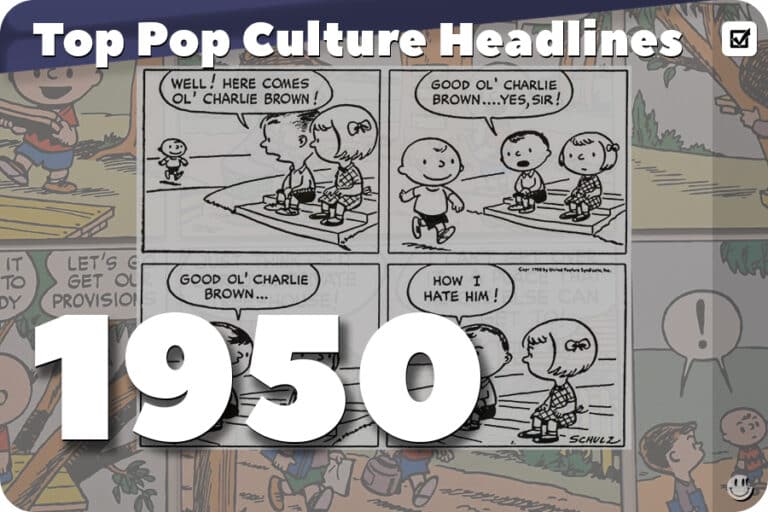
Peanuts debuted in seven newspapers on October 2, 1950, with a four-panel strip by Charles M. Schulz. Charlie Brown, Snoopy, Patty, and Shermy appeared in that first strip. The strip ran uninterrupted for 49 years, 7 months, and 12 days, until Schulz died on February 12, 2000 — the night before his final Sunday strip was published. At its peak, Peanuts appeared in 2,600 newspapers worldwide and was read by 355 million people in 75 countries.
All About Eve (1950) received 14 Academy Award nominations — a record that stood until Titanic in 1997. It starred Bette Davis, Anne Baxter, and George Sanders. Davis reportedly based her performance on her own insecurities about aging in Hollywood.
Sunset Boulevard (1950), directed by Billy Wilder, featured silent film star Gloria Swanson playing a faded silent film star. Real-life director Cecil B. DeMille appeared as himself. When it was screened for studio executives, legend holds that one executive said, “We should horsewhip the director.” Louis B. Mayer reportedly shouted that Wilder had “bitten the hand that feeds him.” It is now ranked one of the greatest films ever made.
Television was transforming American life in 1950. The number of TV sets in American homes had jumped from 1 million in 1948 to 4.4 million by 1950 and would reach 15 million by 1952. Your Show of Shows with Sid Caesar and Imogene Coca premiered on NBC and immediately became the most sophisticated comedy on American television — its writing staff at various points included Neil Simon, Carl Reiner, Mel Brooks, and Larry Gelbart.
Milton Berle, known as “Uncle Miltie” and “Mr. Television,” was so popular that his Tuesday-night show on NBC led restaurants and movie theaters to report sharp drops in business. Plumbers reported that water usage spiked during commercial breaks, as viewers rushed to the bathroom during his show.
Walt Disney’s Cinderella was released on February 15, 1950, the studio’s first animated feature since Bambi in 1942. It revived the Disney company’s fortunes at a critical moment, generating enough profit to fund the studio’s next decade of production.
The first TV remote control, Zenith’s “Lazy Bones,” went on sale in 1950. It was connected to the television by a cable running across the floor. People tripped over it constantly. The truly wireless remote wasn’t introduced until 1955.
The first charge card payment was made at Majors Cabin Grill restaurant in New York City in 1950 by Frank McNamara, who had been embarrassed at a dinner when he discovered he had forgotten his wallet. He founded the Diners Club card. Cards became available to the public on May 13, 1950. Credit as a way of life in America had begun.
The transistor radio didn’t exist yet, but the transistor itself was patented in 1950 by William Shockley of Bell Labs. It would make possible every electronic device of the next 75 years, from the pocket radio to the smartphone.
Kathryn Johnston became the first girl to play Little League baseball in 1950 by tucking her hair under her cap, calling herself “Tubby,” and joining the Kings Dairy team posing as a boy. When her coach discovered she was a girl, he said: “That’s okay — you’re a darned good player.” Little League didn’t officially open to girls until 1974.
Earl Lloyd became the first African American to play in an NBA game on October 31, 1950, when he suited up for the Washington Capitols. Chuck Cooper and Nat “Sweetwater” Clifton also integrated the NBA that season; Lloyd played first only because of the schedule.
7UP contained lithium citrate — a mood-stabilizing drug — as an ingredient until 1950. The “7” in the name may refer to lithium’s atomic mass. The formula change went unannounced.
Mother Teresa founded the Missionaries of Charity in Calcutta on October 7, 1950, with 12 members. By the time of her death in 1997, the organization operated 610 missions in 123 countries.
The Empire State Building, completed in 1931, spent most of its early years with significant vacancy — New Yorkers called it the “Empty State Building.” It didn’t become profitable until 1950, nearly 20 years after opening.
Smokey Bear became a living mascot in 1950 when a badly burned black bear cub was rescued from a forest fire in New Mexico. He was named after the fictional Smokey Bear from the Cooperative Forest Fire Prevention campaign. The real Smokey lived at the National Zoo in Washington until his death in 1976. He has his own ZIP code.
I, Robot by Isaac Asimov was published in 1950 and collects nine short stories that introduce the Three Laws of Robotics. The laws have been debated by philosophers, engineers, and science fiction writers for 75 years and now inform actual discussions about AI ethics.
If I Ran the Zoo by Dr. Seuss, published in 1950, contains the first recorded use of the word “nerd” in print. The sentence: “And then, just to show them, I’ll sail to Ka-Troo and bring back an IT-KUTCH, a PREEP, and a PROO, a NERKLE, a NERD, and a SEERSUCKER, too!” No one is sure where Seuss got the word.
The pirate accent as we know it — the “Arrr, matey” cadence — was invented by actor Robert Newton in his portrayal of Long John Silver in the 1950 Disney adaptation of Treasure Island. Newton was from Cornwall and exaggerated a West Country English accent for the role. Before his performance, there was no standard “pirate accent” in popular culture.
The first commercially available children’s toy to contain radioactive material was the “Gilbert U-238 Atomic Energy Lab” set, released in 1950. It contained actual uranium ore, a Geiger counter, a cloud chamber, and a spinthariscope. It was marketed for children 10 and up. The toy was discontinued in 1951.
The Great Brinks Robbery on January 17, 1950, saw eleven thieves steal $2.7 million from the Brinks armored car headquarters in Boston, the largest cash theft in U.S. history at the time. Only $58,000 was ever recovered. All eleven were eventually caught. The statute of limitations on the robbery had expired before several were convicted, meaning they couldn’t be charged with the robbery itself, only with related crimes.
The US Navy secretly sprayed San Francisco with Serratia marcescens bacteria from September 20-27, 1950, to simulate a biological attack and study how a germ weapon might spread in a coastal city. The “harmless” bacteria were not harmless; one man died of a resulting infection, and hospitals reported unusual spikes in pneumonia cases. The government was later sued, but the suit was dismissed on the grounds of sovereign immunity.
The Tollund Man, one of the best-preserved bog bodies ever discovered, was found in Denmark in 1950. He had been hanged, then placed in a peat bog in approximately 400 BC. His face was so well preserved that police initially thought they had found a recent murder victim.
Ranch dressing was invented at Hidden Valley Guest Ranch in Santa Barbara, California, in 1950, by plumber-turned-rancher Steve Henson. He began selling the dry seasoning mix by mail; Clorox eventually acquired the brand for $8 million in 1972 and made it America’s most popular salad dressing.
An estimated 50% of all American films made before 1950, and over 90% of those made before 1929, are lost forever — destroyed by fire, deterioration, or deliberate dumping by studios that didn’t recognize their cultural value.
L. Ron Hubbard published Dianetics: The Modern Science of Mental Health in 1950, which became the basis for Scientology. The American Psychological Association rejected its claims. It became a bestseller anyway.
The Myxoma virus was deliberately released into the wild rabbit population in Australia in 1950 to control rabbit numbers that had devastated the continent’s agriculture since European rabbits were introduced in 1859. The virus killed over 500 million rabbits in the first two years. The rabbit population eventually developed resistance.
Corn Pops debuted in 1950. The name has been changed and changed back so many times since that tracking it is a minor achievement in cereal history.
The Cold War in 1950
The Stasi, East Germany’s secret police, was founded on February 8, 1950. It would become one of the most extensive surveillance operations in history, employing one informant for every 63 citizens by the 1980s.
Julius Rosenberg was arrested on June 17, 1950, on suspicion of passing atomic bomb secrets to the Soviet Union. His wife, Ethel, was arrested on August 11. Both were executed on June 19, 1953 — the first American civilians executed for espionage in U.S. history.
Radio Free Europe made its first broadcast on July 4, 1950, transmitting into Czechoslovakia. It was covertly funded by the CIA and aimed at providing uncensored news to people living under communist regimes.
The Habit
Watching Your Show of Shows on NBC
Christmas Gifts and First Appearances of 1950
Little People and the Safety School Bus, Wooly Willy, official Magic 8 Ball, Silly Putty
Silly Putty was introduced as a toy on March 6, 1950, by entrepreneur Peter Hodgson, who bought the rights for $147. The substance itself was invented in 1943 by James Wright at General Electric while attempting to develop synthetic rubber. It bounced, stretched, and picked up newspaper print. Nobody at GE had a use for it. Hodgson packaged it in plastic eggs and sold it to a toy store. Sales were slow until a New Yorker reporter wrote about it. Within a year, 250,000 eggs had been sold. Silly Putty went into space on Apollo 8. It was inducted into the National Toy Hall of Fame in 2001.
Nobel Prize Winners
Physics — Cecil Frank Powell (for the photographic method of studying nuclear processes and the discovery of the pion)
Chemistry — Otto Paul Hermann Diels and Kurt Alder (for the Diels-Alder reaction in organic chemistry)
Medicine — Edward Calvin Kendall, Tadeusz Reichstein, and Philip Showalter Hench (for discoveries relating to cortisone)
Literature — Bertrand Russell (British philosopher, mathematician, and social critic)
Peace — Ralph Bunche (first Black person to win the Nobel Peace Prize, for mediating the 1949 Arab-Israeli armistice)
Economics — Prize not yet established (first awarded 1969)
Popular and Best-Selling Books of 1950
Across the River and Into the Trees — Ernest Hemingway
The Adventurer — Mika Waltari
The Cardinal — Henry Morton Robinson
The Lion, the Witch and the Wardrobe — C.S. Lewis
The Disenchanted — Budd Schulberg
The Egyptian — Mika Waltari
Floodtide — Frank Yerby
Joy Street — Frances Parkinson Keyes
Jubilee Trail — Gwen Bristow
The Parasites — Daphne du Maurier
Star Money — Kathleen Winsor
The Wall — John Hersey
Broadway in 1950
Guys and Dolls (musical) opened November 24, 1950, and ran until November 28, 1953. It won five Tony Awards and remains one of the most beloved Broadway musicals ever produced. Frank Loesser wrote every word and note.
Peter Pan opened at the Imperial Theatre for 320 performances, establishing the role that would define Mary Martin’s career.
Best Film Oscar Winner
All the King’s Men, directed by Robert Rossen, won Best Picture at the 22nd Academy Awards in 1950, presented for the 1949 film year.
The Bomb
Movie: Fancy Pants, starring Bob Hope and Lucille Ball, proved that some comedians are better in their own medium. Hope’s radio and TV persona never quite translated to the big screen.
TV: The technology itself was the bomb — in a good way. Television detonated inside American culture in 1950 and never stopped exploding.
Top Movies of 1950
- Cinderella
- King Solomon’s Mines
- Annie Get Your Gun
- Cheaper by the Dozen
- Father of the Bride
- All About Eve
- Sunset Boulevard
- Harvey
- The Asphalt Jungle
- Rio Grande
Most Popular TV Shows of 1950
- Texaco Star Theatre (NBC)
- Fireside Theatre (NBC)
- Philco TV Playhouse (NBC)
- Your Show of Shows (NBC)
- The Colgate Comedy Hour (NBC)
- Gillette Cavalcade of Sports (NBC)
- The Lone Ranger (ABC)
- Arthur Godfrey’s Talent Scouts (CBS)
- Hopalong Cassidy (NBC)
- Mama (NBC)
1950 Billboard Number One Songs
(The Billboard chart in 1950 tracked “Best Sellers in Stores” and “Most Played by Jockeys” separately; this reflects the most popular songs of the year by combined performance)
Goodnight, Irene — The Weavers with Gordon Jenkins (13 weeks at #1 — the longest run of the year)
The Tennessee Waltz — Patti Page
Mona Lisa — Nat “King” Cole (won the Academy Award for Best Original Song)
Harbor Lights — Sammy Kaye
It Isn’t Fair — Sammy Kaye
Rag Mop — The Ames Brothers
Chattanoogie Shoe Shine Boy — Red Foley
Sentimental Me — The Ames Brothers
I Can Dream, Can’t I? — The Andrews Sisters
Daddy’s Little Girl — The Mills Brothers
Simple Melody — Bing Crosby and Gary Crosby
Third Man Theme — Anton Karas
Hoop-Dee-Doo — Perry Como
Sam’s Song — Bing Crosby and Gary Crosby
Goodnight, Irene was originally recorded by Huddie “Lead Belly” Ledbetter, who died in 1949. The Weavers’ version — commercially sanitized from Lead Belly’s original — became one of the biggest hits of the year. It helped spark the American folk music revival that would culminate in the early 1960s.
1950 United States Census
Total U.S. Population: 151,325,798
New York, NY — 7,891,957
Chicago, IL — 3,620,962
Philadelphia, PA — 2,071,605
Los Angeles, CA — 1,970,358
Detroit, MI — 1,849,568
Baltimore, MD — 949,708
Cleveland, OH — 914,808
St. Louis, MO — 856,796
Washington, D.C. — 802,178
Boston, MA — 801,444
Sports Champions of 1950
World Series: New York Yankees
NFL Champions: Cleveland Browns (their first NFL title after dominating the rival AAFC for four years)
NBA Champions: Minneapolis Lakers
Stanley Cup: Detroit Red Wings
U.S. Open Golf: Ben Hogan (returning from a near-fatal car accident in 1949 that doctors said would end his career)
U.S. Open Tennis — Men: Arthur Larsen | Women: Margaret Osborne DuPont
Wimbledon — Men: Budge Patty | Women: Louise Brough
NCAA Football: Oklahoma
NCAA Basketball: CCNY (City College of New York — the only school ever to win both the NIT and NCAA tournaments in the same year)
Kentucky Derby: Middleground
FIFA World Cup: Uruguay (defeated Brazil 2-1 in the “Maracanazo” — a result so shocking that the stadium fell silent and many Brazilians in attendance wept openly)
Sports Highlight: Ben Hogan won the U.S. Open at Merion Golf Club in June 1950, just 16 months after a near-fatal head-on collision with a Greyhound bus in February 1949. Doctors had said he would never walk normally again. His 1950 U.S. Open victory is considered one of the greatest comebacks in sports history.
FAQs — 1950 Trivia, Fun Facts, and Pop Culture History
Q: What was the biggest event of 1950?
A: The Korean War began on June 25, 1950, when North Korean forces crossed the 38th parallel. Within days, U.S. forces were committed. By October, China had entered the conflict. It cost over 36,000 American lives before ending in a stalemate in 1953. No peace treaty has ever been signed.
Q: What famous comic strip debuted in 1950?
A: Peanuts by Charles M. Schulz, debuting October 2, 1950, in seven newspapers. It eventually ran in 2,600 newspapers worldwide and was read by 355 million people daily. Schulz wrote and drew every strip himself until the night before he died in February 2000.
Q: What word first appeared in print in 1950?
A: “Nerd” — in Dr. Seuss’s If I Ran the Zoo, published in 1950. No one is entirely sure where Seuss invented it.
Q: What new payment method was introduced in 1950?
A: The Diners Club charge card made its first transaction in 1950, when founder Frank McNamara used it at a New York City restaurant after being embarrassed by forgetting his wallet. It was the first modern charge card; the credit card revolution followed.
Q: What toy debuted in 1950 that is still sold today?
A: Silly Putty, introduced March 6, 1950, by Peter Hodgson. It had been invented in 1943 by a General Electric scientist who couldn’t find a practical use for it. Hodgson bought the rights for $147 and packaged them in plastic eggs. It has been in continuous production since.
Q: What Hollywood film received the most Oscar nominations ever in 1950?
A: All About Eve received 14 nominations — a record that stood until Titanic in 1997. It won six, including Best Picture.
Q: Who was Ben Hogan, and why was his 1950 victory significant?
A: Ben Hogan was arguably the greatest golfer of his era. In February 1949, he nearly died in a head-on collision with a Greyhound bus. Doctors said he might never walk again. Sixteen months later, he won the U.S. Open. It is one of the greatest athletic comebacks in history.
Q: What was the pirate accent invented in 1950?
A: The “Arrr, matey” pirate accent was created by actor Robert Newton for his portrayal of Long John Silver in Disney’s 1950 Treasure Island. Newton exaggerated his native West Country English accent. Before his performance, there was no standard pirate voice in popular culture.
Q: What did television look like in 1950?
A: In 1950, 4.4 million American families owned a TV set, up from 1 million in 1948. Programming was in black and white, broadcast only a few hours per day, and dominated by variety shows, comedies, and westerns. Texaco Star Theatre with Milton Berle was so popular it reportedly changed bathroom usage patterns across the country during commercial breaks.
Q: What children’s product from 1950 contained radioactive material?
A: The Gilbert U-238 Atomic Energy Lab, marketed to children aged 10 and up, contained actual uranium ore, a Geiger counter, a cloud chamber, and a spinthariscope. It was sold for one year before being discontinued. It is now a collector’s item.
More 1950 History and Trivia Resources
BabyBoomers.com (1950)
Most Popular Baby Names (BabyCenter.com)
Popular and Notable Books (popculture.us)
Broadway Shows that Opened in 1950X
1950 Calendar, courtesy of Time and Date.com
Fact Monster
Fifties Web (1950)
1950s, Infoplease.com World History
1950 in Movies (according to IMDB)
Retrowaste Vintage Culture
1950 Television
1950s Slang
1950 US Census Fast Facts
Wikipedia 1950