1916 History, Facts, and Trivia
Quick Facts from 1916
- World Changing Event: The Battle of the Somme — July 1 to November 18, 1916 — was one of the bloodiest battles in human history. On the first day alone, 57,470 British Empire soldiers were casualties, 19,240 of them killed. Over the course of the battle, more than one million soldiers died. The tactical result was inconclusive.
- The Movies to Watch: All silent films — Intolerance, 20,000 Leagues Under the Sea, The Aryan, Civilization, and The Fall of a Nation
- Most Famous American: Charlie Chaplin — who signed a contract worth $10,000 per week plus a $150,000 signing bonus, making him one of the highest-paid people in the United States
- Notable Books: Portrait of the Artist as a Young Man by James Joyce and Seventeen by Booth Tarkington
- U.S. Life Expectancy: Males — 49.6 years | Females — 54.3 years
- The Conversation: America was watching Europe tear itself apart in WWI and asking: Do we have to get involved?
- President: Woodrow Wilson — reelected on the slogan “He Kept Us Out of War.” Within five months of his second inauguration, he asked Congress to declare war.
Top Ten Baby Names of 1916
Girls: Mary, Helen, Dorothy, Margaret, Ruth Boys: John, William, James, Robert, Joseph
The Movie Stars
The term “movie star” originated at Paramount Pictures in 1916, when the studio contracted 22 actors and featured each with a star on its logo — the first time the term was used in its modern sense. The 22 original “movie stars” included Mary Pickford, Sessue Hayakawa, Wallace Reid, and Thomas Meighan.
The Stars of Silent Film
Mary Pickford was the biggest female star in America — she signed a contract in June 1916 for $10,000 per week plus profit participation, guaranteeing over $1 million per year. She was one of the wealthiest people in the country.
The Quote
“America cannot be an ostrich with its head in the sand.” — President Woodrow Wilson, 1916
“If you want to make enemies, try to change something.” — Woodrow Wilson, Address to the World’s Salesmanship Congress, July 1916
Time Magazine
Time magazine did not exist in 1916 — it was founded in 1923. There is no 1916 Person of the Year.
We Lost in 1916
Rasputin — Grigori Rasputin, the self-proclaimed mystic who held enormous influence over Russia’s royal family, was murdered by a group of Russian nobles on the night of December 29-30. The killing reportedly involved poisoned cake, multiple gunshots, and drowning — each of which he survived for a time before finally succumbing. The legends surrounding his death have never been fully disentangled from the facts.
Henry James, author of The Portrait of a Lady and The Turn of the Screw, died on February 28, at the age of 72
Jack London, author of The Call of the Wild and White Fang, died on November 22, at the age of 40
Hetty Green, “the Witch of Wall Street” and the richest woman in America, died July 3, at age 81
Jessie James’s son, Jesse James Jr., was still alive in 1916, working as a lawyer. His father had been dead for 34 years.
Firsts, Inventions, and Wonders
Piggly Wiggly opened its first self-service grocery store in Memphis, Tennessee on September 6, 1916, allowing customers to select their own items rather than asking a clerk. The concept of the modern supermarket begins here. The store’s founder, Clarence Saunders, posted a sign: “To have no store clerks gab and smirk while folks are standing around ten deep to get waited on.”
The Professional Golfers Association of America (PGA) was founded in New York City on April 10, 1916.
The Fall of a Nation (1916) — the sequel to D.W. Griffith’s Birth of a Nation — is considered the first sequel in film history. No surviving copies exist.
The National Park Service was established by President Wilson on August 25, 1916, consolidating management of 37 national parks and monuments. It remains one of the most consequential conservation decisions in American history.
Mr. Peanut was created by 14-year-old Antonio Gentile in 1916 for a Planters design contest. He won $5. Mr. Peanut appeared in the Saturday Evening Post on February 23, 1918.
Oxycodone — a narcotic painkiller closely related to codeine — was first synthesized in Germany in 1916. Its consequences for America would not be fully understood for another century.
Norman Rockwell’s first cover for the Saturday Evening Post was published May 20, 1916, depicting a boy dressed up in his Sunday best being mocked by friends playing baseball. He would go on to paint 321 more Post covers over 47 years.
Tristan Tzara is widely credited with founding the Dada art movement in Zurich in 1916 — a deliberate embrace of absurdity, anti-logic, and anti-war sentiment in response to the carnage of WWI.
The Chicago Cubs played their first game at Weeghman Park — now Wrigley Field — on April 20, 1916, defeating the Cincinnati Reds 7–6 in 11 innings.
The phrase “Founding Fathers” — referring to Adams, Franklin, Hamilton, Jay, Jefferson, Madison, and Washington — was coined by Warren G. Harding in a 1916 speech.
The U.S. Department of the Interior’s National Park Service was officially created in 1916 under the Organic Act, signed by President Wilson.
Charlie Chaplin signed with Mutual Film Corporation in 1916 for $10,000 per week plus a $150,000 signing bonus — one of the largest entertainment contracts in history to that point. He used the freedom to create some of his most beloved short films.
Mary Pickford signed a contract for $10,000 per week plus profit participation in June 1916, becoming one of the first and highest-paid entertainment figures in American history.
By 1916, there were more than 21,000 movie theaters in the United States. Films had moved from nickelodeons and storefronts into “dream palaces” — large, elegantly appointed theaters with plush seating and pipe organs. Going to the movies was no longer a working-class novelty. It was America’s dominant entertainment.
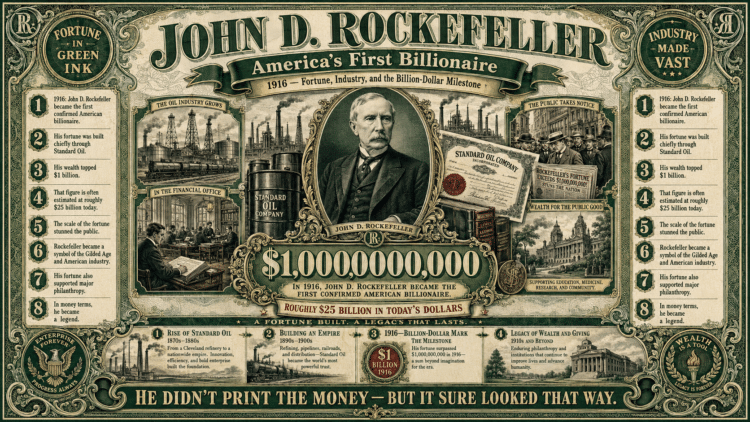
John D. Rockefeller became the world’s first confirmed American billionaire in 1916, with a net worth estimated at over $1 billion — roughly $25 billion in today’s dollars.
Pop Culture Facts and History
America in 1916 was a country in anxious suspension. The Great War had been raging in Europe for two years. Nearly every American family had roots in the countries that were tearing each other apart — Ireland, Germany, Italy, Poland, Russia, and England. The country was simultaneously deeply sympathetic to the Allies and deeply unwilling to send its sons to die in European trenches. Wilson won reelection in November by the narrowest of margins on the promise to keep America out. He declared war the following April.
The silent film era was at its apex. Charlie Chaplin, Douglas Fairbanks, Mary Pickford, and D.W. Griffith were the biggest names in a new and powerful art form. Films were silent but never quiet — live piano, organ, or full orchestra accompanied every screening. Audiences were interactive, rowdy, and enormous.
D.W. Griffith’s Intolerance (1916) was one of the most ambitious films ever made — four parallel stories spanning thousands of years, intercut in a then-revolutionary way. It was Griffith’s attempt to address criticism of his racist film The Birth of a Nation (1915). It was a commercial failure but remains one of the most technically influential films in cinema history.
The Battle of the Somme — a British documentary film featuring actual WWI combat footage — was released in Britain in August 1916 and was seen by 20 million people in its first six weeks. It was the first time most civilians had seen real war on film. Many fainted. Nothing would ever look the same.
In 1916, music was transitioning from ragtime to the early roots of jazz. The phonograph was in about 10% of American homes. Vaudeville was still packed in theaters nationwide. Tin Pan Alley in New York was the center of American popular music, churning out sheet music by the millions. People still played piano in their parlors.
The Great Migration began in earnest around 1916 as approximately 500,000 African Americans began moving from the rural South to Northern and Midwestern cities, drawn by war industry jobs and escaping the brutality of Southern segregation. The Black populations of Cleveland, Detroit, and Chicago would surge by 300–600% within a decade. It transformed American culture, eventually giving rise to the Harlem Renaissance.
The New Jersey shore shark attacks of July 1916 — a series of attacks over 12 days along 80 miles of coastline, killing four people — sparked nationwide panic and became the inspiration for Peter Benchley’s 1974 novel Jaws and Steven Spielberg’s 1975 film.
On October 7, 1916, Georgia Tech defeated Cumberland College in football 222–0, the largest margin of victory in college football history. Georgia Tech’s coach was John Heisman. The Heisman Trophy was named in his honor in 1935.
The Star-Spangled Banner was not the official national anthem until 1931. The poem by Francis Scott Key was written in 1814 as The Defence of Fort McHenry. It was paired with the melody of an old English drinking song — “To Anacreon in Heaven” — and began to be called “The Star-Spangled Banner” around 1916 as it grew in popularity.
The Statue of Liberty’s torch has been closed to the public since July 30, 1916, when German saboteurs blew up the Black Tom munitions depot in Jersey City — the explosion damaged the torch structure. It has never been reopened.
America’s last stagecoach robbery occurred on December 5, 1916. A mail wagon headed for Jarbidge, Nevada, was ambushed. Driver Fred Searcy was killed, and $4,000 vanished. Suspect Ben Kuhl was convicted, in part based on a bloody palm print, the first time palm print evidence was used in a U.S. courtroom. The money was never recovered.
Jeanette Rankin of Montana was elected to the U.S. House of Representatives on November 7, 1916 — the first woman elected to the U.S. Congress, four years before women won the right to vote nationwide. When she voted against entering WWI in 1917, she said: “I want to stand by my country, but I cannot vote for war.”
In 1916, the British Army rescinded its requirement that all soldiers must grow a mustache — a rule that had been in force since 1860. The reason: recruits were so young that some couldn’t grow more than a faint shadow of facial hair.
Frank Grigware escaped from Leavenworth Prison in 1910 while serving a life sentence. By 1916, he had made it to Canada, changed his name, and been elected mayor of Spirit River, Alberta. He was not caught for decades.
A “blue discharge” – neither honorable nor dishonorable – was introduced by the U.S. military in 1916 as a way to remove service members suspected of homosexuality without formal court martial proceedings. It remained in use until 1947 and carried a lasting social stigma.
In 1916, Woodrow Wilson nominated Louis Brandeis to the U.S. Supreme Court — the first Jewish justice in American history. The nomination was fiercely contested for months before confirmation.
President Wilson signed the Adamson Act in 1916, establishing an eight-hour workday for railroad workers — a landmark in American labor law that began a decades-long shift toward the 40-hour work week.
The first blood transfusion using stored, cooled blood was successfully performed by the British Royal Army Medical Corps on January 1, 1916 — a technique that would go on to save millions of lives.
Land at the corner of Broadway and Wall Street was selling for $7 per square inch in 1916, the highest real estate prices ever recorded in America at that point.
The Tragedy
In 1916, 2,223 Americans died in mining accidents, a statistic that generated political pressure for safer working conditions but little immediate change.
WWI
The Battle of the Somme (July 1 – November 18, 1916) cost more than one million casualties on all sides. The British Army suffered 57,470 casualties on the first day — its bloodiest in history. The battle advanced the front line by approximately seven miles.
A miscalculation of Montana’s population led to the drafting of 40,000 men — roughly 10% of the state’s population.
The 1916 Summer Olympics, scheduled to be held in Berlin, were canceled due to the war. They would not be held again until 1920.
The Odd
Thirty Toronto men were arrested for removing the tops of their bathing suits in public, exposing their nipples. The charge was indecency.)
Bronisław Huberman’s Stradivarius violin was stolen by a café musician named Julian Altman, who performed with it for presidents for 49 years before confessing on his deathbed. His wife received a $263,000 finder’s fee.
Nobel Prize Winners
Physics — Not awarded
Chemistry — Not awarded
Medicine — Not awarded
Literature — Carl Gustaf Verner von Heidenstam
Peace — Not awarded
Economics — Prize not yet established (first awarded 1969)
Biggest Pop Artists of 1916
The American Quartet, Sam Ash, Elsie Baker, Elizabeth Brice, Henry Burr, Albert Campbell, Enrico Caruso, Arthur Collins, Marguerite Dunlap, Marguerite Farrell, Arthur Fields, Byron G. Harlan, Charles Harrison, Al Jolson, Charles King, Olive Kline, Harry Macdonough, John McCormack, Lambert Murphy, Billy Murray, Geoffrey O’Hara, The Orpheus Quartet, The Peerless Quartet, Prince’s Orchestra, The Taylor Trio, The Victor Military Band, Walter Van Brunt, Elizabeth Wheeler
Most Popular Entertainment of 1916
Radio did not yet exist for consumers — the first commercial radio broadcast was 1920. Americans entertained themselves through vaudeville theater, nickelodeons and movie palaces, phonograph records, player pianos, parlor music, and professional baseball. The most popular radio — so to speak — was the phonograph, owned by roughly 10% of households.
Vaudeville was at the height of its popularity — traveling variety shows featuring comedians, singers, acrobats, and novelty acts playing every city in America.
Popular and Best-Selling Books of 1916
Fiction Bestsellers: Seventeen — Booth Tarkington
When a Man’s a Man — Harold Bell Wright
Just David — Eleanor H. Porter
Mr. Britling Sees It Through — H.G. Wells
Life and Gabriella — Ellen Glasgow
The Real Adventure — Henry Kitchell Webster
Bars of Iron — Ethel M. Dell
Nan of Music Mountain — Frank H. Spearman
Dear Enemy — Jean Webster
The Heart of Rachael — Kathleen Norris
Portrait of the Artist as a Young Man — James Joyce
A Course in General Linguistics — Ferdinand de Saussure
Imperialism: The Highest Stage of Capitalism — Vladimir Lenin
Democracy and Education — John Dewey
Psychology of the Unconscious — C.G. Jung (English translation)
Broadway in 1916
Notable 1916 Broadway productions included Ziegfeld Follies of 1916 — Florenz Ziegfeld’s annual revue featuring spectacular sets, beautiful chorus girls, and top comedic and musical talent. The Follies were the Super Bowl of American entertainment in the 1910s.
The Century Girl opened in November 1916 at the Century Theatre — a spectacular revue featuring music by Victor Herbert and Irving Berlin, representing two generations of American popular music on the same stage.
The Bomb
Movie: Civilization — a pacifist allegorical epic about the horrors of war, made as anti-war sentiment peaked in America. By the time it was released, audiences were beginning to accept that war might be inevitable. Its message arrived at the wrong moment.
Top Movies of 1916
- 20,000 Leagues Under the Sea
- Intolerance
- The Fall of a Nation
- The Aryan
- Civilization
- Less Than the Dust
- The Battle of the Somme (documentary)
- Joan the Woman
- The Americano
- The Innocent Lie
Sports Champions of 1916
World Series: Boston Red Sox (Babe Ruth pitched 13 scoreless innings in Game 2 — a World Series record that stood for 43 years)
Stanley Cup: Montreal Canadiens
U.S. Open Golf: Chick Evans
U.S. Open Tennis — Men: Richard Norris Williams | Women: Molla Bjurstedt
Wimbledon: Not held due to WWI
NCAA Football: Pittsburgh
Kentucky Derby: George Smith
Boston Marathon: Arthur Roth — 2:27:16
NFL Trivia: One of only five NFL games ever to end 2–0 was played on November 21, 1926, but the NFL was founded in 1920. In 1916, American professional football was still disorganized and pre-league.
College Football Trivia: On October 7, 1916, Georgia Tech defeated Cumberland College 222–0 — the largest margin of victory in college football history. Cumberland had disbanded its football team the prior year but was contractually obligated to play. They reportedly fielded 16 players who had never played organized football. Georgia Tech’s coach was John Heisman — the Heisman Trophy bears his name.
FAQs — 1916 Trivia, Fun Facts, and Pop Culture History
Q: What was the biggest military event of 1916?
A: The Battle of the Somme — 141 days of combat on the Western Front, resulting in over one million casualties. The British Army suffered 57,470 casualties on the first day alone — its single bloodiest day in history.
Q: Who was the first woman elected to the U.S. Congress?
A: Jeanette Rankin of Montana, elected November 7, 1916 — four years before women won the right to vote nationwide. She voted against U.S. entry into WWI and later cast the only vote against entering WWII as well.
Q: What Hollywood milestone happened in 1916?
A: The term “movie star” was coined by Paramount Pictures, which featured 22 contracted actors with stars on its logo. Charlie Chaplin signed for $10,000 per week. Mary Pickford signed for $10,000 per week plus profit participation. Hollywood’s star system was born.
Q: What self-service grocery innovation started in 1916?
A: Piggly Wiggly opened the first self-service grocery store in Memphis, Tennessee, on September 6, 1916, allowing customers to select their own items rather than asking clerks. It was the beginning of the modern supermarket.
Q: What famous sporting blowout happened in 1916?
A: Georgia Tech defeated Cumberland College 222–0 on October 7, 1916 — the largest margin of victory in college football history. Coach John Heisman later had the sport’s most prestigious award named after him.
Q: Why is the Statue of Liberty’s torch closed?
A: The torch has been closed to the public since July 30, 1916, when German saboteurs blew up the Black Tom munitions depot in Jersey City, structurally damaging the torch. It has never been reopened.
Q: What shark attack inspired a famous novel and film?
A: A series of shark attacks along the New Jersey shore in July 1916 killed four people and became the basis for Peter Benchley’s 1974 novel Jaws and Steven Spielberg’s 1975 film.
Q: What labor law did Wilson sign in 1916?
A: The Adamson Act, establishing an eight-hour workday for railroad workers — a landmark that helped pave the way for the 40-hour work week across American industry.
Q: What was America’s last stagecoach robbery?
A: December 5, 1916, in Jarbidge, Nevada. Driver Fred Searcy was killed, $4,000 stolen, and the suspect Ben Kuhl was convicted partly on palm print evidence — the first time palm prints were used in a U.S. court.
Q: What famous institution was established in 1916?
A: The National Park Service was established on August 25, 1916, under the Organic Act signed by President Wilson, consolidating management of America’s national parks and monuments.
More 1916 History and Trivia Resources
Popular and Notable Books (popculture.us)
Broadway Shows that Opened in 1916
1916 Calendar, courtesy of Time and Date.com
Fact Monster
1916 in Movies (according to IMDB)
Wikipedia 1916