

1909 History, Facts, and Trivia
Quick Facts from 1909
- World-Changing Event: On February 12, 1909, the nation’s largest and most widely recognized civil rights organization was founded. The NAACP was founded on the 100th anniversary of Abraham Lincoln’s birth, in direct response to a race riot in Springfield, Illinois — Abraham Lincoln’s hometown — that had occurred the previous year. It remains the most important civil rights organization in American history.
- Popular Songs: By the Light of the Silvery Moon, Casey Jones, and Put on Your Old Grey Bonnet
- Most Famous American: Theodore Roosevelt, who left for Africa on safari the day after leaving the presidency, and whose absence was immediately felt
- U.S. Life Expectancy: Males 50.5 years; Females 53.8 years
- 364,545 pianos were sold in the United States in 1909, a record that would not be surpassed for decades
- The Conversation: What would America look like without Theodore Roosevelt running it?
Top Ten Baby Names of 1909
Girls: Mary, Helen, Margaret, Ruth, Dorothy, Elizabeth, Florence, Ethel, Emma, Marie Boys: John, William, James, George, Robert, Charles, Joseph, Frank, Edward, Walter
The Stars
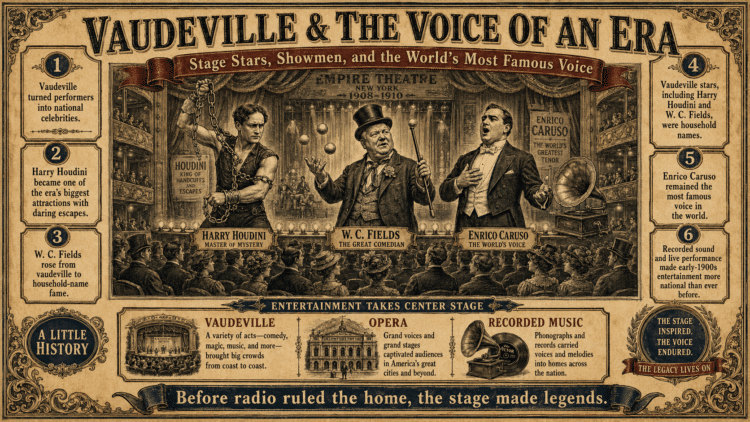
The nickelodeon era was at its peak. Film actors were still anonymous. Vaudeville stars, including Harry Houdini and W.C. Fields, were household names. Enrico Caruso remained the most famous voice in the world.
The Quote
“I came in with Halley’s Comet in 1835. It is coming again next year, and I expect to go out with it.” — Mark Twain, 1909. He died April 21, 1910, the day after the comet’s closest approach. He was right to the day.
“Get action. Seize the moment. Man was never intended to become an oyster.” — Theodore Roosevelt, departing for Africa, 1909
The Academy Awards, Time Magazine, Miss America
None existed in 1909.
We Lost in 1909
Geronimo, Apache leader, died February 17, age approximately 79, of pneumonia at Fort Sill, Oklahoma, still a prisoner of war. He had spent his final years as a celebrity, selling autographs and appearing at fairs. He never returned to his homeland. His last words reportedly were to his nephew: “I should never have surrendered.”
King Leopold II of Belgium died on December 17, at the age of 74; his rule of the Congo Free State had resulted in the deaths of an estimated 10 million people
Isaac Albéniz, Spanish composer, died May 18, at age 48
Sarah Orne Jewett, American author, died June 24, at the age of 59
Algernon Charles Swinburne, English poet, died April 10, age 71
The NAACP
On February 12, 1909, the 100th anniversary of Abraham Lincoln’s birth, a group that included African American leaders such as W.E.B. Du Bois and Ida B. Wells-Barnett announced the formation of a new organization called the National Association for the Advancement of Colored People.
In 1908, a deadly race riot rocked the city of Springfield — eruptions of anti-Black violence were horrifically commonplace, but the Springfield riot was the final tipping point. Appalled at this rampant violence, a group of white liberals that included Mary White Ovington and Oswald Garrison Villard issued a call for a meeting to discuss racial justice. Some 60 people, seven of whom were African American, signed the call.
The NAACP was explicitly interracial from its founding — an unusual and deliberate statement in 1909. The national leadership has always been interracial, although the membership has remained predominantly African American.
Its first major campaign was against lynching, which was not a relic of the distant past in 1909 but an ongoing epidemic. Between 1877 and 1950, over 4,000 Black Americans were lynched in the American South. The NAACP’s anti-lynching campaign, its legal victories, and its role in organizing the March on Washington decades later make it one of the most consequential organizations in American history.
Perhaps its most famous legal victory came in 1954, when NAACP Legal Defense and Education Fund founder Thurgood Marshall won the landmark Brown v. Board of Education decision. Marshall went on to become the first African American Supreme Court justice in 1967.
America in 1909 — The Context
William Howard Taft was inaugurated on March 4, 1909, inheriting a presidency from Theodore Roosevelt that had redefined what the executive branch could do. Taft was larger, calmer, and less combative than his predecessor. Roosevelt went to Africa the day after the inauguration. Taft struggled to live up to the progressive expectations Roosevelt had set. By 1912, Roosevelt would run against him.
The country was prosperous but deeply unequal. The 16th Amendment — establishing the federal income tax — was being debated in Congress. The automobile was beginning to reshape American geography. The nickelodeon era was at its peak. And in the Jim Crow South, Black Americans lived under a system of legal apartheid that the NAACP was just beginning to organize against.
Pop Culture Facts and History
The Eiffel Tower had been scheduled for demolition in 1909, having been built as a temporary structure for the 1889 Paris World’s Fair. It was saved when the French military recognized its value as a radio transmission tower — it had been used for military communications since 1903. In 1913, it transmitted a time signal to Washington, D.C. The tower that nobody wanted has now stood for 136 years.
Alice Ramsey, a 22-year-old from Hackensack, New Jersey, became the first woman to drive an automobile across the United States in 1909, completing the journey from New York to San Francisco in 59 days. She was accompanied by three female passengers, none of whom could drive. Of the 3,800-mile route, only 152 miles were paved. She changed 11 tires. The journey made international headlines.
Harry Houdini published Handcuff Secrets in 1909, in which he voluntarily revealed some of his most famous escape techniques. He reasoned that exposing imitators’ inferior methods would make his own genuine skills more impressive by comparison. He was not wrong.
The Indianapolis Motor Speedway was built in 1909 on 328 acres of farmland northwest of Indianapolis. The original surface, crushed gravel and tar, proved dangerously inadequate and led to fatalities in early races. Over the winter of 1909-1910, the track was repaved with 3.2 million bricks, earning the nickname “The Brickyard.” The first Indianapolis 500 was run in 1911.
The NAACP was founded on February 12, 1909, in direct response to the 1908 Springfield race riot, by an interracial group that included W.E.B. Du Bois, Ida B. Wells-Barnett, Mary White Ovington, and Oswald Garrison Villard. The Race Riot of 1908 in Springfield, Illinois, the state capital and Abraham Lincoln’s hometown, was a catalyst showing the urgent need for an effective civil rights organization.
The first International Women’s Day was organized by the Socialist Party of America on February 28, 1909, in New York City — initially called National Woman’s Day. It became international the following year, spreading to Europe through socialist organizations. It is now observed on March 8 in countries worldwide.
The Oval Office was constructed in 1909 as part of an expansion of the West Wing under President Taft. Taft, at 340 pounds, the largest president in American history, reportedly got stuck in the White House bathtub and had a larger one installed. The Oval Office has been redecorated by nearly every president since, but has maintained its distinctive shape.
The “customer is always right” slogan entered American retail culture in 1909, attributed to Harry Gordon Selfridge, founder of Selfridge’s department store in London, though similar sentiments had been expressed by the American retailer Marshall Field before him. The full phrase, as Selfridge used it, was more nuanced than its modern application — he meant that customers should be taken seriously, not that they were literally always correct. American retail culture enthusiastically adopted the truncated version.
The first Christmas Club savings account was opened in 1909 by the Carlisle Trust Company in Pennsylvania — a dedicated savings account into which customers made small regular deposits throughout the year, specifically to fund Christmas shopping. It became enormously popular during the Depression. Millions of Americans used Christmas Club accounts through the 1970s.
Condé Nast Publications was founded in 1909 by Condé Montrose Nast, beginning with the purchase of Vogue magazine. The company would eventually publish Vanity Fair, The New Yorker, GQ, Wired, and dozens of other titles, becoming one of the most influential media companies in the world.
Max Factor was founded in 1909 by Maksymilian Faktorowicz, a Polish-born cosmetics expert who had emigrated to Los Angeles. He initially supplied makeup to the nascent film industry, developing formulas specifically designed to look natural under the harsh lighting of early film sets. His products eventually reached the mass consumer market. The phrase “made up” — meaning wearing cosmetics — comes from the theatrical tradition that Max Factor professionalized.
The 1909 Honus Wagner T206 baseball card became the most valuable baseball card in history. Wagner, one of the greatest players of the era, demanded that the American Tobacco Company stop producing cards bearing his likeness because he did not want to be associated with tobacco promotion, or possibly because he wanted to be paid for the use of his image. The cards were recalled and destroyed; only approximately 50 survived. One sold at auction for over $7.25 million in 2021.
The pH scale — the measure of acidity and alkalinity — was developed in 1909 by Danish chemist Søren Sørensen while working at the Carlsberg Laboratory in Copenhagen, specifically to control the acidity of beer during fermentation. It has since become fundamental to chemistry, biology, medicine, and agriculture. Its debt to beer is rarely mentioned in chemistry textbooks.
Abercrombie & Fitch published their first catalog in 1909, featuring outdoor sporting equipment, hunting gear, and wilderness supplies. The store outfitted Theodore Roosevelt’s African safari. Its evolution into a teen clothing brand selling low-rise jeans came considerably later.
New York City was first referred to as “The Big Apple” in 1909, in Edward S. Martin’s book The Wayfarer in New York. The nickname did not enter widespread usage until the 1920s, when it was popularized by horse-racing writer John Fitz Gerald to describe New York’s racetracks. It became the city’s universal nickname in the 1970s through a tourism campaign designed to improve New York’s image during its fiscal crisis.
Construction of the U.S. Navy base at Pearl Harbor, Hawaii, began in 1909. The base would be the target of the Japanese attack on December 7, 1941, 32 years later.
The Cherry Mine Disaster in Cherry, Illinois on November 13, 1909, killed 259 men and boys when a fire broke out in the coal mine 500 feet below ground. The mine had no emergency exits; firefighters tried pumping water down the shafts but succeeded only in creating steam. It was the third-deadliest mine disaster in American history and led directly to the Illinois Mining Investigation Commission and stronger mine safety laws.
Milton Hershey, unable to have children, founded the Milton Hershey School for orphaned boys in 1909, endowing it with 30% of the Hershey Company’s future profits. He later donated his entire fortune to the school’s trust. The trust now has assets exceeding $17 billion and continues to provide free education, housing, and medical care to children in financial need. It is the richest school in the world.
Ty Cobb led the American League in home runs in 1909 without hitting a single ball over the outfield fence — all nine of his home runs were inside-the-park. The dead-ball era meant home runs were largely a product of speed rather than power.
The Eton Wall Game, played at Eton College in England, last recorded a goal in the St Andrew’s Day match of 1909. The game is played on a narrow strip alongside a wall; goals are so difficult to score that they occur roughly once per decade. The 1909 goal remains the most recent one in the game’s most prestigious annual match.
The world’s oldest operating airport was established in 1909 at College Park, Maryland, when Wilbur Wright arrived to train two U.S. Army Signal Corps officers in flying. The College Park Airport is still in operation today — the oldest continuously operating airport in the world.
General Motors acquired Cadillac in 1909, adding the luxury brand to its growing portfolio of automobile manufacturers. Cadillac was founded in 1902 using the assets of Henry Ford’s failed second automotive company.
The superstition of saying “Rabbit, Rabbit, Rabbit” on waking on the first day of each month to bring good luck was first recorded in print in 1909. Its origins are obscure. Theodore Roosevelt reportedly observed the practice. Franklin Roosevelt claimed to have missed saying it only once, on a day when something went wrong.
President Taft became the first president to drive an electric car in 1909, though he also maintained a fleet of gasoline-powered automobiles. The White House stables were converted into a garage.
Nobel Prize Winners
Physics — Guglielmo Marconi and Karl Ferdinand Braun (for contributions to the development of wireless telegraphy)
Chemistry — Wilhelm Ostwald (for work on catalysis)
Medicine — Emil Theodor Kocher (for work on the thyroid gland)
Literature — Selma Lagerlöf (Swedish author — the first woman to win the Nobel Prize in Literature)
Peace — Auguste Beernaert and Paul d’Estournelles de Constant
Economics — Prize not yet established
Selma Lagerlöf became the first woman to win the Nobel Prize in Literature in 1909. Her novel The Saga of Gösta Berlings had made her famous across Scandinavia; her children’s book The Wonderful Adventures of Nils is still read worldwide.
Popular and Best-Selling Books of 1909
The Inner Shrine — Basil King
Katrine — Elinor Macartney Lane
The Silver Horde — Rex Beach
The Man in Lower Ten — Mary Roberts Rinehart
The Trail of the Lonesome Pine — John Fox Jr.
Truxton King — George Barr McCutcheon
Also notable: The Promise of American Life by Herbert Croly — the book that defined Progressive Era political philosophy and influenced Theodore Roosevelt’s “New Nationalism” platform.
Broadway in 1909
The Chocolate Soldier opened September 13, 1909, running 296 performances — one of the biggest musical hits of the season.
The Dollar Princess and The Midnight Sons were also major productions.
Best Film Oscar Winner
The Academy Awards did not exist until 1929.
Top Films of 1909
(Still short films — all under 20 minutes)
A Corner in Wheat — D.W. Griffith for Biograph (considered one of the first films to make a direct political argument — against grain speculation and its effect on the poor)
The Lonely Villa — D.W. Griffith (introduced cross-cutting as a narrative technique)
Pippa Passes — D.W. Griffith
D.W. Griffith directed approximately 140 short films in 1909 alone for the Biograph Company. He was essentially inventing film grammar in real time.
Most Popular Entertainment of 1909
Nickelodeons remained the dominant film venue — approximately 8,000-10,000 across America.
Vaudeville was still the most popular form of live entertainment.
Baseball was the national pastime.
Piano sales hit their all-time record of 364,545 units — the player piano and parlor piano were the phonograph of their era.
1909 Most Popular Songs
By the Light of the Silvery Moon — Billy Murray and Haydn Quartet
Casey Jones — Billy Murray
Put On Your Old Grey Bonnet — Billy Murray
Yiddle on Your Fiddle — Ada Jones
Heaven Will Protect the Working Girl — Billy Murray
The Grand Old Rag — Billy Murray
Billy Murray remained the most recorded popular artist in America for the fifth consecutive year.
Sports Champions of 1909
World Series: Pittsburgh Pirates (defeating the Detroit Tigers — Honus Wagner vs. Ty Cobb, the greatest matchup of the dead-ball era. Wagner won.)
Stanley Cup: Ottawa Hockey Club
U.S. Open Golf: George Sargent
U.S. Open Tennis — Men: William Larned | Women: Hazel Hotchkiss Wightman
Wimbledon — Men: Arthur Gore | Women: Dora Boothby
NCAA Football: Yale
Kentucky Derby: Wintergreen
Boston Marathon: Henri Renaud — 2:53:36
Sports Highlight: The 1909 World Series matched the two greatest players of the era — Honus Wagner of the Pittsburgh Pirates and Ty Cobb of the Detroit Tigers. Wagner, at 35, hit .333 and stole 6 bases. Cobb, at 22, hit .231 and was thrown out stealing twice by Wagner. Pittsburgh won in seven games. It was considered a generational passing — and the old lion won.
FAQ — 1909 Trivia, Fun Facts, and Pop Culture History
Q: What major civil rights organization was founded in 1909?
A: The National Association for the Advancement of Colored People, founded on February 12, 1909 — the 100th anniversary of Abraham Lincoln’s birth — by a group including W.E.B. Du Bois, Ida B. Wells-Barnett, and Mary White Ovington. It was founded in direct response to a race riot in Springfield, Illinois, and remains the oldest and largest civil rights organization in America. Nobel Peace Prize
Q: What did Mark Twain predict about his own death in 1909?
A: Twain noted he had been born in 1835 during Halley’s Comet’s previous visit and expected to die when it returned in 1910. He died April 21, 1910 — the day after the comet reached its closest approach. He was correct to the day.
Q: What record was set in piano sales in 1909?
A: 364,545 pianos were sold in the United States — the all-time record. The player piano and parlor piano were the primary home entertainment technology of the era, before the phonograph and radio made recorded music universally accessible.
Q: What famous baseball card was produced in 1909?
A: The T206 Honus Wagner card, produced by the American Tobacco Company. Wagner demanded production be stopped because he didn’t want to be associated with tobacco promotion. The few surviving cards have sold for millions — one fetched over $7.25 million in 2021.
Q: What famous building was constructed in 1909?
A: The Oval Office, built as part of an expansion of the West Wing under President Taft. It has been redecorated by nearly every president since, but it maintains its distinctive shape.
Q: What scale invented in 1909 is now fundamental to science?
A: The pH scale, developed by Danish chemist Søren Sørensen at the Carlsberg Laboratory in Copenhagen, was specifically designed to control beer acidity during fermentation. It is now essential to chemistry, biology, medicine, and agriculture.
Q: What disaster killed 259 miners in Illinois in 1909?
A: The Cherry Mine Disaster on November 13, 1909, when fire broke out 500 feet underground in a coal mine in Cherry, Illinois. The mine had no emergency exits. It was the third-deadliest mine disaster in American history and led directly to stronger mine safety laws.
Q: Who was the first woman to drive across America?
A: Alice Ramsey, a 22-year-old from New Jersey, completed the first transcontinental automobile drive by a woman in 1909, from New York to San Francisco in 59 days, over roads that were only paved for 152 of the 3,800 miles.
Q: What major school was founded in 1909 with chocolate money?
A: The Milton Hershey School for orphaned boys, founded by Milton Hershey, with 30% of all future Hershey Company profits. He later donated his entire fortune to the trust. The school now has assets exceeding $17 billion and continues to provide free education and housing to children in financial need.
Q: What famous airport established in 1909 is still operating today?
A: College Park Airport in Maryland was established when Wilbur Wright arrived to train two U.S. Army officers in 1909. It is the oldest continuously operating airport in the world.
More 1909 History Resources
Most Popular Baby Names (BabyCenter.com)
Popular and Notable Books (popculture.us)
Broadway Shows that Opened in 1909
1909 Calendar, courtesy of Time and Date.com
1909 in Movies (according to IMDB)
Wikipedia 1909


