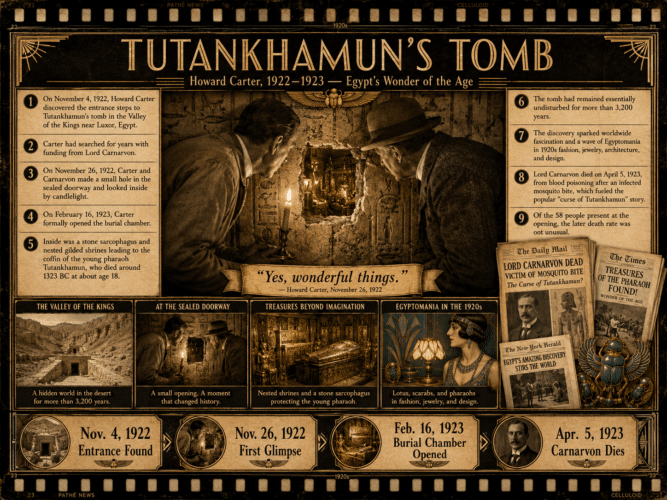
World Pop Culture-Changing Event: Howard Carter opened the inner burial chamber of Pharaoh Tutankhamun’s tomb in February 1923 and found the sarcophagus — revealing a solid gold coffin inside a stone sarcophagus inside a gilded wooden shrine inside another shrine, like the world’s most elaborate nesting doll, untouched for 3,200 years
Big Movie: Cecil B. DeMille’s The Ten Commandments premiered at Grauman’s Egyptian Theatre in Hollywood on December 23, 1923
Other Movies to Watch: Safety Last!, The Hunchback of Notre Dame, The Pilgrim, Three Ages, and The Extra Girl
“John” had been the most popular name for American boys every single year from 1880 through 1923 — a 43-year run that ended in 1924.
U.S. Life Expectancy in 1923
Males: 56.1 years; Females: 58.5 years
The Stars
Theda Bara, Marion Davies, Pola Negri, Mary Pickford
Miss America
Mary Katherine Campbell, Columbus, Ohio — her second consecutive Miss America title. She was also first runner-up at the 1924 pageant, making her arguably the most dominant contestant in the pageant’s early history.
We Lost in 1923
Warren G. Harding, the 29th President of the United States, died August 2, 1923, in San Francisco, at age 57, from what was officially described as a heart attack or stroke. He had been returning from a trip to Alaska and Canada — the first sitting U.S. president to visit Alaska — when he fell ill. He had been dealing with indigestion, fever, and shortness of breath for days. His death came suddenly and was surrounded by rumor and speculation, partly because his wife refused to allow an autopsy. The Teapot Dome and other scandals of his administration were already beginning to surface. The combination of suspicious timing and a refused autopsy produced conspiracy theories that circulated for decades. No credible evidence of foul play was ever established.
Born in 1923
Charlton Heston — October 4, 1923, in Evanston, Illinois. He starred in Ben-Hur, The Ten Commandments, and El Cid, and later became president of the National Rifle Association.
Hank Williams — September 17, 1923, in Georgiana, Alabama. He became one of the most influential figures in the history of country music before his death at age 29 in 1953.
America in 1923 — The Context
Warren Harding died on August 2, 1923, and Calvin Coolidge was sworn in as president at 2:47 a.m. by his father, a notary public, in the family’s farmhouse in Plymouth Notch, Vermont, by the light of a kerosene lamp. The scene — a son sworn in by his father in a modest Vermont farmhouse in the middle of the night — was irresistible to the American press and became one of the most mythologized images of the presidency.
Coolidge inherited Harding’s scandals, Harding’s cabinet, and the most prosperous economy in American history. He addressed none of the first, gradually replaced the second, and took credit for none of the third — principally by doing very little, which turned out to be politically effective. His nickname was “Silent Cal.” A famous story holds that, at dinner, a woman told him she had bet someone she could get more than two words out of him. He replied: “You lose.”
In 1923, the country was prosperous, restless, and loud. Jazz was everywhere. Prohibition had failed to reduce alcohol consumption and had created organized crime instead. The Ku Klux Klan had swelled to an estimated five million members and was operating openly across the country, including in Northern states. German hyperinflation was so severe that a loaf of bread cost 200 trillion marks by November — a currency collapse so complete that workers were paid twice a day so they could spend their wages before they became worthless.
King Tut’s Tomb
Howard Carter had discovered the entrance to Tutankhamun’s tomb on November 4, 1922, in the Valley of the Kings near Luxor, Egypt. He had been searching for years, funded by Lord Carnarvon. On November 26, 1922, Carter and Carnarvon made a small hole in the sealed doorway and peered in by candlelight. Carnarvon asked if he could see anything. Carter replied: “Yes, wonderful things.”
On February 16, 1923, Carter opened the inner burial chamber and found the sarcophagus — a stone box containing a gilded wooden shrine, within which lay another shrine, within which lay another, and within which lay the solid-gold coffin holding the mummy of the boy pharaoh, who had died around 1323 BC at approximately 18 years of age. The tomb had lain essentially undisturbed for over 3,200 years.
The opening of the tomb generated international fascination and sparked a wave of Egyptomania in fashion, architecture, and design — Egyptian motifs appeared in Art Deco buildings, jewelry, and consumer products throughout the 1920s. Lord Carnarvon died on April 5, 1923, six weeks after the tomb was opened, of blood poisoning from an infected mosquito bite. The “curse of Tutankhamun” narrative, launched by sensational press coverage, was immediately and enduringly popular. Of the 58 people present at the opening of the tomb, the subsequent death rate was consistent with normal actuarial expectations.
The Beer Hall Putsch
On November 8-9, 1923, Adolf Hitler and approximately 2,000 Nazi Party members attempted to seize power in Munich in a coup modeled on Mussolini’s March on Rome the previous year. The putsch collapsed when Bavarian state police fired on the marchers. Sixteen Nazis and four police officers were killed. Hitler was wounded when the man next to him was shot and dragged him to the ground. He was arrested two days later.
Hitler was tried for treason, convicted, and sentenced to five years in Landsberg Prison. He served less than nine months. During his imprisonment, he dictated Mein Kampf to his secretary, Rudolf Hess. The failed putsch and the trial — which Hitler used as a national platform — gave the Nazi movement more visibility than a successful coup might have.
November 9 is known as the day of fate in German history. On November 9, 1848, Robert Blum was executed. On November 9, 1918, Kaiser Wilhelm II abdicated. On November 9, 1923, Hitler’s Beer Hall Putsch failed. On November 9, 1938, Kristallnacht occurred. On November 9, 1989, the Berlin Wall came down. Five enormous events on the same calendar date, spanning 141 years.
The Death of President Harding
Warren Harding had left Washington in June 1923 for a national tour that included a trip to Alaska — the first by a sitting U.S. president. He was visibly unwell for much of the trip. On August 2, he died in his suite at the Palace Hotel in San Francisco. His wife, Florence, refused to allow an autopsy. Coolidge was sworn in the same night.
The Teapot Dome scandal — in which Harding’s Interior Secretary Albert Fall had secretly leased federal oil reserves to private companies in exchange for cash bribes — was already being investigated. Fall was later convicted of bribery, becoming the first sitting cabinet member convicted of a crime committed while in office. Harding himself was never charged with personal wrongdoing, but his administration’s corruption was extensive and became his legacy.
The Great Kanto Earthquake
On September 1, 1923, at 11:58 a.m. — lunchtime, when most families were preparing midday meals over open fires — a magnitude 7.9 earthquake struck the Kanto region of Japan, destroying Tokyo and Yokohama. The earthquake itself caused enormous structural damage, but the fires that followed were catastrophic. Because the quake struck precisely when cooking fires were lit across the city, fires broke out in thousands of places simultaneously and merged into a firestorm. In one incident near the Sumida River, 44,000 people who had gathered in an open area for safety were killed in minutes by a single fire whirlwind — a “dragon twist” of superheated air and flame. Approximately 142,000 people died in total, making it the deadliest earthquake in Japan’s recorded history and one of the deadliest natural disasters of the 20th century.
In the disaster’s aftermath, mob violence was directed at Korean residents of Tokyo, who were falsely accused of poisoning wells and committing acts of violence. An estimated 6,000 Korean people were murdered by vigilante groups. The Japanese government’s role in spreading the rumors that triggered the killings remains a source of ongoing historical controversy.
German Hyperinflation
Germany’s defeat in World War I had left it with massive war reparations under the Treaty of Versailles. The government’s response to the economic pressure was to print money. By 1923, the German mark had collapsed completely. In January 1923, a loaf of bread cost 250 marks. By November 1923, it cost 200 trillion marks. The exchange rate to the dollar, which had been 4.2 marks per dollar in 1914, reached 4.2 trillion per dollar.
Workers were paid twice daily so they could spend their wages before they became worthless. People used wheelbarrows to carry money to the store. Children played with paper-brick toys because they were cheaper than actual toys. Savings accumulated over a lifetime were wiped out in weeks. The middle class was devastated. The resentment and instability produced by this experience created the political conditions in which Hitler’s movement found its first mass audience.
Pop Culture Facts and History
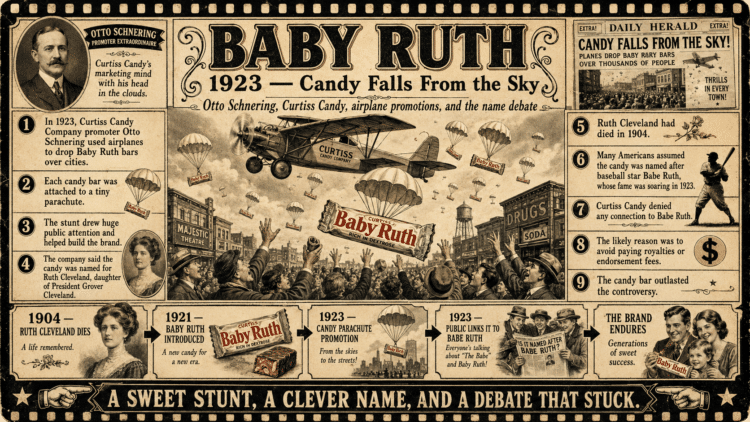
The Baby Ruth candy bar was promoted in 1923 by Otto Schnering of Curtiss Candy Company, who had Baby Ruth bars dropped from airplanes over cities, each attached to a tiny parachute. The candy’s name was officially attributed to President Grover Cleveland’s daughter, Ruth Cleveland, who had died in 1904. Most Americans assumed it was named after Babe Ruth, whose fame was at its height in 1923. The candy company denied any connection to the baseball player, most likely to avoid paying royalties. The candy bar outlasted the controversy.
Walt Disney and his brother Roy founded the Walt Disney Company in October 1923 in Hollywood, California, initially called the Disney Brothers Cartoon Studio. Their first contracted production was a series of animated short films called the Alice Comedies, featuring a live-action girl interacting with animated characters. The company’s first recurring character, Pete the Bear, debuted in 1925. Mickey Mouse was still five years away.
Yankee Stadium opened on April 18, 1923, in the Bronx. The first game was against the Boston Red Sox, attended by an estimated 74,000 people — the largest crowd ever to watch a baseball game to that point. Babe Ruth hit a three-run home run. The Yankees won 4-1. The stadium was immediately nicknamed “The House That Ruth Built,” which was accurate: the Yankees had purchased Ruth’s contract from Boston in 1920, and the enormous crowds he drew had made the new stadium financially viable.
Time Magazine, founded by Briton Hadden and Henry Luce, published its first issue on March 3, 1923. It was the first weekly news magazine in the United States, designed to summarize the week’s events for busy readers who did not have time to read daily newspapers in full. Hadden and Luce were 24 years old. The magazine’s distinctive style — short sentences, unusual compound adjectives, inverted syntax — was partly a product of the founders’ Yale education and partly of the physical constraints of fitting a lot of information into a small space.
Harold Lloyd’s Safety Last! was released in April 1923 and featured one of the most famous images in silent film history — Lloyd hanging from the hands of a large clock on the face of a building twelve stories above a Los Angeles street. The stunt was real. Lloyd had lost his thumb and forefinger in 1919 when a prop bomb exploded in his hand, and he performed the climbing sequence wearing a prosthetic glove. The sequence took three days to film.
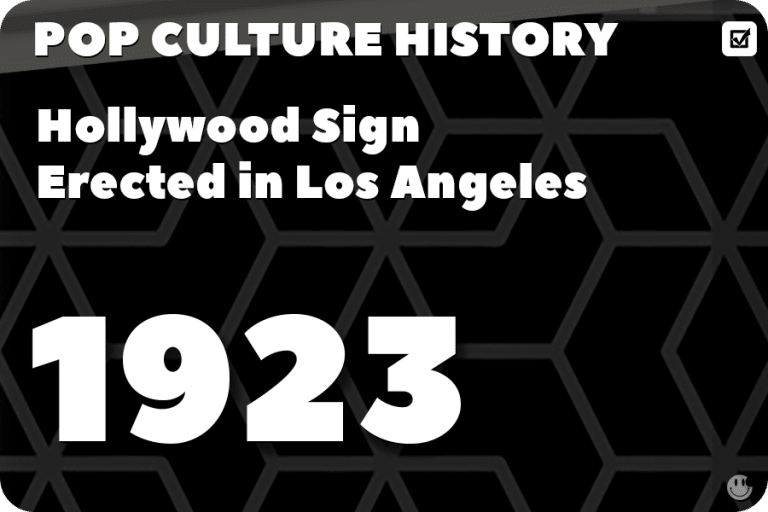
The Hollywoodland sign was erected in the hills above Los Angeles in July 1923 as an advertisement for a new residential real estate development. Each letter stood 50 feet tall and 30 feet wide and was lit by 4,000 light bulbs. The sign was originally intended to stand for 18 months before being removed. It has now been standing for over a century, minus the “land” portion removed in 1949. Every subsequent iteration of the Hollywood sign traces its existence to a real estate promotion.
Insulin became widely available for the treatment of diabetes in 1923, following Frederick Banting’s discovery the previous year. Banting refused to put his name on the patent, considering it unethical for a doctor to profit from a discovery that would save lives. He and his co-inventor, Charles Best, sold the patent to the University of Toronto for one dollar each. Banting received the Nobel Prize in Medicine in 1923 for the discovery.
The Cecil B. DeMille production of The Ten Commandments was filmed partly in the Egyptian dunes near Guadalupe, California. The production involved 1,500 humans, 3,000 animals, and 25,000 tons of sand. When filming concluded, DeMille had the entire set — including 21 sphinxes, 35-foot statues, and gates standing 110 feet tall — buried in the sand. Most of the buried set pieces remain there today, slowly being excavated by archaeologists who have been digging since the 1980s.
The Coca-Cola six-pack was introduced in 1923, designed to make it easier to carry bottles home from the store and to encourage the purchase of multiple bottles at once. It became one of the most influential retail packaging innovations of the century, eventually adopted across the beverage industry and beyond.
Edwin Hubble used the 100-inch Hooker telescope at Mount Wilson Observatory in California in 1923 to study variable stars in the Andromeda nebula. By calculating their distance, he proved that Andromeda was an entirely separate galaxy far outside the Milky Way — not a nebula within our own galaxy as previously believed. The discovery transformed humanity’s understanding of the scale of the universe. The Milky Way was not the universe; it was one galaxy among billions.
The Mayday distress call was introduced by Frederick Stanley Mockford, a senior radio operator at Croydon Airport in London, in 1923. Asked to suggest a distress signal that could be understood by pilots and ground crews regardless of nationality, he proposed “Mayday” — derived from the French venez m’aider, meaning “come help me.” Most of the radio traffic between Croydon Airport and Paris made the French derivation practical. The word “Mayday” has been the international distress call ever since.
The first 24 Hours of Le Mans endurance race was held on May 26-27, 1923, on a circuit near the French city of Le Mans. André Lagache and René Léonard won in a Chenard-Walcker, covering 1,372 miles. Le Mans became the most prestigious endurance race in the world and has been held annually ever since, with only a gap during World War II.
Wembley Stadium opened on April 28, 1923, in London, hosting the FA Cup Final between Bolton Wanderers and West Ham United. The match became famous not for the football but for the crowd — an estimated 200,000 people forced their way into a stadium designed for 127,000. A single police officer on a white horse — Billie — was photographed clearing the pitch of spectators. The game was subsequently known as the “White Horse Final.” Wembley later hosted the 1948 Summer Olympics.
Warner Brothers was incorporated as a film studio on April 4, 1923. Four brothers — Harry, Sam, Albert, and Jack Warner — had been in the film business since 1918, but formally incorporated their studio that year. Four years later, they produced The Jazz Singer, which permanently changed the film industry.
Dance marathons swept the United States in 1923. Alma Cummings danced for 27 consecutive hours in March 1923, attracting enormous press coverage. Vera Sheppard broke her record a few months later with 69 hours. The American Society of Teachers of Dancing petitioned against them, calling them “dangerous and a disgrace to the art of dancing,” a move that ensured their continued popularity. The marathons eventually grew into multi-day endurance spectacles with prize money, and some participants danced while sleeping upright on their partners.
Gene Salazar signed a lifetime endorsement deal with Wilson Sporting Goods in 1923 and collected royalty checks for 75 years, until his death in 1997. The deal he made in 1923 was still paying out in the late 20th century.
John Hertz, owner of the Yellow Cab Company, acquired Walter Jacobs’ car rental company in 1923 and renamed it Hertz. The yellow-and-black Hertz logo carried over directly from Yellow Cab. Hertz became the dominant car rental company in the United States and held that position for decades.
Skippy peanut butter was created as a promotional item for the comic strip Skippy, which debuted in 1923 and ran until 1945. The peanut butter named after the strip was introduced in 1933. The comic strip is largely forgotten; the peanut butter is not.
Words entering the English language in print for the first time in 1923 included “bathtub gin,” “Bible-thumper,” “blind date,” “malarkey,” and “mass-produce” — a reasonable cross-section of the decade’s preoccupations.
Delaware’s chicken industry dates back to 1923, when a farm in Ocean View, Delaware, received a shipment of 500 chicks instead of the 50 it had ordered. Rather than return them, the farmer raised all 500 and sold them at a profit. The accidental over-shipment launched an agricultural industry that still produces over 200 million broiler chickens annually.
Calvin Coolidge lit the first official National Christmas Tree on the White House grounds on December 24, 1923, pressing an electric button that illuminated a 48-foot balsam fir. The tradition has been observed every year since.
President Coolidge’s State of the Union address on December 6, 1923, was the first presidential address to be broadcast on radio, carried simultaneously by four stations. About the same number of American households had radio sets tuned in.
Nobel Prize Winners
Physics — Robert Andrews Millikan for his work on the elementary charge of electricity and on the photoelectric effect, confirming Einstein’s equation for the photoelectric effect experimentally Chemistry — Fritz Pregl for his invention of the method of micro-analysis of organic substances, which allowed chemists to analyze minute quantities of material Medicine — Frederick Grant Banting and John James Rickard Macleod for the discovery of insulin; Banting shared his prize money with Charles Best, who had assisted him; Macleod shared his with James Collip; the patent was sold to the University of Toronto for one dollar Literature — William Butler Yeats, an Irish poet and dramatist, for his always inspired poetry, which in a highly artistic form gives expression to the spirit of a whole nation Peace — not awarded in 1923
Broadway in 1923
Runnin’ Wild opened October 29, 1923, at the Colonial Theatre, an all-Black revue that introduced the Charleston to Broadway audiences. The Charleston then swept the country as the decade’s defining dance.
The Adding Machine by Elmer Rice opened March 19, 1923, at the Garrick Theatre. A pioneering work of American Expressionist theater depicting an office worker who murders his boss after learning he will be replaced by a machine, it was decades ahead of its cultural moment.
Top Movies of 1923
The Ten Commandments
The Hunchback of Notre Dame
Safety Last!
Three Ages
The Pilgrim
The Extra Girl
A Woman of Paris
Our Hospitality
Scaramouche
The White Sister
Popular and Best-Selling Books of 1923
Babbitt — Sinclair Lewis Black Oxen — Gertrude Atherton The Breaking Point — Mary Roberts Rinehart The Enchanted April — Elizabeth von Arnim His Children’s Children — Arthur Train The Prophet — Kahlil Gibran The Sea Hawk — Rafael Sabatini Wanderer of the Wasteland — Zane Grey
The Prophet by Kahlil Gibran, published in 1923, is one of the best-selling books of the 20th century and has been translated into over 100 languages. It has never gone out of print. Gibran was a Lebanese-American poet who wrote it in English after composing earlier versions in Arabic. The book presents a series of philosophical meditations on love, work, children, joy, and death, delivered by a prophet about to sail for home. Its quotations appear at weddings and funerals with approximately equal frequency.
Biggest Pop Artists of 1923
Billy Jones, Paul Whiteman, Al Jolson, Bessie Smith, Van and Schenck, Fred Waring’s Pennsylvanians, Ted Lewis, Isham Jones, Marion Harris, Eddie Cantor, Ben Bernie, Blossom Seeley, Ernest Hare, Nora Bayes
Bessie Smith, the “Empress of the Blues,” made her first commercial recording in 1923 — Down Hearted Blues — which sold 780,000 copies in its first six months, an extraordinary figure for the era. She became the highest-paid Black entertainer in America and one of the most important figures in the history of American music.
Louis Armstrong began recording in 1923 with King Oliver’s Creole Jazz Band in Chicago, the first recordings that documented what would become the most influential solo voice in jazz history.
Sports Champions of 1923
World Series: New York Yankees defeated the New York Giants 4-2; the first Subway Series played at the new Yankee Stadium; Babe Ruth hit .368 with three home runs; it was the Yankees’ first World Series championship Stanley Cup: Ottawa Senators — defeated the Edmonton Eskimos 2-0 U.S. Open Golf: Bobby Jones won his first U.S. Open, beginning the run of dominance that culminated in the 1930 Grand Slam U.S. Open Tennis: Men/Women: Bill Tilden / Helen Wills Wimbledon: Men/Women: Bill Johnston / Suzanne Lenglen NCAA Football Champions: Illinois and Michigan (co-champions) Kentucky Derby: Zev, who defeated the English champion Papyrus in a special transatlantic match race later that year, was one of the most publicized horse races of the decade Boston Marathon: Clarence DeMar, 2:23:47, his third consecutive win; he won seven total
Sports Highlight: The first Yankee Stadium World Series was the first in which both teams played all their home games in the same borough. The Yankees and Giants had shared the Polo Grounds, but the Yankees’ new stadium put them in a different part of the Bronx. DeMar’s third consecutive Boston Marathon win was part of a career that included seven victories total, making him the most successful marathon runner in the race’s history. Frank Hayes became the first and only jockey to win a race posthumously, dying of a heart attack mid-race at Belmont Park in June 1923 — his body stayed in the saddle, and his horse Sweet Kiss crossed the finish line in first place at 20-1 odds.
FAQs: 1923 History, Facts, and Trivia
Q: What was discovered in Tutankhamun’s tomb in 1923? A: Howard Carter opened the inner burial chamber on February 16, 1923, and found a stone sarcophagus containing a series of gilded wooden shrines, within which lay a solid gold coffin holding the mummy of the boy pharaoh, who had ruled Egypt around 1332-1323 BC. The tomb had lain essentially undisturbed for over 3,200 years.
Q: Who became president in 1923 and how? A: Calvin Coolidge, who was sworn in at 2:47 a.m. on August 2, 1923, by his father — a notary public — in the family’s farmhouse in Vermont, after the death of President Warren Harding. It was the only presidential oath administered by a father to his son in American history.
Q: What was the Beer Hall Putsch of 1923? A: Adolf Hitler and approximately 2,000 Nazi Party members attempted to seize power in Munich on November 8-9, 1923, modeled on Mussolini’s March on Rome. Bavarian police fired on the marchers, killing 16 Nazis. Hitler was arrested, tried for treason, and sentenced to five years in prison. He served for less than nine months and used the time to dictate Mein Kampf. The failed coup was a decade before his actual rise to power.
Q: What was the Great Kanto Earthquake? A: A magnitude 7.9 earthquake struck the Tokyo-Yokohama region of Japan on September 1, 1923, at lunchtime, when cooking fires were lit across both cities. The resulting firestorm killed an estimated 142,000 people — the deadliest earthquake in Japanese history. A single fire whirlwind near the Sumida River killed 44,000 people sheltering in an open area in minutes.
Q: What did Edwin Hubble discover in 1923? A: Using the 100-inch telescope at Mount Wilson Observatory, Hubble proved that the Andromeda nebula was a separate galaxy located far beyond the Milky Way. The discovery established that the universe contained billions of galaxies and permanently transformed humanity’s understanding of its scale and place.
Q: What was the Hollywood sign originally for? A: A real estate advertisement for a new housing development called Hollywoodland in the hills above Los Angeles, erected in July 1923. The sign was designed to stand for 18 months. It is still there, now reading simply “Hollywood,” more than a century later.
Q: What happened to the set of the 1923 Ten Commandments? A: Cecil B. DeMille had the entire set — sphinxes, statues up to 35 feet tall, gates 110 feet high — buried in the sand dunes near Guadalupe, California, after filming ended, rather than pay to dismantle and remove it. Most of the buried pieces remain there. Archaeologists have been excavating the site since the 1980s.
Q: How was insulin handled after its discovery in 1923? A: Frederick Banting and Charles Best sold the patent to the University of Toronto for one dollar each, refusing to profit from a discovery that would save lives. Banting won the Nobel Prize in Physiology or Medicine that year for the discovery.