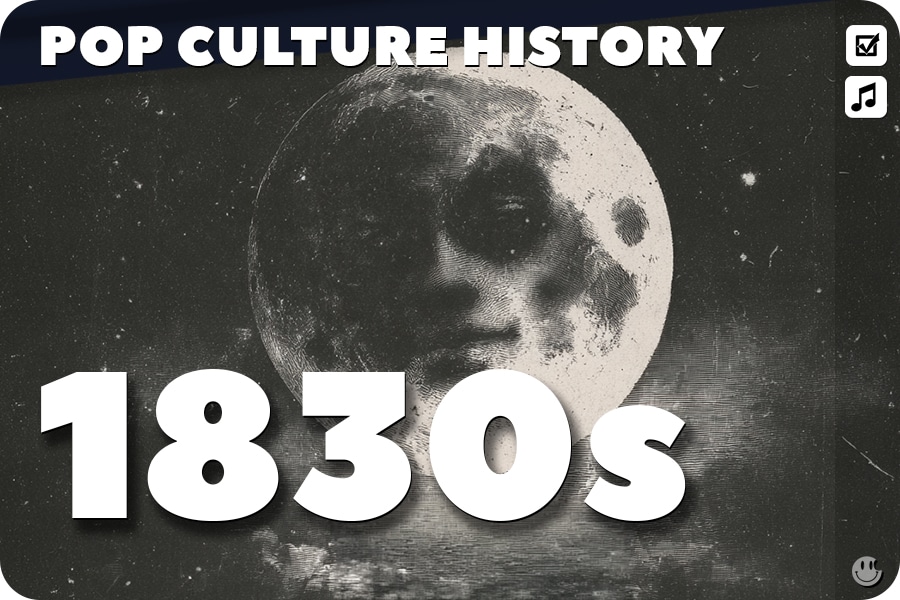
1830s History, Facts, and Trivia: Pop Culture of the 1830s
The 1830s were the decade America got its first cheap newspapers, its first frontier superstar, and its first great media hoax. A one-cent paper called the New York Sun convinced readers that bat-winged people lived on the moon, Davy Crockett went from congressman to Alamo martyr to almanac legend, and Uncle Sam made his first appearances in political cartoons. Steam locomotives raced horses, Samuel Colt patented his revolver, photography was born, and a young Queen Victoria gave her name to an entire era. It was a decade that went full steam ahead.
Quick Facts from the 1830s
- World-Changing Event: The penny press, starting with Benjamin Day’s New York Sun on September 3, 1833, made newspapers affordable for working people
- Presidents: Andrew Jackson (1829–1837) and Martin Van Buren (1837–1841)
- U.S. Population: 12.9 million in 1830, growing to 17.1 million by 1840
- Top Songs: America (My Country, ‘Tis of Thee), Zip Coon (the tune of Turkey in the Straw), Woodman, Spare That Tree, and Mary Had a Little Lamb (published as a poem in 1830)
- Notable Books: Oliver Twist, The Pickwick Papers, The Hunchback of Notre-Dame, Democracy in America, Twice-Told Tales, and Hans Christian Andersen’s first fairy tales
- The Conversation: Did you read in the Sun that they found people on the moon? And remember the Alamo!
Spotlight: Davy Crockett, King of the Wild Frontier
David Crockett of Tennessee was a real frontiersman, militia scout, and three-term congressman who built his public image as a plain-spoken backwoods humorist. A popular 1831 play, The Lion of the West, featured a character obviously based on him, and Crockett’s 1834 autobiography popularized his motto: be always sure you’re right, then go ahead. After losing his 1835 reelection bid, he famously told voters they could go to hell and he would go to Texas.
He died at the Alamo on March 6, 1836, at 49. How he died is still argued: some accounts say he fell fighting, while a disputed Mexican officer’s diary says he was captured and executed. Either way, the Crockett Almanacs kept him alive for 20 more years with tall tales, and Walt Disney’s 1954–1955 TV series sold millions of coonskin caps to kids who had never seen a raccoon.
Spotlight: The Great Moon Hoax
In August 1835, the New York Sun ran a series of articles claiming that famous astronomer Sir John Herschel had used a giant telescope in South Africa to discover life on the moon, including unicorns, bipedal beavers, and winged humanoid “man-bats.” The articles, probably written by reporter Richard Adams Locke, were a sensation, and the Sun briefly became the best-selling newspaper in the world. Herschel himself reportedly found the whole thing funny. The hoax was never formally retracted, and it remains one of the great examples of media lunacy.
Spotlight: Uncle Sam Gets a Face
The name “Uncle Sam” dated to the War of 1812, when meatpacker Samuel Wilson of Troy, New York, shipped barrels stamped “U.S.” to the Army, and soldiers joked they came from “Uncle Sam.” In the 1830s, political cartoonists began drawing Uncle Sam as a character, often alongside or in place of the older Yankee figure Brother Jonathan. The tall, bearded, star-spangled Uncle Sam would come later, mostly thanks to Thomas Nast. Congress officially recognized Samuel Wilson as the namesake of Uncle Sam in 1961.
Legends, Fables, and Folk Heroes
Tom Thumb vs. the Horse: On August 28, 1830, Peter Cooper’s tiny steam locomotive Tom Thumb raced a horse-drawn railcar on the Baltimore and Ohio line. The engine pulled ahead, then a belt slipped, and the horse won. The locomotive lost the race, but the railroads won the century.
Remember the Alamo: The 13-day siege of the Alamo in San Antonio ended on March 6, 1836, with the deaths of Crockett, Jim Bowie, William Travis, and the other defenders. Six weeks later, Sam Houston’s army shouted “Remember the Alamo!” as it routed Santa Anna at San Jacinto, winning Texas independence. The Bowie knife became a national craze.
Jim Crow: White performer Thomas D. Rice became an international star in the early 1830s with Jump Jim Crow, a song-and-dance routine in blackface that mocked Black Americans. The character’s name later became the label for the segregation laws of the South, a reminder of how deeply minstrel caricatures shaped American culture.
Barnum’s First Show: In 1835, a young P.T. Barnum launched his career by exhibiting Joice Heth, an elderly enslaved woman he falsely billed as George Washington’s 161-year-old nurse. It was an early sign of the showman’s talent for humbug and of the exploitation that sometimes powered it.
What Happened in the 1830s?
The Indian Removal Act of 1830 led to the forced relocation of the Cherokee, Choctaw, Creek, Chickasaw, and Seminole nations. On the Cherokee “Trail of Tears” in 1838 and 1839, thousands died on the march to Indian Territory.
Nat Turner led an uprising of enslaved people in Southampton County, Virginia, in August 1831, and William Lloyd Garrison launched his abolitionist newspaper The Liberator that same year.
Andrew Jackson’s war on the Second Bank of the United States and wild land speculation helped cause the Panic of 1837, a depression that lasted into the 1840s. Jackson also survived the first attempted assassination of a president in 1835, when both of his attacker’s pistols misfired.
Queen Victoria came to the British throne in June 1837 at age 18, beginning the Victorian era. In 1839, enslaved Africans seized the Spanish schooner Amistad, and their case reached the U.S. Supreme Court, where John Quincy Adams won their freedom in 1841.
Firsts, Inventions, and Wonders of the 1830s
- Photography. Louis Daguerre’s process was announced in Paris in 1839, and within months Americans were posing for daguerreotypes.
- Samuel Colt received his U.S. patent for a revolving pistol on February 25, 1836.
- Cyrus McCormick’s mechanical reaper (1831, patented 1834) and John Deere’s steel plow (1837) transformed farming on the prairie.
- Samuel Morse and Alfred Vail developed their telegraph code and demonstrated the telegraph in 1838.
- Charles Goodyear discovered vulcanization in 1839, supposedly by accidentally dropping rubber and sulfur on a hot stove.
- Friction matches went on sale in the late 1820s and 1830s, ending the age of the tinderbox.
- Procter & Gamble was founded in Cincinnati in 1837 by a candlemaker and a soapmaker who married sisters.
Pop Culture Facts and History
Samuel Francis Smith wrote America (My Country, ‘Tis of Thee) to the tune of Britain’s God Save the King, and it was first sung by children in Boston on July 4, 1831. It served as an unofficial national anthem for most of the century.
Sarah Josepha Hale published Mary’s Lamb in 1830. It was based on a real lamb that followed young Mary Sawyer to school in Sterling, Massachusetts. Fifty years later, it was the first thing Thomas Edison recorded on his phonograph.
Charles Dickens became the world’s first celebrity novelist with The Pickwick Papers (1836–1837), published in cheap monthly installments, and followed it with Oliver Twist. American publishers, under no copyright obligation, pirated him freely.
Alexis de Tocqueville toured the U.S. in 1831 and published Democracy in America in 1835, still one of the most quoted books ever written about the country. Hans Christian Andersen published his first fairy tales the same year.
Conjoined twins Chang and Eng Bunker, born in Siam, toured America and Europe throughout the 1830s. Their fame made “Siamese twins” a household term. They later settled in North Carolina, married sisters, and had 21 children between them.
Sports in the 1830s
- The Olympic Ball Club of Philadelphia, founded in 1833, played “town ball,” one of baseball’s ancestors.
- Horse racing was the most popular spectator sport, and big match races between Northern and Southern horses drew tens of thousands of people.
- Rowing and sailing regattas drew big crowds in New York harbor, and cricket was still more popular than baseball in many American cities.
We Lost in the 1830s
James Monroe, 5th president, July 4, 1831, age 73
Johann Wolfgang von Goethe, author of Faust, March 22, 1832, age 82
Sir Walter Scott, author of Ivanhoe, September 21, 1832, age 61
Charles Carroll, last surviving signer of the Declaration of Independence, November 14, 1832, age 95
John Marshall, chief justice, July 6, 1835, age 79
Davy Crockett, frontiersman and congressman, March 6, 1836, age 49
Jim Bowie, frontiersman, March 6, 1836, about age 40
James Madison, 4th president, June 28, 1836, age 85
Aaron Burr, vice president, September 14, 1836, age 80
Alexander Pushkin, Russian poet, February 1837, age 37
Born in the 1830s
Emily Dickinson (1830), Sitting Bull (about 1831), Louisa May Alcott (1832), Lewis Carroll (1832), Horatio Alger (1832), Johannes Brahms (1833), Alfred Nobel (1833), Edwin Booth (1833), Edgar Degas (1834), James McNeill Whistler (1834), Mark Twain (1835), Andrew Carnegie (1835), Winslow Homer (1836), Wild Bill Hickok (1837), J.P. Morgan (1837), Grover Cleveland (1837), John Muir (1838), General Tom Thumb (1838), George Armstrong Custer (1839), and John D. Rockefeller (1839)
FAQs: 1830s History, Facts, and Trivia
What was the Great Moon Hoax?
A series of articles in the New York Sun in August 1835 claiming astronomer John Herschel had discovered life on the moon, including winged “man-bats.” It was entirely made up.
How did Davy Crockett die?
At the Alamo on March 6, 1836. Most accounts say he died in battle, but a disputed diary by Mexican officer José Enrique de la Peña claims he was captured and executed.
Who was the real Uncle Sam?
Samuel Wilson, a meatpacker from Troy, New York, who supplied the Army during the War of 1812. Congress recognized him as Uncle Sam’s namesake in 1961.
When was photography invented?
Louis Daguerre’s process was publicly announced in 1839, the year generally considered the birth of photography.
Where did the term Jim Crow come from?
From a blackface minstrel character popularized by Thomas D. Rice around 1830. The name later became shorthand for Southern segregation laws.
Keep exploring: « Pop culture of the 1820s | 1800s Pop Culture: The 19th Century Decade by Decade | Pop culture of the 1840s »
More 1830s History and Trivia Resources
Wikipedia: 1830s
Wikipedia: Great Moon Hoax
Britannica: Davy Crockett
Wikipedia: Uncle Sam
Britannica: Daguerreotype