1995 Pop Culture Headlines
Top Events in January 1995 Pop Culture History
1. The Great Hanshin Earthquake Strikes Kobe, Japan (January 17, 1995): This magnitude 6.9 earthquake devastated the port city, killing more than 6,000 people and causing extensive damage to buildings and infrastructure that many had assumed were earthquake-resistant. Trivia: The disaster exposed serious weaknesses in Japan’s seismic building codes and emergency response systems, prompting sweeping nationwide reforms to construction standards and disaster preparedness in the years that followed.
2. Newt Gingrich Becomes Speaker of the House (January 4, 1995): The Georgia Republican was sworn in as Speaker following the GOP’s sweeping 1994 midterm victory, which had delivered Republicans control of the House for the first time in forty years on the strength of Gingrich’s “Contract with America” campaign platform. Trivia: Gingrich’s confrontational governing style would soon collide directly with President Clinton’s White House, setting the stage for the government shutdowns that would follow just months later that winter.
3. The Mexican Peso Crisis Deepens (January 31, 1995): President Clinton invoked emergency executive powers to extend a $20 billion loan to Mexico, aiming to prevent the country’s currency collapse from spiraling into a broader financial catastrophe that could spill across the border. Trivia: The intervention proved controversial in Congress, where many lawmakers balked at using executive authority to bypass a skeptical legislature, but the loan was ultimately repaid in full well ahead of schedule.
4. Serial Killer Fred West Is Found Dead in His Cell (January 1, 1995): The British murderer, awaiting trial for the killings of up to twelve women and girls including two of his own daughters, was found hanged in Winson Green Prison in Birmingham, England, before he could ever stand trial. Trivia: West’s death meant the full truth behind many of his crimes was never established in open court, leaving investigators and victims’ families without the complete public reckoning a trial might have provided.
5. NBC’s “Must See TV” Thursday Lineup Dominates Ratings (Early 1995): Seinfeld, Friends, and ER anchored the network’s Thursday night schedule so thoroughly that advertisers and critics alike began referring to the entire block simply by its now-legendary marketing slogan. Trivia: ER, then in its acclaimed second season starring George Clooney, was frequently the single highest-rated drama on all of television during this stretch, a rare achievement for a medical drama competing against lighter sitcom programming.
Top Events in February 1995 Pop Culture History
1. Barings Bank Collapses (February 26, 1995): Britain’s oldest merchant bank, which had financed the Louisiana Purchase and survived more than two centuries in business, collapsed after rogue trader Nick Leeson’s unauthorized derivatives trading in Singapore racked up losses of roughly $1.4 billion. Trivia: Leeson had reportedly been hiding his mounting losses in a secret internal account for years before the scheme finally unraveled, and his story later became the basis for the 1999 film Rogue Trader.
2. Steve Fossett Completes the First Solo Transpacific Balloon Flight (February 21, 1995): The American adventurer landed in Leader, Saskatchewan, after becoming the first person ever to fly solo across the Pacific Ocean in a hot air balloon, one of many record-setting endurance feats that would define his adventurous career. Trivia: Fossett would go on to set more than 100 different world records across ballooning, sailing, and aviation over the following decade, an extraordinary and wide-ranging résumé of extreme personal endurance challenges.
3. A UN Tribunal Charges Bosnian Serb Commanders with Genocide (February 13, 1995): The International Criminal Tribunal for the former Yugoslavia formally charged 21 Bosnian Serb military commanders with genocide and crimes against humanity, an early step in what would become a lengthy international effort to prosecute atrocities committed during the Bosnian War. Trivia: this tribunal, established by the UN Security Council just two years earlier, represented the first international war crimes tribunal since the Nuremberg trials following World War II.
4. Andy Cole’s Record Transfer Fee (February 1995): Manchester United signed striker Andy Cole from Newcastle United for a British record transfer fee of roughly £7 million, a landmark deal that reflected the rapidly escalating financial stakes of the newly formed Premier League. Trivia: the fee, considered staggering at the time, would be dwarfed many times over within just a few years as football transfer spending continued its dramatic upward climb throughout the following decades.
5. Talk Radio UK Launches (February 14, 1995): This new British commercial radio station debuted, part of a wave of newly licensed stations expanding the UK’s radio landscape following broader deregulation of the industry earlier in the decade. Trivia: The station’s launch reflected a broader global trend of the mid-1990s, in which talk-radio formats were rapidly gaining commercial traction on both sides of the Atlantic.
Top Events in March 1995 Pop Culture History
1. Michael Jordan Announces His Return to the NBA (March 18, 1995): Jordan ended his eighteen-month retirement, during which he’d pursued a brief minor league baseball career, with a simple two-word fax to the media: “I’m back.” Trivia: Jordan returned wearing number 45 instead of his iconic number 23, which the Chicago Bulls had already retired in his honor, though he would switch back to 23 partway through the following season.
2. The Tokyo Subway Sarin Attack (March 20, 1995): Members of the doomsday cult Aum Shinrikyo released sarin nerve gas across multiple Tokyo subway lines during morning rush hour, killing thirteen people and injuring thousands more in the deadliest attack on Japanese soil since World War II. Trivia: cult leader Shoko Asahara had bizarrely claimed at various points to be both Jesus and Buddha, and he was ultimately executed in 2018 along with several other senior cult members convicted in the attack.
3. 67th Academy Awards (March 27, 1995): Forrest Gump swept the ceremony, winning Best Picture, Best Director for Robert Zemeckis, and Best Actor for Tom Hanks, cementing the film’s status as one of the defining box office and cultural phenomena of the mid-1990s. Trivia: host David Letterman’s famously awkward “Oprah, Uma. Uma, Oprah” running joke landed so flatly with the audience that it’s still frequently cited as one of the most notoriously unsuccessful bits in Oscars hosting history.
4. Selena Is Murdered (March 31, 1995): The beloved Tejano singer, often called the “Queen of Tejano Music,” was shot and killed in Corpus Christi, Texas, by Yolanda Saldívar, the president of her own fan club, a shocking loss that devastated her enormous Latino fan base. Trivia: Selena’s posthumously released English-language crossover album, Dreaming of You, debuted at number one on the Billboard 200 the following year, a bittersweet commercial validation of the mainstream stardom she was only just beginning to achieve.
5. Yahoo Is Incorporated (March 2, 1995): David Filo and Jerry Yang formally incorporated their web directory service, which had begun as a simple personal list of favorite websites while the two were Stanford graduate students, launching what would become one of the earliest and most recognizable brands of the commercial internet era. Trivia: Yahoo’s name is technically a backronym for “Yet Another Hierarchically Organized Oracle,” a jokey bit of programmer humor its founders retrofitted onto the name after already liking how it sounded.
Top Events in April 1995 Pop Culture History
1. The Oklahoma City Bombing (April 19, 1995): Timothy McVeigh detonated a massive truck bomb outside the Alfred P. Murrah Federal Building, killing 168 people, including nineteen children in the building’s day care center, in the deadliest act of domestic terrorism in American history. Trivia: McVeigh was actually apprehended within ninety minutes of the blast, arrested initially for driving without a license plate, before investigators connected him to the bombing through forensic evidence recovered from the wreckage.
2. The Samashki Massacre (April 7, 1995): Russian paramilitary troops killed at least 250 civilians in the Chechen village of Samashki during the First Chechen War, one of the most notorious atrocities of the conflict and a stark early indicator of the war’s brutal civilian toll. Trivia: International human rights organizations extensively documented the massacre in the years that followed, and it remains one of the most frequently cited examples of the First Chechen War’s devastating impact on Chechen civilian communities.
3. President Clinton Declares a National Day of Mourning (April 23, 1995): Clinton designated a nationwide day of remembrance for the victims of the Oklahoma City bombing, just days after speaking at a memorial service in the shattered city that had deeply moved much of the country. Trivia: Clinton’s memorial address, in which he promised that “we will stand with you for as many tomorrows as it takes,” is still widely regarded as one of the most effective and unifying speeches of his entire presidency.
4. Sense and Sensibility Wins Best Film at the BAFTA Awards (April 23, 1995): Ang Lee’s adaptation of Jane Austen’s novel, adapted for the screen by star Emma Thompson, earned Britain’s top film honor, part of a broader critical wave of acclaim for the film that would continue through that year’s awards season. Trivia: Thompson’s first screenplay adaptation would go on to win the Academy Award for Best Adapted Screenplay as well, making her the only person in Oscar history to win awards for both acting and screenwriting.
5. The First World Book Day Is Celebrated (April 23, 1995): UNESCO designated this new annual observance to promote reading, publishing, and copyright protection worldwide, choosing April 23 partly because it marks the anniversary of both William Shakespeare’s and Miguel de Cervantes’s deaths. Trivia: the date’s dual literary significance made it a deliberately symbolic choice, honoring two towering figures of English and Spanish literature on the very same calendar day.
Top Events in May 1995 Pop Culture History
1. Sony Unveils the PlayStation in North America (May 1995): Sony formally introduced its PlayStation console to American audiences at the E3 trade show, having already launched the system in Japan the previous December, marking the console’s arrival as a serious challenger in a market long dominated by Nintendo and Sega. Trivia: the console’s $299 launch price directly undercut its rivals, a deliberate pricing strategy that helped it capture significant market share almost immediately upon its full U.S. retail release that September.
2. Aum Shinrikyo’s Headquarters Is Raided (May 16, 1995): Japanese police stormed the cult’s compound near Mount Fuji nearly two months after the deadly Tokyo subway attack, arresting cult leader Shoko Asahara and beginning a sweeping crackdown that would result in more than 200 arrests. Trivia: authorities were concerned enough about potential armed resistance that Japan’s Ground Self-Defense Force stationed an airborne brigade nearby in case backup support was needed during the raid.
3. The Alfred P. Murrah Federal Building Is Imploded (May 23, 1995): The heavily damaged remains of the bombed federal building in Oklahoma City were demolished in a controlled implosion, clearing the site for what would eventually become the Oklahoma City National Memorial. Trivia: The memorial that now occupies the site includes 168 empty chairs, one for each victim of the bombing, with smaller chairs specifically representing the nineteen children who were killed.
4. Everton Wins the FA Cup (May 20, 1995): Everton defeated Manchester United 1-0 at Wembley Stadium to capture England’s historic domestic cup competition, a significant triumph for a club that had gone through a relatively lean stretch in the years prior. Trivia: this victory remains, to this day, the last major domestic trophy Everton has won, a drought that has stretched on for decades since this Wembley triumph.
5. Braveheart Begins Its Theatrical Run (May 24, 1995): Mel Gibson both directed and starred in this sprawling historical epic about Scottish rebel William Wallace, a film that would go on to win Best Picture at the following spring’s Academy Awards despite mixed reactions from historians over its liberties with the actual historical record. Trivia: the film’s massive battle sequences were filmed largely in Ireland, using thousands of Irish Army reservists as extras, since Scotland’s own landscape no longer had enough unspoiled, medieval-looking terrain for the production.
Top Events in June 1995 Pop Culture History
1. Batman Forever Released (June 16, 1995): Val Kilmer took over the title role from Michael Keaton in this brighter, campier installment of the Batman franchise, introducing Jim Carrey as the Riddler and Tommy Lee Jones as Two-Face in a visual style considerably more colorful than Tim Burton’s earlier, darker films. Trivia: Director Joel Schumacher deliberately steered the franchise toward a lighter, more family-friendly tone after the previous film’s darker sensibility had drawn some parental criticism, a stylistic pivot that would continue even further with the franchise’s next installment.
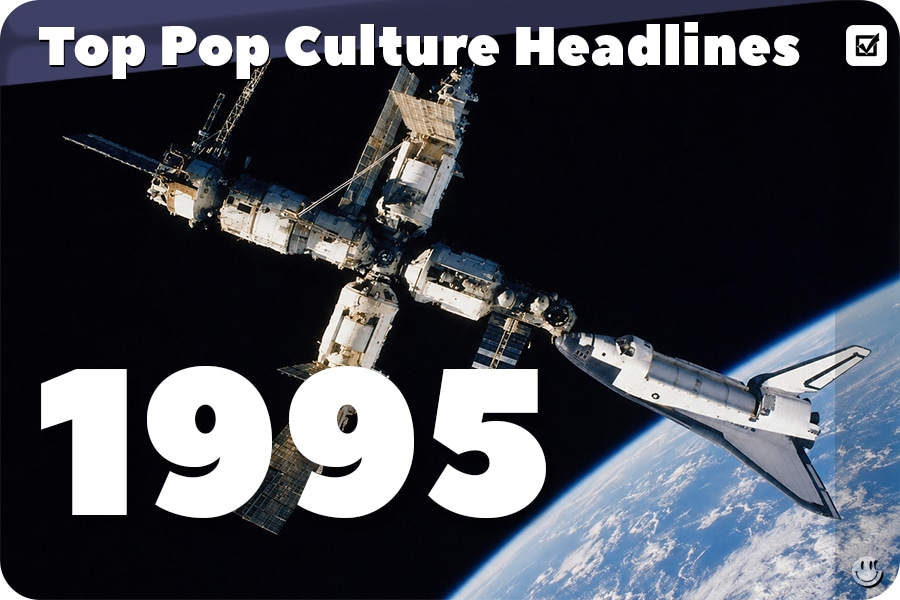
2. Space Shuttle Atlantis Docks with Mir (June 29, 1995): The STS-71 mission achieved the first-ever docking between an American space shuttle and the Russian Mir space station, a historic moment of post-Cold War space cooperation that also brought astronaut Norm Thagard home after a record-setting four-month stay aboard the station. Trivia: this mission marked the beginning of what would become a long-running Shuttle-Mir partnership program, widely seen as an important stepping stone toward the far larger, fully international collaboration that would later build the International Space Station.
3. Hugh Grant’s Arrest (June 27, 1995): The British actor, then one of Hollywood’s most in-demand romantic leading men and publicly dating Elizabeth Hurley, was arrested in Los Angeles for lewd conduct in a widely tabloided scandal that briefly threatened his rising career. Trivia: Grant handled the fallout with self-deprecating humor, famously appearing on The Tonight Show just days later and directly addressing the incident with Jay Leno, a candid move widely credited with helping rehabilitate his public image remarkably quickly.
4. NATO Formally Assumes Bosnia Command (June 1995): French General Bernard Janvier, head of the UN peacekeeping force in Bosnia, formally transferred military authority to NATO command under U.S. Admiral Leighton Smith, a significant step in the international response to the ongoing Bosnian War that would culminate in that summer’s tragic events at Srebrenica. Trivia: this command transition reflected growing international frustration with the limitations of the existing UN peacekeeping mandate, which many felt had proven too weak to prevent escalating violence across the region.
5. WWE’s In Your House Pay-Per-View Series Continues (June 1995): The wrestling promotion’s ongoing monthly pay-per-view schedule kept building storylines throughout the summer ahead of that August’s SummerSlam, part of an era when the company was still finding its footing amid growing competition from rival promotions. Trivia: this period is generally regarded by wrestling historians as something of a transitional era for WWE, sandwiched between its 1980s golden age and the far more commercially explosive “Attitude Era” that would follow just a couple of years later.
Top Events in July 1995 Pop Culture History
1. The Srebrenica Massacre Begins (July 6, 1995): Bosnian Serb forces began shelling the town of Srebrenica, a UN-designated “safe area,” and over the following days systematically massacred more than 8,000 Bosnian Muslim men and boys, the worst act of genocide on European soil since World War II. Trivia: the massacre’s scale and the UN peacekeepers’ documented failure to prevent it, despite the town’s official “safe area” status, became one of the most searing indictments of international peacekeeping shortcomings during the entire Bosnian War.
2. The Chicago Heat Wave (July 13, 1995): A brutal heat wave struck cities across the United States, with temperatures in Chicago reaching 106 degrees and a heat index near 125 degrees, contributing to an estimated 739 deaths in the city alone. Trivia: the disaster disproportionately killed elderly residents living alone, particularly in low-income neighborhoods, and it later became the subject of extensive academic study examining how social isolation can turn extreme weather into a genuinely deadly public health crisis.
3. Amazon Opens for Business (July 16, 1995): Jeff Bezos launched his online bookstore from a Seattle garage, beginning modestly as a simple retailer of books before gradually expanding into the sprawling global e-commerce giant it would become over the following decades. Trivia: Bezos reportedly chose the name Amazon specifically because it starts with the letter A, ensuring prominent placement in alphabetized directories, and because the actual Amazon River’s massive size symbolized his ambitions for the company’s eventual scale.
4. Clueless Released (July 19, 1995): This teen comedy, loosely inspired by Jane Austen’s Emma and following a wealthy, well-meaning Beverly Hills teenager navigating high school social politics, became an instant cultural touchstone, influencing fashion trends and popularizing slang like “as if” for a generation of viewers. Trivia: star Alicia Silverstone was paid a then-remarkable sum for a young actress in a teen film, reportedly negotiated partly on the strength of her already-buzzy profile from a string of popular Aerosmith music videos.
5. Take That Splits as Robbie Williams Departs (July 17, 1995): The wildly popular British boy band announced Williams’s exit amid growing internal tensions, a breakup that dominated UK entertainment headlines and devastated the group’s massive teenage fanbase. Trivia: Williams would go on to become one of the best-selling solo artists in British music history, while Take That itself would eventually reunite years later, minus Williams at first, before he rejoined the group for later reunion tours.
Top Events in August 1995 Pop Culture History
1. Jerry Garcia Dies (August 9, 1995): The Grateful Dead’s guitarist and de facto frontman died of a heart attack at a rehabilitation facility, effectively ending the band’s three-decade run and prompting the surviving members to announce the group’s dissolution later that year. Trivia: Garcia’s death triggered such an outpouring of grief among the band’s devoted “Deadhead” fanbase that impromptu memorial gatherings sprang up in cities across the country within hours of the news breaking.
2. Windows 95 Is Released (August 24, 1995): Microsoft’s new operating system launched with an unprecedented marketing blitz, including a famous ad campaign built around the Rolling Stones’ “Start Me Up,” and customers reportedly lined up outside computer stores overnight for a product that, at the time, was an almost unheard-of level of consumer hype for software. Trivia: Windows 95 introduced the now-ubiquitous Start button and taskbar, interface conventions so intuitive and enduring that variations of them remained part of Windows for the following three decades.
3. Bill Gates Named the World’s Richest Person (August 1995): Forbes magazine ranked the Microsoft co-founder as the wealthiest individual on Earth, with a net worth of approximately $12.9 billion, a title he would hold with only brief interruptions for years to come. Trivia: Gates’s fortune would go on to grow many times over in the following decades, though his ranking as the world’s single richest person would eventually be overtaken by a new generation of tech and e-commerce billionaires.
4. The Deadliest Airline Disaster of the Year (Mid-1995): American Airlines Flight 965 crashed into a mountain near Cali, Colombia, killing 151 people after a navigational error sent the aircraft dangerously off course during its descent, becoming one of the year’s deadliest aviation accidents. Trivia: the crash’s cause was ultimately traced to a data entry error in the plane’s flight management computer, a navigational mistake that led directly to industry-wide reforms in how pilots verify waypoint selections during descent.
5. Waterworld Struggles at the Box Office (Summer 1995): Kevin Costner’s post-apocalyptic ocean epic, which had become the most expensive film ever made up to that point due to its enormously troubled production, opened to a respectable but underwhelming box office performance that made recouping its massive budget a genuine challenge. Trivia: the film’s elaborate, custom-built floating set was so extensive and expensive to maintain that its production costs became a recurring subject of Hollywood cautionary-tale storytelling for years afterward, even though the film eventually turned a modest profit through video and international sales.
Top Events in September 1995 Pop Culture History
1. eBay Launches as AuctionWeb (September 3, 1995): Pierre Omidyar launched this online auction site from his San Jose apartment, selling a broken laser printer as its very first item for $14.83, an inauspicious beginning for what would become one of the internet’s most successful e-commerce platforms. Trivia: Omidyar reportedly emailed the winning bidder to make sure he understood the printer was actually broken, only to learn the buyer was a collector of broken laser printers specifically, an odd but fitting first sale for a site that would soon connect niche buyers and sellers of literally everything.
2. Sony Releases the PlayStation in the United States (September 9, 1995): The console’s official American retail launch, priced at $299, marked Sony’s full entry into a console gaming market previously dominated by Nintendo and Sega, and it would go on to sell more than 100 million units over its lifetime. Trivia: the PlayStation’s eventual massive success is often credited with helping legitimize CD-based gaming over the older cartridge format, a technical shift that enabled far more expansive and cinematic game experiences.
3. The Unabomber’s Manifesto Is Published (September 19, 1995): The New York Times and The Washington Post jointly published the lengthy anti-technology manifesto written by the still-unidentified serial bomber, following an unusual request from law enforcement hoping someone might recognize the writing style. Trivia: the gamble paid off spectacularly when Ted Kaczynski’s own brother, David, recognized the writing and turned him in, leading to Kaczynski’s arrest the following spring.
4. Se7en Released (September 22, 1995): David Fincher’s grim serial-killer thriller, starring Brad Pitt and Morgan Freeman as detectives hunting a murderer staging killings around the seven deadly sins, became a critical and commercial hit known for its bleak atmosphere and now-legendary shocking final twist. Trivia: the studio reportedly pushed hard for a happier ending during production, and it was only through star Brad Pitt’s insistence, backed by director Fincher, that the film’s famously dark original conclusion was preserved.
5. Pride and Prejudice Premieres on BBC One (September 24, 1995): This acclaimed television adaptation of Jane Austen’s novel, starring Jennifer Ehle and Colin Firth, became a cultural phenomenon in Britain, with Firth’s brooding portrayal of Mr. Darcy achieving a level of fame that would follow him for the rest of his career. Trivia: a particular scene of Firth’s Darcy emerging from a lake in a wet shirt, though a relatively brief and unscripted-feeling addition to Austen’s original story, became so iconic that it’s still regularly referenced and parodied in British popular culture decades later.
Top Events in October 1995 Pop Culture History
1. O.J. Simpson Is Acquitted (October 3, 1995): A jury found the former football star not guilty of murdering his ex-wife Nicole Brown Simpson and her friend Ronald Goldman, concluding a sensational 252-day trial that had captivated the nation and exposed deep divisions in how Americans viewed race, celebrity, and the justice system. Trivia: An estimated 150 million Americans watched the verdict live, and the moment reportedly cost American businesses roughly $480 million in lost productivity that single afternoon.
2. The Million Man March (October 16, 1995): Hundreds of thousands of Black men gathered on the National Mall in Washington, D.C., for a demonstration organized by Nation of Islam leader Louis Farrakhan, promoting unity, personal responsibility, and civic engagement within Black communities nationwide. Trivia: crowd size estimates varied wildly between organizers and the National Park Service, a persistent dispute that eventually led the Park Service to stop providing official crowd estimates for demonstrations on the Mall altogether.
3. Hurricane Opal Strikes Florida (October 4, 1995): This Category 3 storm made landfall near Pensacola with sustained winds of 115 miles per hour, causing significant destruction along the Florida Panhandle and becoming one of the costliest hurricanes of the entire season. Trivia: Opal had rapidly intensified in the Gulf of Mexico just before landfall, a dangerous last-minute strengthening pattern that gave coastal residents less warning time to prepare than the storm’s earlier, weaker forecasts had suggested.
4. Quebec Narrowly Rejects Independence (October 30, 1995): Voters in the Canadian province rejected a referendum on pursuing independence from Canada by a razor-thin margin of less than one percentage point, a nail-biting result that came far closer to breaking up the country than most observers had anticipated. Trivia: the referendum’s stunningly close outcome prompted Canada’s federal government to pass the Clarity Act several years later, establishing clearer legal rules for any future secession votes.
5. The Baku Metro Fire (October 28, 1995): A fire broke out aboard a subway train in Azerbaijan’s capital, killing 289 passengers in what remains the deadliest subway disaster in world history. Trivia: the tragedy was worsened by a temporary loss of electrical power that trapped the burning train inside a tunnel rather than at a station platform, severely hampering rescue efforts and contributing to the catastrophic death toll.
Top Events in November 1995 Pop Culture History
1. Yitzhak Rabin Is Assassinated (November 4, 1995): The Israeli Prime Minister was shot and killed by Yigal Amir, a right-wing extremist opposed to the Oslo Accords peace process, immediately after Rabin addressed a large peace rally in Tel Aviv. Trivia: Rabin had shared the Nobel Peace Prize just the previous year with Palestinian leader Yasser Arafat and fellow Israeli politician Shimon Peres, making his assassination an especially devastating blow to the peace process he had helped champion.
2. Princess Diana’s Panorama Interview (November 20, 1995): The Princess of Wales gave a remarkably candid BBC interview, discussing her marriage’s collapse, her mental health struggles, and infamously stating “there were three of us in this marriage,” a reference to Prince Charles’s relationship with Camilla Parker Bowles. Trivia: nearly 23 million British viewers tuned in to the interview, and its raw candor is widely credited with accelerating the process leading to Charles and Diana’s formal divorce the following year.
3. GoldenEye Released (November 17, 1995): Pierce Brosnan made his debut as James Bond in this franchise reboot, the first Bond film released since the Cold War’s end, successfully relaunching the long-running spy series after a six-year gap between films. Trivia: the film’s accompanying N64 video game, released two years later, would go on to become one of the best-selling and most influential console games of the entire decade, arguably even more culturally significant than the movie itself.
4. Peace Talks Begin at Dayton, Ohio (November 1995): Representatives from Bosnia, Croatia, and Serbia gathered at Wright-Patterson Air Force Base for intensive negotiations that would produce the Dayton Peace Accords, formally ending the brutal three-and-a-half-year Bosnian War. Trivia: the talks were deliberately held at an isolated military base specifically to keep negotiators away from media distractions and to enable them to focus entirely on hammering out the complex details of the peace settlement.
5. Toy Story Premieres (November 22, 1995): Pixar’s groundbreaking film, the first feature-length movie ever created entirely through computer animation, opened to widespread critical acclaim and became the highest-grossing film of the entire year, launching one of the most successful franchises in animation history. Trivia: Pixar had spent roughly a decade developing the underlying computer animation technology before this film’s release, a long and technically uncertain gamble that fully paid off once audiences embraced Woody and Buzz Lightyear’s story.
6. Ken Saro-Wiwa Is Executed (November 10, 1995): The Nigerian playwright and environmental activist was hanged alongside eight fellow members of the Movement for the Survival of the Ogoni People, a brutal crackdown on activism against oil pollution in the Niger Delta that drew widespread international condemnation. Trivia: Saro-Wiwa’s execution prompted Nigeria’s temporary suspension from the Commonwealth of Nations, a rare and significant diplomatic rebuke over the case.
7. Mumbai Officially Replaces Bombay (November 1995): India’s Maharashtra state government formally renamed the city of Bombay to Mumbai, part of a broader post-colonial movement to restore original regional names to cities that had carried names imposed or altered during British rule. Trivia: the renaming proved somewhat controversial even domestically, with critics arguing it was driven more by regional political maneuvering than by genuine grassroots cultural sentiment, a debate that continued for years after the change took effect.
Top Events in December 1995 Pop Culture History
1. The Dayton Peace Accords Are Signed (December 14, 1995): Leaders of Bosnia, Croatia, and Serbia formally signed the peace agreement in Paris, officially ending the Bosnian War after negotiations concluded the previous month at Dayton, Ohio, and establishing the framework for postwar Bosnian governance that largely remains in place today. Trivia: the accords divided Bosnia into two semi-autonomous entities under a single unified state, a complex power-sharing structure designed specifically to accommodate the war’s deep ethnic and political divisions.
2. Jumanji Released (December 15, 1995): Robin Williams starred in this adventure fantasy about a magical board game that unleashes jungle chaos into the real world, becoming a beloved family favorite thanks to its groundbreaking, if occasionally unsettling, CGI creature effects for the era. Trivia: the film’s visual effects team relied on then-cutting-edge computer animation for the stampeding animals and other creatures, a technically ambitious effort that pushed the limits of mid-1990s effects technology even in a year that also saw the fully computer-animated Toy Story.
3. The Grateful Dead Officially Disbands (December 1995): Following Jerry Garcia’s death that August, the surviving members of the legendary jam band formally announced they would no longer tour or perform together under the Grateful Dead name, closing out one of the most influential and devotedly followed touring acts in rock history. Trivia: Several former members would go on to continue performing the band’s music together under various other group names in the years that followed, keeping the music’s spirit alive even without the Grateful Dead name itself.
4. Twelve Monkeys Released (December 29, 1995): Terry Gilliam’s time-travel thriller, starring Bruce Willis as a prisoner sent back through time to investigate a deadly future pandemic, opened to strong reviews and earned Brad Pitt an Academy Award nomination for his manic supporting performance. Trivia: the film’s central concept was loosely inspired by the 1962 French short film La Jetée, a hauntingly told story composed almost entirely of still photographs.
5. Waiting to Exhale Released (December 22, 1995): This ensemble drama, based on Terry McMillan’s bestselling novel and starring Whitney Houston and Angela Bassett, followed four Black women navigating love, friendship, and heartbreak, becoming both a box office success and a genuine cultural touchstone for its era. Trivia: the film’s soundtrack, featuring Houston alongside artists like TLC and Mary J. Blige, became a massive commercial hit in its own right, eventually going multi-platinum and spinning off several charting singles.