1929 History, Facts, and Trivia
Quick Facts from 1929
- World-Changing Event: The Wall Street Crash began on October 24, 1929 — “Black Thursday” — and peaked on October 29, “Black Tuesday,” when the Dow Jones lost 12% of its value in a single day. Over the following weeks, more than $30 billion in market value evaporated — roughly ten times the entire annual federal budget. The Great Depression had begun.
- Other World-Changing Event: Edwin Hubble proposed the expanding universe theory, presenting evidence that the universe was not static but growing — every galaxy moving away from every other galaxy. The implications for cosmology, theology, and the human sense of place in the cosmos were considerable.
- Top Songs: Singin’ in the Rain and When You’re Smiling
- Must-See Movies: The Cocoanuts (the Marx Brothers’ film debut), Blackmail (Hitchcock’s first sound film), Pandora’s Box, and The Hollywood Revue of 1929
- The Most Famous Person in America: Al Jolson
- Notable Books: All Quiet on the Western Front by Erich Maria Remarque and A Farewell to Arms by Ernest Hemingway
- Jell-O (3 packs): 20 cents; loaf of bread: 9 cents
- The Funny Duo: George Burns and Gracie Allen
- Chinese Zodiac: Year of the Snake, associated with wisdom, intuition, and a talent for sensing trouble before it arrives — a useful quality in October 1929
- The Conversation: Did you hear what happened on Wall Street? Is it really as bad as they say?
Top Ten Baby Names of 1929
Girls: Mary, Betty, Dorothy, Helen, Margaret Boys: Robert, James, John, William, Charles
U.S. Life Expectancy in 1929
Males: 55.8 years; Females: 58.7 years
The Stars
Josephine Baker, Clara Bow, Dolores Costello, Louise Brooks, Joan Crawford, Marion Davies, Dolores Del Rio, Mary Eaton, Greta Garbo, Myrna Loy, Thelma Todd, Anna May Wong
The Quote
“Nobody shot me.” — Mobster Frank Gusenberg, to police, after being shot 14 times in the St. Valentine’s Day Massacre. He died three hours later without identifying his attackers.
Time Magazine’s Man of the Year
Owen D. Young, chairman of General Electric, was recognized for negotiating the Young Plan, which restructured Germany’s World War I reparations payments to stabilize European economies. The plan worked for approximately a year before the Depression made it irrelevant.
Miss America
No Miss America was crowned in 1929. The pageant was suspended that year due to financial and organizational difficulties.
We Lost in 1929
Wyatt Earp — the frontier lawman, gambler, and participant in the Gunfight at the O.K. Corral- died January 13, 1929, at age 80, in Los Angeles. He had outlived most of his contemporaries from the Wild West era and spent his final decades in Southern California, occasionally consulting on Western films. Among those who attended his funeral were Tom Mix and William S. Hart, the leading cowboy stars of early Hollywood.
Lillie Langtry, the actress and socialite who had been one of the most celebrated women of the Victorian era, a friend of Oscar Wilde and rumored companion of the Prince of Wales, died February 12, 1929, at age 75.
Born in 1929
Martin Luther King Jr. — January 15, 1929, in Atlanta, Georgia. He was awarded the Nobel Peace Prize in 1964 and assassinated in 1968. His birth year was 1929; his effect on American life extended far beyond it.
Audrey Hepburn — May 4, 1929, near Brussels, Belgium. She became one of the most celebrated actresses and humanitarian figures of the 20th century.
Anne Frank — June 12, 1929, in Frankfurt, Germany. Her family fled to Amsterdam in 1933. She died in Bergen-Belsen concentration camp in February 1945, at age 15. Her diary was published in 1947.
America in 1929 — The Context
Herbert Hoover was inaugurated on March 4, 1929, as the 31st president of the United States, replacing Calvin Coolidge. Hoover had been Secretary of Commerce and was considered one of the most capable administrators in the country. He inherited what appeared to be a thriving economy. Stock prices had been rising for years, speculation was rampant, and the conventional wisdom held that American prosperity was permanent.
Seven months later, the market collapsed. Hoover’s response — initially measured, eventually inadequate — defined his presidency. He told Congress in December 1929 that the worst effects of the crash were behind the nation and that Americans had regained faith in the economy. The Great Depression lasted another decade.
The decade ending in 1929 had been the Roaring Twenties — jazz, flappers, Prohibition speakeasies, rising automobile ownership, expanding consumer credit, and a bull market that seemed to defy gravity. It turned out to be defying gravity. Gravity eventually noticed.
The Wall Street Crash
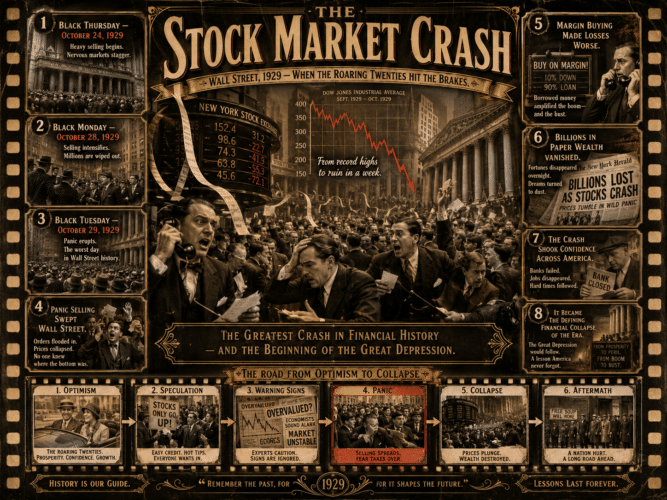
The collapse began on Thursday, October 24, 1929, when the stock market opened to a wave of panic selling. Bankers attempted to stabilize prices by publicly purchasing large blocks of stock, as J.P. Morgan Sr. had done during the Panic of 1907. The intervention worked temporarily. On Monday, October 28, the market fell 13%. On Tuesday, October 29 — “Black Tuesday” — it fell another 12%. Ticker machines fell hours behind trading as the volume overwhelmed the technology. Crowds gathered outside the New York Stock Exchange. Fortunes accumulated over years evaporated in hours.
The crash alone did not cause the Great Depression. It triggered a credit contraction, bank failures, and a collapse of consumer spending that together produced the economic catastrophe. Over the following three years, the Dow Jones fell 89% from its September 1929 peak. Unemployment reached 25% by 1933. The banking system, which had no deposit insurance until 1933, failed nationwide.
Joe Kennedy — father of the future president — sold his entire stock portfolio before the crash after receiving stock tips from a shoeshine boy. He reasoned that when shoeshine boys were offering stock tips, the market had become too popular for its own good. He was correct.
William Durant, who had founded both General Motors and Chevrolet, lost his entire fortune in the crash. He died in 1947, largely bankrupt, managing a bowling alley in Flint, Michigan.
The St. Valentine’s Day Massacre
On February 14, 1929, seven members of the Bugs Moran gang were lined up against a garage wall at 2122 North Clark Street in Chicago and shot by men dressed as police officers. The killings were widely attributed to Al Capone’s organization, though Capone was in Florida at the time and was never charged. The massacre gave Capone effective control of Chicago’s bootlegging and gambling operations and made him the most notorious gangster in America.
Frank Gusenberg, one of the victims, was found with 14 bullet wounds when police arrived. He refused to identify his attackers, saying only “nobody shot me,” and died three hours later. The garage was subsequently used as a tourist attraction.
The First Academy Awards
The 1st Academy Awards were presented on May 16, 1929, at the Blossom Room of the Hollywood Roosevelt Hotel, hosted by actor Douglas Fairbanks. The ceremony lasted approximately 15 minutes. About 270 people attended. The winners had been announced in advance — on the back page of the Academy’s newsletter — so there was no suspense. The films honored were from the 1927-28 period.
Wings, a silent World War I aerial combat film, won Outstanding Picture — the only silent film ever to win Best Picture. Sunrise won the short-lived Unique and Artistic Production award, which was discontinued after the first year. Emil Jannings won Best Actor. Janet Gaynor won Best Actress for performances in three separate films. The word “Oscar” had not yet been coined. The term reportedly originated a few years later, though the exact origin is disputed.
Rumors circulated that MGM studio head Louis B. Mayer had influenced the outcome. They have circulated around the Academy Awards ever since.
Pop Culture Facts and History
The Cocoanuts was the Marx Brothers’ first film, released in 1929, adapted from their 1925 Broadway show. Groucho, Harpo, Chico, and Zeppo brought their anarchic stage comedy to the screen at a moment when sound had just transformed movies. The timing was fortuitous. Their rapid-fire wordplay, physical comedy, and systematic destruction of narrative logic were perfectly suited to sound film.
Blackmail, directed by Alfred Hitchcock and released June 21, 1929, was the first British sound film. While directing it, Hitchcock made what is cited as the first recorded use of “that’s what she said” — or more precisely, its ancestor: “as the girl said to the soldier.” The joke was 90 years ahead of its mainstream moment.
Popeye the Sailor made his first appearance in the King Features comic strip Thimble Theatre on January 17, 1929. The strip had been running since 1919, focused on other characters, primarily Olive Oyl and her family. Popeye was introduced as a one-shot character for a single storyline. Reader response was so strong that he gradually took over the strip entirely. Spinach consumption among American children reportedly increased significantly after the launch of the animated series Popeye in 1933.
Mickey Mouse spoke for the first time in the short film The Karnival Kid in 1929. His first words were “Hot dogs!” He was the first cartoon character to speak in a synchronized sound film. Walt Disney provided the voice.
The Museum of Modern Art opened to the public on November 7, 1929 — two weeks after the stock market crash — in rented rooms in the Heckscher Building in Midtown Manhattan. Its founding director was Alfred Barr, who was 27 years old. MoMA’s opening collection included work by Cézanne, Gauguin, Seurat, and van Gogh. It moved to its current location on 53rd Street in 1939.
Vatican City became an independent sovereign state on February 11, 1929, when Italy and the Holy See signed the Lateran Treaty, resolving a dispute that had left the papacy in effective self-imposed isolation since 1870. The entire state occupies 110 acres within the city of Rome, the smallest internationally recognized independent state in the world by both area and population.
The Graf Zeppelin — the German rigid airship LZ 127 — completed the first round-the-world flight in August 1929, departing from Lakehurst, New Jersey, on August 8 and returning on August 29 after 21 days, 7 hours, and 34 minutes. The journey covered over 21,500 miles and included the first nonstop transpacific crossing by any aircraft, from Japan to Los Angeles. Approximately one million people lined the route in various countries to watch it pass overhead.
Frozen foods were introduced to the American public in 1929 by Clarence Birdseye, who had developed his “flash freezing” technique after observing how Inuit people in Labrador preserved fish in extreme cold. Birdseye’s General Foods company launched a line of frozen meats, fish, vegetables, and fruits in Springfield, Massachusetts. The technology transformed American food distribution and eating habits over the following decades.
Sunglasses were mass-produced for the first time in 1929, when Sam Foster began selling inexpensive celluloid glasses on the Atlantic City boardwalk under the Foster Grant brand. Before 1929, protective eyewear had been expensive and uncommon outside specific professions. Foster’s boardwalk experiment demonstrated that ordinary people would spend 25 cents to protect their eyes from the sun.
The car radio was introduced by Motorola in 1929, though it did not go on commercial sale until 1930. Early models required installation by a mechanic and cost $120 — about a fifth of the price of a new car. The name “Motorola” combined “motor” and “Victrola,” the dominant home audio brand of the era.
7-Up was invented in 1929, originally called “Bib-Label Lithiated Lemon-Lime Soda” — a name with some commercial limitations. The original formula contained lithium citrate, a mood-stabilizing compound. The lithium was removed in 1950. The name was simplified to 7-Up in 1936. The original selling point of a mood-enhancing soft drink has not been revived.
Bingo was popularized in the United States in 1929 by Edwin Lowe, a New York toy salesman who came across a carnival game called “Beano” in Atlanta — players covered numbers on a card with beans as a caller drew them randomly. Lowe brought it back to New York and played it with friends. During one session, an excited winner called out “Bingo!” instead of “Beano” by mistake. Lowe kept the name and commissioned a mathematician to develop 6,000 unique card combinations to prevent multiple simultaneous winners. The game spread across the country within a year.
The countdown — the sequence of counting backward from a number to zero to signal the launch of something — was first used in Fritz Lang’s 1929 science fiction film Frau im Mond (Woman in the Moon), where it was invented purely for dramatic effect. The rocket scientists who later designed actual launch procedures adopted it because it worked. Every rocket launch countdown since derives from a 1929 film technique.
The practice of identifying baseball players by jersey numbers was introduced by the New York Yankees in 1929, with numbers initially corresponding to the players’ positions in the batting order. The Cleveland Indians followed suit the same season. Numbers were worn on jerseys by most teams within a few years and became universal by 1937.
Amos’n ‘n Andy debuted on NBC Blue radio on August 19, 1929, and almost immediately became the most popular program in the country. Theaters in some cities dared not open until the 15-minute show had ended. The program ran in various formats for 32 years. Its racial stereotypes became increasingly controversial, and it was canceled from television in 1953 under pressure from civil rights organizations.
Music and the Spoken Word, a religious broadcast by the Tabernacle Choir at Temple Square in Salt Lake City, debuted on July 15, 1929. It has broadcast every week without interruption, making it the longest-running continuous network radio program in the world — over 4,400 weekly broadcasts by the time this page was written.
The word “zombie” entered Western popular culture through W.B. Seabrook’s 1929 book The Magic Island, in which he described Haitian Vodou practices and the concept of the undead. The word and concept spread quickly into American horror fiction and eventually into every corner of popular culture.
The term “blue chip,” for high-value stocks, was first used in 1929, borrowing from poker’s high-value blue chips. It entered common financial vocabulary at approximately the moment the stocks it described collapsed.
Admiral Richard Byrd and his crew became the first people to fly over the South Pole on November 29, 1929, departing from their base at Little America, Antarctica. The flight lasted about 19 hours.
The Lateran Treaty, which established Vatican City, also resolved a fundamental question about the Pope’s status in Rome that had existed since 1870. Pope Pius XI had not left the Vatican compound in 59 years as a form of protest against the Italian state’s seizure of papal territories. On July 25, 1929, following the treaty, he emerged into St. Peter’s Square for the first time before approximately 250,000 people.
Princeton researchers succeeded in transmitting sound through a live cat in 1929 by using its cochlear membranes as a telephone receiver component. The experiment demonstrated the sensitivity of the auditory system and produced one of the stranger footnotes in the history of telecommunications. The cat survived.
An estimated 90% of all American films made before 1929 were lost — destroyed for their silver content, burned in studio fires, or simply discarded because no one considered them worth preserving. The early history of cinema exists largely as descriptions and still photographs of films no living person has seen.
The Geneva Convention relative to the treatment of prisoners of war was signed on July 27, 1929, establishing international standards for the humane treatment of captured combatants. It was the foundation of the laws of war governing military conflict for the rest of the century.
Nobel Prize Winners
Physics — Louis de Broglie for his discovery of the wave nature of electrons, which established the dual particle-wave nature of matter and became foundational to quantum mechanics
Chemistry — Arthur Harden and Hans von Euler-Chelpin for their investigations on the fermentation of sugar and fermentative enzymes, work foundational to understanding metabolism
Medicine — Christiaan Eijkman and Sir Frederick Gowland Hopkins for their discovery of antineuritic vitamins (Eijkman) and for his discovery of the growth-stimulating vitamins (Hopkins); their work established the field of nutritional science and explained diseases like beriberi and scurvy that had killed millions throughout history
Literature — Thomas Mann, a German novelist, for Buddenbrooks and The Magic Mountain, for principally for his great novel Buddenbrooks, which has won steadily increased recognition as one of the classic works of contemporary literature
Peace — Frank Billings Kellogg, former U.S. Secretary of State, for co-authoring the Kellogg-Briand Pact of 1928, an international agreement outlawing war as a means of national policy; 62 nations eventually signed it; World War II began ten years later
Broadway in 1929
Show Boat opened in December 1927, ran through 1929, and remained the dominant musical of the era, establishing the template for the integrated American musical with its serious treatment of race and its score by Jerome Kern and Oscar Hammerstein II.
Fifty Million Frenchmen opened November 27, 1929, at the Lyric Theatre with music and lyrics by Cole Porter. It ran for 254 performances and included “You Do Something to Me,“ which became a standard.
Top Movies of 1929
- The Broadway Melody
- The Cocoanuts
- Hallelujah
- In Old Arizona
- The Hollywood Revue of 1929
- Innocents of Paris
- The Desert Song
- Blackmail
- Pandora’s Box
- Bulldog Drummond
Hollywood was in full transition from silent to sound film in 1929. Studios that had resisted the change were now racing to catch up. Many silent film stars found that their careers ended because their voices did not match audience expectations. Others, like Greta Garbo, whose first sound film debuted in 1930, thrived. The year’s films ranged from all-talking musicals to late-silent masterworks — a medium in the midst of reinventing itself.
Popular and Best-Selling Books of 1929
A Farewell to Arms — Ernest Hemingway
All Quiet on the Western Front — Erich Maria Remarque
The Bishop Murder Case — S.S. Van Dine
Dodsworth — Sinclair Lewis
Red Harvest — Dashiell Hammett
The Sound and the Fury — William Faulkner
All Quiet on the Western Front sold 2.5 million copies in Germany in its first year — the fastest-selling book in German publishing history. Remarque had fought in World War I at age 18. The novel’s unflinching portrayal of the war’s futility and horror made it an instant international sensation and an eventual target for Nazi book burnings in 1933.
The Sound and the Fury by William Faulkner, published on October 7, 1929, told the same story four times from four different perspectives, one of which was a character with a mental disability. It sold modestly at first. It is now considered one of the greatest American novels of the 20th century.
Biggest Pop Artists of 1929
Al Jolson, Paul Whiteman, Rudy Vallee, Gene Austin, Eddie Cantor, Cliff Edwards, Ruth Etting, Libby Holman, Helen Kane, Ted Lewis, Nick Lucas, Ethel Waters, Ted Weems, Gus Arnheim
Sports Champions of 1929
World Series: Philadelphia Athletics defeated the Chicago Cubs 4-1; the Athletics trailed 8-0 in Game 4, before scoring 10 runs in the bottom of the seventh inning, one of the most stunning comebacks in World Series history
Stanley Cup: Boston Bruins, defeated the New York Rangers 2-0
U.S. Open Golf: Bobby Jones, one of five major championships he won in 1929-30, leading to the Grand Slam
U.S. Open Tennis: Men/Women: Bill Tilden / Helen Wills
Wimbledon: Men/Women: Henri Cochet / Helen Wills
NCAA Football Champions: Notre Dame
Kentucky Derby: Clyde Van Dusen
Boston Marathon: Johnny Miles, 2:33:08
Sports Highlight: Babe Ruth hit his 500th career home run on August 11, 1929, becoming the first player in Major League Baseball history to reach that milestone. Bobby Jones was in the middle of what became the most dominant period of individual performance in golf history — he won the U.S. Open in 1929 and in 1930 completed the Grand Slam, winning all four major championships in the same calendar year, a feat that has never been equaled.
FAQ — 1929 Trivia, Fun Facts, and Pop Culture History
Q: What caused the Wall Street Crash of 1929?
A: A combination of speculative excess, overvalued stocks purchased heavily on margin, and a collapse of confidence that turned selling into panic. The crash began on October 24 and peaked on October 29, erasing more than $30 billion in market value — ten times the federal annual budget. It triggered credit contraction, bank failures, and a deflationary spiral that became the Great Depression.
Q: What was the St. Valentine’s Day Massacre?
A: On February 14, 1929, seven members of the Bugs Moran gang were executed in a Chicago garage by men dressed as police officers, in a killing widely attributed to Al Capone’s organization. Frank Gusenberg, who survived with 14 bullet wounds for three hours, refused to name his attackers. The massacre effectively ended Moran’s control of Chicago bootlegging.
Q: Who was born on January 15, 1929?
A: Martin Luther King Jr., in Atlanta, Georgia. He led the Montgomery Bus Boycott in 1955, delivered the “I Have a Dream” speech in 1963, received the Nobel Peace Prize in 1964, and was assassinated in Memphis in 1968.
Q: What was the first sound film directed by Alfred Hitchcock?
A: Blackmail (1929), originally shot as a silent film and then partially reshot with sound. While making it, Hitchcock used a phrase cited as the earliest recorded version of “that’s what she said.”
Q: When did Mickey Mouse first speak?
A: In the 1929 short The Karnival Kid, in which he said “Hot dogs!” He was the first cartoon character with synchronized speech.
Q: What film introduced the countdown to zero?
A: Fritz Lang’s 1929 science fiction film Frau im Mond (Woman in the Moon) introduced the backward countdown for dramatic effect. Real rocket programs later adopted it because it worked.
Q: What soft drink contained lithium when it was invented in 1929?
A: 7-Up, originally called “Bib-Label Lithiated Lemon-Lime Soda.” The lithium citrate was removed from the formula in 1950.
Q: When did Vatican City become an independent state?
A: February 11, 1929, through the Lateran Treaty signed between Italy and the Holy See, resolving a dispute dating to 1870. Vatican City occupies 110 acres within Rome and is the smallest independent state in the world.
More 1929 Facts & History Resources:
Most Popular Baby Names (BabyCenter.com)
Popular and Notable Books (popculture.us)
Broadway Shows that Opened in 1929
1929 Calendar, courtesy of Time and Date.com
Fact Monster
1920s Fads (BabyCenter.com)
1920s, Infoplease.com World History
1929 in Movies (according to IMDB)
Retrowaste Vintage Culture
1920s Slang
Wikipedia 1929