

1911 Trivia, Fun Facts, and Pop Culture History
Quick Facts from 1911
- World-Changing Event: The Triangle Shirtwaist Factory fire in New York City on March 25, 1911, killed 146 workers — mostly young immigrant women — and became the defining catalyst for American labor law, workplace safety regulations, and the modern labor movement
- Other World-Changing Event: Roald Amundsen and his Norwegian expedition reached the South Pole on December 14, 1911, becoming the first humans in history to do so
- Top Songs: Alexander’s Ragtime Band by Arthur Collins and Byron G. Harlan, Some of These Days by Sophie Tucker, and Come Josephine in My Flying Machine by Ada Jones and Billy Murray
- Must-See Movies: Dante’s Inferno, The Lonedale Operator, and Richard III — the oldest surviving American feature-length film
- Notable Books: The Secret Garden by Frances Hodgson Burnett and Of Human Bondage by W. Somerset Maugham (published in installments)
- First-class stamp: 2 cents; gallon of gas: approximately 16 cents; average annual household income: $750
- Chinese Zodiac: Year of the Pig, associated with generosity, good luck, and an honest appreciation for life’s pleasures
- The Conversation: Did you hear about the Triangle fire? They locked the doors.
Top Ten Baby Names of 1911
Girls: Mary, Helen, Margaret, Dorothy, Ruth Boys: John, William, James, George, Robert
U.S. Life Expectancy in 1911
Males: 50.9 years; Females: 54.4 years
We Lost in 1911
Gustav Mahler, an Austrian composer and conductor, one of the greatest symphonists in the Western tradition, died May 18, 1911, at age 50, of bacterial endocarditis. He left his 10th Symphony unfinished. Several composers have attempted completions since. None has fully satisfied the argument about what he intended.
W.S. Gilbert, the librettist half of Gilbert and Sullivan, whose comic operas H.M.S. Pinafore, The Pirates of Penzance, and The Mikado defined Victorian entertainment, died May 29, 1911, at age 74, while attempting to rescue a young woman from drowning in a lake on his estate. He succeeded. The effort killed him.
Joseph Pulitzer — newspaper publisher, founder of the New York World, and the man whose endowment established the Pulitzer Prizes for journalism and the arts- died on October 29, 1911, at age 64.
Born in 1911
Ronald Reagan — born February 6, 1911, in Tampico, Illinois. He became a Hollywood actor, president of the Screen Actors Guild, Governor of California, and the 40th President of the United States. In 1911, none of that was imaginable.
America in 1911 — The Context
William Howard Taft was president, navigating the middle of a single term between two Roosevelt administrations — Theodore’s before him and the ghost of one after him. The Progressive Era was reshaping American politics, with reformers pushing for antitrust enforcement, labor protections, women’s suffrage, and the direct election of senators. The economy was industrializing rapidly, immigration was transforming American cities, and the gap between industrial wealth and working-class poverty was producing real political pressure. The Triangle Shirtwaist fire made that pressure impossible to ignore.
The Triangle Shirtwaist Factory Fire
On March 25, 1911, fire broke out on the upper floors of the Triangle Shirtwaist Company building in Greenwich Village, New York City. The building had no sprinkler system. The stairwell doors had been locked by management to prevent workers from taking unauthorized breaks or stealing fabric scraps. Workers on the eighth, ninth, and tenth floors had only two exits — one locked, one already engulfed in flame. Some jumped from windows. Others burned. When it was over, 146 workers were dead. The youngest was 14 years old. Most were young immigrant women from Italy and Eastern Europe.
The owners were charged with manslaughter. The jury acquitted them. A civil suit resulted in $75 in damages per deceased victim.
The fire transformed American labor politics. It galvanized the International Ladies’ Garment Workers’ Union, led directly to the creation of the New York Factory Investigating Commission, and produced 36 new laws governing factory safety, working hours, and child labor within three years. Frances Perkins, who witnessed the fire from the street, went on to become Franklin Roosevelt’s Secretary of Labor and the architect of many New Deal labor protections. She cited that afternoon on Washington Place as the moment she understood what her work had to be.
The South Pole
On December 14, 1911, Norwegian explorer Roald Amundsen and four companions planted the Norwegian flag at 90 degrees south latitude, becoming the first humans to reach the South Pole. They had traveled 1,400 miles by dog sled from their base camp on the Ross Ice Shelf. The journey took 99 days. They arrived back safely.
British explorer Robert Falcon Scott reached the South Pole 34 days later, on January 17, 1912, only to find Amundsen’s flag already there. Scott and all four of his companions died on the return journey.
The First Indianapolis 500
The inaugural Indianapolis 500 was held on May 30, 1911, at the newly constructed Indianapolis Motor Speedway. Ray Harroun won, driving his Marmon Wasp at an average speed of 74.6 miles per hour over 500 miles. Harroun was the only driver in the race without a riding mechanic, whose job was to watch for cars overtaking. His solution was to mount a small mirror on his car’s cowling so he could see behind him. It was the first documented use of a rear-view mirror on an automobile. He won.
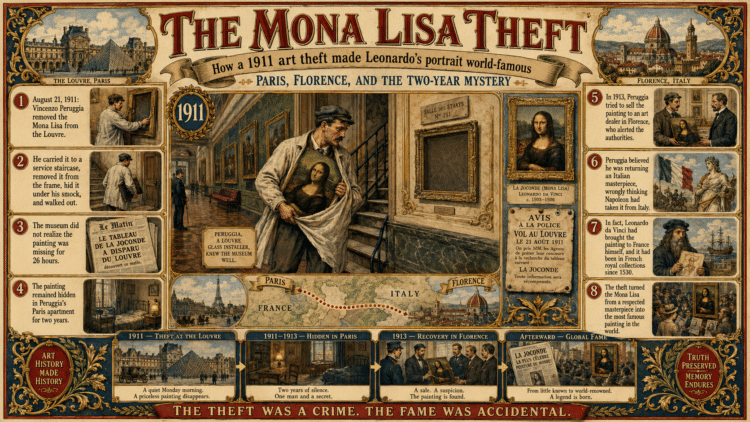
The Mona Lisa Theft
On August 21, 1911, Vincenzo Peruggia walked into the Louvre, lifted the Mona Lisa off the wall, carried it to a service staircase, removed it from its frame, hid it under his smock, and walked out. Security did not notice the painting was missing for 26 hours. It sat in Perugia’s Paris apartment for two years before he attempted to sell it to an art dealer in Florence, who then alerted the authorities.
Perugia believed he was returning a stolen masterpiece to Italy, under the mistaken impression that Napoleon had taken it. Napoleon had not — Leonardo da Vinci had brought the painting to France himself, and it had been in French royal collections since 1530. The theft inadvertently made the Mona Lisa world-famous. Before 1911, it was considered a significant work but not particularly more celebrated than dozens of others in the Louvre. The two-year mystery turned it into the most famous painting in the world.
Pop Culture Facts and History
Morton Salt began adding magnesium carbonate to its product in 1911 to prevent caking in humid conditions. The tagline “When it rains, it pours” followed naturally. It remains one of the most recognized slogans in American brand history.
Crisco vegetable shortening was introduced by Procter & Gamble in 1911, marketed as a pure, all-vegetable alternative to lard. It was one of the first mass-produced hydrogenated vegetable products and transformed American home baking. The health implications of hydrogenated fats were not yet understood and would not be for several decades.
The world’s first official airmail flight took place on February 18, 1911, when Henri Pequet flew 6,500 letters 13 kilometers from Allahabad to Naini in British India. The flight lasted approximately 13 minutes. Organized airmail service followed within a few years.
The first airplane to land on a ship did so on January 18, 1911, when aviator Eugene Ely landed a Curtiss pusher biplane on a wooden platform constructed over the deck of the USS Pennsylvania in San Francisco Bay. He took off again successfully. The U.S. Navy took careful note.
Samuel J. Battle became the first Black police officer in New York City in 1911, appointed despite significant resistance from within the department. He went on to become a sergeant, a parole commissioner, and one of the most respected figures in New York law enforcement.
Parks Canada was established on May 19, 1911, as the Dominion Parks Branch — the world’s first national park service. Canada created the institutional model that the United States and other countries later adopted.
The US House of Representatives was fixed at 435 seats in 1911 by the Apportionment Act, when the U.S. population was 94 million. The cap has not changed since. The U.S. population has since grown past 330 million, meaning each representative now serves roughly three times as many constituents as in 1911. The math has become a recurring subject of debate.
George Selden, a patent lawyer, had held a remarkably broad patent on the gasoline-powered automobile since 1895, collecting royalties from virtually every American car manufacturer without ever building a functioning vehicle himself. Henry Ford challenged the patent in court. In 1911, a federal court of appeals ruled that Selden’s patent only applied to cars using the specific two-cycle engine described in the original filing, which no manufacturer actually used. Selden had collected royalties for 16 years on a patent that turned out to cover almost nothing.
China banned the practice of foot binding in 1911 following the Xinhai Revolution, which ended over 2,000 years of imperial rule. The custom had been practiced for roughly a thousand years, beginning in the 10th-century Song Dynasty, and had affected an estimated one billion women over its history. Enforcement of the ban was gradual and uneven, particularly in rural areas, but the revolution marked its official end.
The US House of Representatives rejected a proposal to give women the right to vote on January 12, 1911. Women would not receive the vote nationally for another nine years.
A series of boys’ adventure novels featuring a young inventor named Tom Swift was enormously popular in the early 1910s. One, Tom Swift and His Electric Rifle (1911), described a handheld weapon that fired electrical charges. Decades later, when inventor Jack Cover developed a conducted-energy weapon for law enforcement, he named it after the fictional device: the TASER, standing for “Tom A. Swift Electric Rifle.”
Hugo Gernsback published his science fiction novel Ralph 124C 41+ in 1911. The book accurately predicted television, videophones, commercial aviation, solar energy, sound film, synthetic fabrics, tape recorders, and spaceflight. It also contained the first accurate technical description of radar, which would not be demonstrated in practice for another 24 years.
Pittsburgh had been officially spelled “Pittsburg” — without the final ‘h’ — from 1891 to 1911, following a U.S. Board on Geographic Names standardization ruling. The city fought the change for two decades and finally got the ‘h’ restored in 1911. The citizens of Pittsburgh have spelled it correctly ever since and have been quietly annoyed by the whole episode.
The bear depicted on the California state flag was modeled after a real grizzly bear named Monarch, who lived in captivity in California and died in 1911. He was the last grizzly bear known to exist in California. The California grizzly was declared extinct in 1922.
The fastest temperature drop in recorded history occurred in Rapid City, South Dakota, on January 10, 1911, when the temperature fell 49 degrees Fahrenheit in just 15 minutes. Residents experienced this firsthand and did not enjoy it.
In 1911, the United States endured one of the coldest winters on record. Niagara Falls froze solid enough for people to walk across it. Photographs exist and remain impressive.
The 11th Edition of the Encyclopaedia Britannica was published in 1911 — 29 volumes covering the full state of human knowledge at the time. It is still considered one of the greatest reference works ever assembled, written by leading scholars in every field. It is now in the public domain and freely available online, which would have seemed miraculous to its editors.
Paul Geidel was convicted of second-degree murder in 1911, at age 17, for killing a 73-year-old man in a New York hotel. He served 68 years and 245 days in prison — the longest documented prison sentence in American history. He was offered parole after 63 years, but voluntarily chose to remain incarcerated. He was finally released in 1980 at age 86, having spent nearly his entire life in prison.
A colony of Adelie penguins in Antarctica was observed by explorer George Murray Levick during the 1910-1913 British Antarctic Expedition, displaying behaviors that Levick could only describe, in shocked terms, as homosexual and necrophilic activity. His findings were considered too indecent for publication and were suppressed. The notes were finally published in full in 2012, 101 years later. The penguins were unavailable for comment.
The mummified body of outlaw Elmer McCurdy, who died in a shootout in 1911, was embalmed by a funeral home that could not locate his next of kin and subsequently rented him out as a sideshow attraction. His body passed through various carnivals and traveling shows for over 60 years before ending up as a prop in a funhouse at the Nu-Pike amusement park in Long Beach, California. In 1976, a film crew for The Six Million Dollar Man discovered the “prop” was an actual human corpse when an arm broke off, revealing bone and muscle tissue. McCurdy was finally identified and given a proper burial in Guthrie, Oklahoma, in 1977.
The federal court case United States v. Forty Barrels and Twenty Kegs of Coca-Cola was filed in 1911. The government’s case, backed by religious reformers, argued that caffeine in Coca-Cola was harmful and was causing moral transgression. The case was eventually settled. Coca-Cola reduced its caffeine content slightly. The forty barrels and twenty kegs remained in federal custody throughout.
Richard III, a 1911 film adaptation of Shakespeare’s play, became the oldest surviving American feature-length film when a former projectionist donated an intact copy to the American Film Institute in 1996. It had been considered lost since the 1920s. Its survival was accidental. Its rediscovery was extraordinary.
IBM was founded on June 16, 1911, in New York, initially named the Computing-Tabulating-Recording Company. It adopted the name International Business Machines in 1924.
Nobel Prize Winners
Physics — Wilhelm Wien — for his work on thermal radiation and the laws governing the emission of radiation from black bodies
Chemistry — Marie Sklodowska-Curie — for the discovery of radium and polonium; her second Nobel Prize, making her the first person to win the award twice and the only person to win it in two different scientific disciplines
Medicine — Allvar Gullstrand — for his work on the dioptrics of the eye, specifically the mathematical model of how the eye focuses light
Literature — Count Maurice Maeterlinck — Belgian playwright, best known for The Blue Bird
Peace — Tobias Asser and Alfred Hermann Fried — for work in international arbitration and the promotion of world peace through international law
Broadway in 1911
The Pink Lady opened March 13, 1911, and ran for 312 performances at the New Amsterdam Theatre, becoming one of the biggest hits of the season. Its score by Ivan Caryll included the waltz My Beautiful Lady, which became one of the most performed songs of the year.
Little Boy Blue and various other operettas and revues filled Broadway in 1911, a year in which the form still dominated the commercial theater before the American musical had fully developed its own identity.
Top Movies of 1911
- Dante’s Inferno
- The Lonedale Operator
- Richard III
- The Last Drop of Water
- Comrades
- The Villain Foiled
- The Manicure Lady
- The Baron
- Enoch Arden
- His Trust
Popular and Best-Selling Books of 1911
The Broad Highway — Jeffrey Farnol
The Prodigal Judge — Vaughan Kester
The Winning of Barbara Worth — Harold Bell Wright
Queed — Henry Sydnor Harrison
The Harvester — Gene Stratton-Porter
The Iron Woman — Margaret Deland
The Long Roll — Mary Johnston
Molly Make-Believe — Eleanor Abbott
The Rosary — Florence Barclay
The Common Law — Robert W. Chambers
The Secret Garden — Frances Hodgson Burnett
Principles of Scientific Management — F.W. Taylor
The Mind of Primitive Man — Franz Boas
Zuleika Dobson — Max Beerbohm
Biggest Pop Artists of 1911
The American Quartet, Henry Burr, Albert Campbell, Enrico Caruso, Arthur Collins, Byron G. Harlan, Victor Herbert and His Orchestra, Ada Jones, Fritz Kreisler, The Lyric Quartet, Harry Macdonough, John McCormack, Reed Miller, Eddie Morton, Billy Murray, Will Oakland, The Peerless Quartet, Prince’s Orchestra, Blanche Ring, Sophie Tucker, Walter Van Brunt, Reinald Werrenrath
Sports Champions of 1911
World Series: Philadelphia Athletics — defeated the New York Giants 4-2; pitcher Chief Bender and Eddie Collins were the stars of a dominant Athletics team managed by Connie Mack
Challenge Cup (Stanley Cup precursor): Ottawa Hockey Club
U.S. Open Golf: John McDermott — the first American-born player to win the U.S. Open, at age 19, still the youngest U.S. Open champion in history
U.S. Open Tennis: Men/Women: William Larned / Hazel Hotchkiss
Wightman Wimbledon: Men/Women: Anthony Wilding / Dorothea Lambert Chambers
NCAA Football Champions: Princeton and Penn State (co-champions)
Kentucky Derby: Meridian
Boston Marathon: Clarence DeMar, 2:21:39
Sports Highlight: John McDermott’s U.S. Open win in 1911 at age 19 broke a long streak of British dominance in American golf’s most prestigious event. He remains the youngest U.S. Open champion ever. Clarence DeMar’s Boston Marathon win in 1911 launched one of the most remarkable distance running careers in American history — he would go on to win the race seven times, his last victory coming in 1930 at age 41.
Note: The source data listed Wimbledon men’s champion as Laurence Doherty, who had retired from competitive tennis by 1906. The 1911 Wimbledon men’s singles title was won by Anthony Wilding of New Zealand.
FAQs: 1911 History, Facts, and Trivia
Q: What was the most consequential event in American labor history in 1911?
A: The Triangle Shirtwaist Factory fire on March 25, 1911, killed 146 workers, mostly young immigrant women, when locked doors and a lack of fire safety equipment trapped them on the upper floors. The public outrage led directly to sweeping labor law reforms in New York and influenced federal workplace safety legislation for decades.
Q: Who stole the Mona Lisa in 1911, and how?
A: Vincenzo Peruggia, an Italian handyman who had previously worked at the Louvre, walked in during public hours, removed the painting from the wall, tucked it under his smock, and walked out. It was missing for two years before he was caught trying to sell it in Florence. The theft inadvertently made the painting the most famous in the world.
Q: Who reached the South Pole first in 1911?
A: Norwegian explorer Roald Amundsen, who arrived on December 14, 1911, with four companions after a 99-day journey by dog sled. British explorer Robert Falcon Scott arrived 34 days later, only to find Amundsen’s flag. Scott and his entire party died on the return journey.
Q: What was the first Indianapolis 500, and what innovation did it produce?
A: The inaugural Indy 500 was held on May 30, 1911. Winner Ray Harroun mounted a small mirror on his car to see traffic behind him without a riding mechanic — the first documented use of a rear-view mirror on an automobile.
Q: What Nobel Prize milestone occurred in 1911?
A: Marie Curie won her second Nobel Prize, in Chemistry, for the discovery of radium and polonium. She became the first person to win the Nobel Prize twice and the only person to win it in two different scientific disciplines.
Q: What was the TASER named after, and what is the connection to 1911?
A: The TASER was named after Tom Swift and His Electric Rifle, a 1911 boys’ adventure novel in which the young inventor creates a handheld weapon firing electrical charges. Inventor Jack Cover used the acronym: Tom A. Swift Electric Rifle.
Q: What patent was overturned in 1911 that freed the American automobile industry?
A: The Selden patent, held by lawyer George Selden since 1895, which had claimed broad rights over gasoline-powered automobiles. Selden collected royalties for 16 years without ever building a working car. A 1911 appeals court ruled that the patent applied only to a specific two-cycle engine that no manufacturer was actually using, effectively invalidating it.
More 1911 Facts & History Resources:
Most Popular Baby Names (BabyCenter.com)
Popular and Notable Books (popculture.us)
Broadway Shows that Opened in 1911
1911 Calendar, courtesy of Time and Date.com
Fact Monster
1911 in Movies (according to IMDB)
Wikipedia 1911


