

1901 History, Facts, and Trivia
Quick Facts from 1901
- World Changing Event: President William McKinley was shot on September 6 at the Pan-American Exposition in Buffalo, New York, and died on September 14. Theodore Roosevelt — age 42, the youngest president in American history — was sworn in on the same day. America’s entire trajectory changed in eight days.
- Popular Songs: I Love You Truly, Mighty Lak’ a Rose, and Hiawatha
- Most Famous American: Theodore Roosevelt, by September 14
- U.S. Life Expectancy: Males 47.6 years; Females 50.6 years
- The First Nobel Prizes were awarded in 1901, the year Alfred Nobel had specified in his 1895 will
- The Conversation: Would the new president be as easy for corporate interests to manage as McKinley had been? The answer, delivered almost immediately, was no.
Top Ten Baby Names of 1901
Girls: Mary, Helen, Anna, Margaret, Ruth, Elizabeth, Florence, Ethel, Emma, Marie
Boys: John, William, James, George, Charles, Robert, Joseph, Frank, Edward, Walter
The Stars
Lillian Russell, the most famous actress and beauty of the era. Anna Held, Florenz Ziegfeld’s girlfriend and the inspiration for the Ziegfeld Follies. Vesta Victoria and Marie Lloyd, British music hall stars touring America.
The Quote
“I wish to preach, not the doctrine of ignoble ease, but the doctrine of the strenuous life.” — Theodore Roosevelt, defining his presidency before it began
“I am not sorry for my crime.” — Leon Czolgosz, final words before execution by electric chair, October 29, 1901
Predictions for America in 2001 (Made in 1901)
A Ladies’ Home Journal article from December 1900 predicted what life would look like in 100 years. Some highlights: There will be no C, X, or Q in the English alphabet. No more mosquitoes or flies. Strawberries as large as apples. University education free for everybody. Trains run at 150 miles per hour. Horses nearly extinct. Ready-cooked meals available for walk-in or car.
The train and fast-food predictions were reasonable. The rest, less so.
The Academy Awards, Time Magazine, Miss America
None existed in 1901. The Academy Awards began in 1929. Time magazine launched in 1923. The Miss America pageant started in 1921.
We Lost in 1901
Queen Victoria of Great Britain — died January 22, age 81, ending a reign of 63 years and 7 months — the longest of any British monarch to that point. Her death marked the end of the Victorian era as both a historical period and a cultural sensibility.
President William McKinley died September 14, at age 58, from gangrene following two gunshot wounds inflicted on September 6 at the Pan-American Exposition in Buffalo. He was the third U.S. president to be assassinated.
Henri de Toulouse-Lautrec, French Post-Impressionist painter, died September 9, age 36, from alcoholism and syphilis
Benjamin Harrison, 23rd President of the United States, died on March 13, age 67, from pneumonia
Giuseppe Verdi, Italian composer of Aida, Otello, and Falstaff, died January 27, age 87; the streets of Milan were covered in straw to muffle the sound of horses so as not to disturb his final days
The Assassination of President McKinley
On September 6, 1901, a deranged anarchist named Leon Czolgosz shot McKinley at the Pan-American Exposition in Buffalo, New York. McKinley was standing in a public receiving line in the Temple of Music, shaking hands with visitors. Czolgosz concealed his gun in a handkerchief, making it appear as though he had an injured hand.
McKinley was shot twice. One bullet was superficial; the other lodged in his abdomen. Surgeons operated but could not find the second bullet. McKinley initially appeared to recover. Then gangrene set in silently around the wound.
McKinley died on September 14, marking the third time a sitting U.S. president had been assassinated, following Abraham Lincoln in 1865 and James Garfield in 1881.
The jury deliberated for less than 30 minutes before returning a guilty verdict. Czolgosz was sentenced to death and executed in the electric chair at Auburn Prison on October 29, 1901. His final words were: “I am not sorry for my crime.”
McKinley’s death not only plunged the nation into mourning but also ushered in a new and transformative chapter in American leadership with the sudden ascension of Vice President Theodore Roosevelt.
An X-ray machine, then a new invention, was available at the Exposition specifically to demonstrate the technology. Doctors chose not to use it to locate the bullet, fearing the effects of unproven radiation. Had they used it, the bullet might have been found, and McKinley might have survived.
McKinley’s death directly prompted Congress to officially assign the Secret Service responsibility for presidential protection. Previously, presidential security had been informal and inconsistent.
Theodore Roosevelt Takes Office
Theodore Roosevelt unexpectedly became the 26th president of the United States in September 1901. Only 42 years old when he took office, he was the youngest president in the nation’s history, and his youth and vigor immediately transformed the public image of the presidency.
Roosevelt had been a cowboy, a soldier, a police commissioner, a naturalist, and a war hero. He had charged up San Juan Hill with the Rough Riders in the Spanish-American War in 1898. He had written 35 books. He had been shot in the chest while delivering a campaign speech in 1912, completed the speech anyway, and then went to the hospital. He was, by most accounts, genuinely extraordinary.
The Republican Party’s conservative establishment had placed him on the vice presidential ticket specifically to get him out of New York politics, where his reform tendencies were inconvenient. They called the vice presidency a dead end that would neutralize him. Within 18 months of McKinley’s assassination, Roosevelt had filed antitrust suits against the largest railroad monopoly in the country and invited Black leader Booker T. Washington to dine at the White House — the first time a Black American had been formally invited to dine with a president. Both acts caused national controversy. Roosevelt didn’t care.
On December 3, 1901, Roosevelt delivered his first annual message to Congress, asking for federal power to regulate corporations “within reasonable limits.” The trust-busting era had begun.
Pop Culture Facts and History
The world’s longest-burning light bulb was switched on at Fire Station No. 6 in Livermore, California, in 1901. It was a handblown carbon filament bulb manufactured by the Shelby Electric Company. As of this writing, it is still burning — over 120 years of continuous illumination. It has its own webcam.
The first Nobel Prizes were awarded on December 10, 1901 — the fifth anniversary of Alfred Nobel’s death, as he had specified in his will. The Physics Prize went to Wilhelm Conrad Röntgen for his discovery of X-rays in 1895. The Peace Prize was shared by Jean Henri Dunant, founder of the Red Cross, and Frédéric Passy, a French peace activist. The tradition of awarding prizes on December 10 continues to this day.
Annie Edson Taylor became the first person to survive going over Niagara Falls in a barrel on October 24, 1901 — her 63rd birthday. She had invented the stunt herself, padded the barrel with a mattress, and went over the Horseshoe Falls. She survived with only a small gash on her head. When she emerged, she reportedly said: “No one ought ever do that again.” She made almost no money from the stunt and died in poverty.
The Cadillac Motor Company was founded in 1901 in Detroit, named after Antoine de la Mothe Cadillac, the French explorer who had founded the city of Detroit in 1701. It was established using the assets and factory of Henry Ford’s failed Detroit Automobile Company. Henry Ford had left the company; his replacement was Henry Leland, who would build Cadillac into a luxury brand. Ford went on to do acceptably well elsewhere.
John W. Nordstrom and Carl F. Wallin opened a shoe store in Seattle in 1901 — the first Nordstrom. Nordstrom had made $13,000 in the Klondike Gold Rush and invested it in the store. The company has been family-owned for most of its history.
The United States Army Nurse Corps was established as a permanent part of the Army’s Medical Department in 1901, providing women with an official military role for the first time. They were not given full military rank or benefits for another four decades.
The College Board administered its first standardized admissions test in June 1901, covering nine subjects, including Latin, Greek, history, and mathematics. It was the predecessor to the SAT. The first exam was taken by 973 students. It was initially essay-based, not multiple choice.
The U.S. Secret Service was established in 1865 to combat counterfeit currency. It was not until McKinley’s assassination in 1901 that Congress officially expanded its mandate to include the protection of the president. Three presidents had now been assassinated; the country had finally decided this was a problem worth addressing formally.
Gustave Whitehead claimed to have flown a powered, controlled aircraft in Bridgeport, Connecticut, on August 14, 1901 — over two years before the Wright Brothers’ flight at Kitty Hawk. His claim was reported in a local newspaper. Whether the flight actually occurred remains disputed by aviation historians, with the Smithsonian Institution maintaining the Wright Brothers’ priority. Connecticut officially recognized Whitehead as the first in flight in 2013; the matter remains debated.
Abraham Lincoln’s coffin had been moved 17 times and opened six times since his first burial in 1865. The last time it was opened — September 26, 1901 — eyewitnesses reported his face was still recognizable, 36 years after his death, due to the embalming process used for his lying-in-state.
The last Passenger Pigeon in the wild was shot in 1901. The species had once darkened American skies in flocks estimated at billions — naturalist John James Audubon wrote of flocks that blocked the sun for three days as they passed. The last captive Passenger Pigeon, named Martha, died at the Cincinnati Zoo on September 1, 1914.
Since Abraham Lincoln’s coffin had been moved and opened multiple times, officials decided in 1901 to bury it permanently in a steel cage embedded in concrete beneath the Lincoln Tomb in Springfield, Illinois.
The tongue taste map — the idea that you taste sweet on the tip of your tongue, salty on the sides, and bitter at the back — is based on a misinterpretation of a single 1901 German scientific paper. The original paper by David P. Hänig actually suggested only subtle regional differences in sensitivity; subsequent researchers exaggerated and hardened these into a definitive “map.” The map was taught as fact for most of the 20th century. It is incorrect. Taste receptors are distributed throughout the tongue.
Charlotte Anne Moberly and Eleanor Jourdain claimed in 1901 to have experienced a time slip in the Palace of Versailles, encountering 18th-century gardens and a woman who they later believed was Marie Antoinette. Their account, published in 1911 as An Adventure, remains one of the most discussed alleged time-slip experiences in paranormal literature.
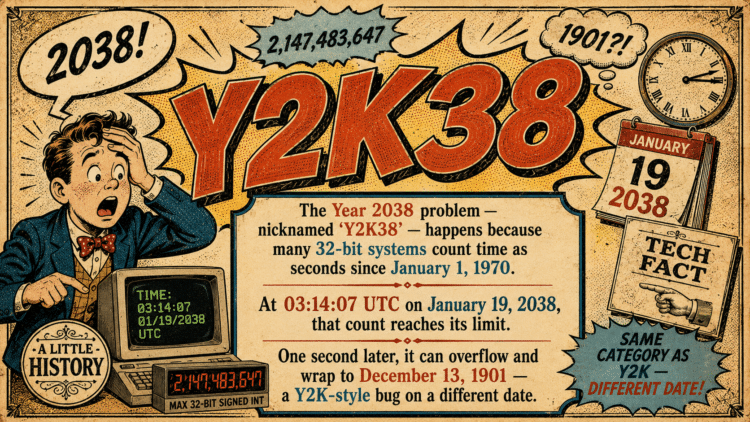
The Year 2038 Problem exists because many 32-bit computer systems track time as the number of seconds elapsed since January 1, 1901. On January 19, 2038, these systems will exceed their maximum value and roll back to 1901 — exactly the same category of problem as Y2K, but for a different date. It has been nicknamed “Y2K38.”
Blanche Monnier was rescued by French police in May 1901 after having been locked in a room by her mother for 25 years, since 1876, when she was 25 years old and had wanted to marry a man her mother disapproved of. When found, she weighed 55 pounds and was lying in a room described as indescribable by the officers. Her mother was convicted but died in prison shortly afterward.
Booker T. Washington published Up from Slavery in 1901, his autobiography describing his journey from slavery to founding the Tuskegee Institute. Roosevelt read it and invited Washington to dinner at the White House on October 16, 1901. The invitation caused a national uproar, particularly in the South. Roosevelt was unmoved.
Nikola Tesla received a patent for “Apparatus for the Utilization of Radiant Energy” in 1901, one of a series of patents for wireless electrical transmission. His ambitious Wardenclyffe Tower project — intended to provide global wireless electricity — was already under construction on Long Island. His financial backer, J.P. Morgan, would pull funding in 1903. The tower was never completed.
The Harvey Firestone tire company, the International Ladies’ Garment Workers’ Union, and Nordstrom were all founded within a year of each other, reflecting the industrial and commercial expansion of the early 1900s.
The aftermath of the Boxer Rebellion was still being settled in 1901. The Boxer Protocol, signed September 7, required China to pay 450 million silver taels to foreign powers over 39 years — an amount exceeding the Chinese government’s entire annual revenue. The United States later returned most of its share to fund scholarships for Chinese students.
The Horrible
Blanche Monnier, rescued May 1901 after 25 years of captivity — detailed above.
The assassination of President McKinley was the third presidential assassination in 36 years.
A mine explosion at Wellington Colliery Company in Cumberland, British Columbia, killed 64 miners.
Nobel Prize Winners
(First year Nobel Prizes were awarded — December 10, 1901)
Physics — Wilhelm Conrad Röntgen (for his discovery of X-rays in 1895)
Chemistry — Jacobus Henricus van ‘t Hoff (for discovering laws of chemical dynamics)
Medicine — Emil Adolf von Behring (for work on diphtheria and tetanus antitoxins)
Literature — Sully Prudhomme (French poet — a controversial choice; Tolstoy was widely expected to win)
Peace — Jean Henri Dunant and Frédéric Passy (Dunant had founded the Red Cross; Passy had founded France’s first peace society)
The omission of Tolstoy from the Literature Prize in 1901 — and every year until his death in 1910 — remains one of the Nobel Committee’s most criticized decisions.
Popular and Best-Selling Books of 1901
The Crisis — Winston Churchill (American novelist)
Alice of Old Vincennes — Maurice Thompson
The Helmet of Navarre — Bertha Runkle
The Right of Way — Gilbert Parker
Eben Holden — Irving Bacheller
The Visits of Elizabeth — Elinor Glyn
The Puppet Crown — Harold MacGrath
Richard Yea-and-Nay — Maurice Hewlett
Graustark — George Barr McCutcheon
Also notable: Up from Slavery by Booker T. Washington, Kim by Rudyard Kipling, The Octopus by Frank Norris, and Man and Superman by George Bernard Shaw.
Broadway in 1901
The Wild Rose and The Strollers were major musical hits of the season.
Florenz Ziegfeld was producing lavish shows featuring his girlfriend Anna Held, laying the groundwork for what would become the Ziegfeld Follies in 1907.
Vaudeville continued to dominate popular entertainment, with the Keith and Orpheum circuits booking performers into hundreds of theaters nationwide.
Top Short Films of 1901
(All films were very short — most under 5 minutes)
Scène de Ballet — early dance film
A Telephone Communication — Edison Manufacturing
Terrible Teddy, the Grizzly King — Edison Manufacturing (a satire of Theodore Roosevelt’s hunting exploits, released before he became president)
President McKinley’s Funeral — various producers (filmed and distributed within weeks of McKinley’s death)
Most Popular Entertainment of 1901
Vaudeville remained the dominant form of entertainment — an estimated 25 million Americans attended vaudeville performances annually by the early 1900s. John Philip Sousa’s band was on permanent tour, filling concert halls everywhere. Ragtime music was played in every saloon and parlor with a piano. Film was a novelty attraction within vaudeville shows; dedicated movie theaters were still three to four years away.
1901 Most Popular Songs
(Popularity tracked by sheet music sales — no formal recording chart existed)
I Love You Truly — Carrie Jacobs-Bond (one of the most popular wedding songs of the early 20th century)
Mighty Lak’ a Rose — Ethelbert Nevin
Hiawatha — Neil Moret
The Stars and Stripes Forever — John Philip Sousa
Because — Guy d’Hardelot
A Little Girl in Blue — various artists
Absence Makes the Heart Grow Fonder — Arthur Gillespie
Sports Champions of 1901
American League Baseball: Chicago White Sox (the AL’s first season as a major league)
National League Baseball: Pittsburgh Pirates
World Series: Not held in 1901 (first World Series was 1903)
Stanley Cup: Montreal Shamrocks
U.S. Open Golf: Willie Anderson
U.S. Open Tennis — Men: William Larned | Women: Elisabeth Moore
Wimbledon — Men: Arthur Gore | Women: Charlotte Sterry
NCAA Football: Michigan (undefeated, outscored opponents 550-0)
Kentucky Derby: His Eminence
Boston Marathon: John “Jack” Caffery — 2:29:23
Sports Highlight: In 1901, the University of Michigan football team was coached by Fielding Yost in his first year, going 11-0 and outscoring opponents 550-0 — the most lopsided season in college football history. They did not allow a single point. Michigan won the first Rose Bowl game on January 1, 1902.
FAQs: 1901 History, Facts, and Trivia
Q: Who was assassinated in 1901?
A: President William McKinley was shot on September 6 at the Pan-American Exposition in Buffalo, New York, by anarchist Leon Czolgosz. He died eight days later on September 14 from gangrene. He was the third U.S. president to be assassinated, following Lincoln in 1865 and Garfield in 1881.
Q: Who became president after McKinley?
A: Theodore Roosevelt, who was sworn in on September 14, 1901, at age 42, became the youngest president in American history. His youth and vigor immediately transformed the public image of the presidency. Encyclopedia.com
Q: When were the first Nobel Prizes awarded?
A: December 10, 1901 — the fifth anniversary of Alfred Nobel’s death, as he had specified in his will. The first Physics Prize was awarded to Wilhelm Röntgen for the discovery of X-rays. The first Peace Prize was shared by Jean Henri Dunant, founder of the Red Cross, and Frédéric Passy.
Q: Who was the first person to survive Niagara Falls in a barrel?
A: Annie Edson Taylor, who went over the Horseshoe Falls on October 24, 1901 — her 63rd birthday. She survived with a small cut on her head. She had invented the stunt herself to make money, made almost none from it, and spent her later years in poverty.
Q: What famous company was founded using Henry Ford’s old factory in 1901?
A: Cadillac Motor Company was established in 1901 using the assets of Ford’s failed Detroit Automobile Company. Henry Ford left to start a new venture. Cadillac, under Henry Leland, became one of America’s premier luxury car brands.
Q: What famous shoe store opened in 1901?
A: John W. Nordstrom and Carl F. Wallin opened their first shoe store in Seattle in 1901. Nordstrom had made $13,000 in the Klondike Gold Rush and invested it in retail. It became one of the largest department store chains in America.
Q: What was the first Nobel Peace Prize given for?
A: Shared between Jean Henri Dunant — who had founded the Red Cross after witnessing the horrific casualties at the Battle of Solferino in 1859 — and Frédéric Passy, who had founded France’s first peace society in 1867. Dunant had spent years in poverty before the prize; it restored his international reputation.
Q: What is the Year 2038 Problem?
A: Many 32-bit computer systems count time as seconds elapsed since January 1, 1901. On January 19, 2038, these systems will exceed their maximum value and roll back to 1901 — the same type of overflow problem as Y2K, but for 2038. It has been nicknamed “Y2K38.”
Q: What happened to the last Passenger Pigeon?
A: The last wild Passenger Pigeon was shot in 1901. The species had once been the most numerous bird in North America, with flocks estimated in the billions. Martha, the last captive Passenger Pigeon, died at the Cincinnati Zoo on September 1, 1914. The species declined from billions to zero in roughly 50 years due to hunting and habitat destruction.
Q: What famous light bulb was turned on in 1901?
A: The Centennial Bulb at Fire Station No. 6 in Livermore, California — a hand-blown carbon filament bulb installed in 1901 that has been burning almost continuously ever since, for over 120 years. It has its own webcam at centennialbulb.org.
More 1901 History and Trivia Resources
Popular and Notable Books (popculture.us)
Broadway Shows that opened in 1901
1901 Calendar, courtesy of Time and Date.com
Fact Monster
Wikipedia 1901


