

1915 History, Facts, and Trivia
Quick Facts
- World-Changing Event: A German U-boat torpedoed and sank the British ocean liner RMS Lusitania on May 7, 1915, killing 1,195 people, including 128 Americans, pushing the United States steadily toward entering a war it had been watching from a careful distance
- America-Changing Event: D.W. Griffith’s The Birth of a Nation premiered on February 8, 1915, becoming the first feature-length blockbuster film in American history and simultaneously one of the most racist and damaging pieces of popular entertainment ever produced
- Top Songs: Sweet Georgia Brown was written this year; popular artists included Al Jolson, John McCormack, and Billy Murray
- Must-See Movies: The Birth of a Nation, The Tramp (Charlie Chaplin), The Cheat, and The Italian
- Notable Books: Of Human Bondage by W. Somerset Maugham and The Metamorphosis by Franz Kafka
- First-class postage stamp: 2 cents; Ford Model T: $350
- Chinese Zodiac: Year of the Rabbit, associated with caution, creativity, and a preference for keeping the peace — a quality in short supply in Europe in 1915
- The Conversation: Have you heard about the Lusitania? Do you think America will get into the war?
Top Ten Baby Names of 1915
Girls: Mary, Helen, Dorothy, Margaret, Ruth
Boys: John, William, James, Robert, Joseph
U.S. Life Expectancy in 1915
Males: 52.5 years; Females: 56.8 years
The Stars
Theda Bara, Charlie Chaplin, Mary Pickford, Douglas Fairbanks, Lillian Gish
Theda Bara was the first modern sex symbol of the film era, created almost entirely by studio publicity. Her real name was Theodosia Goodman, and she was from Cincinnati. The name “Theda Bara” was an anagram of “Arab Death,” which the studio invented to suggest a mysterious foreign origin. She played vampires and temptresses and was one of the biggest box office draws of the silent era.
Audrey Munson became the first person to appear nude in a non-pornographic American film in 1915’s Inspiration. She had previously modeled for dozens of public sculptures across New York City, making her arguably the most reproduced face and figure in American public art.
We Lost in 1915
Booker T. Washington, educator, author, orator, and the most influential Black American public figure of the late 19th and early 20th centuries, died on November 14, 1915, at age 59, at his home at Tuskegee Institute in Alabama. He had founded Tuskegee in 1881 and built it into one of the most respected educational institutions in the country.
Alexander Scriabin, Russian composer and pianist, died April 27, 1915, at age 43, of blood poisoning from a lip infection. He had been working on a massive multimedia composition called Mysterium that he believed would transform human consciousness. He did not finish it.
America in 1915 — The Context
Woodrow Wilson was in the third year of his first term, navigating the increasingly difficult position of American neutrality as the war in Europe consumed more lives and more territory with each passing month. The U.S. population had just crossed 100 million. Unemployment was 8.5%. The country was industrializing rapidly, the Great Migration of Black Americans from the rural South to Northern cities was beginning, and American cinema was finding its commercial and artistic footing — for better and worse simultaneously.
The war was not yet America’s war, but it was getting harder to look away. The sinking of the Lusitania in May killed 128 Americans and shifted public opinion. Wilson protested diplomatically. The debates about preparedness versus neutrality would define American politics for the next two years.
World War I in 1915
By 1915, the Western Front had settled into the trench warfare that would define the war: hundreds of miles of muddy trenches, barbed wire, artillery barrages, and infantry charges across open ground into machine-gun fire. The gains were measured in yards. The casualties numbered in the hundreds of thousands.
The Second Battle of Ypres in April and May 1915 saw Germany use poison chlorine gas on Allied troops for the first time — a development that permanently changed warfare and led to the introduction of gas masks and chemical warfare programs on all sides.
The Gallipoli campaign, launched in April 1915, was an Allied attempt to knock the Ottoman Empire out of the war by capturing Constantinople. It failed at enormous cost. Over 130,000 Allied soldiers died. The campaign left a defining wound in the national identities of Australia and New Zealand, whose ANZAC troops suffered catastrophic losses. April 25 — the date of the landing — is still observed as ANZAC Day.
The Armenian Genocide began in 1915 when the Ottoman government ordered the systematic deportation and mass killing of Armenian Christians. Estimates of the death toll range from 600,000 to 1.5 million people. It was in response to this that the Allied powers first used the phrase “crime against humanity” in formal diplomatic communication — the term’s first recorded use in that context.
The Lusitania
On May 7, 1915, the British ocean liner RMS Lusitania was torpedoed by German submarine U-20 off the coast of Ireland. The ship sank in 18 minutes. Of the 1,959 people on board, 1,195 died, including 128 Americans. Germany had warned that ships in British waters were subject to attack. The British government had not rerouted or slowed the Lusitania. The American public was outraged. Wilson sent a diplomatic protest. Germany temporarily softened its submarine campaign. The issue would resurface, and when it did, America would enter the war.
The Birth of a Nation
D.W. Griffith’s The Birth of a Nation premiered on February 8, 1915, in Los Angeles, and became the first commercially blockbuster feature film in American history. It ran for nearly three hours, used innovative filmmaking techniques, including close-ups, tracking shots, and cross-cutting, that shaped cinema for decades, and grossed an estimated $10 million — an extraordinary sum at the time.
It was also a work of explicit white supremacist propaganda. It portrayed Black Americans as violent and sexually threatening, depicted the Ku Klux Klan as heroic saviors of the South, and used its unprecedented cultural reach to legitimize racial terror. It was the first film screened at the White House, at a showing arranged for President Woodrow Wilson. Wilson’s historical writings were quoted in the film’s subtitles without his objection. The film directly contributed to the revival of the Ku Klux Klan, which reorganized formally in Georgia in December 1915 after years of dormancy. The NAACP organized protests against the film in cities across the country. Some municipalities banned it. Most did not.
Griffith’s technical innovations are real and foundational to the art of cinema. The use he put them to in 1915 is a permanent part of the film’s record.
Albert Einstein’s General Theory of Relativity
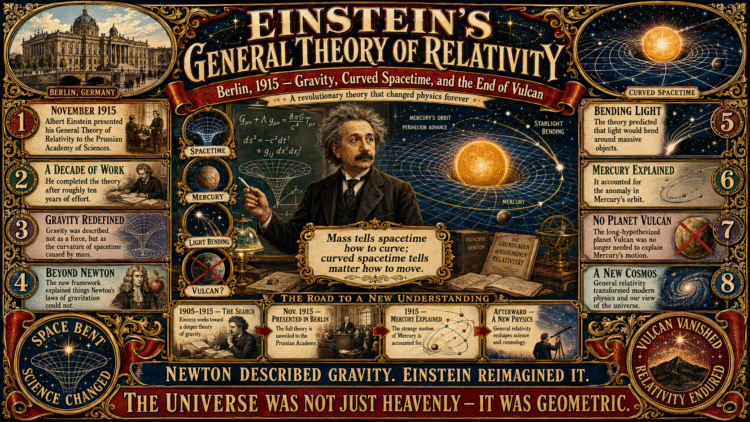
Albert Einstein presented his General Theory of Relativity to the Prussian Academy of Sciences in November 1915, completing it after a decade of work. The theory described gravity not as a force but as a curvature of spacetime caused by mass — a framework that replaced Newton’s laws of gravitation, predicted the bending of light around massive objects, and explained phenomena Newton’s equations could not account for. It also disproved the long theorized existence of the planet Vulcan, which astronomers had proposed to explain anomalies in Mercury’s orbit. Those anomalies, it turned out, were explained by general relativity itself.
Pop Culture Facts & History
The Birth of a Nation directly triggered the revival of the Ku Klux Klan. On December 4, 1915, the Superior Court in Fulton County, Georgia, accepted the charter for a reconstituted Klan, founded by William Joseph Simmons at Stone Mountain, Georgia, inspired by the film’s heroic portrayal of the original organization. The revived Klan grew to an estimated 4 to 5 million members by the mid-1920s, with a significant presence in Northern states as well as the South.
The first transcontinental telephone call was made on January 25, 1915, connecting New York and San Francisco. Alexander Graham Bell, in New York, repeated his first telephone words to his original assistant Thomas Watson, now in San Francisco: “Mr. Watson, come here. I want to see you.” Watson replied that it would take him about five days.
The word “jazz” was first used in print to describe music in the Chicago Daily Tribune on July 11, 1915. The music itself had been developing in New Orleans for years. The name was new.
Charlie Chaplin introduced his Tramp character in The Tramp in 1915, cementing a persona that would make him the most recognized entertainer on earth. The Tramp — with the bowler hat, the cane, the oversized shoes, and the small mustache — became the first globally iconic character of the film age.
Birth of a Nation was the first movie screened at the White House. President Wilson reportedly said after the screening that it was “like writing history with lightning.” He later denied making the statement.
Buckminster Fuller began what he called the Dymaxion Chronofile in 1915: a diary in which he attempted to document his entire life, recording events every 15 minutes until his death in 1983. The completed archive runs to 14,000 pages and is held at Stanford University. It is the most thoroughly documented human life in history and also, presumably, the most exhausting to maintain.
The Great Migration — the movement of Black Americans from the rural South to Northern industrial cities — began in earnest around 1915, accelerated by wartime factory jobs, the collapse of Southern cotton crops from the boll weevil, and the daily reality of Jim Crow. Between 1915 and 1970, an estimated six million Black Americans relocated. It permanently transformed the demographics and culture of Northern cities.
The first stop sign in America appeared in Detroit, Michigan, in 1915. It was white with black letters and measured 24 inches square. The familiar red octagon did not become standard until 1954.
Johnny Gruelle received U.S. Patent No. 47,789 for his Raggedy Ann doll on September 7, 1915. The character was named after two James Whitcomb Riley poems: “The Raggedy Man” and “Little Orphant Annie”.
Tom Lyle Williams created Maybelline mascara in 1915 after watching his sister Maybel use a mixture of Vaseline and coal dust to darken her lashes. He named the product after her, combining “Maybel” with “Vaseline.” It became one of the best-selling cosmetics brands in history.
Growers of “alligator pears” — a name that was doing nobody any favors — collectively agreed in 1915 to start calling their product avocados. Sales improved.
The Sun-Maid Raisin Girl was created in 1915 when a raisin company executive spotted Lorraine Collett, a teenage girl drying her curly hair in the sun while wearing her mother’s red bonnet. She was hired for a promotional stunt that included dropping raisins from an airplane. The image became one of the most enduring brand symbols in American food history.
Wrigley’s Gum mailed a stick of gum to every address listed in U.S. phone directories as a mass marketing campaign in 1915. At the time, the phone book contained approximately 1.5 million addresses. It was one of the first large-scale direct marketing campaigns in American commercial history.
Wrigley Field in Chicago became the first baseball stadium to allow fans to keep home run and foul balls that landed in the stands in 1915. Every other major league stadium eventually followed.
The first haunted house attraction opened in 1915: the Orton and Spooner Ghost House in Liphook, England. It was a traveling fairground attraction. The American haunted house industry, now generating over $500 million annually, traces its lineage directly to this format.
California became the first U.S. state to ban cannabis in 1915. Twenty-eight more states had banned it by 1931.
Cecil Chubb purchased Stonehenge at a public auction in 1915 as a surprise gift for his wife. She did not want it. He donated it to the British government in 1918. It is now a UNESCO World Heritage Site and one of the world’s most visited attractions, which suggests the wife may have made an error in judgment.
A raisin mine fire began in 1915 in the Red Ash Coal Mine at Laurel Run, Pennsylvania, when a carbide lamp was inadvertently left hanging from a timber beam that subsequently ignited. The fire is still burning today, over 110 years later. It is one of several coal seam fires in Pennsylvania that have been burning continuously for decades, the most famous being the Centralia mine fire that began in 1962.
The SS Eastland, a passenger ship carrying Western Electric employees and their families to a company picnic, capsized in the Chicago River at its dock on July 24, 1915, killing 844 people. The Eastland was top-heavy and had a history of instability; recent regulatory-mandated additions of lifeboats following the Titanic disaster had made it even more so. It remains the deadliest single maritime disaster in Great Lakes history.
The real Chef Boyardee, Ettore “Hector” Boiardi, directed the catering for President Woodrow Wilson’s wedding reception in December 1915. He was 17 years old. He went on to found the canned pasta company that bears his phonetically simplified name.
Typhoid Mary: Mary Mallon, an asymptomatic typhoid carrier who had been released from quarantine in 1910, was found working as a cook at Sloan Hospital in New York in 1915 under an assumed name, having infected 25 more people. She was placed in quarantine for the rest of her life on North Brother Island, where she died in 1938.
The phrase “when life gives you lemons, make lemonade” was coined in 1915 by writer Elbert Hubbard in an obituary for his friend Marshall P. Wilder, a dwarf actor and comedian. Hubbard wrote it as a tribute to Wilder’s lifelong optimism in the face of physical adversity.
The Hawaiian island of Ni’ihau has been privately owned since 1864, when it was purchased by Elizabeth Sinclair from King Kamehameha V for $10,000 in gold. It has been closed to outside visitors since 1915. It’s approximately 170 residents are native Hawaiians, and Hawaiian remains the primary language spoken there.
The West Point Class of 1915 produced 59 generals from 164 graduates, a ratio so extraordinary that it became known as “The Class the Stars Fell On.” Among its members were Dwight D. Eisenhower, who commanded Allied forces in Europe in World War II and became the 34th President, and Omar N. Bradley, who commanded U.S. ground forces in the same war.
The 1915 West Point Class’s notable alumni: Eisenhower and Bradley both graduated in the middle of their class. Neither was considered a standout cadet. History had different plans.
The phrase “crime against humanity” was used for the first time in formal diplomatic communication in 1915, when the Allied powers issued a joint declaration condemning the Ottoman government’s systematic killing of Armenian civilians.
Neon advertising signs were patented in 1915 by Georges Claude, a French engineer who had first demonstrated neon lighting publicly in 1910. The first neon signs in the United States arrived in Los Angeles in 1923, purchased by a Packard dealership.
The Typo
The Washington Post published a report in 1915 stating that President Woodrow Wilson had spent an evening “entering” his fiancée rather than “entertaining” her. The correction was presumably issued promptly.
Nobel Prize Winners
Physics — William Henry Bragg and William Lawrence Bragg, father and son, for their work on X-ray crystallography; William Lawrence Bragg remains the youngest Nobel laureate in physics in history, at age 25
Chemistry — Richard Willstatter — for his research on plant pigments, especially chlorophyll
Medicine — not awarded in 1915
Literature — Romain Rolland, French novelist and humanitarian, honored partly for his pacifist stance during the war
Peace — not awarded in 1915
Broadway in 1915
Nobody Home opened April 20, 1915, at the Princess Theatre — the first of the intimate “Princess Theatre musicals” produced by F.C. Comstock and Guy Bolton with music by Jerome Kern. The Princess Theatre shows pioneered the concept of a musical comedy with a coherent, integrated plot rather than a loose revue format, directly influencing the development of the modern American musical.
A Celebrated Case and various Ziegfeld Follies productions also ran in 1915, as Florenz Ziegfeld continued to build the annual revue series that would define Broadway spectacle for the next two decades.
Top Movies of 1915
- The Birth of a Nation
- The Tramp
- The Cheat
- The Italian
- Regeneration
- The Warrens of Virginia
- The Raven
- Carmen
- Jordan Is a Hard Road
- The Outlaw’s Revenge
Popular and Best-Selling Books of 1915
The Turmoil — Booth Tarkington
A Far Country — Winston Churchill
Michael O’Halloran — Gene Stratton-Porter
Pollyanna Grows Up — Eleanor H. Porter
K — Mary Roberts Rinehart Jaffery — William J. Locke
Felix O’Day — F. Hopkinson Smith
The Harbor — Ernest Poole
The Lone Star Ranger — Zane Grey
Angela’s Business — Henry Sydnor Harrison
The Good Soldier — Ford Madox Ford
The Rainbow — D.H. Lawrence
Of Human Bondage — W. Somerset Maugham
The Metamorphosis — Franz Kafka
Herland — Charlotte Perkins Gilman
Spoon River Anthology — Edgar Lee Masters
The Golden Bough — James George Frazer
Biggest Pop Artists of 1915
Henry Burr, Albert Campbell, Arthur Collins, The Conway’s Band, Alma Gluck, Byron Harlan, Charles Harrison, Morton Harvey, Al Jolson, Irving Kaufman, Olive Kline, The Lyric Quartet, Harry Macdonough, George MacFarlane, John McCormack, Lambert Murphy, Billy Murray, The Peerless Quartet, Prince’s Orchestra, Homer Rodeheaver, Cal Stewart, Reinald Werrenrath, Bert Williams
Sports Champions of 1915
World Series: Boston Red Sox — defeated the Philadelphia Phillies 4-1; a 20-year-old left-handed pitcher named Babe Ruth won his first World Series ring as a member of the pitching staff, though he did not start a Series game that year
Stanley Cup: Vancouver Millionaires — defeated the Ottawa Senators 3-0, one of the dominant performances in early Stanley Cup history
U.S. Open Golf: Jerome Travers
U.S. Open Tennis: Men/Women: Bill Johnston / Molla Bjurstedt
Wimbledon: not held due to World War I
NCAA Football Champions: Cornell, finishing 9-0
Kentucky Derby: Regret — the first filly to win the Kentucky Derby, a feat not repeated until Winning Colors in 1988
Boston Marathon: Edouard Fabre, 2:31:41
Sports Highlight: Regret’s Kentucky Derby victory on May 8, 1915, made her the first filly to win the race in its 41-year history. Her owner, Harry Payne Whitney, had been advised not to enter her against the colts. She won by two lengths. It took 73 years before another filly won.
FAQ — 1915 Trivia, Fun Facts, and Pop Culture History
Q: What event most pushed the United States toward entering World War I?
A: The sinking of the RMS Lusitania by a German U-boat on May 7, 1915, killed 1,195 people, including 128 Americans. The attack outraged the American public and shifted opinion against Germany, though the U.S. did not formally enter the war until April 1917.
Q: What was The Birth of a Nation, and why does it matter?
A: D.W. Griffith’s 1915 film was the first commercially successful feature-length movie and introduced filmmaking techniques that defined cinema for decades. It was also a work of white supremacist propaganda that directly contributed to the revival of the Ku Klux Klan. Both things are true, and neither cancels out the other. It is one of the most consequential and most troubling films ever made.
Q: What scientific theory was completed in 1915 that changed our understanding of the universe?
A: Albert Einstein’s General Theory of Relativity, presented to the Prussian Academy of Sciences in November 1915. It replaced Newton’s law of gravitation, described gravity as the curvature of spacetime, and remains one of the foundational frameworks of modern physics.
Q: What was the deadliest maritime disaster in Great Lakes history?
A: The capsizing of the SS Eastland in the Chicago River on July 24, 1915, which killed 844 people. The ship overturned at its dock while boarding passengers for a company outing, making it one of the deadliest maritime disasters in U.S. history overall.
Q: What cosmetic product was invented in 1915 that is still sold today?
A: Maybelline mascara, created by Tom Lyle Williams, who named it after his sister Maybel, combining her name with “Vaseline,” the product she had been using to darken her lashes.
Q: What fruit changed its name in 1915?
A: The avocado, which had been called the “alligator pear.” Growers collectively decided in 1915 to adopt the name avocado, derived from the Nahuatl word ahuacatl. The rebrand worked.
Q: What was the first stop sign in America?
A: The first stop sign appeared in Detroit, Michigan, in 1915. It was white with black letters. The standard red octagonal sign did not become uniform across the United States until 1954.
Q: Who was in the West Point Class of 1915?
A: Known as “The Class the Stars Fell On,” the 1915 West Point class produced 59 generals from 164 graduates — including Dwight D. Eisenhower, who commanded Allied forces in Europe in World War II, and Omar N. Bradley, who commanded U.S. ground forces in the same war.
More 1915 Facts & History Resources:
Most Popular Baby Names (BabyCenter.com)
Popular and Notable Books (popculture.us)
Broadway Shows that Opened in 1915
1915 Calendar, courtesy of Time and Date.com Fact Monster
1915 in Movies (according to IMDB)
Wikipedia 1915


