1902 Trivia, History, and Fun Facts
Quick Facts from 1902
- World Changing Event: The volcanic eruption of Mount Pelée on Martinique on May 8 killed between 28,000 and 40,000 people — the deadliest volcanic eruption of the 20th century. The city of Saint-Pierre, population 30,000, was incinerated in two minutes. One prisoner survived, protected by the thick stone walls of his underground jail cell.
- Popular Songs: Bill Bailey, Won’t You Please Come Home, In the Good Old Summer Time, and Under the Bamboo Tree
- Must-See Films: A Trip to the Moon by Georges Méliès — the first science fiction film ever made
- Most Famous American: Theodore Roosevelt, now nine months into a presidency nobody had planned on
- U.S. Life Expectancy: Males 49.8 years; Females 53.4 years
- The Conversation: The Teddy Bear — and the president who accidentally created the most beloved toy in history
Top Ten Baby Names of 1902
Girls: Mary, Helen, Anna, Margaret, Ruth, Elizabeth, Florence, Ethel, Emma, Marie Boys: John, William, James, George, Charles, Robert, Joseph, Frank, Edward, Walter
The Stars
Lillian Russell remained the reigning theatrical beauty of the era. Actress Maude Adams was the biggest stage star in America — her portrayal of Peter Pan was a national phenomenon. Vaudeville was at its peak.
The Quote
“I have always been fond of the West African proverb: Speak softly and carry a big stick; you will go far.” — Theodore Roosevelt, 1902
“No one ought ever do that again.” — Annie Taylor, the first person to survive Niagara Falls in a barrel, 1901 — still the wisest statement ever made about the stunt
The Academy Awards, Time Magazine, Miss America
None existed in 1902.
We Lost in 1902
Bret Harte, American author of the Gold Rush short stories, died May 5, at age 65
Elizabeth Cady Stanton, women’s suffrage pioneer, died October 26, age 86, eighteen years before women won the vote
Cecil Rhodes, British imperialist and founder of Rhodesia, died on March 26, age 48, from heart failure; his will established the Rhodes Scholarships
Émile Zola, French novelist and author of the J’accuse letter defending Dreyfus, died September 29, age 62, of carbon monoxide poisoning from a blocked chimney flue; whether it was an accident or murder remains disputed
Frank Norris, American novelist (The Octopus, McTeague), died October 25, age 32, from peritonitis following surgery S
Samuel Butler, English author of The Way of All Flesh, died June 18, at the age of 66
America in 1902 — The Context
Theodore Roosevelt was nine months into a presidency thrust upon him by an assassin’s bullet and was already transforming the office. He filed the first major antitrust suit under the Sherman Act against the Northern Securities Company in February 1902 — directly challenging J.P. Morgan’s railroad monopoly. Morgan reportedly went to the White House and told Roosevelt: “If we have done anything wrong, send your man to my man and we can fix it up.” Roosevelt replied that the point was not to “fix it up” but to stop it. The era of unchecked corporate monopoly was ending.
In November 1902, Roosevelt went bear hunting in Mississippi and accidentally invented the most beloved toy in history.
The Birth of the Teddy Bear
In November 1902, President Theodore Roosevelt — known to friends and press as ‘Teddy’, though he himself reportedly disliked the nickname — traveled to Mississippi to help settle a border dispute between Mississippi and Louisiana. While there, he accepted an invitation from state governor Andrew H. Longino to join a hunting party near the town of Onward.
The hunt did not go to plan. After several fruitless days, Roosevelt’s hunting guides, eager to produce a kill for the President, tracked and cornered an old, injured black bear, clubbed it into submission, and tied it to a willow tree. They then summoned Roosevelt, suggesting he shoot the bear for the honor of the hunt. Roosevelt refused. He considered shooting a tethered, injured animal deeply unsportsmanlike. He ordered the bear to be euthanized humanely, done with a knife by his guide.
On November 16, 1902, Clifford K. Berryman, a cartoonist for the Washington Post, published a cartoon titled ‘Drawing the Line in Mississippi’ depicting Roosevelt, rifle pointed away, refusing to shoot a small, cowering bear held by a hunter on a rope. Berryman’s bear was deliberately cute and non-threatening. The cartoon was reprinted across the country.
Morris Michtom was a Russian-Jewish immigrant who ran a small candy and novelty store in Brooklyn, New York, with his wife, Rose. After seeing the Berryman cartoon in late 1902, Rose sewed two small stuffed bears, and Morris placed them in the shop window with a hand-written sign: ‘Teddy’s Bear’. The response was immediate. Michtom wrote to Roosevelt asking permission to use the name; Roosevelt agreed, reportedly saying he doubted his name would be much use in the toy business, but Michtom was welcome to try.
By 1903, the Michtoms had founded the Ideal Novelty and Toy Company to meet demand. The company became one of the largest toy manufacturers in America and later gave the world the Rubik’s Cube in the 1980s.
Simultaneously, German toy company Steiff, completely independently, was developing a jointed plush bear of their own design. The Michtoms gave the toy its name. The Steiffs gave it its form. Both produced their first bears within the same 12-month window, with no apparent communication between them.
Roosevelt hated the nickname “Teddy.” He considered it undignified. He used it as a mascot in his 1904 reelection campaign anyway. The bear outlasted the presidency, the nickname, and the man.
The Mount Pelée Eruption
On May 8, 1902, at 7:52 a.m., Mount Pelée on the Caribbean island of Martinique erupted with a pyroclastic surge — a superheated cloud of gas, ash, and rock traveling at 100 mph that flowed down the mountain and incinerated the city of Saint-Pierre in approximately two minutes. The city had a population of roughly 30,000. Approximately 28,000-40,000 people died.
Only two people in Saint-Pierre survived. One was a shoemaker at the edge of town. The other was Ludger Sylbaris — a prisoner held in an underground stone cell for causing a disturbance the night before. His solitary confinement cell was so heavily constructed that it deflected the worst of the surge. He suffered severe burns but survived. He was later pardoned and toured with Barnum and Bailey Circus as “The Man Who Lived Through the Destruction of Saint-Pierre.”
Mount Pelée remains the deadliest volcanic eruption of the 20th century.
Pop Culture Facts & History
A Trip to the Moon (Le Voyage Dans la Lune), directed by Georges Méliès and released in France in September 1902, was the first science fiction film ever made — and the first film to tell a complete narrative story using special effects. It ran approximately 14 minutes, longer than almost any film previously produced. Its iconic image of the rocket ship landing in the Man in the Moon’s eye is one of the most recognizable frames in cinema history. Méliès used hand-painted film frames, camera tricks, and theatrical staging to achieve effects that had never been seen. It was the most ambitious film made to that date.
The Flatiron Building at 175 Fifth Avenue in Manhattan was completed in 1902. Officially called the Fuller Building, it was immediately renamed by New Yorkers for its distinctive triangular shape. At 307 feet it was among the tallest buildings in the world at completion and was considered an engineering marvel. It also created strong street-level wind currents that attracted men hoping to watch women’s skirts blow upward — a phenomenon that prompted police to routinely move spectators along with the order “23 Skidoo!”
The Electric Theatre opened in Los Angeles in April 1902 — the first full-time, purpose-built movie theater in the United States. Previous films had been shown in vaudeville venues, penny arcades, and converted storefronts. The Electric Theatre charged 10 cents admission and showed films continuously. It seated approximately 200 people. The nickelodeon era was about to begin.
The first Rose Bowl game, then called the Tournament East-West Football Game, was played on January 1, 1902, in Pasadena, California. Michigan defeated Stanford 49-0. Stanford asked to stop at halftime. Michigan’s coach Fielding Yost obliged. The game was not played again until 1916; the Tournament of Roses organizers replaced it with chariot races in the intervening years, which proved less popular.
Paleontologist Barnum Brown discovered the first major Tyrannosaurus Rex skeleton in 1902 near Jordan, Montana. Brown — who worked for the American Museum of Natural History and always wore a fur coat in the field — became the most successful dinosaur fossil hunter in history. He found the T. Rex skeleton that still stands in the museum’s Hall of Saurischian Dinosaurs.
The Caduceus — the symbol of two snakes on a winged pole, emblem of the Greek god Hermes — was mistakenly adopted as the symbol of the U.S. Army Medical Corps in 1902. The correct symbol of medicine is the Rod of Asclepius — one snake on a plain pole. The Army still uses the wrong one. So does almost every American hospital, pharmacy chain, and medical service that chose a logo without first checking mythology.
The word “Middle East” was coined in 1902 by American naval strategist Alfred Thayer Mahan in an article in London’s National Review titled “The Persian Gulf and International Relations.” Mahan used the term to describe the region between Arabia and India. It has been in use ever since.
J.C. Penney opened his first store in Kemmerer, Wyoming, in 1902, which he called The Golden Rule. He had $500 of his own money and borrowed the rest. The store gave credit generously and shared profits with employees — both radical retail practices at the time. By 1929, there were 1,400 JCPenney stores across America.
The American Automobile Association was founded in Chicago on March 4, 1902, by nine automobile clubs united by their frustration with poor roads, lack of signage, and local police treating automobiles as public hazards. One of the AAA’s first acts was lobbying for better roads. It is still doing this.
The Texaco company was formed in 1902 in Beaumont, Texas, following the massive Spindletop oil discovery of 1901. Beaumont had transformed overnight from a small town to a boomtown of 50,000 people camped around an oil gusher producing more oil than all other U.S. wells combined.
Denmark became the first country to use fingerprinting to identify criminals in 1902, adopting the system developed by Francis Galton and Edward Henry. The U.S. had been slower to adopt it, though several American police departments were in the process of doing so.
The Rhodes Scholarship was established by the will of Cecil Rhodes, the British imperialist who died in March 1902. The scholarships were intended to bring outstanding students from British colonies, the United States, and Germany to study at Oxford. Whatever one thinks of Rhodes’s politics and methods, the scholarship he established became one of the most prestigious academic honors in the world.
Andrew Carnegie gave $10 million to found the Carnegie Institution for Science in Washington, D.C. in 1902. Carnegie had already donated over $60 million to public libraries. He would eventually give away over 90% of his fortune — approximately $380 million, or roughly $6 billion in today’s dollars.
Marie and Pierre Curie isolated radium chloride in pure form in 1902, after four years of processing tons of uranium ore. Marie Curie won the Nobel Prize in Physics the following year. She was working in a shed with no proper laboratory, no ventilation, and no protective equipment. She carried radioactive isotopes in her pockets. Her notebooks from this era are still too radioactive to handle without protective gear and are stored in lead-lined boxes at the French National Library.
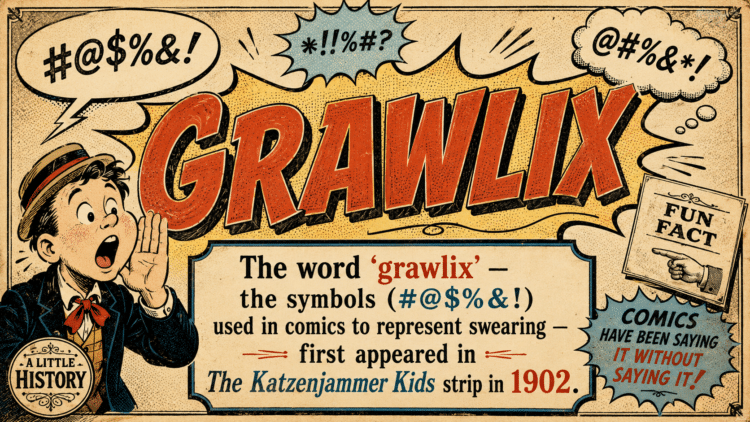
The word “grawlix” — the symbols (#@$%&!) used in comics to represent swearing — first appeared in The Katzenjammer Kids strip in 1902. The term “grawlix” itself was coined much later by cartoonist Mort Walker, but the convention of using typographic symbols for profanity has been standard in comics ever since.
Albert Einstein and his girlfriend, Mileva Marić, had a daughter, Lieserl, in January 1902, before they were married. Einstein was living in Bern at the time, unable to find work. Lieserl’s existence was unknown to the world until 1986, when letters between Einstein and Marić were discovered. What happened to Lieserl is unknown; she most likely died of scarlet fever in infancy or was given up for adoption. Einstein is believed to have never met her.
The Astor Hotel opened in New York in 1902 and was one of the grandest hotels in America. The corner of Broadway and 44th Street in Times Square — then called Longacre Square — was being transformed into the entertainment center it would become.
Enrico Caruso made his first phonograph recording in 1902 for the Victor Talking Machine Company — one of the first major recording sessions by a classically trained singer. The recordings sold in enormous numbers, helping establish the phonograph as a serious instrument for music reproduction rather than merely a novelty.
The Horrible
Mount Pelée eruption, Martinique, May 8, 1902, 28,000-40,000 dead, the deadliest volcanic disaster of the 20th century.
The Yacolt Burn, September 1902, was a series of fires across Washington and Oregon that killed approximately 70 people and burned nearly one million acres, remaining one of the largest fire disasters in Pacific Northwest history.
The Wellington Colliery explosion near Cumberland, British Columbia, killed 64 miners.
The Mystery
Albert Einstein’s daughter Lieserl, born in January 1902, remained unknown to the world until 1986. Her fate remains one of history’s small, private mysteries.
Nobel Prize Winners
Physics — Hendrik Antoon Lorentz and Pieter Zeeman (for research into the influence of magnetism on radiation)
Chemistry — Hermann Emil Fischer (for work on sugar and purine synthesis)
Medicine — Ronald Ross (for work on malaria transmission by mosquitoes)
Literature — Christian Matthias Theodor Mommsen (German historian of Rome)
Peace — Élie Ducommun and Charles Albert Gobat (for their work at the Permanent International Peace Bureau)
Economics — Prize not yet established
Popular and Best-Selling Books of 1902
The Virginian — Owen Wister (the first great American Western novel; established the template for the cowboy hero)
Mrs. Wiggs of the Cabbage Patch — Alice Caldwell Hegan
Dorothy Vernon of Haddon Hall — Charles Major
The Mississippi Bubble — Emerson Hough
The Hound of the Baskervilles — Arthur Conan Doyle
Mrs. Wiggs of the Cabbage Patch — Alice Caldwell Hegan
Also notable: The Tale of Peter Rabbit by Beatrix Potter (self-published in 1901, commercially published in 1902), Heart of Darkness by Joseph Conrad, and Varieties of Religious Experience by William James.
The Virginian by Owen Wister established the template for the American Western novel and film: the stoic cowboy, the code of honor, the showdown. Every Western that followed owes it something.
Broadway in 1902
The Wizard of Oz musical adaptation opened on Broadway in January 1902, starring Fred Stone and Dave Montgomery as the Scarecrow and Tin Man. It was a massive hit, running 293 performances and touring for years. The musical was quite different from the later film — it was a burlesque with topical political humor and no ruby slippers.
A Chinese Honeymoon opened in 1902 and became the first Broadway musical to run over 1,000 performances.
Best Film Oscar Winner
The Academy Awards did not exist until 1929. There is no Oscar winner for 1902.
Top Films of 1902
(Still very short by modern standards — most under 15 minutes)
A Trip to the Moon (Le Voyage Dans la Lune) — Georges Méliès (France — first science fiction film)
Jack and the Beanstalk — Edwin S. Porter for Edison Manufacturing (first American narrative fantasy film)
Life of an American Fireman — Edison Manufacturing (early example of narrative editing)
Fun in a Bakery Shop — Edison Manufacturing
Most Popular Entertainment of 1902
Vaudeville remained dominant. The phonograph was growing as a home entertainment medium — Enrico Caruso’s 1902 recordings helped establish it as more than a novelty.
Baseball was completing its first full season as a two-league sport.
The Electric Theatre in Los Angeles was pointing toward the future.
1902 Most Popular Songs
(Popularity tracked by sheet music sales and early phonograph recordings)
Bill Bailey, Won’t You Please Come Home — Arthur Collins
In the Good Old Summer Time — Blanche Ring
Under the Bamboo Tree — various artists
The Entertainer — Scott Joplin (published 1902 — peak of the ragtime era)
On a Sunday Afternoon — various artists
Bedelia — Billy Murray
Meet Me in St. Louis, Louis — written 1902, recorded 1904 for the World’s Fair
Sports Champions of 1902
American League Baseball: Philadelphia Athletics
National League Baseball: Pittsburgh Pirates
World Series: Not held in 1902 (first World Series was 1903)
Stanley Cup: Winnipeg Victorias and Montreal Hockey Club
U.S. Open Golf: Laurie Auchterlonie
U.S. Open Tennis — Men: William Larned | Women: Marion Jones
Wimbledon — Men: Laurence Doherty | Women: Muriel Robb
NCAA Football: Michigan (for a second consecutive undefeated season under Fielding Yost)
Kentucky Derby: Alan-a-Dale
Boston Marathon: Sammy Mellor — 2:43:12
Sports Highlight: The first Rose Bowl, January 1, 1902 — Michigan defeated Stanford 49-0. Stanford asked to stop at halftime; Michigan obliged. It remains the largest margin of victory in Rose Bowl history.
FAQs: 1902 History, Facts, and Trivia
Q: How was the Teddy Bear invented in 1902?
A: President Roosevelt refused to shoot a bear tied to a tree during a Mississippi hunting trip in November 1902, calling it unsportsmanlike. Cartoonist Clifford Berryman drew the scene for the Washington Post. Brooklyn shopkeeper Morris Michtom and his wife Rose made two stuffed bears inspired by the cartoon, placed them in their window as “Teddy’s Bear,” and asked Roosevelt’s permission to use his name. He agreed. The Michtoms founded the Ideal Novelty and Toy Company in 1903 to meet demand. Simultaneously, German toymaker Steiff independently developed a jointed plush bear. The two companies gave the world its most beloved toy from opposite sides of the Atlantic in the same year.
Q: What was the deadliest volcanic eruption of the 20th century?
A: Mount Pelée on Martinique, May 8, 1902, which killed between 28,000 and 40,000 people when a pyroclastic surge incinerated the city of Saint-Pierre in approximately two minutes. One prisoner survived, protected by the thick walls of his underground jail cell.
Q: What was the first science fiction film? A:
A Trip to the Moon by Georges Méliès, released in France in September 1902, is 14 minutes long, using trick photography, theatrical staging, and hand-painted film frames to depict a rocket voyage to the Moon. Its image of the rocket landing in the Man in the Moon’s eye remains one of the most iconic frames in cinema history.
Q: What building completed in New York in 1902 is still famous today?
A: The Flatiron Building at 175 Fifth Avenue — triangular in shape, 307 feet tall, completed in 1902. Its distinctive shape made it instantly famous and gave rise to the nickname that replaced its official name, the Fuller Building.
Q: What medical symbol error began in 1902?
A: The U.S. Army Medical Corps adopted the Caduceus — two snakes on a winged pole, symbol of the god Hermes — instead of the Rod of Asclepius, the actual Greek symbol of medicine. The error was pointed out almost immediately. It has never been corrected. Most American hospitals and pharmacies still use the wrong symbol.
Q: When did JCPenney open?
A: J.C. Penney opened his first store in Kemmerer, Wyoming, in 1902, calling it The Golden Rule. He had $500 of his own money. By 1929 there were 1,400 JCPenney stores nationwide.
Q: What word was coined in 1902?
A: “Middle East” — coined by American naval strategist Alfred Thayer Mahan in a 1902 article in the National Review to describe the region between Arabia and India. It has been in use ever since.
Q: What famous fossil was discovered in 1902?
A: Paleontologist Barnum Brown discovered the first major Tyrannosaurus Rex skeleton near Jordan, Montana, in 1902, working for the American Museum of Natural History. The skeleton he found still stands in the museum today.
Q: What was the first purpose-built movie theater in America?
A: The Electric Theatre, opened in Los Angeles in April 1902, charging 10 cents admission and showing films continuously. Previous films had been shown in vaudeville houses and penny arcades. The dedicated movie theater was born.
Q: What mystery surrounded Albert Einstein in 1902?
A: Einstein and his girlfriend, Mileva Marić, had a daughter named Lieserl in January 1902, before their marriage. Her existence was unknown to the world until letters were discovered in 1986. What happened to Lieserl — whether she died in infancy from scarlet fever or was given up for adoption — remains unknown. Einstein is believed to have never met her.
More 1902 History and Trivia Resources
Popular and Notable Books (popculture.us)
Broadway Shows that opened in 1902
1902 Calendar, courtesy of Time and Date.com
Fact Monster
Wikipedia 1902