1905 History, Facts, and Trivia
Quick Facts from 1905
- World Changing Event: Albert Einstein, a 26-year-old Swiss patent clerk with no university position and no laboratory, published four papers in a single year that overthrew 200 years of Newtonian physics, proved the existence of atoms, explained light as both wave and particle, established the Special Theory of Relativity, and derived E=mc². He did all of this in his spare time.
- Popular Songs: In My Merry Oldsmobile, Yankee Doodle Boy, and Everybody Works But Father
- Most Famous American: Theodore Roosevelt — inaugurated for his first elected term on March 4
- U.S. Life Expectancy: Males 47.3 years; Females 50.2 years
- Illiteracy rate in the U.S.: 10.7% of the population
- The Conversation: The Russo-Japanese War ended, and a non-European power had defeated a European empire for the first time in the modern era
Top Ten Baby Names of 1905
Girls: Mary, Helen, Margaret, Anna, Ruth, Elizabeth, Florence, Ethel, Emma, Marie Boys: John, William, James, George, Charles, Robert, Joseph, Frank, Edward, Walter
The Stars
Maude Adams as Peter Pan was the defining theatrical performance of the era. Enrico Caruso was the most famous voice in the world. Nickelodeon film performers remained nameless — studios still refused to credit them.
The Quote
“Imagination is more important than knowledge.” — Albert Einstein, 1905 — though he didn’t say this in those exact words until much later; in 1905, he was too busy rewriting physics to coin aphorisms
“I did not seek power; power sought me.” — Theodore Roosevelt, capturing the accident of history that had made him president
We Lost in 1905
Jules Verne, author of Twenty Thousand Leagues Under the Sea and Around the World in Eighty Days, died on March 24, at the age of 77. He had predicted the submarine, the helicopter, television, space travel, and the internet. He missed by very little.
Henry Irving, the first actor to be knighted in Great Britain, died on October 13, at the age of 67, collapsing after a performance
Adolphe Appia, theater designer — still alive in 1905, Stanford White, architect — still alive in 1905, murdered in 1906,
Sitting Bull — died in 1890
America in 1905 — The Context
Theodore Roosevelt had been elected president in his own right in November 1904, winning 56% of the popular vote. His inauguration on March 4, 1905, was a celebration of progressive ambition. He was using the presidency as a “bully pulpit” — one of the phrases he coined — to reshape the relationship between government and business in America.
The country was simultaneously prospering and transforming. Nickelodeons were opening everywhere. Automobiles were becoming less exotic. The labor movement was organizing. Immigration was at its peak. And in a patent office in Bern, Switzerland, a clerk named Albert Einstein was spending his lunch breaks and evenings changing everything.
Einstein’s Miracle Year
In 1905, Albert Einstein was 26 years old, working as a Technical Expert Third Class at the Swiss Patent Office in Bern, Switzerland. He had failed to get a university teaching position after graduating. He had no laboratory, no research assistants, no university affiliation, and no access to the latest scientific literature. At the time the papers were written, Einstein did not have easy access to a complete set of scientific reference materials.
Between March and September 1905, he published four papers in Annalen der Physik — the leading German physics journal — that together constitute the most productive single year in the history of science.
Paper 1: The Photoelectric Effect (March 1905) Einstein proposed that light consists of discrete packets of energy — quanta — rather than continuous waves. This contradicted the dominant wave theory of light that had been accepted for a century. Such a hypothesis would provide an answer to the problem of black-body radiation where classical theories had failed, and would also explain several puzzling properties of fluorescence, photoionization and the photoelectric effect. Einstein himself considered this his most revolutionary paper. It won him the Nobel Prize in Physics in 1921 — not his relativity work, but this. Every solar panel, digital camera, and photodetector in the world operates on this principle.
Paper 2: Brownian Motion (May 1905) Einstein provided the first mathematical explanation of why microscopic particles suspended in fluid move in erratic, random patterns. Some scientists thought that the pollen particles were being jiggled by the liquid’s atoms and molecules. Realizing that they were right, Einstein gave for the first time a mathematical treatment of the random motion of the pollen grains. This paper definitively proved the existence of atoms, which was still contested in 1905. It resolved one of the most fundamental debates in all of science.
Paper 3: Special Relativity (June 1905). Einstein proposed that the laws of physics are the same for all observers moving at constant velocity, and that the speed of light is constant regardless of the observer’s motion. The implications were staggering: time passes at different rates depending on relative motion; objects moving near the speed of light contract in length; simultaneity is relative. Two centuries of Newtonian absolute space and time were overturned in a 30-page paper. Einstein was a patent clerk who had never run an experiment.
Paper 4: Mass-Energy Equivalence (September 1905). Einstein showed that mass and energy are two aspects of the same thing: mass-energy. The equation E=mc² — energy equals mass times the speed of light squared — was the consequence. The speed of light is approximately 300 million meters per second; squared, it is an enormous number. A tiny amount of mass contains an extraordinary amount of energy. This equation eventually explained stars, nuclear reactions, and the atomic bomb. It is the most famous equation in history.
When the papers were published, almost nobody noticed. The physics community was initially skeptical or indifferent. Max Planck read them carefully and recognized their significance. Most others did not. Einstein kept his job at the patent office for another three years.
Pop Culture Facts and History
The first purpose-built nickelodeon in America opened in Pittsburgh, Pennsylvania, in June 1905, founded by Harry Davis and John Harris at 433-435 Smithfield Street. They charged 5 cents admission and showed short films continuously. The name combined the admission price with the Greek word for theater. Within two years, there were over 5,000 nickelodeons across America. The modern film industry was born in Pittsburgh.
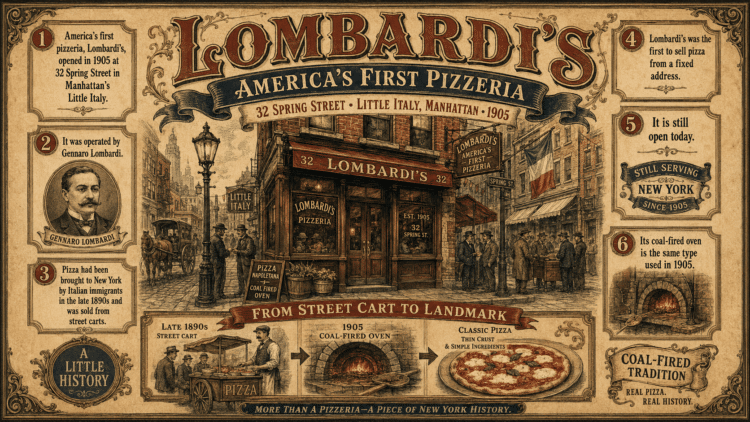
America’s first pizzeria, Lombardi’s, opened in 1905 at 32 Spring Street in Manhattan’s Little Italy neighborhood and was operated by Gennaro Lombardi. Pizza had been brought to New York by Italian immigrants in the late 1890s, sold from street carts. Lombardi’s was the first to sell it from a fixed address. It is still open. The coal-fired oven it uses today is the same type as the one used in 1905.
The Niagara Movement was founded on July 11, 1905, by W.E.B. Du Bois and 28 other Black intellectuals at Niagara Falls, Ontario — they had been refused accommodations on the American side due to racial segregation. The Movement demanded full civil and political rights for Black Americans. It formally merged with other groups in 1909 to become the NAACP.
Frank Epperson was 11 years old in 1905 when he accidentally left a cup of flavored water with a wooden mixing stick on his San Francisco porch overnight in freezing temperatures. In the morning, he found a frozen ice pop on a stick. He called it an “Epsicle.” He did nothing commercial with the discovery for nearly two decades, until his own children started calling them “Pop’s sickles” — and he finally filed a patent in 1923.
Theodore Roosevelt forced rule changes in American football in 1905, after at least 18 college players were killed during the season, and President Roosevelt threatened to abolish the game by executive order if safety was not addressed. The forward pass — which had been theoretically allowed since 1906 but had been used only rarely — was promoted as the key reform. The game was transformed from a battering-ram ground contest into the sport Americans now recognize.
Mata Hari, Dutch-born Margaretha Zelle, became an exotic dancer in Paris in 1905, performing barely clothed “Javanese temple dances” for French society audiences. She invented her entire exotic persona, background, and biography from scratch. She was from the Netherlands. She was later executed by France in 1917 as a German spy. Whether she actually was one remains historically disputed.
Las Vegas was founded on May 15, 1905, when the San Pedro, Los Angeles, and Salt Lake Railroad auctioned 1,200 lots of land in the Mojave Desert. The site was a water stop on the rail line. The town was incorporated in 1911. Gambling was illegal in Nevada until 1931. Everything that happened afterward was not foreseeable in 1905.
The Cullinan Diamond — the largest gem-quality rough diamond ever found — was discovered in South Africa on January 26, 1905, weighing 3,106.75 carats. It was purchased by the Transvaal government and presented to King Edward VII as a birthday gift. It was cut into nine major stones and 96 minor ones; the two largest are set in the British Imperial State Crown and the Sovereign’s Scepter with Cross, both on display in the Tower of London.
Rotary International was founded in Chicago on February 23, 1905, by lawyer Paul Harris and three business associates — the first service club in the world, based on the principle that members would meet at rotating locations. It now has 1.4 million members in 46,000 clubs worldwide.
The United States Forest Service was established on February 1, 1905, transferring administration of federal forest reserves from the Interior Department to the Agriculture Department under Gifford Pinchot. Roosevelt had already set aside 150 million acres of national forests; the Forest Service was the agency responsible for managing them.
The National Audubon Society was formally incorporated in 1905 following the murder of game warden Guy Bradley by plume hunters in the Florida Everglades. Bradley had been protecting egrets from hunters supplying the millinery industry — women’s hats of the era required enormous quantities of bird feathers. His murder galvanized conservation advocates and led directly to the founding of the Society and the passage of the first federal bird protection laws.
Variety magazine began publishing in New York on December 16, 1905, founded by Sime Silverman as a trade paper for the vaudeville industry. It evolved into the definitive trade publication of the American entertainment industry. Its headline style — dense, punchy, jargon-filled — became a cultural institution. “Sticks Nix Hick Pix” (rural audiences reject rural films) remains one of the most famous headlines in American journalism history.
Novocaine — the first synthetic local anesthetic — was patented by German chemist Alfred Einhorn in 1905. Before its development, dental work was performed without effective anesthesia. Novocaine is arguably responsible for more human gratitude than any other pharmaceutical ever developed.
The Russo-Japanese War ended on September 5, 1905, with the Treaty of Portsmouth, negotiated by Theodore Roosevelt. Japan had defeated Russia decisively in both land and naval battles — the Battle of Tsushima in May 1905 was one of the most complete naval victories in history, destroying virtually the entire Russian Baltic Fleet. It was the first time in the modern era that a non-European power had defeated a European empire in a major war. The consequences rippled through global politics for decades. Roosevelt won the Nobel Peace Prize in 1906 for his mediation.
The Welsh rugby team sang “Hen Wlad Fy Nhadau” before their match against New Zealand in December 1905 in response to the New Zealand team’s haka. It was the first time a national anthem had been sung before a sporting event, establishing a tradition that now occurs before virtually every international athletic competition worldwide.
Prince Carl of Denmark was offered the throne of newly independent Norway in 1905 following the peaceful dissolution of Norway’s union with Sweden. He declined to accept unless the Norwegian people voted for it. The referendum returned 79% in favor of the monarchy. He accepted, took the name Haakon VII, and ruled until his death in 1957, including guiding Norway’s government-in-exile during the Nazi occupation of WWII.
Montenegro and Japan were technically at war from 1904 to 2006 — Montenegro had allied with Russia in the Russo-Japanese War, but was absent from the 1905 peace treaty. Both countries formally signed a peace treaty in 2006 when Montenegro declared independence and was recognized as a sovereign state. It is the most leisurely conclusion to a war in modern history.
The New York Hippodrome opened on April 12, 1905, as the largest theater in the world — seating 5,300 people and featuring a massive water tank for aquatic spectacles, an ice rink, and enough backstage machinery to simulate almost any theatrical effect. It stood at 43rd Street and Sixth Avenue. Eleanor Roosevelt held her wedding reception there.
The House of Mirth by Edith Wharton was published in 1905 and became an immediate bestseller, selling 30,000 copies in its first month. Its depiction of a woman destroyed by the social cruelties of New York high society made it one of the sharpest social novels in American literature.
The Clansman by Thomas Dixon Jr. was published in 1905 — a romantic glorification of the Ku Klux Klan that D.W. Griffith would adapt into The Birth of a Nation in 1915, one of the most influential and most destructive films ever made.
The Grover Shoe Factory disaster in Brockton, Massachusetts, on March 20, 1905, killed 58 people when a boiler explosion collapsed the building and started a fire. It led directly to stricter boiler inspection laws and factory safety regulations in Massachusetts.
Nobel Prize Winners
Physics — Philipp Eduard Anton von Lenard (for research on cathode rays)
Chemistry — Adolf von Baeyer (for work on organic dyes and hydroaromatic compounds)
Medicine — Robert Koch (for investigations relating to tuberculosis) Literature — Henryk Sienkiewicz (Polish author of Quo Vadis)
Peace — Bertha von Suttner (Austrian novelist and pacifist — first woman to win the Nobel Peace Prize)
Economics — Prize not yet established
Bertha von Suttner became the first woman to win the Nobel Peace Prize in 1905. She had personally convinced Alfred Nobel to establish a peace prize when the two were acquainted in Paris.
Popular and Best-Selling Books of 1905
The Marriage of William Ashe — Mary Augusta Ward
Sandy — Alice Hegan Rice
The Garden of Allah — Robert Hichens
The Clansman — Thomas Dixon Jr. (later adapted into Birth of a Nation)
The House of Mirth — Edith Wharton
The Masquerader — Katherine Cecil Thurston (second year on bestseller list)
Broadway in 1905
Maude Adams continued her celebrated run in Peter Pan, cementing her status as the most beloved stage actress in America.
The Squaw Man, a Western drama that would later become one of the first Hollywood feature films, opened in 1905.
George M. Cohan’s Little Johnny Jones was still running from its 1904 opening.
Best Film Oscar Winner
The Academy Awards did not exist until 1929.
Top Films of 1905
(The nickelodeon era was just beginning — most films were still under 15 minutes)
Rescued by Rover — Cecil Hepworth (Britain — a genuinely moving short film about a dog rescuing a kidnapped baby, one of the most sophisticated films of the era)
The Adventures of Sherlock Holmes — Vitagraph Company
The White Caps — Edison Manufacturing
A Country Stud Horse — American Mutoscope and Biograph
Most Popular Entertainment of 1905
Nickelodeons were opening across the country. Vaudeville was still the dominant live entertainment form.
Baseball held the World Series for the first time since 1903.
The phonograph was standard in middle-class homes.
1905 Most Popular Songs
In My Merry Oldsmobile — Billy Murray (a celebration of automobile culture)
Everybody Works But Father — Billy Murray
My Gal Sal — Byron G. Harlan
Hiawatha — Arthur Pryor’s Band
Yankee Doodle Boy — Billy Murray (still charting from the 1904 Little Johnny Jones)
Waltz Me Around Again Willie — Ada Jones
Tammany — Billy Murray
Billy Murray remained the dominant recording artist of the era for a third consecutive year.
Sports Champions of 1905
World Series: New York Giants (defeated Philadelphia Athletics 4-1; Christy Mathewson pitched three complete-game shutouts in five days — one of the greatest individual World Series performances in history)
Stanley Cup: Ottawa Hockey Club
U.S. Open Golf: Willie Anderson (his fourth U.S. Open title — still tied for the most ever)
U.S. Open Tennis — Men: Beals Wright | Women: Elisabeth Moore
Wimbledon — Men: Laurence Doherty | Women: May Sutton (first American to win Wimbledon)
NCAA Football: Chicago
Kentucky Derby: Agile
Boston Marathon: Frederick Lorz — 2:38:25
Sports Trivia: Frederick Lorz — the Boston Marathon winner in 1905 — is the same man who was disqualified at the 1904 Olympics for riding in a car for 11 miles of the marathon course. He was banned, reinstated, and apparently learned his lesson.
May Sutton of the United States became the first non-British player to win Wimbledon in 1905, defeating defending champion Dorothea Douglass. The British lawn tennis establishment was not pleased.
Christy Mathewson’s three shutouts in the 1905 World Series — pitched in five days — is still considered one of the greatest individual pitching performances in baseball history.
FAQs — 1905 History, Facts, and Trivia
Q: What did Einstein publish in 1905?
A: Four papers in Annalen der Physik — his Annus Mirabilis, or miracle year. They covered the photoelectric effect, Brownian motion, Special Relativity, and mass-energy equivalence, producing the famous equation E=mc². Einstein was 26 years old, working as a patent clerk, with no laboratory or university position. The papers established the foundation of modern physics.
Q: What was Einstein’s most important paper in 1905?
A: Einstein himself considered his paper on the photoelectric effect — proposing that light consists of discrete packets of energy called quanta — his most revolutionary. It ultimately won him the Nobel Prize in Physics in 1921. His Special Relativity paper is more famous, but the photoelectric effect paper was more fundamentally radical.
Q: What future major city was founded in 1905?
A: Las Vegas, founded May 15, 1905, when a railroad auctioned lots in the Mojave Desert. The site was a water stop. Gambling was illegal in Nevada until 1931.
Q: What was the first nickelodeon?
A: The first purpose-built nickelodeon in America opened in Pittsburgh, Pennsylvania, in June 1905, admitting customers for 5 cents to watch continuous short film programs. Within two years there were over 5,000 nickelodeons across the country.
Q: What’s the story of the Popsicle?
A: Eleven-year-old Frank Epperson accidentally created it in 1905 by leaving a cup of flavored water with a mixing stick on his porch overnight in freezing temperatures. He called it an Epsicle. He didn’t patent it until 1923, by which time his own children were calling it “Pop’s sickle.” The name stuck.
Q: What was the Niagara Movement, and why does it matter?
A: W.E.B. Du Bois and 28 Black intellectuals founded it on July 11, 1905, at Niagara Falls — on the Canadian side because they were refused accommodation on the American side due to racial segregation. It demanded full civil and political rights for Black Americans and merged with other groups in 1909 to become the NAACP.
Q: What is the most famous diamond in history, and when was it found?
A: The Cullinan Diamond — 3,106.75 carats, discovered January 26, 1905, in South Africa. It was cut into nine major stones; the two largest are set in the British Crown Jewels.
Q: What dental invention came from 1905?
A: Novocaine, patented by Alfred Einhorn in 1905, was the first practical synthetic local anesthetic. Before its development, dental procedures were performed without effective pain relief. It is arguably responsible for more human gratitude than any pharmaceutical in history.
Q: When did the Russo-Japanese War end, and why did it matter?
A: The Treaty of Portsmouth ended the war on September 5, 1905, mediated by Theodore Roosevelt. Japan had decisively defeated Russia, the first time in the modern era that a non-European nation had defeated a European empire in a major war. It reshaped global politics and won Roosevelt the Nobel Peace Prize.
Q: What tradition did Wales accidentally start in 1905?
A: When Wales played New Zealand in rugby in December 1905, the Welsh team spontaneously sang their national anthem in response to the New Zealand haka. It was the first time a national anthem had been sung before a sporting event — a tradition now universal at international competitions worldwide.
More 1905 Facts & History Resources:
Most Popular Baby Names (BabyCenter.com)
Popular and Notable Books (popculture.us)
Broadway Shows that Opened in 1905
1905 Calendar, courtesy of Time and Date.com
Fact Monster
1905 in Movies (according to IMDB)
Wikipedia 1905