Sail History, Explore Delaware’s Industrial Past, and Meet the Ship That Started It All
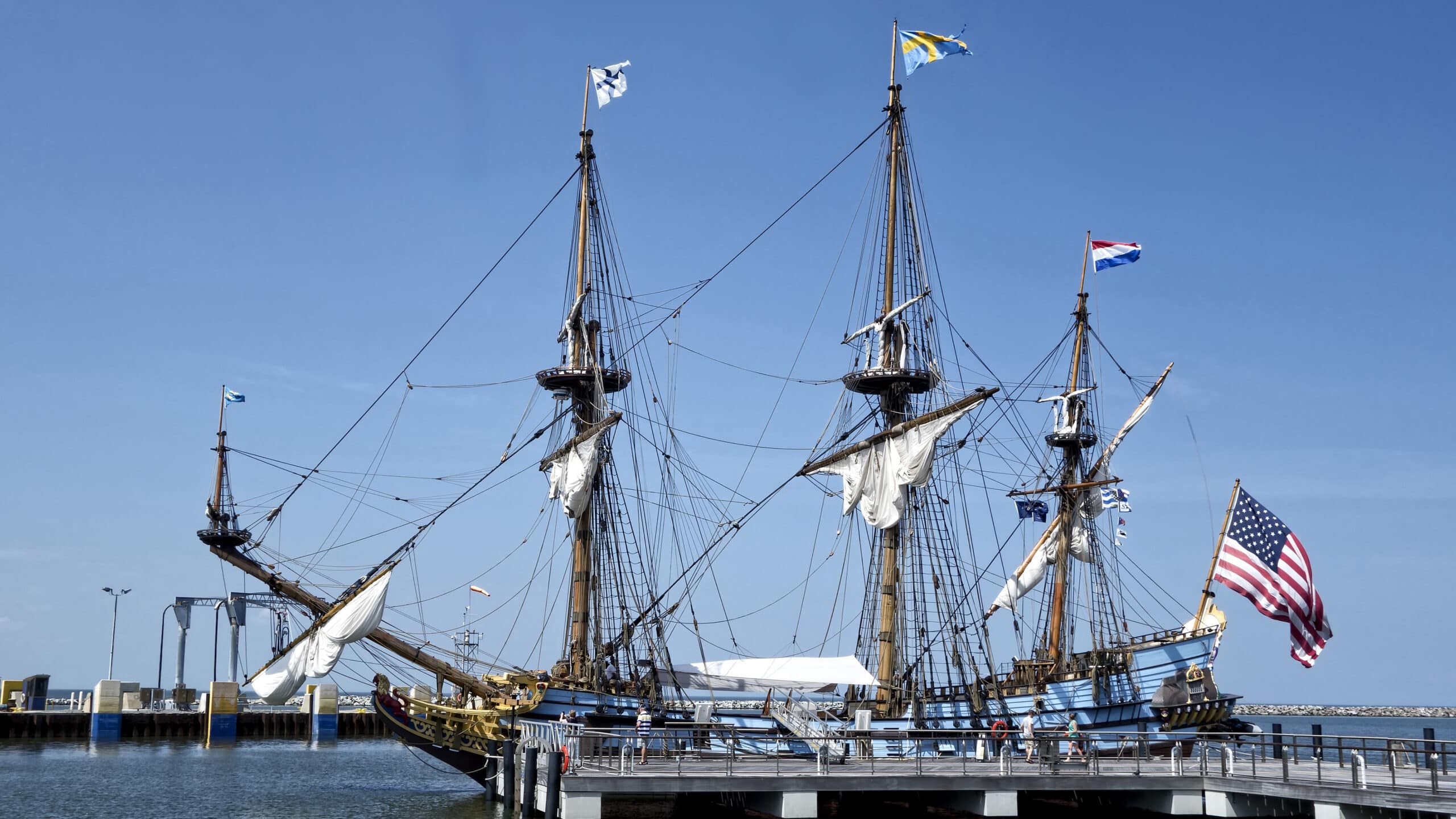
On Wilmington’s Riverfront, adjacent to Fort Christina Park, stands the home base of Kalmar Nyckel — Delaware’s official tall ship and the full-scale replica of the 17th-century square-rigger that carried the first Swedish settlers to the Delaware Valley in 1638. The Kalmar Nyckel Foundation operates both the ship and the Copeland Maritime Center, a museum and education facility that connects the founding voyage to centuries of Wilmington’s industrial and maritime history.
Copeland Maritime Center hours vary by season. Winter admission is $5/adult and $3/ages 3–12. Sunday public hours run 10:00 a.m.–4:00 p.m. from late May through late October. Always check kalmarnyckel.org for current seasonal hours before your visit, as the center’s schedule shifts and the ship is frequently away on sailing programs and regional engagements. The center is closed on days when it is committed to private events — calling ahead or checking the website is strongly recommended.
The Original Kalmar Nyckel: A Colonial Voyage Rivaling the Mayflower
In the winter of 1637–1638, a Dutch-built ship named Kalmar Nyckel — “Key of Kalmar” — departed Sweden carrying a company of Swedish, Finnish, German, and Dutch settlers under commission of the New Sweden Company. They landed at the site of present-day Wilmington in the spring of 1638, establishing Fort Christina and the Colony of New Sweden: the first permanent European settlement in the Delaware Valley.
The original Kalmar Nyckel completed four round-trip crossings of the Atlantic — more than any other vessel of its era. Despite that remarkable record and the establishment of the settlement that would eventually become Delaware, the ship and its story remained largely unknown outside the region for centuries. As the Foundation itself notes, its historical significance rivals that of the Mayflower, yet the story was never widely told.
That changes at the Copeland Maritime Center.
The Replica Ship: Delaware’s Seagoing Ambassador
In the early 1990s, a group of committed Delaware citizens undertook the project of building a full-scale, fully functional replica of the original Kalmar Nyckel using period-appropriate construction methods and materials. The replica was launched in 1997 and has sailed as Delaware’s official goodwill ambassador ever since.
The ship operates out of Wilmington but travels up and down the East Coast for public sailing events, diplomatic functions, educational programs, and commemorative voyages. When in port, she is available for:
Public Day Sails — ticketed sails on the Delaware River and Christina River (tickets are limited; book online in advance)
River Cruises — smooth-water group cruises for families and private parties
Crew Training — the Foundation offers volunteer crew training using both the ship and in-center replicas
Private Events — the ship and the riverfront venue are available for weddings, corporate events, fundraisers, and team-building programs
Sailing season details for 2026 will be posted on the Foundation’s website. Always verify the ship’s home-port schedule, as she is frequently away.
The Copeland Maritime Center: Three Stories of Delaware History
The Copeland Maritime Center opened in 2015 as the land-based home of the Foundation’s educational mission. It is far more than a gift shop and lobby — the Center houses a serious collection of permanent and rotating exhibits covering maritime history, colonial settlement, and Wilmington’s industrial era.
Permanent Exhibits Include:
Destination Delaware: Fort Christina, First Log Cabins, and the New Sweden Frontier The story of the 1638 landing — the Swedish and Finnish settlers, Fort Christina, the early log cabin construction (an architectural tradition the Scandinavian settlers introduced to North America), and the founding of the Colony of New Sweden.
Science of Sailing A STEM-focused exhibit connecting centuries of maritime navigation to modern scientific principles — dead reckoning, celestial navigation, angles of sail, displacement, ballistics, and stability. The floor itself is designed to simulate latitude and longitude. This exhibit doubles as a classroom for school field trips.
The Riverfront Room Wilmington’s largely forgotten role as one of America’s great industrial cities. Archival photographs, model trains, and original maps document the city that “launched 10,000 ships and built 30,000 railcars” — an industrial powerhouse that powered much of the nation’s transportation infrastructure from before the Civil War through the end of World War II.
Join the Crew An interactive exhibit (opened May 2024) inviting visitors into the experience of crewing a 17th-century tall ship.
The Center also features an Emmy-nominated documentary, Kalmar Nyckel: The Forgotten Journey, available for viewing and purchase.
Annual Events at the Kalmar Nyckel Foundation
The Foundation’s calendar of community events is one of the most varied of any cultural institution on the Wilmington Riverfront:
LEGO Brick Shipbuilding Contest — a family-oriented annual favorite featuring ship-building challenges, prize drawings, and Peoples’ Choice awards
Underground Railroad Black History Event — educational programming connecting the region’s maritime history to its Underground Railroad heritage
Captain Kidd’s Pirate Day — seasonal family programming aboard and alongside the ship
Halloween Ghost Ship — family-friendly fall festival with indoor ghost ship tours, pumpkin painting, costume parades, and ship tours. Free admission.
Women’s History Month programming — March activities included with winter admission
Season Opening Celebration — annual launch of the tall ship’s public sailing season
Visiting Kalmar Nyckel with Old Swedes and Fort Christina
The Kalmar Nyckel Foundation is located adjacent to Fort Christina Park, the site of the original 1638 Swedish landing, and within a short walk of Old Swedes Historic Site (Holy Trinity Church) on East 7th Street. All three sites together form the core of Wilmington’s Swedish colonial heritage trail — a half-day itinerary that traces one of America’s least-told founding stories from the landing site to the church to the ship that made it all possible.