
Delaware Art Museum
Wilmington, DE 19806 United States Get Directions
Delaware Art Museum – History & Overview
The First State’s Premier Art Museum and Home to the Most Significant Pre-Raphaelite Collection Outside the United Kingdom
Howard Pyle, the Wyeth Circle, American Illustration, and a Stunning Pre-Raphaelite Collection in a Park Setting
There is a reason British art lovers make the transatlantic trip to a museum in Wilmington, Delaware: the Delaware Art Museum holds the largest collection of British Pre-Raphaelite paintings outside the United Kingdom — a concentration of Rossetti, Millais, Burne-Jones, and their contemporaries that simply does not exist at this level anywhere else in America. That alone would make the museum worth a visit. But the Delaware Art Museum is also the primary repository of the work of Howard Pyle — the Wilmington-born illustrator who essentially invented the visual language of American adventure storytelling — and holds a broad collection of American art spanning painting, sculpture, and decorative arts from the 18th century to the present.
The Delaware Art Museum is open Wednesday through Sunday, 10:00 a.m.–4:00 p.m. The museum is closed Monday and Tuesday.
Admission: Adults $18 | Seniors (62+) $15 | Students with ID $15 | Children ages 7–18: $10 | Children 6 and under: Free | Members: Free. Free admission on Sundays from 10:00 a.m.–noon. Thursday evening hours extend to 8:00 p.m. during the warmer months with “Art After Hours” programming — check delart.org for the current seasonal schedule. The museum also participates in Museums for All ($2 admission with EBT card) and the Delaware Libraries Museum Pass program.
Howard Pyle and the Birth of American Illustration
The Delaware Art Museum was founded in 1912 — initially as the Howard Pyle Collection of the Wilmington Society of the Fine Arts — with the explicit purpose of preserving the work of Wilmington’s most famous artist. Howard Pyle (1853–1911) was born in Wilmington and lived most of his life there. His influence on American visual culture was extraordinary and far-reaching.
Pyle is credited with establishing the tradition of American narrative illustration — the rich, dramatically composed, historically researched imagery that filled the pages of Harper’s Weekly, Scribner’s Magazine, and the era’s major periodicals and books. His illustrations for editions of Robin Hood, King Arthur, and his own pirate stories defined how generations of Americans visualized the medieval world and the age of piracy.
But Pyle’s influence extends even further through the students he trained at his Brandywine School in Chadds Ford, N.C. Wyeth, Maxfield Parrish, Jessie Willcox Smith, Frank Schoonover, and dozens of other illustrators who shaped American visual culture through the 20th century. The Wyeth family’s artistic dynasty — Andrew Wyeth and Jamie Wyeth included — traces directly to Pyle’s teaching.
The museum’s Howard Pyle collection is the largest in the world, encompassing paintings, drawings, and illustrated manuscripts that document Pyle’s complete career.
Trivia: Howard Pyle’s paintings of pirates are so foundational to how Americans imagine pirates that virtually every pirate image in popular culture — from Treasure Island illustrations to Hollywood costume design — visually traces back to Pyle’s compositions. He is, in a very real sense, the person who decided what pirates look like.
The Pre-Raphaelite Collection
The museum’s Pre-Raphaelite holdings arrived through the generosity of Samuel Bancroft Jr. (1840–1915), a Wilmington textile manufacturer who became one of the world’s most passionate collectors of Pre-Raphaelite art in the late 19th century. Bancroft corresponded directly with the artists, purchased works directly from their studios, and assembled a collection of singular depth and quality.
The Pre-Raphaelite Brotherhood — founded in London in 1848 by Dante Gabriel Rossetti, John Everett Millais, and William Holman Hunt — rejected what they saw as the mechanical conventions of post-Renaissance academic painting in favor of intense color, meticulous detail, literary and symbolic subjects drawn from medieval and classical sources, and a moral seriousness about the purpose of art. Their work was controversial when it was made and is now recognized as one of the most distinctive movements in 19th-century Western art.
The Bancroft collection at the Delaware Art Museum includes major works by Rossetti (including multiple paintings and drawings of Jane Morris, his great obsession), Burne-Jones, Ford Madox Brown, William Holman Hunt, and their associates. For anyone seriously interested in 19th-century British painting, this collection is one of the most important assemblages accessible in the United States — and it is here, in Wilmington.
American Art Collections
Beyond Pyle and the Pre-Raphaelites, the Delaware Art Museum holds a substantial and growing collection of American art covering multiple centuries and media:
American Illustration Works by N.C. Wyeth, Maxfield Parrish, Jessie Willcox Smith, Frank Schoonover, and other members of the Brandywine School that grew directly from Howard Pyle’s teaching — presented as art, not merely as a commercial product.
19th- and Early 20th-Century American Painting: Works by John Sloan — the Ashcan School painter who spent his early career in Wilmington — are particularly well represented, connecting the museum to another chapter of American artistic rebellion against academic convention.
Contemporary American Art The museum maintains an active contemporary program, with rotating exhibitions of work by living artists alongside its permanent collection galleries.
Copeland Sculpture Garden Surrounding the museum building, the outdoor sculpture garden provides a setting for large-scale works within a park landscape — free to visit at any time.
Programs, Classes, and Community Engagement
The Delaware Art Museum runs one of the most active community education programs of any art museum in the region:
- Studio art classes in ceramics, photography, printmaking, drawing, and painting for adults and children
- Art After Hours — Thursday evening social programming during warmer months, combining art, music, and food
- Family programs on weekends connect children to the collections through hands-on art-making
- School and group tours with curriculum-aligned programming
- Art Reach programs provide deeply discounted access for low-income and disabled visitors
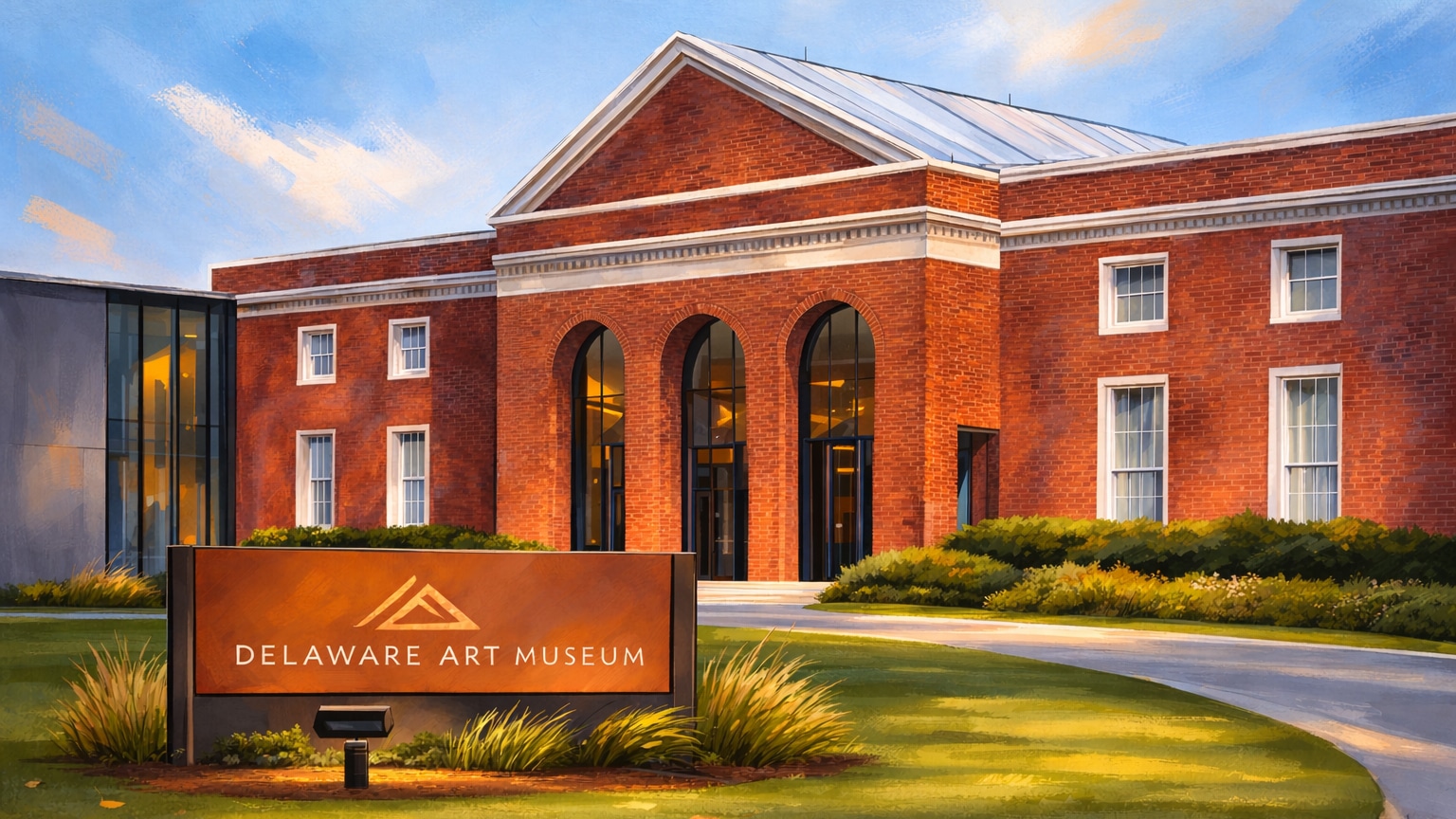
The museum building, designed in the American modernist tradition, is set in Kentmere Park — a neighborhood green space north of downtown Wilmington. The parkside setting makes the Delaware Art Museum one of the more pleasant museum arrival experiences in the region: there is something gentle about approaching an art museum through a park.
Delaware Art Museum in the Wilmington Cultural Landscape
The Delaware Art Museum is one of the cultural anchors of northern Delaware — alongside the Hagley Museum, Nemours Estate, Winterthur Museum, and the Delaware Museum of Nature and Science — defining the Brandywine Valley as one of the richest cultural corridors in the mid-Atlantic. For visitors exploring Wilmington and northern Delaware, the museum pairs naturally with Rockwood Park & Museum (both offer 19th-century art and decorative arts) or with a walk through Brandywine Park, which connects the museum’s neighborhood to the Brandywine Creek waterfront just to the east.
oughtful integration of indoor and outdoor art experiences.
Events at this venue
The weather can affect any outdoor events. Please check ahead if the weather looks questionable.